
118 Joel Timmons on Surfing, Songwriting, and Soulful Journeys
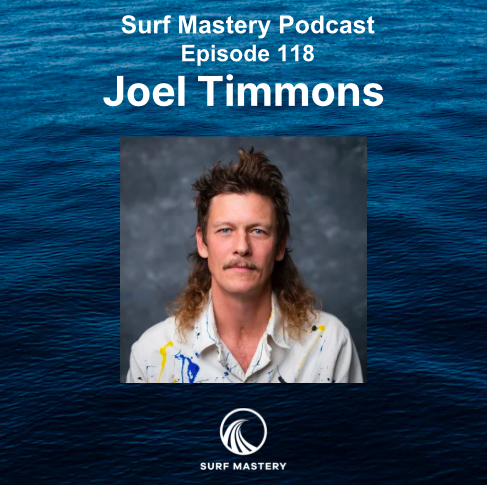
Joel Timmons on Surfing, Songwriting, and Soulful Journeys
If you’ve ever found yourself seeking balance between creativity and passion, or wondering how to turn life's challenges into powerful art, this episode is your invitation to explore that path. Joel Timmons, musician and lifelong surfer, shares how his emotional songwriting and connection to the ocean fuel each other—and how vulnerability, self-work, and rhythm tie it all together.
Discover the deeply personal story behind Joel’s standout track “Say It To My Face” and the emotional reconciliation that followed.
Learn how Joel’s journey from coastal South Carolina to Nashville—and back again—influenced the sound and soul of his new album.
Find out why both music and surfing are lifelong pursuits of flow, mastery, and humble progression—whether you're in the studio or in the lineup.
Tap play now to hear Joel’s heartfelt journey through music, surf, recovery, and rediscovery—and why he’d pick a surfboard over a guitar if he had to choose.
https://open.spotify.com/artist/40Gd49hHE75WtRiqYGGhGj?si=_WNyIrmQQLG7n77zxft70A
https://www.instagram.com/joeltimmonsmusic/
Episode music: “Say it to my face” - Joel Timmons
Key Points
Surfing and songwriting, as activities that challenge individuals to be in the moment and focused on their immediate surroundings and tasks, are often pursued for personal joy and expression rather than financial gain.
Joel Timmons discusses how songwriting serves as a therapeutic tool for self-expression and personal growth, often stemming from a kernel of pain or question that needs articulation.
Joel Timmons started surfing at age 13 after moving back to Sullivan's Island, South Carolina, from Louisiana, where he began by riding boogie boards and small styrofoam surfboards.
Joel Timmons identifies as a musician who surfs, valuing both activities for their continuous learning and improvement aspects, and notes that both can be pursued regardless of professional success.
Joel Timmons emphasizes the importance of being fully invested and present during performances, noting that this genuine engagement tends to resonate more with audiences.
Joel Timmons reflects on his early musical influences, including his parents, Led Zeppelin, and the music education he received through choir and band programs, as well as informal jam sessions with friends.
Joel Timmons spent five years living in Nashville, which significantly influenced his musical development, particularly in songwriting and the incorporation of fiddle and pedal steel sounds into his music.
Joel Timmons' decision to pursue music professionally was solidified after a life-changing trip around the world, despite facing significant health challenges upon his return.
Joel Timmons discusses the impact of AI on the music industry, expressing both fascination and concern, and highlights the irreplaceable value of live, person-to-person musical experiences.
Joel Timmons admires Tom Petty's songwriting and artistry, recalling an early concert experience and the influence of Petty's work on his own musical journey.
Outline
Joel Timmons' Background and Interests
Joel Timmons is a surfer and songwriter from Sullivan's Island, South Carolina.
Joel grew up with a deep connection to both music and the ocean.
Joel considers themself a musician who surfs, rather than a surfer who plays music.
Joel owns upwards of 15-20 guitars and half a dozen surfboards.
Joel's favorite surfboard is a 9-3 single fin classic longboard.
Joel's New Album and Songwriting Process
Joel's new album is called Psychedelic Surf Country.
The song Say It To My Face is Joel's favorite from the album.
Joel finds songwriting to be a therapeutic and cathartic process.
Joel wrote Say It To My Face during a period of personal growth and reconciliation with a friend.
Joel did not release Say It To My Face as a single, which may explain why it is not as popular as other songs on the album.
Surfing and Music as Lifelong Pursuits
Both surfing and music are lifelong pursuits for Joel.
Joel sees synergies between surfing and music, such as the long arc of the journey and the joy of expression.
Joel believes that most people who surf or make music do it for the right reasons, not just for money.
Joel finds that performing from a place of authenticity and passion resonates most with audiences.
Joel's Musical Influences and Development
Joel's parents and early musical memories influenced their musical development.
Joel's biggest musical influence is Led Zeppelin.
Joel's first concert was seeing Aerosmith in seventh grade.
Joel's first song was a melodramatic piece about misery, inspired by bands like Blind Melon and Smashing Pumpkins.
Joel's songwriting was influenced by John Prine, whose plain spoken delivery and empathy resonated with Joel.
Joel's Time in Nashville
Joel lived in Nashville for about five years, which was important for their musical development.
In Nashville, Joel fell in love with fiddle and pedal steel sounds and became more serious about songwriting and storytelling.
Joel met many talented musicians in Nashville who inspired and influenced their own musical growth.
Joel's Health Challenges and Recovery
Joel experienced a near-death experience in India, where they contracted Guillain-Barre syndrome and became paralyzed.
Joel's recovery took a full year, during which they relearned how to walk and play music.
Nutrition and lifestyle played a crucial role in Joel's recovery, as did their passion for music and surfing.
Joel's Future Plans and Projects
Joel plans to perform and promote their new album, Psychedelic Surf Country.
Joel will attend a bluegrass guitar camp to improve their skills and potentially join their wife's band.
Joel will tour with an artist named Maya DeVitri and their own band, Soul Driven Train, throughout the summer.
Joel's Views on AI and the Music Industry
Joel is fascinated and terrified by the potential of AI in music, but believes it is still far from replicating the human element of live performances.
Joel uses AI tools like ChatGPT for tasks like writing emails and sequencing records, but resists using it for songwriting.
Joel believes that the unique vibe and human connection of live music cannot be replicated by AI.
Transcription
Joel Timmons
The vast majority of people that do it don’t ever make a dollar off it. It’s just something innate in people, and it’s something joyful and a sense of expression. Surfing and playing an instrument or singing a song challenges you to be in the moment and be focused on immediate surroundings and task at hand.
Michael Frampton
Welcome back or welcome to the Surf Mastery Podcast. That is a couple of quotes from today’s guest, Joel Timmons. Joel is a surfer and a songwriter from Sullivan’s Island in South Carolina, who grew up with a deep connection to both music and the ocean. And that is a song called Say It To My Face off his new album, Psychedelic Surf Country, which will play out in its entirety at the end of this interview. It’s my favorite song off the album, so thank you for letting me use it in this podcast. I thoroughly enjoyed my conversation with Joel. I am a huge fan of listening and playing music. And this is a little bit of a different episode. Not a lot of surf content per se. It’s mostly about music. And let me know if you’re enjoying these different episodes. We did one a couple of weeks ago about parenting. This one’s about music. And let me know if you’re enjoying the eclecticness of these episodes. And without further ado, I will fade in my conversation with Joel Timmons.
Michael Frampton
Thanks for joining.
Joel Timmons
Thank you.
Michael Frampton
I’ve been listening to the new album.
Joel Timmons
Sweet, how’s it translate down under?
Michael Frampton
Man. Yeah, I’m enjoying it. Pretty good, man.
Joel Timmons
You’re in New Zealand?
Michael Frampton
Yes, I am.
Joel Timmons
Cool.
Michael Frampton
Favourite song on that album is Say It To My Face.
Joel Timmons
Oh, cool, man. Yeah. Yeah, I think that’s, for me at least, it’s the most... lyrically, it’s the most relatable song.
Michael Frampton
Cool.
Joel Timmons
Yeah. Very good. It’s pretty direct. Yeah, no, I like that. Yeah, this sounds like there’s a lot of self-work thing going on as well.
Michael Frampton
I guess so.
Joel Timmons
Yeah. Yeah. I think songwriting is like a big tool for me with that, almost like journaling can be, and then sometimes those journals end up out in the world and that is quite therapeutic. Yeah. To have some secret little kernel of pain or question and then articulate it to yourself and make it feel nice to yourself and then get to share it with an audience.
Michael Frampton
Definitely transformative.
Joel Timmons
I guess songwriting is very cathartic in that way. Yeah, the good ones are. That particular song, I was just at home, just like crying my eyes out. The words were just pouring out of me like the tears. And since that moment, I had had the opportunity to get back together with that friend and have the conversation that we needed to have, even before I went into the studio to record it. So then being in the studio, it was really magical to be able to access the pain of when we were at odds, but then also with the knowledge of, okay, we did it. And that kind of jam out at the end of the song, that sort of resolves to a major key, and that musically was that reconciliation. So it was, yeah, it was really a beautiful journey.
Michael Frampton
Yeah. It’s a beautiful song.
Joel Timmons
Sophie sent me an earlier version of it before it was released.
Michael Frampton
Oh, cool.
Joel Timmons
Once it was released, I went on to—the album was released—I went on to Spotify, and I assumed that would be the most popular song. I was quite surprised to see that it wasn’t.
Michael Frampton
Interesting.
Joel Timmons
Yeah. Yeah. And I didn’t release that one as a single. So some of those songs that have singles, were released as singles, have had a little more time out there. I just know of the few people that I’ve talked to into the empire, people like that song, which I didn’t... I love that song, but I didn’t know that it was gonna be special for some people. I’m glad to hear you say you like Say It To My Face.
Michael Frampton
We played that one Friday. I hit a release show here in town.
Joel Timmons
Oh yeah?
Michael Frampton
And we played the whole album top to bottom live, and that one...
Joel Timmons
Oh, rad.
Michael Frampton
That one felt really potent.
Joel Timmons
I’m really enjoying the Trying song as well. It’s really cool.
Michael Frampton
Yeah, that one was also very fun live. That was like the last—we were at the finish line on the record and you could really cut loose. People were dancing and everything, so it was a good time.
Michael Frampton
So, let’s keep it surfing a little bit. When did you start surfing?
Joel Timmons
Yeah. So I grew up on a barrier island in South Carolina, Sullivan’s Island. So we were like riding boogie boards and little styrofoam surfboards when I was a toddler, four or five years old. My family, when we moved to Louisiana for three years, when I was entering fourth grade—fourth, fifth, and sixth grade—we were in Baton Rouge, Louisiana. So there was no ocean there. My mom was a windsurfer, so we did a little windsurfing in Louisiana, brought that from South Carolina. And then when I moved back, all my little buddies that I grew up with were all surfing at that...At that point. I guess that was in seventh grade when I was like 13. So I started, yeah, I started surfing and studying and like reading the magazines and watching Endless Summer and that kind of thing. And then I guess like the surf season here is—we get hurricane swells in the late summer and early fall, and then really most of the waves come in the winter. But I wasn’t—when I first started—I wasn’t surfing in the wintertime. It was probably high school before I got a wetsuit and started surfing year-round. And the year I graduated high school, a couple of us took a surf trip to Costa Rica, which is a rite of passage for an East Coast surfer. Outer Banks in North Carolina, Florida, and then like the Caribbean or Central America.
Michael Frampton
Yeah.
Joel Timmons
Puerto Rico as well. I’ve been to Puerto Rico a couple of times. I went there in college for the first time, so a couple of years later. Yeah, that’s a really close flight and man, an awesome surf destination. Yeah, I guess I’ve been there maybe four or five times now.
Michael Frampton
Yeah, to Puerto Rico?
Joel Timmons
Yeah. Yeah. I’ve been there once and the waves were huge. I was so surprised how much swell they get there. Yeah, I just got back from the Virgin Islands, which are just like the U.S. Virgin Islands, like the next islands over from Puerto Rico. And I’ve been going down there every winter for about 15 years and have scored some great swells down there. This year was a bit off. When I showed up, everybody was like, “It’s the best season we’ve ever seen.” The old guys were like, “The waves haven’t stopped since September.” And then there was one more swell when I got there, and then it stopped and it’s gone quiet. But I did get to catch one good swell down there this year.
Michael Frampton
Are you a surfer who plays music or a musician who surfs?
Joel Timmons
I’m a musician who surfs. Yeah. Yeah, for sure. Definitely. Nobody’s paying me to show up and surf. Yeah. And I do get gigs. I don’t know which one I would choose if I had to choose one or the other. Both have really guided me and helped me at different times.
Michael Frampton
If you were stuck on a desert island, would you choose a surfboard or a guitar?
Joel Timmons
Surfboard or a guitar? Golly, if there were waves, I’d probably have to choose a surfboard. I’m trying to think of some loophole where I can like get a guitar that’s shaped like a hand plane or something.
Michael Frampton
What’s harder—surfing or music—for you personally?
Joel Timmons
I think surfing’s harder. I don’t know. The Surf Mastery title of the podcast is scary for me ‘cause I definitely don’t feel like I’m a master of it, and I don’t feel like I’m a master of music either. That’s what the concept of mastery means. It’s not that you’ve mastered something, it’s that you have a drive to get better no matter what level you are.
Michael Frampton
Yeah, just want to improve.
Joel Timmons
Yep. And I do think there’s a parallel there in music for sure, as with surfing. It’s something—I’m 45 years old now—and I’m realizing now, oh gosh, I am one of those old guys now at this point. But there’s a generation or two ahead of me that I look up to and want to still be doing this in 20 or 30 years, both music and surfing. And it’s about learning and improving, even if my body presents limitations to me. If my fingers aren’t as fast or my pop-ups not as fast, to still be on a journey with it.
Michael Frampton
Definitely. Oh, for sure. And I see a lot of synergy with music and surfing. I think surfing is far more an art form than it is a sport. And you can pick your own journey. You could spend your entire lifetime only playing country music and never master it, and then decide to go into another genre and be like a beginner again. And the same with surfing. You change to a different type of board or a different type of wave that you want to surf and begin your journey all over again.
Joel Timmons
Yeah. Music’s interesting too, because there’s probably amazing classically trained jazz musicians living in New York who barely earn any money. And then you’ve got people like—have you heard of The Chats?
Michael Frampton
The Chats?
Joel Timmons
No?
Michael Frampton
Uh-uh.
Joel Timmons
They’re an Australian band. Just grunge, punk rock, basic music. But their lyrics speak to the entire culture of Australia. So they’re cool. Sold-out shows. And they’re certainly by no means talented musicians—they’re not terrible—but music’s cool like that. You don’t have to be an exceptional, talented musician. You just have to play and speak from the heart and be good enough to perform to make it.
Michael Frampton
Yeah.
Joel Timmons
When Jack Johnson had his records that were really hitting, that was super inspiring for me. To be like, “This guy, okay, we know him from his surfing and his writing in the surf world, and his music is beautiful, but it’s not fancy. It’s very direct and plainspoken. It sounds like something you’d hear at a bonfire.” And when that was like, “Wow, this can really resonate with so many people,” that’s amazing. I found that encouraging as a young songwriter, trying to find my sound and my way.
Michael Frampton
Yeah.
Joel Timmons
On that note, what advice would you have for, let’s say, someone who’s starting to play guitar later in life? Do you ever look back and go, “If I had to start all over again, I wouldn’t do this and this. Instead, I’d focus on that”?
Michael Frampton
That’s interesting.
Joel Timmons
Yeah. It’s such a different environment now, like with all the teaching tools on the internet. I have a few guitar students, mostly young kids, a couple that are teens and then some eight- and nine-year-old little dudes that are just exploring to find out what they’re into. And it’s easier for those kids, I think, than it is for an adult. I was probably 12 or 13 when I started picking up the guitar. And I was just, for some reason at that point, so driven to do it and had free time to dedicate hours at it. And today I don’t know that I would have the focus or the time to devote to a new thing like I had when I was that age.
Not to discourage any adult learners, but just—it’s going to be difficult. And there’s this painful part of getting the mechanics of your hand to just hold the press, press the strings down. That’s really defeating at first and it doesn’t sound good. Once you press through that and it becomes fun and rewarding because you’re making pleasant sounds—yeah.
Michael Frampton
Do you play any other instruments?
Joel Timmons
I’m a percussionist. I play a lot of hand percussion, some drum set. My wife’s an upright bass player, so I’ve gotten better at the bass. I’m not really hireable yet because I physically can’t do it for a whole gig. Ten minutes and then this finger starts getting a blister and this hand starts cramping up. It’s a physical instrument. But yeah, I’d say percussion, guitar, vocals—my main expressions.
Michael Frampton
That’s interesting because you—considering you have a background in percussion and guitar, one would assume bass would be quite easy for you?
Joel Timmons
Yeah, the bass guitar I can play and feel comfortable with that, but the upright bass is just such a—oh yeah. There’s no frets there. Strings are really big around and you really have to, one, have good technique and also just have a certain amount of strength and callous to make the instrument speak. And my wife plays bluegrass music, so it’s just like boom on the bass, and like in the jam situation, you gotta just keep that going and it’s gotta be even, and it’s gotta be loud. And she could do it all night—relaxed, with good technique and beautiful tone. And I’m like, “Take the bass!” And I’m sweating and inefficient with my movements and it doesn’t sound as good. It’s not as in tune. And then I’m like, “Okay, sub, please.” So I just haven’t devoted the hours and hours it takes to just get that basic good technique down, yeah.
Michael Frampton
Yeah, with that instrument.
Joel Timmons
But I’m—there’s one right over there. I could work on it here after this. That’s a rewarding instrument for me.
Michael Frampton
Yeah, the fretless bass—it feels really good to play it. When you play live with your band, do you have a double bass player?
Joel Timmons
Certain groups I do. The band that I played with on this album—Ethan J—he’s the bass player. And he played both double bass on some tracks and then bass guitar and some five-string bass guitar, some four-string bass guitar. We recorded it at this guy Mike Elizondo’s ISS recording studio. And Mike’s a brilliant bass player and producer, and Ethan was a kid in a candy store. “I’m going to use a different one on every—every—” This particular nuance of this song requires this particular electric bass from this era. And Mike had them. Had all of them there.
Michael Frampton
So cool.
Joel Timmons
But yes—sometimes it’s bass guitar, sometimes it’s upright, sometimes it’s both.
Michael Frampton
How many guitars do you own?
Joel Timmons
Fifteen. Upwards of 15 or 20, maybe.
Michael Frampton
Oh yeah. How many surfboards?
Joel Timmons
Half a dozen. Not too many.
Michael Frampton
And if you had to choose one surfboard, which one would it be?
Joel Timmons
I think I have a 9’3” Bing—like a single fin classic longboard. I guess it would probably depend where I’m going to be. But I guess if it’s just the board firm, I can still go anywhere I want. Of the boards I have now, I’d probably stick with the 9’3” because I get more days here on that board than anything. Though I’d get myself in trouble if I was in real heavy surf with that.
Michael Frampton
Yeah.
Joel Timmons
Break it in half, and then I’d have two shorties.
Michael Frampton
Do you see many synergies between surfing and music?
Joel Timmons
Yeah. Yeah. I mean, we were talking about just the long arc of the journey. It’s something I’ve been doing since I was a kid and I’m still really excited about it and still improving in some ways. And the vast majority of people that do it don’t ever make a dollar off it. It’s just something innate in people and it’s something joyful and a sense of expression. And then there’s this little industry that makes money on it. Some people are professionals at it, but that’s just a small part of the experience of music or surfing. And yeah, I’m lucky. I’m lucky to get to be making money doing music and traveling. But I think I would still be doing it whether or not it was my job. It would still be a part of me.
Michael Frampton
So you’re doing it for the right reasons, let’s say. And when you’re performing from that place, is that the performance in the song that tends to resonate most with the audience?
Joel Timmons
I certainly—when I go to a show, it’s generally pretty obvious energetically if the performer is fully invested in the moment or disappointed or thinking about whatever. It’s a really challenging life to be away from home and putting your best self out there every night. Usually I can find that joy and the excitement of the moment. That both—surfing and playing an instrument or singing a song—challenges you to be in the moment and be focused on immediate surroundings and the task at hand.
Michael Frampton
Yeah. Do you ever find yourself struggling to get into that flow state as a performer?
Joel Timmons
Yeah, sometimes. If the audio is challenging, if I can’t hear the guitar or my voice in the way that I’m used to, or if the instrument won’t stay in tune—sometimes I’m like fighting the mechanics of it. Or if I’ve had too many gigs and my voice is worn out, if I’m thinking about just the physicality of it—that can be a challenge. But then, I don’t know, sometimes you can press through. And yeah, it’s not something that I’m thinking about usually on stage. But I think that’s probably an indication that I’m there—whether or not I’m enjoying it—I’m just really focused and primed up into the moment.
Michael Frampton
Are you able to—same thing in surfing would be the next question.
Joel Timmons
Yeah. Except when it’s real crowded.
Michael Frampton
Oh, yeah.
Joel Timmons
Yeah. I really struggle with that. To not have my mind taken by the social or the dynamic when it’s a lot of folks out there. Or get frustrated on the wave count or whatever. Where I live here, my local is just a big sandbar so you can spread out. There are certain days where it’s crowded everywhere, but that’s just a handful of days a year. So usually I can just spread out. Surf traveling—sometimes it’s not like that.
Michael Frampton
Yeah, performing as a musician is unique like that. Once you’ve got the stage, you’ve got the stage.
Joel Timmons
It’s true.
Michael Frampton
Or do you sometimes have exceptions to that?
Joel Timmons
Yeah.
Michael Frampton
What would be an exception?
Joel Timmons
You have a sit-in musician who wants to steal the limelight or something.
Michael Frampton
Yeah, the sit-in harmonica player that won’t take a hint.
Joel Timmons
Yeah. When I was on this recent tour in the Virgin Islands, we actually had a really beautiful gig that sort of morphed into this showcase of all these local musicians who had shown up. We’d been down there for a week and it was our second to last show, and we had a steel drum player that came in for a while, and a saxophone player, a harmonica player—all these guys. At the end of the show, we were like, “Wow, that could have just gone so sideways,” and it was just wonderful. Everybody read the room, played appropriately, didn’t overstay their welcome, and it just flowed.
Joel Timmons
But that—when sometimes when you're mixing too many ingredients in or just have... audio—if we're playing bars where there's not really a stage, it's just a sand dance floor and a sand stage, and then you have people that invite themselves on, think they can play the tambourine...
Michael Frampton
Oh yeah. It sounds like a crowded lineup.
Joel Timmons
Yeah. Totally.
Michael Frampton
And then when it's you and your buddies on stage, that's like surfing with you and your best mates.
Joel Timmons
Yeah. That's the best, for sure.
Michael Frampton
Yeah. And then of course you've got your solo sessions, which are extra special. What would the equivalent of the solo session be? Like you're just in the bar, you and the bartender, you're like, “Man, this sounds so good right now.”
Joel Timmons
Yeah, or just you in the bedroom with an acoustic.
Michael Frampton
Yeah, no, that’s true. That’s where a lot of it starts.
Joel Timmons
Yeah.
Michael Frampton
How many hours a day, when you were first really inspired and coming up and learning, would you spend on the instrument?
Joel Timmons
I think I spent like upwards of three or more hours a day when I was first really tackling it. And then maybe backed off that at some point. And then back to that point again at different periods. I’m actually signed up to go to a bluegrass guitar camp this May. It’s like—there’s a big tradition of fiddle, banjo, bluegrass camps in the Appalachians and out West, all over the U.S. I’m adjacent to that scene. I’ve grown up hearing bluegrass music, but not playing it and going to those camps, whereas my wife is just deeply bluegrass from before she was born. Part of it is wanting to be able to keep up with her and her friends, but also I’m genuinely interested in getting better at this kind of music. It’s going to be fun to go and, like you’re saying, be a beginner again in this particular genre. I’m like, “Yeah, okay, I get paid to play the guitar—but not this type.”
Michael Frampton
You’re going there as a student?
Joel Timmons
As a student. Yeah.
Michael Frampton
Oh wow.
Joel Timmons
Yeah. I sent my application, my video in, and sent my money in. It'll be three or four days. I’ll have to leave for one of the days to go play a gig and then come back—miss one of the days. But I’m excited about that. I haven’t ever done a surf camp or anything like that. The first time I went to Costa Rica, I guess because I was a minor, we went to a camp that took us around to the beach. So I guess I did do that when I was a kid.
Michael Frampton
Yeah. Those types of camps are becoming more and more popular in surfing—where you go on a surf trip for a week or so, and the objective is to actually learn and to get better at surfing and/or learn a new style of surfing. Those are becoming more and more popular.
Joel Timmons
Yeah. Totally. In music, there seems to be less arrogance around that. Even though you love to play and perform and write from the heart, you’re still very aware of, “Hey, you know what? I could do with some theory and learning some different styles.” And there’s a humbleness within the music industry that hasn’t really infiltrated surfing culture as much yet.
Michael Frampton
Yeah, and I was just thinking—it’s there. There are videos and people breaking down surf lessons, but it seems like a much more difficult thing. Like, I can sit here with my guitar, stop the video, play it in slow motion, and really integrate a lot of stuff with a YouTube instructor. But watching a video and then going out and paddling around and trying to integrate all that is a much slower, more difficult loop to get your reps in.
Joel Timmons
Yeah. I guess surfing with that analogy would be more similar to singing. When you are singing, and then you hear yourself back on a recording, you're like, “Oh, that’s not how I thought it sounded.”
Michael Frampton
Yeah.
Joel Timmons
Because when you watch yourself back on footage of surfing, you’re like, “Oh.” But I think in the same way as singing, the more you record and listen to yourself, the closer those two things become—the way it sounds when you're doing it and the way it sounds on the recording.
Michael Frampton
Has that been your experience?
Joel Timmons
I think so, yeah. And maybe you just get more used to the sound of your amplified voice and it not coming through your head. I’ve gotten more comfortable with that and knowing how much of that I want in the stage monitors. If it’s too muddy or too bright, I now know how to get it to where it feels comfortable and doesn’t feedback. I can sing quiet and hear myself, or I can sing loud and not blow my head off. I think that’s come with experience.
Michael Frampton
Mic technique.
Joel Timmons
Yeah. Same with surfing. When you watch yourself on video, and then go back and practice, those two things—the way surfing feels and the way it looks—start to line up.
Michael Frampton
Did you have lessons growing up—music lessons?
Joel Timmons
A little bit. It was more just like playing music with groups of people. There were other kids getting instruments at the same time I was. And there was this art school that one of the kids I grew up with—his mom started it when we were really little—and it grew into a program. There was an early American folk ensemble that this lady, Hazel Ketchum, taught. We were probably in seventh, eighth, ninth grade, and we were playing guitars. She was teaching us everything from Grateful Dead songs to old English ballads. It was acoustic music, and she was teaching us how to be in an ensemble. We did read music a little bit, but it was a lot of learning by ear and harmony singing by ear.
Joel Timmons
In school, I was in the choir and in the band program, so I was getting a little more structured musical education there. And then in our afternoons, my friends and I were making up songs and jamming in the garage on electric guitars and drum sets, so I was getting it from all sides.
Michael Frampton
Not too many private lessons?
Joel Timmons
Not really. A handful at the very beginning on guitar.
Michael Frampton
Were your parents musical?
Joel Timmons
Yeah, my mom. She had a guitar at the house. She played guitar. And at church, we would all sing in the choir. She would—before church—there would be a more informal kind of song circle, and that’s the first place I saw people playing guitar and singing. I was just amazed at how fast they could move from one chord to the next—right in time with the song, not even breaking stride. I remember placing my fingers individually, slowly, stretching them to get that chord, and I was amazed that people could just fluidly move between them.
Michael Frampton
But they weren’t professional?
Joel Timmons
No, not professional—but in a reverent way, for sure.
Michael Frampton
Who’s your biggest influence musically?
Joel Timmons
Some of those earliest memories would make it tough to not say my parents, especially because they were the ones taking me to concerts and encouraging me to be in the choir. Also, I had a really great choir instructor in high school—Ms. Austin—who also sponsored the guitar club at our school, which was like the “boys with guitar toys” jam space during homeroom. Ms. Austin helped me a lot. And then, Led Zeppelin is still maybe my favorite band of all time. They were long since passed when I discovered them through cassette tapes, but it still felt as vibrant as ever.
Michael Frampton
You mentioned concerts. What was the first concert that made a big impression on you?
Joel Timmons
I have a really early memory—there’s something in Charleston, South Carolina, called the Spoleto Festival, and it’s like an arts-from-around-the-world kind of thing. It’s still going on. Some of it’s highbrow opera and chamber music. And then the city does its own sort of sister festival at the same time. I remember seeing these guys playing Andean panpipes. It was a whole ensemble of dudes playing in concert together, and I just remember it totally blowing my little mind.
Joel Timmons
I also have memories of the choir at church. And then the first real rock-and-roll concert I went to was in seventh grade—Aerosmith. A friend of ours—the cool mom—loaded a bunch of us into the car and drove us two hours up the road to Columbia, to the Coliseum, to see Aerosmith.
Michael Frampton
Wow.
Joel Timmons
Yeah. That was awesome.
Michael Frampton
What year was that?
Joel Timmons
I’m thinking it was like ’92.
Michael Frampton
Wow, so they were already old rockers by then.
Joel Timmons
Yeah, I don’t know if it was the “Get a Grip” tour or when they had all the cow graphics—it might’ve been that era.
Michael Frampton
They still played “Sweet Emotion” and stuff?
Joel Timmons
Yeah.
Michael Frampton
That would’ve been amazing.
Joel Timmons
“Janie’s Got a Gun,” yeah.
Michael Frampton
What’s the first song you wrote—or at least, the one that comes to mind when I say that?
Joel Timmons
There were two songs, probably in seventh grade or something. There was one I wrote by myself that was super melodramatic: “My life is full of misery, you love everybody but you just can’t stand me.” Real sorry-for-myself 12-year-old emo stuff.
Joel Timmons
And then me and my friend, Natonya, co-wrote a song about a stick. It was like a story about an inanimate object—a little bit buried Tom Robbins—which I didn’t really realize at the time. It was the whole life story of this stick. Neither one of those songs ever got recorded.
Michael Frampton
Maybe they should be.
Joel Timmons
Dig back, yeah—why not? You never know. There’s a lot of wisdom in the childlike perspective.
Michael Frampton
It makes me think of “Hazard” by Richard Marx. That was a songwriting project given to him by a teacher. He wrote it for no reason apart from that, and it became one of his most famous songs.
Joel Timmons
That’s cool.
Michael Frampton
Yeah. And I definitely—there was one song, I can’t remember the title—but I heard a lot of John Prine influence in one of your songs.
Joel Timmons
Cool. Yeah, he was a huge influence for me, for sure. I do remember hearing John Prine for the first time—not live—but my friend Joey, his dad lived up in the country in McClellanville, South Carolina, and we would go up there sometimes on the weekends, probably around that same seventh, eighth, ninth grade. We stayed at his dad’s—Dirty Dan’s—house, and Dirty Dan was like, “You guys need to listen to this.” And he played us “Sam Stone” and “Paradise” and “Angel from Montgomery.” Since then, John has been a total songwriting light for me. His plainspoken delivery, but with layers and layers of empathy and humanity.
Joel Timmons
I got to see him live a couple of times in Nashville. He lived in Nashville when I was living there. One time we went to Arnold’s—it’s like this meat-and-three restaurant. My mom was in town, my wife, probably both my parents and my wife and I, all went for lunch. And then here comes John—this was one of his regular spots. He goes to the buffet, and I’m kind of stunned. He walks past the table, and my mom—she can’t keep it cool—she says, “I love you, John. We love you, John. Thank you.” And he was like, “Okay.” I was so embarrassed at the time. And then a few years later, COVID happened and we lost him in the early days of COVID. I was really grieving that a lot during a crazy time, and I was so glad that my mom told him that she loved him when she had the chance. Even though it was a little inappropriate, hey—that was her chance. She took it.
Michael Frampton
And he knew it.
Joel Timmons
Yeah. I’m sure he appreciated it on some level. She didn’t grab him or jump up and try to take a picture or anything. I was probably the one taking a picture over my shoulder at him.
Michael Frampton
How long did you spend living in Nashville?
Joel Timmons
I lived there for about five years. I was visiting Shelby, my wife, for about a year before I moved there. So I think I moved there in 2015, and then in 2020 we moved out. But I’m heading back there next week. I love it—it’s an awesome place.
Michael Frampton
No surfing though?
Joel Timmons
No. It’s a long way from the beach.
Michael Frampton
How important was that Nashville time to your musical development?
Joel Timmons
I think this new record definitely wouldn’t have happened without Nashville. It’s me trying to document and take a Polaroid of that time and the people I met there. There are lots of songs about South Carolina, the Lowcountry, my youth on the coast—but all the sounds, the fiddle, the pedal steel—I fell in love with that in Nashville. I got more serious about songwriting and storytelling. The musicians I got to meet there—you just get better by hearing those people play regularly and watching their approach up close. You’re just surrounded by it. It’s like going to the North Shore as a surfer.
Michael Frampton
Yeah. You better learn to duck-dive or go back to Alabama.
Joel Timmons
Yeah.
Michael Frampton
Psychedelic Surf Country—what inspired that title?
Joel Timmons
It was after we’d made the record, and it was like, “Oh God, here comes another one of these decisions—what are we going to call it?” I was just describing the sound to somebody and I said, “I don’t know—it’s like psychedelic surf country.” And then I thought, “That kind of sounds cool.” The first way I was using it was to describe it as a genre or an amalgam of sounds. But I also like thinking about it as a place. A friend of mine the other night said, “Oh, I thought it was a place—where you’re from.” And I was like, “Oh yeah, sure—that too.” It just came out of my mouth, and I thought, “I think I like that. I think it sums it up pretty well.” I did a quick Google search and it wasn’t already a band or anything. Lots of psychedelic surf rock, lots of surf-country, even psychedelic-country, but I couldn’t find all three together.
Michael Frampton
Does it describe your three favorite things?
Joel Timmons
Yeah. Pretty well. Three interests for sure.
Michael Frampton
The psychedelia is when the walls start getting fuzzy and the boundaries between things get blurry and you realize there’s a great unity behind everything. And that’s like music—a genre-less place.
Joel Timmons
Yeah.
Michael Frampton
That gave me the image of—what’s that cartoon? With the Black musician who has an out-of-body experience. Have you seen that?
Joel Timmons
I don’t know if I have. Was it one of those documentaries with cartoon reenactments?
Michael Frampton
No. It’s a really good movie. It’s about a Black music teacher who finally gets offered a gig with a famous jazz musician. But then he dies and has an out-of-body experience and comes back.
Joel Timmons
Oh, I have to check that out.
Michael Frampton
I’ll put the title of that movie in the show notes if I don’t remember it before the end of this. Really cool movie. All talking about the soul of music. He very much loses himself in the music and has a psychedelic experience while jamming.
Joel Timmons
Yep.
Michael Frampton
I’m very much an amateur musician, but I’ve certainly had jam sessions where you’re just playing a song and the song takes over and you’re almost witnessing yourself. And I think those are the best surfing sessions too—when you become one with the rhythm of the ocean. You’re not really thinking, you’re just moving in time with the waves.
Joel Timmons
Yeah. That’s a noble pursuit.
Michael Frampton
I think so. And I think for getting better at surfing, I always say to people—if you want to become a good musician and you’re not naturally gifted or you don’t play by ear or anything, then there’s no way around it. You have to spend time learning your chords and your scales and your modes. And then when you jam, if those things are in your muscle memory, you don’t have to think about them. That’s when you can slot in and have that creative expression.
Joel Timmons
Yeah.
Michael Frampton
And I think surfing is the same thing. It’s more athletic—it’s full-body movements, not just fingers. But if people want to become better at surfing, they really do have to practice those movements over and over again. Just install a slow-motion popup and a tube stance into your nervous system—just like a music scale or a chord shape.
Joel Timmons
Yeah.
Michael Frampton
Do you have people doing those motions on land? Like surf-specific exercises?
Joel Timmons
Yep.
Michael Frampton
That’s the thing—if you didn’t grow up surfing as a kid for eight hours a day, and you come to surfing later in life or you reach a stage where you want to really improve, there’s no way around it. Because even if you go surfing for three hours, maybe three minutes of that is actually spent standing on a wave. The rest is just paddling or waiting.
Joel Timmons
Yeah.
Michael Frampton
So there’s no getting around those surfing exercises.
Joel Timmons
The rest is just paddling in circles, trying not to drown—is what I tell people basically.
Michael Frampton
So I always use the analogy of music. Musicians humble themselves. They do the scales, they learn the chords, the theory—and that’s what gives way to jam sessions, songwriting, and creative flow.
Joel Timmons
Yeah. Totally.
Michael Frampton
Where in New Zealand are you?
Joel Timmons
I’m in a place called Hawke’s Bay, which is on the east coast of the North Island.
Michael Frampton
Cool.
Joel Timmons
Long way away. I got to visit New Zealand just once, in 2003. I was doing an around-the-world itinerary. I had finished college, worked for a year, saved up some money. We flew to Tonga, then crewed a sailboat from Tonga and came in through the Bay of Islands. Then caravaned around New Zealand for six weeks. It was awesome. I can’t believe I haven’t been back. It was life-changing. I’ve been back to Australia a few more times since then.
Michael Frampton
Were you here in New Zealand playing music?
Joel Timmons
I had a little backpacker guitar with me, and we were just cruising around. Met some house truckers, did some car park jamming. But no gigs or anything. I wasn’t at that level yet. That was the trip where I decided, “Yeah, okay—I want to do music for real.” When I came back to the States, I started. I already had a band and had been playing gigs, but I was like, “No. I’m not going to grad school. This is what I want to do.”
Michael Frampton
How old were you then?
Joel Timmons
Twenty-three or twenty-four.
Michael Frampton
Was that a scary decision?
Joel Timmons
Yeah, I guess so. Maybe not at the time. When you’re 23, you feel like you can do anything. There have been scary parts along the way—moments of reevaluation, reinvestment, digging back in. But on that same trip, we went to Tonga, New Zealand, Australia, then Indonesia, Southeast Asia, Nepal, and India. The plan was to go to Europe, but in India I got super sick and ended up in New Delhi with Guillain-Barré Syndrome. I was basically fully paralyzed.
Michael Frampton
Wow.
Joel Timmons
It was a real near-death experience. When I came back to the States, I was in a wheelchair, couldn’t sing, couldn’t play guitar. But I knew that’s what I wanted to do. Focusing in on music—and my old bandmates, who would accommodate me, let me play just a little bit, and encouraged me—was a huge part of my recovery.
Michael Frampton
How long was recovery?
Joel Timmons
Like a full year. I was in the hospital for six weeks. When I came out, I was super emaciated. Then it was just physical therapy for the better part of a year. Retraining everything—learning how to walk again, everything.
Michael Frampton
How important was nutrition and lifestyle on that journey?
Joel Timmons
Extremely. And surfing, too. Initially I was body surfing and bodyboarding, then longboarding and stand-up paddleboarding. Through my different physical restraints, it opened my eyes to all these different ways of getting out there and riding waves and getting the benefits. Nutrition was more about just eating anything and everything because I was down to a skeleton. I’ve always been thin, so I just try to eat a lot—but make sure I eat a lot of vegetables too.
Michael Frampton
Lifestyle must be a challenge being a musician?
Joel Timmons
For sure. Having a regular time to go to bed, a regular time to wake up, and three square meals—it’s tough. Sometimes I’m in a different bed in a different town every night. And there’s always alcohol and every other thing around. But I’ve managed to not go to jail or die. I’ve seen plenty of people who have, and the wreckage along the way—it can go either way.
Michael Frampton
So when you finally made that commitment—“I’m going to put everything into music”—was it a relief in some ways?
Joel Timmons
Maybe, yeah. It definitely allowed me to let go of some of those other voices. I studied geology in undergrad, studied science. That’s a field with a lot more opportunity if you go to graduate school or get a PhD. I also wondered about being a wilderness instructor or a few other things. But I dove into the band, treated it like a business. Moved into a house with my buddies—my best friends—and everybody had their role. It was super DIY. Not necessarily punk rock, but very communal. We shared groceries, piled into the van, drove across the country, played shows, made what we could out of it. It was pretty dang fun—but also very scary. You’re watching your friends take exits off this lifestyle—getting married, having kids, settling down—and I’ve seen folks take the off-ramp. But for whatever reason, I’ve stayed the course.
Michael Frampton
You mentioned a scientific side. Did that show up in your songwriting? Any songs based on science or theory?
Joel Timmons
Yeah, I wrote a song that started off as a kid’s song. I was working at a camp in North Carolina—right around the time the band was getting serious. It was for the summer solstice. I wrote a song explaining the position of the planets, what the solstice is, why we have seasons. It turned into a jam that my band Sol Driven Train has played for years. But it started off as a nursery rhyme science lesson. I’ve also written some book report songs about local history and stuff like that.
Michael Frampton
So what’s the future hold for your music? Do you have another album concept or are you focused on this one for now?
Joel Timmons
It’s going to be performing and doing press stuff for this record. I’m heading to Nashville the day after tomorrow to play a show. My wife—she’s also a musician—has a listening party for her new record. So it’s coming right in the tail of mine. Part of my going to bluegrass camp is to get good enough that maybe she’ll hire me in her band when her record comes out. I’m also touring with an artist named Maya de Vitry. She’s a Nashville songwriter I met when I was living there. We’ve got a bunch of West Coast tour dates and more throughout the summer. My band, Sol Driven Train, is guys I’ve known since childhood here in Charleston. We have a scattering of shows—next ones are in Key West, Florida.
Michael Frampton
I’d love to get your opinion on the music scene in general. There’s a lot of talk about AI and AI-written music. Are you experiencing any of that or is it all hearsay?
Joel Timmons
I’ve heard some pretty funny AI songs. It’s getting pretty good. I’m simultaneously terrified and fascinated with AI. I use ChatGPT. I’ve resisted using it for songwriting, though I think it would be a brilliant songwriting partner. But I’ve used it to write difficult emails, or the other day I was doing a TV thing, and it helped me sequence my record. I asked it, “Here are the songs, and a little note about each—give me five different sequencing possibilities.” I didn’t use any of them, but it suggested putting one song first that I never would’ve thought of, and I thought, “What does that mean?” It just generates ideas I wouldn’t think of—really rapidly.
Joel Timmons
As far as generative songs and recordings—I’m sure it’s going to get perceptively good at some point. It’s not quite there yet, but it’s pretty funny. My wife played me this AI bluegrass song the other day—something about Ricky Skaggs in outer space. Very strange, but it had a banjo roll in there and hit the elements. Every field is going to be affected.
Michael Frampton
The music industry’s been through a lot. When you were getting into music, a lot of musicians were making money off CDs. Now those musicians spent all that money, and they’ve got to go back on tour.
Joel Timmons
Totally. Hootie and the Blowfish are a Charleston band that were absolutely blowing up in the early ’90s—when CDs were at their peak. Multi-platinum Cracked Rear View. Darius is still out there. I don’t think he spent all his money, but he’s still touring, doing country. Mark Bryan’s still super active in the Charleston scene. But yeah, I definitely missed that boat. I’ve been a live performer my whole career. That’s how I’ve managed to make it work. The recordings support that and help capture the songs, but most of the revenue has come from face-to-face, old school.
Michael Frampton
Which I don’t think AI will be able to replicate.
Joel Timmons
Unless you’re thinking Westworld.
Michael Frampton
No, I think that’s a long way off—robots as jukeboxes in bars that can play any song. But not just a jukebox—a mechanical robot that physically plays drums, guitar, etc.
Joel Timmons
Chuck E. Cheese used to do that, but they just played recordings. Still, I think you want to see a real person.
Michael Frampton
I think so. That’s a life transmission of heart and soul.
Joel Timmons
Like Rick Beato tried to quantize a John Bonham beat—it sounded terrible.
Michael Frampton
Yeah.
Joel Timmons
There are drummers whose feel and groove you just can’t replicate.
Michael Frampton
That vibe of a band like Led Zeppelin can’t be recreated.
Joel Timmons
You could program it—dump all Bonham’s tracks into an AI, and it would get the tone and feel. But it wouldn’t be new. And it wouldn’t drink all the beer.
Michael Frampton
Are you a fan of Crowded House?
Joel Timmons
Yeah. Absolutely.
Michael Frampton
What did Tom Petty mean to you?
Joel Timmons
Man, I love Tom Petty. I saw him in high school at the Coliseum in Charleston. What a songwriter. The sound was bad that night, and the performance seemed a little lackluster, so I didn’t have a great impression of the live show. I’ve seen videos since and I know he was a fantastic live performer, and his band—one of the best ever. But as a 16-year-old, I was a little unimpressed. Still—I love Tom Petty. That Wildflowers album—maybe my favorite.
Michael Frampton
It’s special.
Joel Timmons
Yeah.
Michael Frampton
Where can people go to find out more about you and listen to your music?
Joel Timmons
I’m on all the streaming services. My name’s Joel Timmons. joeltimmons.com is my website—that’s the main portal. I’m a reluctant user of Instagram—that’s about my only social media—but I’m on there pretty regularly.
Michael Frampton
Awesome. I’ll put links to everything—your website, your Spotify profile, etc.—in the show notes. Joel, thank you so much for your time. I really appreciate it, man.
Joel Timmons
Michael, thanks a lot. I appreciate you having me on.
Michael Frampton
Cool. Alright.
118 Joel Timmons on Surfing, Songwriting, and Soulful Journeys
For the passionate surfer—whether you're a weekend warrior, a surf dad, or an older surfer—this podcast is all about better surfing and deeper stoke. With expert surf coaching, surf training, and surfing tips, we’ll help you catch more waves, refine your paddling technique, and perfect your pop up on a surfboard. From surf workouts to handling wipeouts, chasing bigger waves, and mastering surf technique, we’re here to make sure you not only improve but truly enjoy surfing more—so you can get more out of every session and become a wiser surfer. Go from Beginner or intermediate Surfer to advanced.