
041: Noseriding - with DEVON HOWARD
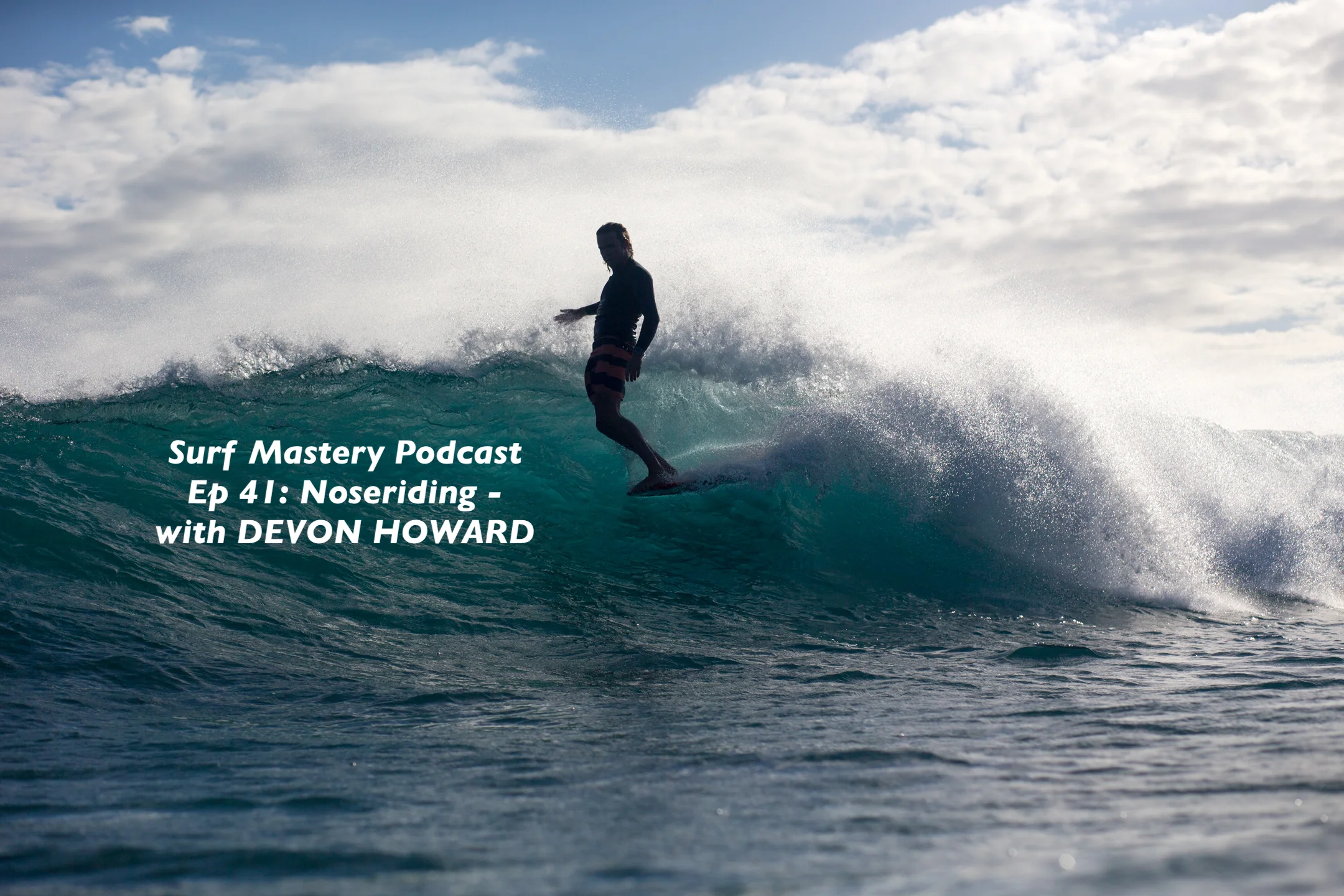
SHOW NOTES
Ever wonder why your nose rides always fall short, even when the conditions are perfect?
In this episode, Devon Howard breaks down what most surfers get wrong about nose riding—and it’s not just about your board. From subtle shifts in ankle engagement to trusting the wave's energy pocket, Devon shares how traditional longboarding is less about force and more about finesse.
Discover how body positioning, footwork, and mental confidence create successful nose rides.
Learn the surprising importance of ankle awareness and how land-based balance training can revolutionize your surfing.
Understand why the right board design (yes, single fin logs) is non-negotiable for hanging ten with grace and control.
Press play now to transform your nose riding technique with proven, practical wisdom from one of traditional longboarding’s most respected voices.
Devon breaks down noseriding & cross stepping, we discuss dry-land and balance training. We talk appropriate traditional longboarding equipment and style. We also get into surfing etiquette, line-up politics and the current state of surfing.
Appropriate Equipment:
https://www.waynerich.com/
https://www.thomassurfboards.com/collections/boards/products/surfboard-06
Devon Surfing:
https://www.youtube.com/watch?v=17bG-BJgEec
Devon:
https://www.instagram.com/devon_howard/?hl=en
http://www.bluskycollective.com/
Ep 70: Devon talks Mid Lengths -
https://podcasts.apple.com/nz/podcast/podcast-surf-mastery/id1088660076?i=1000554669848
Key Points
The importance of proper head and body positioning, particularly in the ankles and feet, for effective longboarding and nose riding is discussed.
The differences in body development and muscle usage between longboard and shortboard surfing are highlighted.
The use of balance boards and cross-stepping techniques to improve longboarding skills and nose riding is explained.
The significance of equipment, specifically the type of board and its design, in enhancing nose riding performance is emphasized.
The role of hand placement and its functional benefits in maintaining balance and control during nose riding is discussed.
The subjective nature of style in surfing and its importance in longboard competitions is explored.
The value of trusting one's instincts and the potential pitfalls of disregarding them in surfing scenarios are highlighted.
The challenges of surfing in crowded conditions and the need for individual responsibility and spatial awareness are addressed.
The excitement and continuous learning in surfing, even at an advanced age, and the role of innovative equipment in enhancing performance are discussed.
Outline
Longboard Surfing Technique
Longboard surfing primarily uses feet, calves, and ankles for balance and control, as opposed to shortboarding which relies more on quads and glutes.
Longboarders maintain a more upright stance, often balancing on one foot while walking the board, which leads to stronger feet and lower leg muscles compared to shortboarders.
Proper nose riding technique involves shifting weight to the back foot and hip while cross-stepping to the nose, which prevents the board from pearling (nose diving) and maintains trim.
The forward hip should be pushed out slightly for balance, similar to a martial arts stance.
Cross-stepping should be smooth and controlled, with 4-6 steps considered ideal.
Taking fewer, larger steps can disrupt the board's trim and is seen as less skillful.
Shuffling feet is effective but less stable than proper cross-stepping.
Hand and arm position is crucial for style and function.
Keeping arms low and hands near the waist helps maintain balance and control.
The front hand often guides direction while the back hand acts as a stabilizer.
Nose riding requires positioning the board high in the pocket of the wave, in the steepest section.
This positioning creates lift and allows for impressive maneuvers like hanging ten with the tail elevated.
Proper positioning is key to successful nose riding.
Equipment for Longboarding
Traditional longboards for nose riding are typically 9'6" to 9'8" long with a single fin.
The lack of side bites (smaller side fins) allows for better hold during nose rides.
The tail should have minimal edge, allowing water to wrap around the rail and create lift.
This hydrodynamic effect is crucial for maintaining trim during nose rides.
A deep single fin provides stability and prevents the tail from sliding out unexpectedly during nose rides.
For larger waves, boards in the 8' to 8'6" range with a 2+1 fin setup (large center fin with smaller side bites) are recommended.
For versatility, a 6'10" hybrid egg shape is recommended as an all-around board for various conditions.
Training and Improvement
Balance training is crucial for longboarding.
Simple exercises like standing on one foot with eyes closed or using balance boards can significantly improve performance.
Focus on keeping the head, neck, and shoulders still while allowing feet and ankles to make fine adjustments for balance.
Watching videos of skilled longboarders can provide valuable insights into technique, wave reading, and style.
It is important to pay attention to when and where surfers initiate their moves in relation to the wave, not just the surfer's actions on the board.
Surfing Culture and Etiquette
A more inclusive and understanding approach to crowded lineups is advocated, encouraging communication and education rather than aggression.
Recognizing that surfing has changed dramatically is important, focusing on the positive aspects of modern surfing, such as improved equipment and greater accessibility.
To navigate crowded breaks, arriving early, positioning deeper, and developing wave-reading skills to catch set waves before others is recommended.
When dealing with etiquette issues, approaching others calmly and educating them about surfing norms is advised, likening it to waiting your turn in other social situations.
The Future of Surfing
Despite increased crowds, optimism about surfing's future remains strong, citing technological advancements in board design and the potential of wave pools.
Embracing change while maintaining respect for tradition and etiquette is encouraged.
Continual learning and experimentation with equipment, even for experienced surfers, is emphasized to keep progressing and maintain enthusiasm for the sport.
Transcription
Devon Howard
Sometimes it's the most simple things that can transform your surfing experience. This is why people struggle with nose riding, is they're not quite sure where to put their head. I didn't know that I could do certain things on a longboard, and that led me into a whole other path of going deeper and deeper.
Michael Frampton
That was the voice of today's guest, Devon Howard. Today's show is all about longboarding, in particular nose riding and cross-stepping. Massive thanks to Devon for taking the time to share some of his knowledge with us. As I was setting up the recording equipment, Devon and I were talking about sort of longevity and injuries and training for surfing and some of the neurology behind it. So that is how the conversation started, and this is where I fade in my conversation with Devon Howard.
Devon Howard
My legs are not super strong because I'm a longboard surfer, and longboard surfers don't, we don't get down real low and compress out of things like a shortboard surfer. We're not using our quads and our tush as much. I think we use more of our feet and our calf. You know, everything in here and in here is pretty strong because you're always, if you think about longboarding, you're really upright and you're on one foot or the other. Because you're walking. And when I go to one foot, I can feel my feet really dig into the floor. You know, and I think if I'm shortboarding, my feet are apart. My feet are strong, but I feel like more is going on here in my quads. So it's just interesting how your body develops based on the type of surfing you're doing. You know, if you're not as maybe well-rounded. Some people surf shortboard and longboard regularly, you know, they've got it covered. But.
Michael Frampton
It's an interesting segue into longboarding and how it can come from the feet a lot. Yeah, there's something I've noticed now because I've only started longboarding about a year ago. And I'd got a 9.3 sort of performance-ish longboard and thought I was longboarding. And then last time I met you, you said you suggested getting a different kind of board. And I got a 9.8 log from Wayne Rich. Nice. You cannot impose your will on that board. Right. Because it just wants to do what the wave's doing. Right. So you have to listen to the board on the wave. Right. And if you go and try and do your shortboarding or even performance longboarding techniques, then the board just says no and just stays what it's doing. So then I'm finding I have to really be aware of what my ankle is doing. Sure. And listen to the wave with my ankle. Yeah, and then trying to cross-step, that's a lot harder than I thought it would be as well. Sure. So I'm definitely becoming more aware of my foot and ankle. Yeah. Because I learned to ride a traditional style longboard.
Devon Howard
Yeah, it's something I didn't think about a whole lot when I was younger. But then in more recent years, people have asked, how can I nose ride better? And then it's like, wow, okay. Well, let's start thinking about this. And just walking around on the floor trying to show someone a technique, then I, you know, you start realizing, like you just said, there's a lot going on in your ankles and all those, when you wiggle your toes, you see all those things moving in your foot like they're all talking to one another. And I remember there was a guy 30 years ago at Cardiff. He made a balance board. He was a chiropractor. He made a board called the Chongo board. You know, there's been a million different balance boards. His was really simple. It was just like one of those softballs you go and hit at the batting cages and a circular piece of plywood. And you just cut a little hole in it and you stood on it. And he gave me one, wanted me to buy it, but I didn't buy it. So he gave it to me, and he said this will help your surf, your longboard surfing immensely. And this guy was way older than we were, like way older. And he could, at the time, he was probably in his mid to late 40s, which seemed really old, but he was hanging ten really well and he was giving credit to this board. You know, like when you're riding a wave, you don't have that many opportunities to practice, but on land, you know, when nothing's going on, you stand on this balance board and it will get your ankles and the metatarsal, all those things, talking to one another. And he would call, he was describing it as like kind of firing up your engine down there, like just getting things. Because you wake up in the morning, there's all that stuff going on with your body. It's really heavy. And if you've ever gone surfing and felt a little off the first few waves, it takes you a few waves to get settled in. Standing on one of these boards gets you almost often going immediately. If you do it right before you go surfing, you do it in the parking lot, you do it in your living room. But back to the longboarding thing, it's having all the toes and ankles and everything. I mean, you could describe it better medically, but everything's communicating with one another. And a lot of longboarding's finesse and balance and, you know, it's not these extreme power maneuvers, especially if you're into the traditional longboard surfing that's on what we call a log or traditional longboard. Has no edge in the tail, they're real flat, they usually have a single fin, and they're really stable in the water. And there's no rules, but I think culturally and in the tradition of surfing, we've really valued clean and balanced surfing. You know, there's no like erratic maneuvers. And if we were to just walk around the floor right here now and just kind of walk smoothly back and forth, you would feel everything kind of happening down in your foot and your calf. I think if you want to learn how to nose ride, being aware of that, you could get there quicker. A lot of people want to know how to nose ride now, like how can I figure it out? It's so hard. Aside from these balance boards, I would tell people to just pick kind of a straight line on the floor and just start cross-stepping, one foot over the other. And we're talking here, so you can't see anything visually, but there's something that goes on as each foot in a cross-step moves forward and over the other. It's a shift of the, a transfer of the weight. When you're nose riding, you don't want the weight of your body on the forward hip. So whatever is most forward, you know, let's say if you're a regular foot and you're going right and you're walking toward the nose of the board, in that case your left hip would be the forward hip. You really want the weight of your body more on your right hip, your right tush, so that as you walk forward—yeah, so I'll see if I can do it with this microphone—so if I'm standing the tail of the board.
Michael Frampton
Even if you're standing on your left foot.
Devon Howard
I'm regular foot and I'm going right. I'll initiate the first step forward, which will put weight on my left foot and in my quad. But I want to be leaning back. Because if I go forward and I'm leaning forward on my right foot that's now in front of me, I'll want to keep falling forward. So when you cross-step, you're always kind of a little bit of a lean. Like if you look at Joel Tudor or great nose riders like David Nueva, and especially you'll see this in women who are really good at cross-stepping. The way that they're built physically, I think, really helps this technique, which is the hip. The forward foot, so before I start cross-stepping, in this case it's my left foot, there would be the leading hip is gonna go out a little bit. And then the back foot is now gonna come over the front, and I'm gonna do my first cross-step. At this point, I'm in this sort of in-between moment. The weight is really here. But I want to, as quickly as possible, get and move the weight and the strength of my body to this foot. So now I bring the other foot forward. I'm almost standing on one leg for a microsecond. I'm standing on this leg and the weight is really in the back part of the board and the body, which would be the right hip. And then it becomes rhythm, where I'm doing this over and over. So I start with the two feet together. I take my right foot and go in front of my left. That's the first cross-step. And then, this all happens very quickly, I put all the weight in that right foot now, and I bring the left foot around in front of the other. Now I'm almost back into my regular stance again. But when I string them together, I'll move like this and, you know, you're going forward and you're—and even when I come back, when I walk back, I'm still keeping the weight to the back. The only time I go with my weight forward is if the board is stalling too much and I'm almost, I can feel that I'm gonna fall out of the wave. Then I can put a little bit more weight forward, which will push the nose of the board down and reengage. But once the board takes off, if I keep all my weight forward, then the board might start sinking, start plowing water. So this is why people struggle with nose riding, is they're not quite sure where to put their weight of their body. And again, I encourage you to look at videos of people like Joel Tudor. If you can find videos of Kassia Meador or some of the ladies, I think they do some of the finest cross-stepping. There's just something really graceful about their approach. And I've never studied this, it's just observation. But I think that the female body, with that lower, a little bit lower center of gravity in the way the hips are, really helps with this weighting. Guys have no hips, so we have to kind of push them out a little more. And you'll see, when you start looking at nose riding pictures, you'll see a lot of times that the forward hip is out toward the nose, and that creates this balance point. If we're leaning forward, we're sort of top-heavy. It's like a martial arts thing. It's harder to push someone over when they're down low and their knees are bent and they're kind of back. If they're forward and top-heavy, and if your lower legs ever get locked or bent, that can be really dangerous too. And you'll see really people that are really good at this, their knees are always slightly bent, just a little. You want to avoid locking the knees, and you just want to stay loose. Like I said earlier, just pick a line—like here, we're on the edge of a rug, you know—and so I can just sort of just follow this, and I'm doing it really slowly. But when you're really doing it, you have to do it quicker. And in cross-stepping, you can take really little baby steps, which is kind of cool and more difficult to do. The more steps you do to the nose, it's obviously more difficult. Initially, when people start doing it, it's almost like kind of cheating. They'll do like two steps, and they do like these really big steps. They jump out really big to get there faster. That's fine for learning, you know. I think initially just to get comfortable. But for example, you know, if you're ever want to get to a level where you're competing professionally, the judge will look at that many steps as sort of cheating. You know, not many people have the goal of trying to be a professional longboard surfer in competition. But if you want a guideline of, you know, where do you want to go with your own personal surfing, I think if you're doing four to six steps to the nose, that's a good zone to be in. It looks and feels good, and it's, you know, it's technically a proper nose ride. The two-step one is really rushed and it can actually kind of throw you off because you're almost leaping and jumping on the board. Just kind of disengages the trim line and can make the board a little wobbly, a little shaky.
Michael Frampton
Yeah, there's more time when nothing's touching the board, right? You're jumping, right? Which is what I've been doing. Yeah, I've been just like shuffling, not even cross-stepping. Just caught out though, like if you're halfway through your shuffle and there's a bump that you didn't, there's nothing touching the board. So yeah, you're gone.
Devon Howard
Yeah, I mean, shuffling, it's effective and it works, you know. There's no—you get.
Michael Frampton
Whereas at least cross-stepping, you still got that one foot there? Sure. So it makes more technical sense in that regard as well.
Devon Howard
Yeah, I think it does.
Michael Frampton
And the way you described it is like it's more you're sneaking up to the front, isn't it? Like you look like you were sneaking, trying not to make any noise on the floor. Yeah.
Devon Howard
Yeah, and where I come from—and a lot of people, I think, appreciate that kind of surfing—is in the height of the longboard era, which was 1966 before the shortboard came along the year after. Surfers really valued a polished, stylish approach. It was just, you know, you can look to a lot of other things—gymnastics, diving, you know, ballroom dancing—there's real value in the perfect form, you know. And it wasn't until, say, something like breakdancing came along that really changed the way you looked at something, or different types of hip-hop dancing, where you're like, whoa, that's not that sort of elegant, fine-form ballroom dancing or perfect-form diving. But that new form can be really appreciated. And I think that's what you have with shortboard surfing. You know, you have Italo Ferreira, who does the craziest aerial maneuvers or the most, you know, powerful turns, but you don't necessarily equate that to the most beautiful style. I mean, that is a subjective term. That could be stylish to somebody else, but to a lot of people it isn't. And then you'd have someone like Conner Coffin, who's on tour and does these beautiful sweeping turns that remind us of Tom Curren or Taylor Knox. And then you have another type of surfing, which is longboard surfing, you know. And I think they can all be appreciated, but with longboard surfing, what makes it unique is nose riding. And that's the one thing I get questioned on the most is, how can I nose ride better? And so the things I was just describing are helpful, but there's a few other factors I think that are really important to know. The equipment is a major factor. You could give yourself a serious advantage by getting the right type of board. Just like with a shortboard, if you want to do airs, there are certain boards that are better at doing airs than others. If you want to catch big waves or tube riding, there's certain boards for that. Well, same for nose riding. And like I described to you, a board that you would enjoy would be something that's 9'6" to 9'8" for the average-sized person, and it's a single fin and typically is the way to go. You can certainly nose ride really well with little side bites, but not as well. And the reason that you want the single fin is it holds better. It's a much deeper fin, it sticks much further into the water, which allows, when you're out on the very tip of the board, it allows it to be anchored and held in without the tail slipping out unexpectedly. And then you fall on your face, you lose your board, you're going swimming. And the other piece of it that's really just as important is the design of the surfboard itself. In the tail end, if you look at any shortboard or most surfboards, they have what's called edge, and the edge gives you release, which is why those boards turn so easily and so well. On a nose rider, if you take that edge off, what happens is the water comes up and over that rail and sort of hugs it. It's almost like, imagine two little hands holding on to the tail of your board while you're out on the nose, on the tip. You know, it's like being on a seesaw and you're out on one end and there's something counterbalancing. There's a hydrodynamic effect that happens with the way the water runs over the rail that if you had edge, the water would come off the rail and sheath off of it, which would cause release. It would drop out because it doesn't have that. The water comes up and over and it's like hugging it really, and that allows you to do those crazy nose rides where you see surfers where there's—in the front foot or two of the board—there's no water underneath. It's like they're just levitating. And that's part of the dynamic thing about nose riding is, with the single fin and what's going on with that rail and where you position the board, you get one of the coolest feelings in surfing, which is to be out on the front of your board. And it's like you're out on a diving board. There's nothing underneath you. And when you can get to that moment and that level and do that sort of nose riding, it's right up there with tube riding, I'm sure. Yeah, let's say tube riding's the ultimate, but I would say hanging tens right behind it, you know, in terms of what feels good—like, whoa, I can't believe I did that. So with the equipment, if you are looking to nose ride better, if you currently have a longboard and it has side bites or it has edge on it, you can nose ride that board for sure. But you're gonna be doing more what I would call hanging five, which is where the front foot's up there, the back foot maybe a foot or a foot and a half behind you. That's a really nice feeling. But if you're seeing surfers that are doing that, where they're hanging ten and there's elevation under the board and they're at high trim speed, hauling ass and kind of arching it out there, you're gonna have to get these other type of board I'm describing. And the last piece of it, aside from the equipment, is going to be positioning. So there's a little misconception that you just run up to the front of the board and it's just gonna start, you know, sort of hydroplaning or elevating out of the water. Doesn't quite work that way. You can nose ride on the mushy, flat part of the wave, but at best you'll be doing one of those hang fives. And you'll notice that the whole time you're doing it, you're almost, you're sort of plowing water. The water is sort of gushing out to the side and almost sometimes shooting up in your face, and it's pretty messy nose riding. What you really want to do is take off a little deeper and you want to place your board high up into the pocket, into the really steep part of the wave. You would honestly think, gosh, I should stay away from that part of the wave because it's risky, I'm gonna eat shit, the board's gonna slide out. But the way that the hydrodynamics of these nose rider boards is, they want you to be stuffed right up into the pocket, high in the wave face. So let's imagine we're on a waist-high wave, maybe stomach-high. Let's pretend it's Malibu or a wave that breaks like that. You can tell by looking at the wave—there's the curling part, there's going to be the part behind there which is just white water in the flats, and then in front of the curl is a flatter part of the wave that will form into the curl. So this is all about timing. And you have to, sort of like when you're backdooring a tube, you know, if you're looking for a tube ride, you can get barreled on the takeoff or you can paddle a little deeper, and you see that the barrel is just a little bit further down the line and you tuck in and kind of what we call backdoor the barrel. Nose riding is a little bit similar. You want to backdoor a section almost, or you want to anticipate it. So you want to look for that section where it's going to be really steep. And you know, as we know, longboards, you can get into the wave pretty early. So before the wave's even broken, you can look down the line and say, wow, I think the wave's really gonna stand up, you know, 20, 30 feet down the way. I'm gonna paddle in and I'm gonna start walking to the nose before I even get to that section. And I'm going, I'm anticipating that it's gonna jack up and bowl right there. And by the time I get to the front of the board, you're perfectly timing the section so that the board is in the high, curling, tight part of the wave and you're on the front end of the board. And it's kind of like that idea of sending it. It's like, okay, I have faith. If I'm gonna backdoor to a tube, I'm anticipating that I'm gonna set this up, get in the barrel and exit cleanly. I'm gonna do that with the nose ride. Some would say it's similar to hucking an air. You know, I pump down the line and if I have faith in my skills, I throw my board and body into the air, but I know—and I'm basically telling myself and communicating with my body—I'm gonna land this thing. It's the same with nose riding. You have to go into the nose ride knowing that, holy shit, this is kind of sketchy, it's really steep here. But you just say, no, I'm gonna stand up here. And you have to tell yourself that—I'm gonna stand up here and I'm gonna pull this off. Where a lot of people struggle with nose riding is they walk up kind of locked and timid and thinking to themselves, my God, I don't want to fall, I don't want to fall, I don't want to fall. And what happens? You fall. Because you're so worried about not falling. And you look at people that nose ride really well, it looks so effortless. It's because they're really letting go and they've done the work to get there. And the work is all the balance stuff you can do in your living room. You can do it on the floor with no balance board. You can get something like the Indo Board or some product like it. If you're crafty, you can just make your own. I mean, you can literally get a piece of wood and a ball and screw it onto the bottom of it. And you, being in the physio business, have seen all the different trainers that are out there. Anything that gets your feet and ankles and calf talking to one another is good training. There's a lot of cool things that you can work on yourself. You don't need to hire a coach or a professional. I think the basic balance training is.
Michael Frampton
I'm gonna add to that just quickly. Yes, people think that the goal is to keep the feet still. Like, even if you just stand on one leg with your eyes closed, people start getting worried about all the twitching in the foot. But the actual goal of the balance, whether you're standing on one foot or whether you're standing on a balance board, is to keep your head, neck, and shoulders still and allow your foot to make those fine adjustments.
Devon Howard
Yeah, I agree with that. When I was a kid, my mom said, don't flail your arms around. My mom was a surfer. And I didn't really understand it. I thought maybe it was because it just didn't look good or whatever. But there's a real function to it. So if the adjustments are happening in your ankles and your knees and your feet, those are kind of like your shock absorbers. And if you can leave your upper body maybe a little more quiet, it's less erratic adjustments need to be made. Because if you move and flail your arms around, it kind of throws you off. That's why I think people really go, wow, longboard surfing is so beautiful. And it's—you see that the top surfers, as they're walking to the front, their hands aren't going up and down and moving all over the place. The hands are usually low and kind of near the waist. It's like anybody that's—you go to Cirque du Soleil or the, you know, any of those people that do the high-wire acts—their upper body movements are really minimal and subtle. And a lot of what's happening is from the waist down. You know, and it is a tightrope act in a way. But fortunately, a surfboard is 23 inches wide usually, you know, so there's a lot of room there. But I think what's important is to understand that it isn't one thing that's going to help you be the best nose rider. It's understanding how all the things we just talked about work together. So the balance, toes, the ankles—wake everything up before you even go surfing. Before you even get on the board, you can literally do this in the parking lot or on the sand. You don't even need a balance trainer. I love what you said about just standing on one foot. It's a really great way to just wake up for any kind of surfing. And then, hopefully, you have a board that is in the—that's described. And then you need to have faith in the positioning. Like, you really have to believe that I can do this. As silly as that sounds, you know, sounds like something, you know, Tony Robbins or somebody would say, but it works. You know, the psychology of faith that you've got the equipment, and you've done some level of training to get there. Then you start getting more comfortable. Once you've nailed a nose ride in a really critical part of the wave, you understand that it's almost easier than doing it in a flat part of the wave. You're trained to make something out of nothing on the flat part of the wave. You're doing all this work. You're trying to get the board to do all the work. Let the wave do the work. The wave can do—like, if you think about other types of surfing you do in shortboarding, you can do just about any maneuver when you have speed. It's amazing, like, how hard you can hit the lip or how good of a cutback you can do when you have speed. You know, and that's the same with longboard surfing. Speed is your friend. You know, you want the board trimming at the highest, most optimal speed it can be. So to do that, you don't want to be low on the wave. If you're too low on the wave, you're not in the energy pocket. You get a little bit mid-face and higher, you notice the board starts taking off and hauling ass. That's the time when you want to start walking up to the nose. It may feel like a time where you should get in safety mode and hunker down and go, man, I got to get around this section. But I would say watch a lot of videos. Go on YouTube, go on Instagram. Think about the things I've said and now look at them happening when you watch people doing it. I think that's really what's helpful in surfing today, where I didn't have a lot of things to watch. I could dig up a few old movies like The Endless Summer, but I didn't have all this education at my fingertips. So much training can be done just off visuals. Yeah, you know, yeah.
Michael Frampton
One thing that helped me a lot on that note—it's not just watching the surfer, because that's part of it for sure—but you want to watch when did they start walking to the nose? What was the wave doing when they made that decision, rather than just watching them and watching what's happening with—we focus on watching the surfer and the top and the front foot of the board, but what's happening with the rest of the eight foot of the board and the wave? Right? And once you start watching the way the wave is literally hugging most of the surfboard and just encapsulating it, and then you're just along for the ride, there's the faith thing. Like, walk up to the nose and trust that the board's gonna stick into the wave and that the wave's gonna push you along. Yeah. And then just keep your head, neck, and shoulders still and let your feet do the adjusting and enjoy.
Devon Howard
Yeah. Another thing too that I've personally found helpful is where your hands are and what they're doing. If you look at Tom Curren, one of, you know, obviously the greatest surfer of all time, look at Tom's hands. And it's almost like he's communicating with his surroundings with the hands. You'll notice that, where the wrists are bent, but the tops of his hands come more toward his arms. He doesn't bend his hands in and they're up and out. And the hands will be kind of in plane with the wave. And there's like the space between the wave and his hands always when he's doing a bottom turn, when he's doing a cutback. And the front hand is always aiming where he wants to go a little bit. The back hand is sort of like a stabilizer. The back hand is always kind of close to the body, and it's like a placement. And the front hand is like a guide. And when you're nose riding—try to find videos or photos of myself—you'll see what I'm talking about with the hands. I'm usually doing something with the hands, and it's not just because it looks cool. I mean, that is a bonus, it does look kind of cool. But there's a function to it that helps anchor and settle in my body into a space that's really comfortable. And I don't know if "secure" is the right word that I'm looking for, but you're just kind of locked in, and it feels right. And it's almost like if someone came up to try to push you on your shoulder to knock you off, that position I'm in is almost like a martial arts position. I'm like, I'm not going anywhere. You know, and that helps when you hit a chop or you hit a bump or maybe there's a surfer paddling in your way that you didn't expect, and now you need to backpedal off the board but maintain control. I think what happens easily is when you're nose riding is something happens that distracts you. And then before you know it, your arms look like you're rolling up the windows, and you're in survival mode trying not to fall and kill someone or yourself. And so I think when you have that hand placement—again, people might say that's just posing or it looks like you're just trying to look cool—but I think there's functional hand placement that ties this all together. You know, that's sort of the last piece of it to me. So I don't know, I hope some of that info is helpful. Did.
Michael Frampton
That's awesome. It's all in the details, and neurologically speaking, if the hand is ready to catch a ball, it's way here. It's awakening the nervous system up. If your hand's over like this, it's shutting it down. Literally, yeah. So when you lie in bed to sleep, are you like ready to catch a ball? No, you soften everything down. And you might, you know, you kind of nestle into a fetal position because you rest and relax. And then when you're like this, you're ready to catch a ball. There's an interplay between the foot and the hand as well. Like, especially even shortboarding, you go up, you want to pull your wrists right back.
Devon Howard
Right? Make that make sense, so.
Michael Frampton
Yeah, and it reacts. It helps your feet to dorsiflex at the same time as well. And there's the spatial awareness feeling from the hands. I mean, your hands are the most alive part of your body. There's so much—there's way more nerve endings in your hands and your feet and your lips than anywhere else in the body. So feeling spatial awareness, the way the wind's moving through your hands, even just getting it close to the wave, you get a closer sense of spatial awareness. Yeah, and of course it looks better. No, not yet.
Devon Howard
Yeah. Have you ever talked to Brad Gerlach? Don't know if he's done with it, but he's been working on this WaveKey. And I feel like some of what we just described, it's got to be what he's working on, because I've just seen limited things and he's described it to me. But where the hands are moving with the body, you know, there's something to it there. I don't have any training and I don't understand why this stuff's happening. I'm just describing that through just sort of the natural process of doing it, I've become aware that it is happening. But there is a deeper connection and understanding and explaining, kind of like what you were just getting into in the physiological sense of what's happening there with that connection. And I think when you're aware of that, it helps you. Helps your technique. If you really appreciate style, it's again, it's a bonus, but it's nice to have an understanding of that those things are working together. And the end result is—for me, if it feels good, it's certainly going to look good. But a lot of the style stuff just feels nice. You know, so style is an interesting conversation because some people, I think, would argue that there's too much emphasis on it. And, you know, hey, surfing should be about freedom of expression. And of course it should be. And it should be about explosive maneuvers, should be about progression—whatever that means. On a personal note, I've just always appreciated beautiful surfing, no matter what decade it's from. If I saw someone surfing in the '30s or the 1980s or '90s, you just—you immediately see it. Like I saw a clip the other day of Margo, Brendan Margieson. He was a really well-known, yeah, Australian surfer. And I don't know if it was the WSL or somebody put up a clip as they were going into the Bells event. They're kind of going back in the archive and looking at, you know, state-of-the-art surf style at certain points in time. And I was like, man, we could use some of that surfing, that style that he has. You just don't see it as much. Imagine taking what Margo is doing and mixing it with someone like Italo, who—where they can do these crazy maneuvers, but they're putting it together with this beautiful style where they still are drawing out these lines. And that body and hand placement, it's hard to articulate it.
Michael Frampton
One of my favorites.
Devon Howard
It's just like really good music or really good wine. You may not have a sophisticated palate, you may not have the vocabulary to describe the music you're listening to and why it's fantastic, but a lot of these things—we collectively know it when we see it, you know. You feel it or you taste it. And I think there's a whole discussion there that you could go down one day about style.
Michael Frampton
I've asked a few people about it. I want to ask you—how can you define style in one sentence?
Devon Howard
I mean, to me, style—gosh. Style, for me, when I pull up to a surf break and I look, I check the waves—style is an individual's way of, to me, of communicating surfing. I'm gonna back up. I don't like the way I described that. It's funny, because I've never just really had to think about or describe. Style is just somebody's personal expression of surfing. So when I look, a lot of times people’s surf styles parallel their personalities. You know, I've seen really radical individuals who are either outspoken, like to party, real extroverts—and I know those people, and I see their surfing styles is oftentimes pretty radical. And I know individuals that are really soft-spoken, understated, and have similar surf styles. They're just these really kind of quiet and smooth. That's not always the case, but it's interesting that a lot of the times the way we express ourselves surfing can draw a lot of similarities to our personalities or the way we move on land. It's interesting. That's very unscientific. It's just my own personal observation.
Michael Frampton
It's a very political way of answering the question. Because the thing is, when we ask what is good style, we're asking you to judge someone's style on you. Because everyone has style, but we're implying that some styles—some people’s styles—are better than others.
Devon Howard
Style is extremely subjective. And I think it's as difficult to answer as what, you know, what is good music? I know music is a really challenging thing for people.
Michael Frampton
I agree. But on that note, I mean music is a great analogy, because you can have a style of music that you don't like. But if it's good music, you have to admit it's somewhat stylish. And I think a better word—and I think in terms of, I think style's the right word that I'm trying to get—I think perhaps rhythm, flow, and grace are words that better articulate the style that we're judging. Because the difference between—I mean you mentioned Italo, he's so dynamic and the performance surfing is off the charts—but you can have Italo do an aerial maneuver, and then you can have John do the same maneuver to the same amplitude. John just did it with more flow.
Devon Howard
Yeah, it was more graceful.
Michael Frampton
Yes. That's the shortboarding thing though. But in terms of longboarding—I mean, flow, rhythm, flow and rhythm are the words for me that articulate what you're looking for in style in a better way. Because that's what the wave's doing. It's flowing. It's in it. It's water. You pour water into a cup, it takes the shape of the cup. It can't—there's nothing else water can do. So when a wave hits shallow water, it has to be rhythmic and fluid. And yeah, there's different speeds of that, different styles of waves.
Devon Howard
Yeah. I wonder, I'm curious—I don't know much. I brought up dancing earlier, but I just always sort of think of longboard surfing and dancing in a way. Ballroom dancing, all those different swing—there's form. And I'm trying to imagine if someone did those styles of dance in a kind of what could be perceived as a bit erratic or not polished.
Michael Frampton
They don't get work.
Devon Howard
They wouldn't get work, and they wouldn't get rewarded. In surfing, we seem to be more flexible with that. Not always. I think the majority of people really appreciate surfing that's smooth and polished and flowing and graceful. And it seems like the perfect approach in surfing—when you're looking at a style versus the maneuvers—is when they come together seamlessly. So John is a perfect example of doing these really progressive maneuvers, and the reason he came on the scene and we loved him so much was that effortless style. And he comes from the skateboarding world, where that's really valued. The skateboarding culture is super into style and all these maneuvers coming together with flow and grace and feeling quite seamless. It's interesting with style—when you look at a lot of, you know, this isn't a nationalistic thing, but because there's an easy example—Brazilian-style surfing, a lot of folks will point to Brazilians as not having the best style, but having really the most progressive maneuvers. But it's funny that even within the Brazilian community, there are a few of the Brazilians that have a grace and a flow that breaks away from that. So why is that? Why is that happening? We don't—in the shortboard world, though, just to be clear—we don't, style is not part of the criteria. Yet it is, however, in longboard surfing. So I recently accepted a role to be the tour director for the WSL for longboard surfing. It's had—traditionally it's had—one event a year, and that determines the world champion. So if you're having a great day, you could be the world champion that weekend. The obvious flaw to that is—are you really truly the champion on one day? Well, technically you are by the ASP, now WSL. But I'd say in the grander scheme of things, from a philosophical standpoint, no. It's not as strong as if you were tested over a period of time, which would be a number of events. I think the men's and women's championship tour has a dozen or so a year. You don't need that many for longboard surfing, but a couple would be nice. So now this year we've introduced four, which is going to be awesome. So, but in the criteria for longboard surfing, style is part of the criteria, which is really interesting. It's the only type of surfing within the WSL. You know, the big wave surfing doesn't have that, as far as I know—I could be wrong. Airborne doesn't have that either. They have a thing, what is it—speed, power, flow? Is that—that's more of the focus. But it would be really interesting if style came into it. And it is up for discussion. You know, and I think it'll be interesting if the long—if in any way, shape, or form, longboard surfing could or would influence that decision. That remains to be seen. But it's really apparent when you're judging longboard surfing that the style, grace, and control—those are words that are used in the criteria. And if those boxes aren't getting checked, you can't reward someone as highly. But I love that they're in there because I think that's what people want to see. They want to see really beautiful, stylish, polished surfing. But at the same time, while they're doing that, doing things that are mind-blowing, that are extremely difficult. Hanging ten in the pocket and basically the wave's barreling on your back and you're hanging ten is pretty awesome. Just as it's awesome to see someone, you know, doing a 540, you know, eight feet over off the top of the wave.
Michael Frampton
Yeah, what's the correct—is there in the criteria flow? Maybe they should—flow, speed, power?
Devon Howard
Yeah.
Michael Frampton
Which—the wording sequence? Yeah.
Devon Howard
So, I mean, there's some work to be done there. But again, not everyone's too concerned about it. I think that a lot of surfing fans that are in the more futuristic, progressive mindset, they just want to see futuristic, progressive moves and not let style get in the way of that necessarily.
Michael Frampton
Yeah.
Devon Howard
I don't—I don't agree with that. But hey, that's what's great about the world. It's full of opinions and points of view, right?
Michael Frampton
Yeah. Yeah. Well, if you're a shortboarder in your 20s, you're not—grace doesn't really enter your vocabulary a lot of the time.
Devon Howard
No. Probably not listening to classical music. Probably don't really care too much about fine wine. But you know, a good beer and a burger will do.
Michael Frampton
Exactly. What's the best surfing advice you've ever had?
Devon Howard
The best surfing advice I've ever had would be similar to what we were talking about with nose ride surfing, which was—you're never gonna be a great nose rider by trying to do it where you are, which is too far in front of the pocket. Tom Wegener, who is about 10 years older than me—he makes boards in Australia. He's an American that moved over there and married a local gal. He's based in Noosa. He makes these beautiful longboards. And he said, "You need to take off deeper." And I took off deeper. He's like, "No, you need to take off deeper." And he pushed me deeper. And that was a game-changer. I went from being an okay nose rider—just kind of okay—to pretty good. And he gave me the advice that you just need to believe that the board is gonna do the work. Have faith. Which is what we were talking about earlier. So I'm passing that on to anyone who's listening here. Thanks to Tom Wegener. It was a really simple thing, you know. But sometimes it's the most simple things that can transform your surfing experience. Let's see—the worst surfing advice. Man, that's a good question.
Michael Frampton
What's the worst surfing advice you've ever had?
Devon Howard
I think the worst surfing advice I had was recently. I don't want to name the surf break, but it's a pretty heavy surf spot. And someone gave me advice on where to paddle out. And I had been watching for about a half hour and I had my own idea of where I should paddle out. And they said, "No, don't paddle out there," had me paddle out this other spot. And it was the worst advice. I ended up getting dry-docked, scraping my knuckles and the bottom of the board on the reef, and getting blasted back up on the beach and embarrassed in front of a bunch of people. That was horrible. And I don't think the person gave me that advice on purpose for that to happen. I think they meant for me to go out there, but they didn't know a whole lot more about where we were paddling out than I did. And so, whenever I've gone against my own instincts, I've regretted it. And my instincts told me to paddle out at this other part of the break.
Michael Frampton
That's good advice. Trust your instincts. Yeah, do you ever ride a shortboard?
Devon Howard
Yes, not very often. I rode a shortboard from age 7 till about 14. And then after that, I got really into longboard surfing. But it's rare that I ride a contemporary shortboard.
Michael Frampton
Well, here's a better question—if it's double overhead and barreling, what sort of board are you on?
Devon Howard
I ride mid-lengths, which are not shortboards. So my favorite range is the sort of 6'10" to 7'. You could call them an egg, but I don't really call them eggs. The boards I ride are somewhere between a shortboard and an egg.
Michael Frampton
So it's kind of like a step up.
Devon Howard
No, it's more—leans more toward a, you could maybe call a hybrid, which is it looks like an egg in terms of the outline, but the rail and rocker is very modern. It has a hard, sort of tucked edge, has a little bit of rocker, it's not too flat, but the rails are quite what I would refer to as foiled—meaning they're really finely tuned, pretty thin. And that to me is the perfect surfboard. I like that more than longboard surfing. If I could ride that every day, I would. But we live in Southern California. It's not overhead that often. So my rule of thumb is, if it's under shoulder high, ride a longboard. Once it's over shoulder high, head high and above, I ride these mid-length boards. I do like fish boards as well a lot. Yep.
Michael Frampton
If you had to choose five surfboards for the rest of your life, what five boards would they be?
Devon Howard
The first one would be an 11-foot Skip Frye. It's called the Eagle, and it's a big board. I don't recommend people ride them—they're really hard to ride. And they're what I call a black belt form of surfing. They're really—crazy rails, they're long, they're just really hard to ride. I love them. I love the challenge. The next one would be a 10-foot nose rider by Thomas Bexon. I really like his boards a lot. The model's called the Keeper. The other board I would ride is the 9'9" Keeper, which is just a smaller version of it. I know that sounds silly to have two of the same boards, but those are the best longboards I've ever ridden, bar none. The other board I would have would be like an 8-foot or an 8'6" gun—something you would ride in like triple overhead type waves. And I like to ride them with a two-plus-one single fin. The middle fin would be six and a half or seven inches, and the side bites would be three and a half. And so that's four boards, right? And then the other one would be a 6'10" hybrid, sort of egg board, which would cover my needs in just about any area. And that would be the—it doesn't really matter who shapes it, it's just that style of board. So it's a lot of big, foamy boards. I think surfing is in a really awesome place. So I'm 45. A lot of people my age and older think surfing is ruined and that it's over. And you know, it depends what lens you're looking at it through. We're never going back to what it was in the '70s.
Michael Frampton
But ride the right board for the right conditions, right? Yeah.
Devon Howard
You know, it was an amazing thing then. And not many people did it, and it was really special. And I think if you're into fishing, you can appreciate what it's like to go to a fishing hole that no one knows about. And there's something special about only a friend or two that you tell about it and bring them to it after they've kind of built your trust. And that's how surfing was for a long time. And it is—I have compassion for people that are frustrated with what it is today. I'm among them. I'm frustrated too. But in recent years, I've shifted the way I've looked at it. I really love surfing and I don't want to stop. And I've put more of an emphasis on that it is something that we can learn to share together. And not being overly romantic about it, but having a reasonable attitude about it, you know. Just two days ago a beginner took off pretty badly right in front of me. It was a wave I'd waited for a while. It was a frustrating moment. But I didn't—in the old days I probably would have yelled or something, "You kook," whatever the things you do. But that doesn't work. What's difficult is I don't want to be the police and I don't want to be everyone's surf instructor. But I know that I'm good enough and I'm gonna go out and get another wave. And there's another day and more waves come—they always do. So in that moment, I'm just learning where I talk to people. I give them a heads-up. "Hey," you try to say something encouraging like, "You know, it's awesome out here today." You try to not come at someone like you're ready to just tell them off. Because as soon as you do that, no one listens and they're going to be defiant. And who knows what could happen? You could be talking to someone who is an ex-war veteran who's been through hell, and maybe they're out there as part of their therapy, and now you're just kind of setting them back again. So I talk to them and say, "Hey, you know, you're right in the most critical part of the wave. It's awesome you're learning. What I think would be really helpful for you is, see this part of the wave over here? If you work on kind of getting the basics down, and when you're ready to come out to this part, before you take off, you just look over your shoulder. So, you know, I'd hate for you to get run into—and vice versa, for me to get hurt." And you come at it reasonably. They go, "Well, thanks." You know, and nine times out of ten it's a pretty good experience. I don't go home feeling like shit. That person doesn't. And so I think what's good about surfing today is that we have more information and more knowledge. There's a lot of really good things. You know, what we've lost—the you're only gonna surf with two or three people—I mean that was lost, honestly, decades ago. What I like about surfing today is we have more knowledge. We have much better equipment. You know, the surfboards are so much better. I wish I had the surfboards that I have today—I wish I had them 25 years ago. And I just think in general, we—especially if you live in America—this is like one of the most amazing—there's so many things that we hate about this country and people say bad stuff about it, but look around you. Like, we're in the greatest time in human civilization. I mean, we can dial up anything on our phone and it can be at our front door in two seconds. We aren't gonna die from a simple wound. There's—I mean, I could go on forever. There's so many amazing things. But we still go to the negative. We'll still talk about how fucked things are. And I think surfing gets pulled into that. You know, surfing gets pulled into, like, "It's worse than ever. We've ruined everything." It's like, no. That's not true. You know, it's changed. But on the horizon, we have wave pools. I was really against wave pools. I might still be. I don't know. But there's a lot of things on the horizon that are going to enhance our lives and make our lives better. The world and our communities are better because of surfing. You know, am I worried about foil boards coming through the lineup and sawing me in half? Yes, I am. But I was worried about SUPs. I thought SUPs were going to kill everybody. They didn't. We're still here. The world didn't implode. We somehow managed our way through it. We're going to manage our way through foils. We're going to manage our way through the next things—which might just simply be ourselves. There's just a lot more of us. But I really—I'm getting a little tired of the discussions in the parking lot and friends and everything about how bad it is. And I'm choosing to look at the things that are really great about it. And that is helping my life. Because I work a lot, and so still having surfing is an important piece to the whole puzzle of my own life. And I think people listening probably feel the same way. And so the challenge for us is finding the joy in embracing the changes without losing our shit, you know. And it's a test. And the way that we do it is to have just a bit more compassion. That, you know, who are we? Like, are we that special that only we can enjoy this? That's kind of crazy that we are led to believe that. And I'm among the people who have thought that over time—that I deserve this more than you do. That's really quite horrible.
Michael Frampton
It's almost your first instinct as a surfer.
Devon Howard
Yes, because you were seeking solace.
Michael Frampton
Yes. But—and it's like, it's still there. You just have to travel. Just take two plane rides and hire a car and go to where there's no one and you'll find perfect waves on tropical islands to yourself, you and—like, if you're willing to travel, it's there. You can't pull up to First Point and go, "Another 60 people."
Devon Howard
It's not going away. We're not changing it. You know, the only thing you can do, honestly, is manage events and experiences in a one-on-one basis. Like, you can't manage the whole lineup. So if you can, you know, if you have a perceived issue with someone who just kind of has your number—like two or three times they're riding in front of you—then, you know, just go up to them and say, "Hey, I see we're going for the same waves. Can we work it out that, you know, when I'm coming down, maybe give me the break and move on to someone else?" You know, like, you have to—it sucks, but you have to kind of just deal with things on an individual basis and try to form these newfound alliances on a literally day-to-day basis. And it's hard. You know, it's really hard to learn how to kind of embrace and exist within this new world order of crowds. You know, it's like—because the alternative is to get really angry and to quit and to leave.
Michael Frampton
Just the wrong edit. If you want a set wave at First Point to yourself, then you have to see that wave before anyone else sees it, and you have to pull in deeper than anyone else. So essentially the better surfer who spent more time in the water, looking at the details and learning how to drop in later, is going to get the wave. Sure. It's like—if you go out there as a beginner/intermediate expecting just to get a set wave at First Point, then it's like you're a football player and you turn up to an NFL game and think you can just join in.
Devon Howard
Yeah, and that's a challenge because the way surfing was introduced to people in a different way—like, a different way now. It's quite accessible. Everybody's a surfer. You know, you get those quizzes on what do you do, and it's like people check the surfing box quite easily. And the barrier of entry is real low. Before, it was quite hard. Nobody would teach you, tell you anything. You'd come down, the ocean would, you know, literally hand your ass back to you and wash you back to the beach, and not one person out there's gonna tell you how to paddle out or what to do. It was like—they'd look and laugh. Good luck. But now there's surf school, surf shops, there's so much info. But the one piece that's still hard for people to get is the cultural norm. That's where people—my generation and older, I'm generalizing here—but that's where we struggle is, you go to a place like Malibu or any break like it, and you just look at the lineup and there's a hundred people. And 20 of them know what's going on. 80 of them don't. And you're still hoping that they would understand the cultural norm, but it's so beyond what we can manage. I just—I'm like, I don't have the answer. So I don't know what it is. It's—I quit, or I get super angry and get, you know, right to the edge of a fistfight all the time, which—that's how a lot of people are dealing with it. That doesn't end well either. I've seen people go home in the sheriff's cars. The only way I try to do, like I said, is on a case-by-case basis. And they go, "Well, you don't own the ocean. It's anyone's turn." I'm like, "Well, I see where you're coming from, but there are cultural norms out here, just like there are on land." You know, and I just say simple things like, "If you go to the deli or you go to the coffee shop and there's no numbers, how do you know whose turn it is?" "Well, I just—you know that person got there before you." It's the same thing. You know, if there's spatial awareness—like you just caught a wave, you came out, and you went by everybody—sit down and look behind you and realize, wow, there's a dozen people here who are up next. Have the wherewithal to allow some waves to go by. That spatial awareness—that's the same as if you went in the deli or the coffee shop and there was no queue. You kind of know what's going on. It's the same thing. And they go, "Really?"
Michael Frampton
Yeah.
Devon Howard
Yeah, it's the same thing.
Michael Frampton
Well, if you want uncrowded waves, don't surf First Point. Go to—Loomit. Like, the waves aren't going to be as good, but you'll find solace. Absolutely. And there's—I surf by myself almost every day in Los Angeles just because I know where to go. So—and I'm willing to maybe walk five minutes from a car park rather than three seconds. There's lots of little things you can do.
Devon Howard
How dare you take personal responsibility. It's—yeah, you have to take responsibility. And just the whole like, "Complaining about how bad it is," I gave up on that a while ago because it didn't change. The outcome was still the same. Those people are still there. You know, so again, you just try to work it out with people individually. If you want to surf First Point all the time, you'll get to know the regular people. They'll get to know you. And they'll stop dropping in on you. But they'll just drop in on the other new people. But like—the point of all this is, though, I'm quite excited about surfing today. I think there are a lot of really amazing things that are happening. And to be freshly turned 45 and still be excited—I never predicted that when I was a kid. You know, you just sort of figure at some point you'll just kind of fade out of it. And honestly, a lot of my friends that I grew up with, there's not many of us left. But I saw Joel Tudor the other day, and it's like, man, we're still doing this. Like, we're still surfing at a high level. And we're still probably more stoked, I think, honestly. You know, we would have never imagined being this excited about surfing and still looking at design, still finding surfboards that can help us improve our surfing. You know, at age 38 or 39, I found a surfboard from Tyler Hatzikian that transformed me. It was another shift, you know, where I didn't know that I could do certain things on a longboard. And that led me into a whole other path of going deeper. And even just a few weeks ago, coming up with an idea in my head with Thomas Bexon and asking him to try something. And he made himself one. He's like, "This is pretty cool," you know. And we got some really good results out of it. Some things that did better, and some that didn't. So we'll back up off some of the things and go deeper on some others. Very cool. But yeah, I think getting really excited about your equipment and understanding what it does—it's good for your surfing. You know, and there's a lot of really good board builders and brands out there that offer a lot of solutions. So if you have an idea, reach out to your shaper and ask them about it. You know, find out if that's the right way to go. And that back and forth is really engaging. It draws you into surfing even more.
Michael Frampton
The future is bright. Yeah. All right. Thank you so much for your time.
41 How To Noseride and Cross Step a Longboard - Devon Howard
For the passionate surfer—whether you're a weekend warrior, a surf dad, or an older surfer—this podcast is all about better surfing and deeper stoke. With expert surf coaching, surf training, and surfing tips, we’ll help you catch more waves, refine your paddling technique, and perfect your pop up on a surfboard. From surf workouts to handling wipeouts, chasing bigger waves, and mastering surf technique, we’re here to make sure you not only improve but truly enjoy surfing more—so you can get more out of every session and become a wiser surfer. Go from Beginner or intermediate Surfer to advanced.