
135: From Presidential Speechwriter to Surfer – David Litt
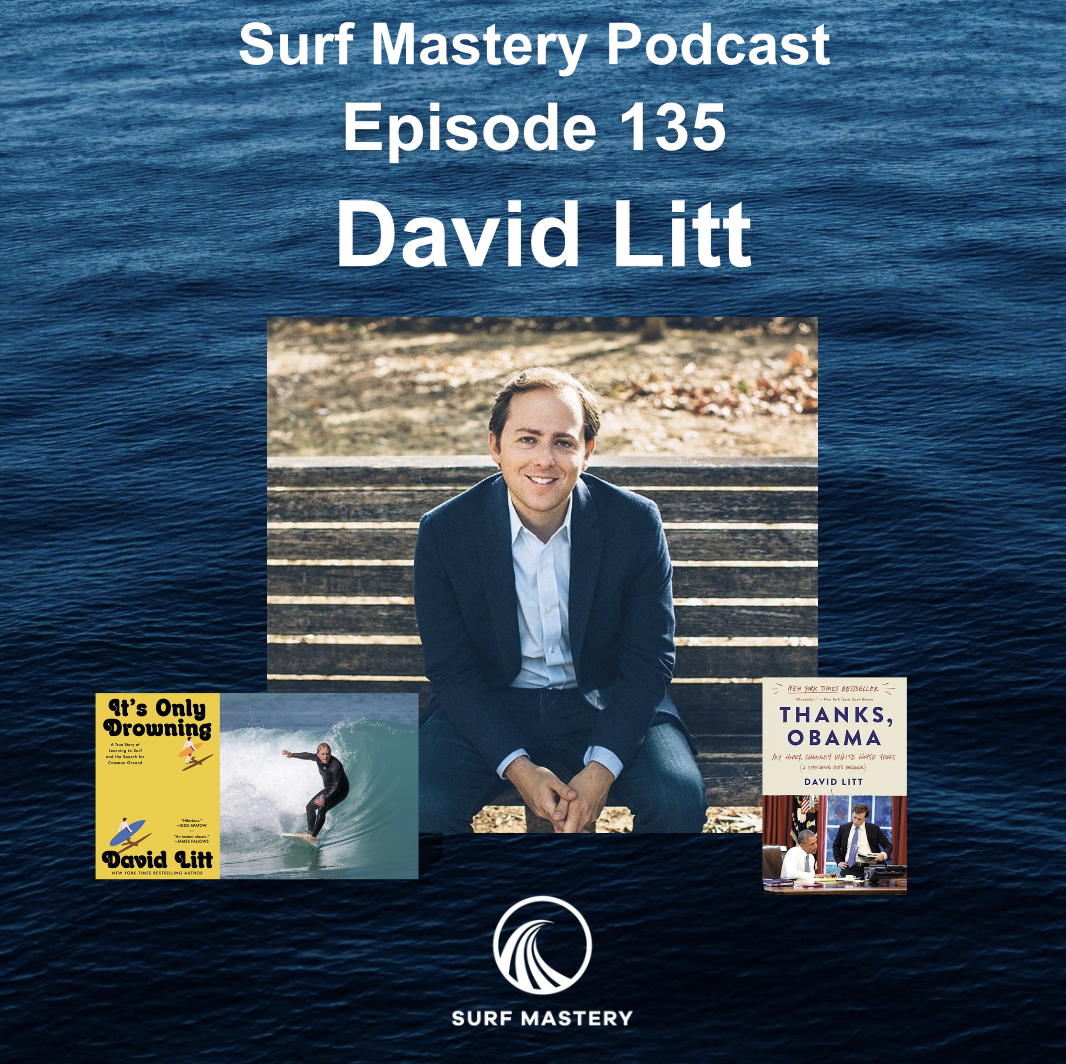
What happens when a former White House speechwriter, who’s written for presidents and packed auditoriums, decides to humble himself in a cold New Jersey lineup at 35?
David Litt isn’t your typical surf author. He joined the Obama White House at just 24 and became one of the youngest senior presidential speechwriters in history, crafting remarks on healthcare, climate change, and even comedy for the Correspondents’ Dinner. After publishing Thanks, Obama and Democracy in One Book or Less, he turned his attention to something far less controllable than politics: surfing.
In this episode, David brings a writer’s precision to the chaos of learning to surf as an adult, articulating the fear of hold-downs, the shame of kook moments, the obsession with progression, and the addictive pull of those brief, otherworldly flashes of flow. It’s a refreshing take for surfers: not from a prodigy, not from a lifelong local, but from someone who can actually put words to what most of us only feel.
3 benefits you’ll gain
A deeper understanding of why surfing feels “more than a sport,” and how chasing flow reshapes your mindset in and out of the water.
Practical perspective on fear, embarrassment, and adult progression, especially if you didn’t grow up in the ocean.
A renewed appreciation for the lineup as neutral ground, where politics, profession, and identity fall away, and only waves (and humility) matter.
Hit play for a thoughtful, funny, and surprisingly relatable conversation that will leave you seeing your own surfing journey, and your next paddle out, in a whole new light.
https://www.davidlittbooks.com
Michael Frampton: are you still surfing?
David Litt: Yeah, I mean, right now I'm in Washington, DC but I was in New Jersey just a couple of days ago and I was out, , actually with my brother-in-law.
We, we went out and it was,, good. , It's gotten cold, but it's also gotten less crowded, so it kind of works out. Right. That's the, that's the trade off in Jersey is in the winter, the crowds go away, but , every time you get. You know, you take a set on the head, you have the worst ice cream headache of your life.
Michael Frampton: Yeah. It gets cold there. All right. Like really, really cold. Yeah.
Ice floating down the Hudson and , into the sea. ,
David Litt: I think the coldest I've surfed in is probably like 35 degrees. , So what, that's something like. Zero or one.
Michael Frampton: Yeah.
David Litt: Chelsea
Michael Frampton: just
David Litt: doesn't, doesn't get much
Michael Frampton: colder.
Really?
David Litt: Yeah. It's basically ice cold. Although it is, it's one thing that I like about surfing on the East coast in the US is one way you can kind of prove that you belong is if you're a new surfer, you don't necessarily need. Skill, if you're willing to show up when it's really miserable out right.
You get a certain kind of respect just for being there. , And you get more respect if you can actually surf. I've heard. But, , hopefully , I'll discover that firsthand one day soon.
Michael Frampton: Yeah. Well, surfing is a, it's a hard sport. ,
David Litt: I, I think it's one of those things, if I had known how difficult.
Surfing is when I started, I definitely would not have started, , especially at 35 years old. So I'm really glad that I had no idea because I, I've gotten so much out of it. But if I had known how difficult this was gonna be, I never would've signed up for it in the first place.
Michael Frampton: So when was the point, like the tipping point of that?
Because obviously you were motivated to start and then you got to a point where you're like, oh man, this is how you must have, there must have been times where you thought, I'm just gonna give up.
David Litt: Yeah, some of it I think is the cliche, right? That first wave you catch, even if it's just you're in the whitewater and you look back on it a few years later and you're like, maybe that was all of four or five seconds.
But there's something pretty remarkable about it, and I think what I really fell in love with quickly was that sense that when you are. Up on a board, you're like in a different dimension, right? I always feel like it's almost like a, like a door to Narnia opens up, right? It's just this different place.
And I started surfing at a time in my life where I was pretty, I, I just kind of gotten out of, or was maybe getting out of the only real episode of true depression that I've ever gone through. And it was really, uh, it was really tough. I mean really, really tough. And so I think the idea of being somewhere else was more attractive than ever.
And. That absolutely hooked me in, right? That feeling of, okay, you're up on the board, that you're in this entirely new reality. And then. The ride ends and you're like, how do I get back there? Right. That was a big part of it. And I think the other thing honestly was I was surfing with my brother-in-law.
He's a good surfer. I knew I was gonna see him for the rest of my life, and I knew that if I chickened out, he would kind of judge me for it. And I was like, I cannot let that happen. And that was a very powerful motivator, right? I talked to other people who learned to surf as an adult without a family member who was always gonna kind of roll their eyes a little bit if they gave up.
And I don't know how they do it.
Michael Frampton: Yeah, well I think it comes back to that, that original flow state that you felt and you connected with the ocean and your mind went blank for, you know, a few seconds on that ride. And it's that feeling that we, that we chase, it's so much more than a sport.
David Litt: Yeah, absolutely.
I think it was one of the hardest things in the book actually, because you, you don't wanna call surfing a sport 'cause that seems to diminish it, but then you don't quite know, there's not enough other words to dis, you don't wanna say an activity or a hobby or what, weirdly. Right. Writing a book about surfing, there are lots of challenges, but one of the biggest challenges was when you're describing the category of things that surfing falls into, what do you call it?
And I don't even know that I succeeded in that. I think sometimes I just. Said, okay, I'll call it a sport in this sentence. And then, you know, but it was, , every time I did, I felt like it's like, ah, no, it's not quite doing it justice. Right.
Michael Frampton: Mm. That's, I think it's, that's part of the allure of surfing.
David Litt: Mm-hmm.
Michael Frampton: I like to describe, I think it's an art, , simply.
David Litt: Yeah. Well, you haven't seen me surf, but yes, it can be. I've certainly seen people surf and think that's, that's, you know, and it is a, it's a. It is a for people when I watch good surfers and I, I didn't, I don't, I wouldn't say that I am, um, especially artistic on a board, uh, yet maybe one day.
But I do think I have an appreciation for that art that I didn't have before. So I, I will watch someone now and, and not just say like, oh, they look like they're good at surfing, but have a sense that they're expressing themselves. Via surfing, and that's cool, right? Like there's not a lot of, there's some other sports like that or some other, you know, pastimes, whatever you wanna call it like that.
But it's, you know, if you're a, if you're a distance runner, you, it's less about self-expression, I think even though it, there's lots of things to recommend it.
Michael Frampton: Yeah. I, I, I think surfing's more akin to. To music because
David Litt: mm.
Michael Frampton: You, you know, you, there's plenty of good artists or musicians who are very famous and have written great songs, but they're not technically very good musicians.
David Litt: Mm.
Michael Frampton: Like, like the punk rock era. You know, where they just sort of choose a, a, a line and they stick to it and they get very good at that particular style of music, let's say, but they might not even know what chords they're playing or
David Litt: Yeah.
Michael Frampton: Anything like that. And I think that's the beauty of surfing is it's definitely a sport if you want to ride a performance shortboard and enter competitions.
But, but anything outside of that really, you choose whatever surfboard you like and whatever beach and style of surfing that you like. You can specialize in that and get reasonably pro proficient. You might not be able to go to Hawaii and surf a, a performance shortboard, but man, if you can, you know, ride some, some waist high or, or shoulder high nice waves on a longboard and you do it well, you're, you're still technically an artist and a surfer.
David Litt: Absolutely. It's one of the things that I actually struggled with surfing because I tend to be the kind of person who says, okay, you, I'm doing a thing right now. I wanna get better. I want to, you know, keep progressing. Not in the, not in the most technical sense of, you know, I want to be able to pop up on a slightly steeper wave, but saying, okay, what's the next thing?
What's the next thing? What's the next thing? And surfing helped me rethink a lot of things in life because with surfing, as you're saying. There sometimes isn't a next thing, right? Sometimes the point of surfing is to do it, and that sounds so obvious. And then at the same time, it's not how I lived the rest of my life, right?
When I was at the White House, I was writing for the senior staff and I loved my job. And then I thought, okay, but I'd really love to write for the president. And then I think, okay, what kinds of speeches haven't I written for the president? I want to do that. And, and being driven in that way, I'm not against it.
Uh, but it can also drive you crazy if you're not careful.
Michael Frampton: But like that, that, that's such a, it's a good analogy because if you're gonna write a speech for the president, you don't have to be a good science fiction writer to do that. You know? You just have to, that's
David Litt: true.
Michael Frampton: You can compress your writing into a particular direction and actually get good at that.
And that's what I think is similar about surfing. I think a lot of surfers that come in, especially, you know, since COVID, a lot of adult learners are coming in and the surfboard industry is just wants you to be a performance short boarder and feed you nothing but Kelly Slater and, and blah, blah, blah. I think that's really puts a lot of people off and makes people not really progress as fast as they should.
But when you sort of approach surfing as more of an an, an art form and it's, you choose your path and it doesn't matter, then it's almost makes it easier. It takes a lot of pressure off as well.
David Litt: Yeah, I, I think what you're saying, you talked about flow earlier and I think that's such a huge part of surfing for everybody no matter what age, experience level, you know, proficiency level you're at, almost everyone is chasing that flow.
And it is true. I feel like boards are never marketed as this will help you, you know, at your level, feel what you're trying to feel. They're all like, you know, it is, it is this, as you're saying, it feels like a path sometimes. , Al although I think the other thing that is. Changing. It's interesting because the, the surf industry I think has been pretty welcoming of all the adult learners 'cause.
We're customers? Uh, no question. There's definitely some surfers who are like, wait a second, what are you doing here? And I, I get that. You know, I'm not trying to say that I don't understand it, but I do think it's the, and also some of that, by the way, is jealousy because I wa on my part, um, you know, on the part of adult learners or something fascinating about surfing is, you know, when I see, when I'm in Jersey on a steep day and I have yet to get barreled, that is, uh, it's, you know, I've gotten into the barrel.
I've just never gotten out and. I watch, you know, someone get barreled on a like steep, you know, head high wave in jersey at low tide. And I know that they're not just doing something I don't yet know how to do. They're feeling something I've never felt before. And that's kind of, again, different with, with surfing, right?
Like if I could run a six minute mile, I don't think I would experience a brand new feeling. I think I'd just be going faster. Whereas if I. Get barreled. I know that's a feeling I just can't describe yet. Know, and that I think is really cool, right? You're always chasing a new, unlocking these new feelings, these new perspectives, these new, it looks different, right?
You, you have the sense that the world looks different each time you get to do something on a board you couldn't do before.
Michael Frampton: Yeah. It's, , getting barreled is. One, it's far more complex than most people think. There's a lot going on. I'm learning
David Litt: that. Yeah.
Michael Frampton: In, in the barrel. You know, I, I remember when I first, I'm sure you've been to Ripley's, believe it or not, in New York, and.
David Litt: No
Michael Frampton: you haven't. Okay.
David Litt: No, I didn't know there was one in New York. Yeah.
Michael Frampton: Okay. Well, there's a,
David Litt: I I grew up there. I feel like that's the kind of stuff that's like tourist stuff we don't
Michael Frampton: do. Yeah, exactly. Exactly. Touche. But there's, when you, when you exit, there's this giant spinning tube that has a bridge going through it, and there's all these light LED lights on the, on the tube and it's spinning.
And I walked, I got about two steps into that tube and I just. I felt like I was gonna fall over the edge. I felt like I was gonna throw up. I had to turn around and go around the other way, and I was motion sick for a couple of days. Like it was a pretty intense experience and it made me realize, oh, that's why I can't get barreled.
Because there's a, there's a mismatch in my sensory perception. I, I was, at the time, I was also studying neurology and yeah, there was a mismatch. My, my peripheral sensory and my balanced sensory system knew that I was level, but my eyes were confused at, and I was like, that's the same as the barrel. No wonder I fall off every time I'm in the barrel.
So I went through this journey of really lining up my ocular and vestibular with your vision and your balance and that. Only then could I get barreled. So
David Litt: interesting.
Michael Frampton: You have to have a very, you have to have, almost have like an elite athlete, uh, balance and visual system to be able to go in the barrel because there's so much going on.
David Litt: . And like, like everything, right? When you watch people do it and they do it well, it looks so easy. , That's the cha. I was just weirdly, I was, um, listening to the audio book of, uh, a biography of Lorne Michaels, you know, the guy who created and, and still runs, sat live.
Michael Frampton: Mm-hmm.
David Litt: And one of the, the many, many sort of quotes that he apparently says often is the pro. The problem with making things look easy is that people think it's easy. I think that's definitely, I imagine true of a lot of surfers. My experience so far is, this was last winter. Matt and I were out surfing. I had the, the guts to try to backdoor a wave.
I got into the barrel. I had enough time to think, oh, holy crap, I'm in the barrel. And then, uh, my board hit me. Well, I had my hands up. It hit me where my face would've been if my hands hadn't been in front of it. So that's as far as I got. But I was like, oh, this is, I, this feels different. It wasn't transcendent 'cause it was mostly a board hitting me in my face, but it was like, this definitely feels like a new.
A new experience. So hopefully, you know, one day I will, uh, I'll get there.
Michael Frampton: Yeah, well, like Jerry Lopez says the first 20 years of surfing is just to test whether you're actually interested or not. And, um,
David Litt: yeah, well he didn't start at 35, I guess.
Michael Frampton: Well, touche Yeah, I was quite a late starter as well, and gosh, it, it was 12, about 12 years into my surfing journey before I really got a proper barrel.
So,
David Litt: yeah,
Michael Frampton: it, it takes time.
David Litt: Right.
Michael Frampton: Um, one of the, one of the things in the book you say is it's surfing is like a language that's trying to kill you, which is very funny. Yeah. But, but also very apt.
David Litt: Well, the, the thing that I, when I started surfing, you know, we've been talking about this, the, this idea that it's hard, but it doesn't look hard when you watch people who are doing it.
And so when I started surfing, I thought, okay, you know, I figured things out in my life. Right? You know, you learn, you figure out, all right, you get better at this thing, then you work on this, that other thing. Um, and I've thought about that in other athletic things too, right? I grew up skiing. .
It's just as a hobbyist, been a runner for a while, that sort of thing. I wrestled in high school, right? So I thought, okay, it's a sport, it's, you know, you, it's like a language, right? You just kind of learn by building blocks. I didn't appreciate the extent to which there is so much. So much of surfing is dealing with the fear and the kind of visceral panic that ha comes from being a tiny animal in a very big ocean, right?
You're just like, oh, my whole evolutionary biology is. Exists to keep me out of here, and now I'm going into here. And that feels very different. And I, and the first time, , the, and I wrote about it in the book. The first time I got held down by a wave of any real size. I just, that was the moment where I was like, oh no, this is, this is not the same even as skiing, right?
I say I love skiing, but I say to people, it's like, if every ski run started with an avalanche, right? Like it's a very different experience.
Michael Frampton: Yeah. I think that's the, the, the biggest barrier for, for, for people to, or I think it's why people take so long to learn surfing. Mm-hmm. Is the, is the fear.
And not just the fear of the ocean, but the fear of shame.
David Litt: Yes. I, I was shocked by this, that for me. I thought I was gonna learn mostly physical stuff, right? I was like, okay, I'm gonna practice my popup and then I'm gonna get better at popping up. And mostly I have to learn how to pop up. And it's true. I'm still working on my popup.
But for me, the real challenge of surfing has been learning to deal with fear, right? As you say, there's the fear of like, there's a big wave right behind me and it feels like it's gonna kill me. How do I not chicken out? But there's also that fear, especially as an adult, where you're like, I'm gonna look like an idiot a lot.
And you know, I'm gonna have like teenagers laughing at me and I'm gonna feel less athletic than I've ever felt in my life. And yet I'm gonna come back to the beach the next day and do it all over again. And if you can do it enough times and you can get your mind right about it. That becomes liberating.
I often say I don't think that surfing has turned me into a different person, but I think it's made me maybe 10% better at dealing with that fear of shame and embarrassment. But 10% is a lot. Right. That that's enough to change your life.
And I absolutely think without surfing I wouldn't have had that, , that knowledge that I have now.
Michael Frampton: Hmm. Yeah. Yeah, that's, I think that's why kids learn a lot faster because they don't care how they look or
David Litt: they just playing. Yeah. And you're used to looking like an idiot when you're a kid. Right. Like, and it's okay.
Right. It's cute. When I started surfing at 35, right? That's around the age where you're just like, definitely not a young adult. You're not an old adult, you're just an adult. You're a regular adult. And so I came from, I had started working at the White House when I was 24.
And obviously the standards, at least in the Obama, you know, I'm not, not commenting these days, but the standards at one time in the White House were very high. So it's not like you could learn on the job, but there was still a sense that youth was part of, you know, part of your identity. Right. So you were figuring things out.
People understood that it was, , it was part of what made. People excited about you at 35, that starts to change a little bit. And so there's this idea if you're embarrassing yourself, you're not a young person figuring it out. You're just an adult who doesn't know what they're doing.
And I think it's why a lot of adults stop learning new things because learning usually involves some amount of embarrassment, especially if you're learning something that you're gonna do in public.
Michael Frampton: Yeah, that's very true. Out, out of all my research, there's, there's only one surfer who started late in life that became any good at it, and that's, , Robert Weaver Wing Nut from Okay.
The endless summer two, and, yeah. I was so surprised and confused when I found out he didn't start surfing till he was 17. I was like, that doesn't make sense. How do you get so good at surfing?
David Litt: Yeah.
Michael Frampton: It starts so late, , and then I got the pleasure of interviewing him and it turns out he's been body surfing since he was five.
David Litt: Yes. That usually there's often that loophole, right? Like, well, so Eve, this is obviously a, a lesser example of it, but, . So I, I've talked about surfing with my, my brother-in-law, Matt, and that's a lot of what the book's about. And I was always like kind of annoyed 'cause you know, I'd say like, oh, how long did it take you to feel comfortable taking off on a, you know, one of these head high waves that, uh, we get in hurricane season?
And he was like, nah, I just always kind of did it right. Like he wasn't, and, and, and I was, where did that come from? But on the other hand, he did, he skateboarded for a long time, even though he started surfing. In his twenties, but he was a skateboarder for a while before that. And you can see that in his form, right?
Where, you know, he's not a, a pro surfer, but he is definitely somebody who is expressing himself on the wave. And, and can, and I write about this in the book, can definitely turn some heads, , when he kind of claws his way onto. Something steep. And I think that is, , if he wasn't a skateboarder, I have to assume that he would be more in, at least I have to tell myself he'd be more in my situation, I, I thought that skiing would be helpful and it wasn't certain ways, but in a lot of ways it was just not similar enough.
Michael Frampton: I grew up skateboarding as well, and it's, , the concrete is brutal. So
David Litt: yeah, imagine far more I would imagine. I, yeah, I wanna get into, I have a surf skate and I just, like, we're talking about fear. I, I, the fear of embarrassment is wearing all the pads and being like the adult at a skate park, not knowing what they're doing.
And then the fear of, , you know, physical injury is, is concrete seems a lot less fun to fall on than the ocean.
Michael Frampton: Oh yeah. But you're right though. I mean, learning to, you know, sort of working on your surfing technique on a, on a surf skate style skateboard is actually a really good way to sort of, to lock it in.
David Litt: , Yeah, I gotta start to do that. We, we, uh, we were talking before, it's, it's winter here, so maybe not for a couple of months, but, alright. Yeah. Yeah. 2026 gonna be the year of this surf scape. Yeah. As long as long as you get knee pads and real good wrist guards. Yeah. And learn how to fall before you skate, which sounds strange.
No, no, that makes sense. Like running up a ramp and, and, and sliding down it on your knees and your hands like, like a kid might do, and just learning how to, instead of. Land hard bang, but learn how to actually slide with it. Oh, I see. Okay. I'm glad we had this talk. Yeah. That was not what I would've done.
Michael Frampton: Yeah. ,
David Litt: I would've just tried it and then probably not tried it again after I got hurt. Yeah,
Michael Frampton: yeah. Yeah. Just really good knee pads and really good risk guards is, is what you need. , And a helmet obviously. Yeah. And, uh, and let go of all that shame
David Litt: sense.
Michael Frampton: Easy as that.
David Litt: Yep. That's, yeah, just do those things and you'll be all set.
Michael Frampton: Yeah. I actually just, was just working on an article at the moment about, how saying that, , good surfers are stoics by default because surfing teaches you stoicism without you realizing it.
David Litt: I like that idea. Tell yeah. Tell me more about that.
Michael Frampton: Yeah, well, I mean, courage, temperance, , justice and wisdom and all, all of the stoic virtues and things that the stoics talk about.
I've been reading, , a lot of Ryan Holiday recently. Mm-hmm. Ah, surfing teaches you all of that stuff just by force sort of thing.
David Litt: Yeah. And well, it's interesting because it's got this kind of hippie reputation. Right. Mm-hmm. But when you do it, so unlike I, I, um, I wrestled in high school, right?
Wrestling is a character building sport for sure. That's what you call something if it's kind of unpleasant . But that's got a very macho reputation. Whereas surfing has this reputation, especially for people who don't surf of being very laid back, very chill, very California. But then as you're saying, right, a lot of these virtues are very, are much more like traditional sort of classical virtues.
Michael Frampton: Yeah, definitely. I think that hippie reputation came from, gosh, if you could wind back the clock and go to first point Malibu, where the water's warm. Mm-hmm. And the waves are really easy and it's not crowded. Surfing pretty, is a lot simpler and a lot less dangerous. Now that's, that's sort of a little, that's a bubble, obviously, a bit of an outlier.
Whereas, you know, if you wanna be a good surfer and surf all conditions and stuff, you, you need to be a bit more stoic than, than hippie. ,
David Litt: Yeah. Well, and, and surfing is interesting 'cause the other, the, you know, the things that I've done more of in life, right, involve. Either the comedy world or the political world, and those are also two universes where people think they really understand them, even if they have no real experience as a practitioner.
Right. And surfing because of the beach Boys, because of, there's a vibe, right? There's all kinds of stuff. I always think that, right? United Airlines is the airline where I happen to have my most of my frequent flyer miles and all of their advertising. For like sign up for United Credit card and get how, however many free frequent flyer miles, it's a picture of a surfboard, right?
That's, it's like the iconography has become so, so, so that everyone feels they understand what surfing is. And I think weirdly, you know, having now been surfing for a couple of years, I think it's mostly given me an understanding of how little I get it. , Where I think I would've said, oh, I kind of get that before.
Okay, well I, I see the, whatever the t-shirt with the surfboard on it. And, , I, I listened to the Beach Boys, I, I, I know the vibe. And now I'm like, oh no, there's a lot more. And it's a lot more, it's a lot more complicated. And as you say too, right, like in all part, all kinds of parts of the world that are not very Californian and attitude.
Michael Frampton: Yeah. I mean, surfing, it's , like, like we said before, like that, that moment where you're on a wave, even if it's for three seconds. We, we will go through so much to get another
David Litt: mm-hmm.
Michael Frampton: Taste of that.
David Litt: Yeah.
Michael Frampton: And we forget about the struggle we went through to get it.
David Litt: It is. I, it happens to me all the time where I'm like, okay, this has been a, you know, tough session or we, we've been talking about surfing in New Jersey in the winter, right?
It's like, I'm freezing cold, I can't feel my feet and I'm just gonna get one more wave. But then you get that wave and you're like, oh, I'm, I just, I should get one more after that. , Totally forgot that it took 45 minutes and, it's snowing out and freezing and you say, oh, the next one I'll just, I'll just grab real quick.
, And there's all kinds of ways you can talk yourself into. Into staying out. , Which is a good thing in some ways, but it's funny to me. I mean, part of, , I think part of this too, and I think I had a big chunk of this in the book, there was a lot of things in the book that I, I ended up having to cut because there were very specifically for surfers and no one else, right?
Like I, there was my editor who has surfed, a couple of times in his life. But, and, and. Likes reading about it, but it was, isn't a nons surfer. He was like, you, you can't write about like, board shapes this much. Right? , No one outside surfing is ever gonna read your book If you have, you know, pages and pages that are about , a fish versus a mid length versus a long board.
And so I, I cut that, but another thing I cut was, was this idea that. Wave energy is just not something you interact with at all as a human being. Right. In other words, going back to skiing, just 'cause it's what I'm familiar with, gravity. You, I, I know how that works. Centrif uh, centrifugal force, right? I know how that works.
Now, skiing is, I, I love skiing, but it, you can kind of guess what it feels like to have gravity and centrifugal force acting on you. Wave energy is totally foreign, right? It's this, it's like being on an alien planet and that is a very addictive thing, I think. .
Michael Frampton: It sure is the neutral ground, the great equalizer, right?
David Litt: Yeah.
Michael Frampton: It doesn't matter how good you are at something else, surfing Will will humble you.
David Litt: Yeah. And, and everyone's chasing. Some version of the same thing. Right. I again, I have absolutely found myself, um, I think about the, the trip that, uh, my brother-in-law law and I, and, uh, we took to the North Shore, right?
Obviously we were not the best surfers out there on the North Shore. We weren't even close. And I'll speak for myself, I certainly wasn't close. , But I was chasing the same thing as some of these guys who were, . Going after the big set waves that I was not going anywhere near. And , again, we're chasing very differently.
I'm not trying to compare myself in skill level, but I do think there is that kind of. That sense of equal ground that says we're all out here looking for some version of the same feeling we can't find anywhere else. And when you're in the lineup, you also just don't know that much about other people, right?
You don't know their politics. You don't know culturally who they are. You don't know what they do for a living, right? It's, it is it it, if you're out in the lineup with strangers in that moment. It feels very equal, or at least it feels , very leveling, right? It may not be equal once you get into the kind of meritocracy of who gets priority on a wave, but it's a very, it's a new society, right?
It is on land. None of that stuff matters in the same way.
Michael Frampton: Yeah. Oh, definitely. If it wasn't for surfing, what sort of relationship do you think you would have with your brother-in-law?
David Litt: You know, it's interesting, I got asked that recently and I, if I get asked things like that enough, I'm like, ah, I gotta ask Matt what he thinks.
So I haven't asked him yet. , I think we probably would kind of be where we were at the start of all of this, or kind of during the pandemic, which is kind of , not hostile, but just like. You're there. I'm there. Hey, how you doing? All right. Good to see you. And a little, and I would've been, I'm not, I wouldn't speak for him.
I would've been a little juer of some of his choices in life, I'm sure of that. And I will also say as we kind of entered this new era, uh, right. Trump 2.0 in the United States, I think I would've felt less curious about sort of his life. Not, and, and, you know, he's not like a Trump. You know, like a big Trump guy or anything.
But he, he is culturally and kind of all of, all of the demographic fault lines in the United States that are, you know, I'm sure wherever you are right now, you're kind of seeing play out, right? Matt and I are on opposite sides of all of those, just by coincidence, and so I think I probably would have not, I've seen him less, and I say this.
With a little bit of, you know, we've talked about shame and embarrassment. I'm embarrassed to say it, but I think I would've seen him less as an individual person and more as a kind of demographic type. And then I would've wondered why he wasn't, you know, friendlier to me. So I'm glad I started surfing, I guess is what I'm saying.
Michael Frampton: . And have you guys sort of pushed and pulled each other from either side of the political spectrum to gain some understanding and maybe even change a a few extreme opinions? Yeah, I think so. In certain ways. I mean, I, I kind of always say like, you can't, you, I'd, I'd ask him about how he's changed because that is also part of what I learned, right?
David Litt: Is like when you try to just think you know what's going on in someone else's head, you're usually wrong. But even little stuff, right? Like I remember, so in, in New Jersey, , there we have a law, the plastic bag ban. You can't use plastic bags, you have to bring a reusable bag. And I remember when he was talking about, like complaining about that and saying, well, the reusable bags, they use up so much plastic, no one remembers to bring 'em, so you're always buying new ones.
And I didn't really take that so seriously. I thought, oh, it's probably Joe Rogan said something about plastic bags and he's just repeating it. And the more I thought about it, and frankly, the more , the more I realized that my. That I was kind of being a jerk and not taking him seriously. Right. And the more curious or open-minded I got, the more I thought, okay, that's actually a pretty good point, right?
I still would like us all to use less plastic bags, but this is not, , if I was, if I was running New Jersey, I'd be like, let's come up with a different and better way to try to, get people to use less of these things because this way is not working. And it's a small thing, but it's a big thing.
The other, I, I often say this with, , with Matt, right? We went to Spain, , on a surf trip, and we stayed in an Airbnb that happened to have an induction cooktop. And I've always been a fan of induction for climate purposes, right. It's a, it's cleaner run, you can run it off electricity, hopefully you can run off clean energy.
And Matt is now a big fan of induction because it cooks a breakfast burrito really quickly and evenly. And it's not that, well, we came to the same place, but it's, it's the kind of thing where if you don't. Step outside your comfort zone. You just don't encounter as many different things. , And when you encounter new stuff, it's one of the best parts of being a human being.
You learn things. And so I think both of us have learned a lot. .
Michael Frampton: That's really cool. Surfing is, , complex outside of the water as well. , If you could go back to speak to your beginner surfing self, what advice would you give yourself? ,
David Litt: Start swimming. We, I mean, that's the surfing advice I'd give myself, right?
, It took me a lot and I, I've actually gotten out of the habit. I gotta get back into it. But it took me a long time to be like, oh, if I did, when I'm not, when I'm not able to surf, if I just go to a pool and swim laps. That's gonna help me last longer when I'm surfing. And I felt like when I was starting the, the biggest hurdle was an hour in or 30 minutes in, I'd get exhausted.
And then everything after, that's just garbage, right? You're not gonna learn when you, when you can barely move. And so when I'm swimming laps, I can just get more out out of each session. And I think if I was talking to a beginner surfer and they, they were getting hooked, right? Like really getting into it, I would just be like, find a place where when you're not on a board, you can go swim laps.
, And then. More emotionally, I think. I think I did a lot of things right, but I think what I would say is, kind of even more of that understand, I, the thing I wish I had known right from the jump, but that I, , an instructor that I had told me kind of quickly is to think about that question of, are you better than you were before , you got went out that day, right?
. That I think is what changed for me, both surfing and made me think, oh, surfing could change my life, was when I started to say, all right, yes. I went out, I got my ass kicked. , I got up on one two foot wave. And other than that was just like pummeled by, , a series of sets that were the height of a garden gnome, right?
Like, I did not feel very proud of myself, but I'm a better surfer than I was before I paddled out. And let's not lose sight of that. And once I started to think about that in other parts of my life, it really changed how I thought about. All kinds of aspects of life, and I think it's a big part of what helped me get out of, that period of depression I was in when I started.
Michael Frampton: Yeah, that's a good point. . You, we don't really regret a surf.
David Litt: No, I, it's, it's amazing how rarely you, you know, I,. Matt and I say this to each other a lot, especially when it's cold in New Jersey, right? It's just better to be surfing than not. And there are really very few instances where I think, oh, I, back when I was like dithering before, , I'm sitting in my warm.
Home office saying, do I really want to go out today? Or I'm looking at the cameras and maybe it's like bigger than I'm used to. It's a little scary. And I say, all right, I'll go for it. Right. It, it is very rare that I've said to myself, I wish I hadn't. Almost always, I'm just really glad I got out there and , obviously that's within some limits, there's been days when it's double overhead in New Jersey and I thought, okay, well I will just watch patiently from the beach and that's cool.
But within those limits, . Almost always, you, you, you regret not going, but you don't regret going.
Michael Frampton: Yeah. How would you describe your relationship with surfing in the ocean?
David Litt: Well, you know, that's a good question. I think that for me, a thing I had never experienced was just being out in the ocean. At all, right?
I, I'd swam a little bit in the ocean, so I, you go to the beach, you duck under some waves. But that, but that experience of just staying there. , And I think it gave me like a new appreciation and respect, but a new appreciation for just being present in the ocean and for being in one spot. I'm the kind of person I tend to be moving around a lot, right?
I tend to like the kind of person who says, okay, maybe there's a hike, right? I'm not, I don't wanna sit on the beach, I wanna go for a walk. And so to be in one spot or one relatively, you know, just one break for a long time and it's really paying attention to it, right?
Really trying to understand that one wave or that one, , the conditions that one day you start to notice stuff. And that I think has been really one of my favorite things about surfing, especially in winter, in, in Jersey, right? Otherwise I would never go out in the ocean in the middle of winter.
What am I? Crazy. And so, and sometimes you see really cool stuff out there, right? We've got some cool birds. Every so often you'll see a whale or some dolphins, , stuff that you just, you never imagined you would see really Beau. And we have great sunsets in New Jersey, very underrated sunsets.
And , I was out the other day and I. More or less still dark. And I caught a couple waves, which was nice. But also like there is just a great sunset I never would've seen. And definitely not from that perspective. So that feels like such a gift, right? Just to be able to spend time out there.
Michael Frampton: Yeah.
Oh, it sure does. Yeah. Surfing is, . It's holistic. And so something you mentioned there was like, I mean, that is how you get better at surfing is looking for more and more details mm-hmm. In what's going on in the ocean. And I, I'm the same. I'm, I'm someone who never. Feels sitting still is boring and, but if I can just lock into sitting there and scanning that little sliver of horizon, trying to predict the next set, where it's coming, where it's gonna break, and reading the little, details on the, on, on the wave.
Yeah. Or the secondary waves and the wind chops and all that jazz. The more, yeah, the more focused and detailed you get to reading and predicting the ocean. That is what makes the difference and that's what separates great surfers from good ones.
David Litt: Yeah. Well, and, and it reminds me of writing a little bit in that if you just start writing, you might think, okay, I wanna write like big stories.
And you have this idea of for the finished product. But if you talk to writers. There are almost all the kinds of people who say, oh, I really want to dig into that sentence, right? Yes, I also wanna do the big stuff. But it's not that, it's not that the sentence is boring, it's that until you really get into it, you don't know why a sentence is so interesting, why rereading the same paragraph over and over again.
You learn something or, or rereading a book you really love, right? You, you learn something new every time. And so I think with surfing it's, and a lot of things that involve that kind of learning or the more you do it, the more you, you. Grow to appreciate the little things. And it, not in a like zen, kumbaya way, but just in a way of saying, oh, I didn't realize how, how much complexity there was and how much there was to learn.
It's like so many things in life when you don't know a lot, you think there's not that much to learn. And then the more you know, the more you say, oh, there's a lot out there. I have, I don't know at all.
Michael Frampton: That's a good point. , That's a great analogy. Yeah. 'cause sometimes we read a sentence.
Especially poetry, I think, oh, wow. What an amazing sentence. And
David Litt: yeah,
Michael Frampton: you wanna read it again? And then you say, oh, then you, maybe the poet rewrote that sentence a hundred times before each word. Mm-hmm. Or each comma was correct. And so yeah, there's the, the details. Hmm. Yeah. When, why writing? When writing, when did your, , writing ability and passion begin?
David Litt: Well, I, I was always a reader, right? I was one of those kids that just loved to read. And I think most writers I know that's kind of how you start, right? In the way that probably most chefs started is like they really liked to eat. When I was in college,, I thought I was gonna do comedy writing.
I, I did standup comedy when I was in high school, growing up in New York, and I got to college. I did improv, I edited the Humor magazine. So that's where. The writing sort of started from was me saying, oh, I wanna do comedy and so I wanna write jokes and I wanna write funny stuff. And then I also had a couple of writing teachers in college who were really great.
So much of it comes, I think, comes down to like, you have people who have done it, who believe in you that you can do it. And I have a lot of respect for people who just use pure willpower to say like, I believe in myself, even though I don't know anybody who, you know, can mentor me. But for me, I, I felt like with writing it was just, it was, I had a sense that this was possible.
Then I ended up in DC and I, when I moved to DC in 2009, I thought I wanted to do healthcare policy because I worked as a field organizer for Barack Obama and, obviously United States, , famously without. Universal healthcare. And we had a lot of people, a lot of volunteers I talked to, I could see what the healthcare system was doing to them.
And it turns out I'd be terrible at that. But I found, , there was a speech writing firm with former Clinton speech writers, right. Who had worked in the White House. And very early on, one of them said to me, , I think if you kept doing this, you could write in the White House one day. And I thought, okay, that's, I, I didn't believe him.
But that meant a lot to me and that sense of someone who saying, I've done it, and I believe that if you work at it, you can do it. I mean, that's a really powerful thing in, in someone's life.
Michael Frampton: Side note. , I think it's, , your surfing book is funny. It's very funny.
David Litt: Well, thank you. Yeah. You know, I, , I know, I, I, I think trying to, I think it's fair to, I don't.
Yeah, I was going for like the funniest surfing book, but I don't think the bar is super high. , There's some irreverent surfing books. There's, there's, uh, so it's not a, it it, but it's not a crowded category. There's really not that many surfing books. Actually. There's some, but compared to a lot of, you know, fly fishing books, there's so many fly fishing books.
I, and I, I, I love a at fly fishing book right there. Baseball, there's a million baseball books. There's not that many surfing books.
Michael Frampton: Yeah, no, you're right. You're right. But it's such a fresh take like. O obviously you're a very good writer. You are, you are. Well thought. And then you came to surfing already a writer, so you could articulate the experience as an adult beginner.
So well, I'll be honest, like when I first. Once we had sort of confirmed this, um, interview, I was like, oh, I suppose I've gotta read this book about surfing from this beginner. And then, right. I was pleasantly surprised at how many times I was just laughing at your, your takes on the surf industry and the, the surf coaches.
And, and also, you know, I, I learned a lot about. , What the journey is like starting surfing as an adult now. Sort of in, in, in the two thousands. 'cause I was a late starter, but I was still, you know, 18, , right. And it was, you know, 20 years ago. What I'm trying to say is like, those who are listening to this podcast, my audience, you might have the same thing or would wanna.
No, read this book. It's very funny. It's a great take on surfing. You, you empathize with, with new surfers, you'll get a new look on surfing itself. , It actually inspired me to go to go surfing, reading the book.
David Litt: Oh, well I appreciate that. No. One of, for me, and I don't know what it says about me, but one of my favorite experiences as a, as a writer is to win over a skeptic.
Right? So my, my favorite. You know, when I say reviews, like, you know, , on Amazon or Goodreads or something, right? My favorite positive reviews are from people who are like, I, you know, like, why would I pick up a book about surfing? I've never thought about surfing in my life. Surfing bores me, and I love this book.
Right. From that I, I'm always happy if somebody says that. But then also the same thing, right? Of people who say, 'cause my biggest. One of my biggest fears when this book came out was that people who have spent their whole lives surfing or, large parts of their lives surfing, would see this as presumptuous or, or not of value to them.
And so I, the fact that there's, you know what you're saying and, and I've heard from other people, which, which makes me feel good, right? Is like that. There's like that. All right. I was skeptical. There's good reason to be skeptical, but I feel a little . I get what you were trying to do, which was specific and I found something for me in it, even though we've had very different experiences.
Right. To me, that's, that's how I feel about writing in general. Right. Of like when I read something I really love and I say, oh, I have no idea fiction or nonfiction. Right. That's not me at all. And yet somehow we can connect. Right. I love that. That's why you keep doing it. .
Michael Frampton: Yeah. I almost felt like the book was written for me, but I can also see how it was written for lots of different.
People, it's very well worth.
David Litt: Oh, well thank you. Yeah. If we, if we can keep, we can keep going with the praise, I'm fine with that. No, I, I but I really, I really do appreciate it. I guess it's, and it's one of the things you talk, you asked me like when I started writing and kind of, and, and I would say for me writing is like surfing in that and I've been writing a lot longer than I've been surfing and I'm much better at it.
And, and I say that just 'cause I've been doing it for longer. . But I would say every week, maybe every couple of days I wanna quit. Right? Like the number of times my wife has heard me be like, maybe I should just give up on the whole writing thing. 'cause it's really hard. And the, the version for me of that feeling of being on a wave and you're kind of in a different dimension is when you make a connection with a reader, right?
That it's not just the getting your own ideas out in the world, but it's that moment where when you feel like you and another human being have somehow. Connected, even though you may not have anything else in common. That's very cool. And it's, and it's hard to get that from, you certainly can get it from a lot of other experiences, but it's, it's hard, especially if you're mean, , you're not good at music.
Michael Frampton: Yeah. Well that could be.
David Litt: I, I almost failed eighth grade clarinet, so Yeah. That was, that version of human connection was out.
Michael Frampton: Oh yeah. Have any lessons you learned from writing helped you to learn how to surf and have any lessons you learned from surfing helped you to be a better writer
David Litt: Well, definitely surfing has helped my writing and we, we talked a little bit about this earlier, that idea of saying, I'm just, I'm better than I was before. Right? You have a, a really just crap day. And instead of saying, I let myself down, you say, I got better. And writing, you know, it's, it's not unlike surfing in that you can have just a really unproductive session.
Right? You and, and it's not the ocean pummeling you, right? It's the inside of your own mind, and either because there's too much there or there's nothing there. , Why did I even think that I. Had the right to try to sit down in front of a blank screen and create something. And if you beat yourself up about that, it just makes you do it again the next day and you don't learn anything.
So I've, I started to say, Hey, okay, this was, you know, if I get up in the morning and I thought, oh, I'm gonna write 1500 words and they're gonna be great, and I write 200 words in their garbage to say, all right, fair enough. But. Better. I'm a better writer than I was before I wrote this down. Right.
Just by doing it, I got better. That's been really, really helpful As a writer going into surfing, I don't know that it's been quite the same. I don't know that being a writer and makes you a, a, any, any better at learning to surf. , I think it's probably for me, been the other way.
Michael Frampton: . It's a really good mantra though, just remembering, uh, , I'm a little bit better than I was. It's sort of a great surfing philosophy that is valid for anything else in life.
David Litt: Absolutely. 'cause then you also start to chase experiences. Because you'll learn stuff, right? Like you then you, , and some of this is cliche and a lot of cliches are cliches 'cause they're true, right?
, You start to think rather than am I gonna succeed or fail? You start to think about the process. You start to say, okay, what decision is gonna lead to me , growing more as a person rather than which decision is gonna be comfortable and kind of give me a. A prize or a gold star or whatever, right?
Often the stuff that pushes you the most that you learn from is not the stuff that feels like a success. And it's not so much that you're learning from failure, it's that you're learning from frustration, right? Like you, you aren't able to do something and that's why you get better at it if you could do it.
You're not better. And I, I think that's, I will say that's, again, we're talking about probably surfing, helping me as a writer. , I really have to remind myself these days if I have a, if I go out and, , it's like a nice two to three foot day, really mellow, maybe in the summer. , I feel like Kelly Slater, right?
I can catch anything I want and I, I can do whatever I want on these, , admittedly pretty small. , On my, on my admittedly pretty big board, but I, I feel, you know, I'm really feeling myself and then having to remember that's actually, like, that might be fun. There's nothing wrong with it, but it's not success, right?
, 'Cause if, if I'm not wiping out at least a little bit, then I'm, then I'm not pushing myself far enough. , And so the real days where I think, okay, that's a, that was successful. , You get a, you get a good wipe out in, right? You're like, oh, I didn't know what I, I went a little too far. . And that, I think is also true for, for writing, right?
When I try to write, , I'm trying to figure out what my next book is gonna be now. But as I think about it, one of the things I want to do with, with every book or writing project is say, what's something I haven't, what's a muscle I haven't really developed before as a writer with this book, I, I thought a lot about descriptions of place, right?
Just descriptive writing. 'cause that's not, I can do it, but it's not where, where I start as a writer. And so I was like, I really wanna focus on that. And so everything I try to think about, uh, how do you, how do you do something you're bad at? . Or at least not as good at?
Michael Frampton: Hmm. Maybe you'll pick up the guitar.
David Litt: Maybe I don't. I, you know, it's what, . I will say, so I'm 39 now, and I feel like the. The days of picking up the guitar and that being cool might be over for me. So now I'll have to do it despite it not being cool. But I feel a little better in that. , Better about that. No, I,, I think, I forget who it was who said that all comedians want to be musicians.
And I think that is, that's largely true , there's plenty of writers. There's something about music. But I also think that, , one of the things I love is I write more is you start to be able to hear the musicality in. Language. , And especially, it's also a really nice thing about speech writing, which, you know, obviously I did professionally for a while and I still do sometimes, , occasionally.
And a, a good speech has the, it certainly has a rhythm, right? It's not the same as a song, but it, it has a lot in common. Is more in common than you think.
Michael Frampton: Oh, totally. Yeah. A good speech is almost poetic.
David Litt: Yeah. And there's that, that sense, right? That silence has a lot and especially when it's delivered well, right?
Silence, , these kind of crescendos that can build. President Obama was very good at that, especially at the end of speeches, right? , You could give him a very long run on sentence and he could al, he could sort of find. He could turn it into a crescendo, whereas if you gave that to most speakers, they wouldn't know what to do with it.
Right. It would be like giving a really complicated piece of music, , to someone who's like, , good but not great at the guitar. They, they would struggle with it, but someone really good can take that and and turn it into something special. .
Michael Frampton: Yes. Well, I think you took your experience, as an adult learner surfer in the surfing world and you know that in with some.
Psychology and some relationship stuff, and it's a great book and
David Litt: Oh,
Michael Frampton: thank you. I think so. , David Lit, author of It's Only Drowning. Go and Get it. It's on Audible as well for those who obviously like listening to podcasts. David, , very well read by the way.
David Litt: Thank you. I, I had to like even try some accents for that one.
Michael Frampton: Yeah.
David Litt: Talk about things that I was scared to do.
Michael Frampton: Yes. No, it was very well read. So you're a good writer and you're a good speaker. I'm assuming you've had some media training as well, so well done. , Yeah. But again, David, thank you so much for taking the time I urge listeners to go out and, , check out David's book.
David Litt: Well, thank you for having me. I'm, I'm glad you liked it.
The Surf Mastery Podcast:
For the passionate surfer - whether you're a weekend warrior, a surf dad, or an older surfer - this podcast is all about better surfing and deeper stoke. With expert surf coaching, surf training, and surfing tips, we’ll help you catch more waves, refine your paddling technique, and perfect your pop up on a surfboard. From surf workouts to handling wipeouts, chasing bigger waves, and mastering surf technique, we’re here to make sure you not only improve but truly enjoy surfing more - so you can get more out of every session and become a wiser surfer. Go from Beginner or intermediate Surfer to advanced