
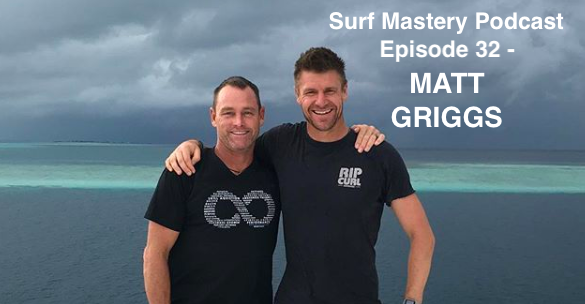
032: MATT GRIGGS - Busting Through Terminal Mediocrity
SHOW NOTES
Do you ever paddle into a wave knowing exactly what you should do—only to repeat the same bad habit again?
In this deep and transformative episode, Michael Frampton reunites with high-performance coach Matt Griggs to unpack why technical knowledge alone isn’t enough to evolve your surfing. Together, they explore how stress, mental distraction, and unconscious habits block progress—and why learning to quiet the mind is the missing piece.
Discover how Kili meditation rewires your awareness to respond better under pressure.
Learn why most surfers plateau and how to finally break the cycle of “terminal mediocrity.”
Uncover how a relaxed mind can unlock more connection, flow, and power in both surfing and life.
Tap play now to learn how calming your mind can radically elevate your surfing—and every other area of your life.
Elite performance coach Matt Griggs teaches us how to break through performance plateaus. In episode 31 - Taylor Knox we touched on the feeling of surfing, in this episode we dive at lot deeper into the 'feeling' of surfing, and how Kelee Meditation can enhance the feeling of surfing, and the quality of your life.
You can hear more from Matt in episodes 03 and 46
https://thenatureofsuccess.com.au
http://www.thekelee.org
https://vimeo.com/239627002
Key Points
Surfing is a metaphor for life, requiring presence and awareness to connect with the wave and avoid defaulting to habits.
Meditation helps develop greater awareness, allowing one to stay present and focused rather than getting caught up in thoughts or distractions.
Relaxing mental energy and letting go of excessive tension or stress is crucial for accessing the best technique and performance.
Self-awareness is the foundation for personal development, as all troubles stem from a lack of understanding oneself.
False beliefs and negative thought patterns can create self-imposed limitations and blocks to growth.
Continuously running experiments and seeking new experiences is essential for refining skills and breaking out of mediocrity.
Developing mental strength through meditation enables greater composure, wisdom, and the ability to let go of fears and distractions.
The goal is to cultivate a state of mind that supports presence, focus, and enjoyment in the present moment.
Outline
Introduction of Matt Griggs
Michael introduces Matt Griggs, a high-performance coach based in Sydney who works with surfers.
Matt previously coached the Rip Curl team, including notable surfers Mick Fanning and Taylor Knox.
This episode follows a previous discussion with Taylor Knox about Kili meditation and its impact on surfing and life.
The podcast aims to delve deeper into the connection between meditation, mindfulness, and surfing performance.
Surfing as a Metaphor for Life
Surfing serves as an excellent metaphor for life, emphasizing the need for presence and connection.
Surfing requires full attention and cannot be done while thinking about other things.
Meeting the wave's energy in the middle is described as having grace or style.
Connecting with the wave is impossible without first connecting with oneself.
A surfer's state of mind directly affects their ability to catch waves and enter a state of flow.
Personal Struggles and Inconsistencies in Surfing
Michael shares their personal struggle with implementing new techniques while surfing, such as looking at the power zone at the bottom of the wave instead of down the line.
They experience inconsistency in skill level, sometimes surprising themselves with improvement and other times feeling less skilled.
There is unease about decision-making in more challenging wave conditions, questioning whether to attempt certain waves or avoid risks.
Mental Blocks and Presence in Surfing
The difference between the best and worst performances of great athletes is minimal.
Most mistakes in surfing stem from mental blocks rather than physical limitations or lack of knowledge.
A common mistake is looking too far ahead while paddling or surfing, which splits attention and reduces presence in the moment.
Being fully present and committed to the current action, whether it's taking off or performing a specific maneuver, is essential.
Kili Meditation and Self-Awareness
Kili meditation is introduced as a tool for developing greater self-awareness and presence.
Meditation helps surfers learn to pay attention, be present, and let go of distracting thoughts.
Relaxation is important in accessing one's best performance.
Meditation can help surfers overcome mental blocks, fears, and excessive tension that interfere with their performance.
Focus and Technique Improvement
Focusing on one aspect of technique at a time is recommended, as multitasking is not effective in surfing.
Surfers should relax and concentrate on the specific element they are trying to improve.
Feeling the motion and not pushing too hard when learning new skills is emphasized.
Lowering mental energy by 20-30% increases the capacity to feel the body and the wave.
Conscious Awareness and Personal Development
Conscious awareness is a key element in surfing and personal development.
Meditation helps develop a closer relationship with one's conscious awareness.
Controlling attention and letting go of disharmonious thoughts is crucial.
Greater self-awareness leads to better connection with the wave and improved surfing performance.
Application of Meditation Skills
Meditation skills learned in a calm environment can be transferred to more challenging situations like surfing.
Developing a stronger relationship with one's conscious awareness can be applied in various life situations.
Staying present and aware during surfing can also improve decision-making in other aspects of life.
Self-awareness is significant in both surfing and life.
Understanding oneself can prevent unnecessary conflicts and improve overall life experiences.
Mindsets for Better Performance
Developing mindsets of care, composure, and wisdom can replace lesser states of mind like frustration and impatience.
Upcoming Trip to the Maldives
An upcoming trip to the Maldives with Taylor Knox will combine surfing, meditation, and personal development.
The trip is an opportunity for surfers to improve their technique while also working on their mental approach to surfing and life.
Learning from a diverse group of successful individuals in a non-competitive, open environment is highlighted.
Transcription
Michael Frampton
Welcome back to the Surf Mastery Podcast. Today's guest is Matt Griggs. Matt Griggs first appeared on the show back in episode four. Matt is a high performance coach working out of Sydney and online. He's the former coach of the Rip Curl team, including Mick Fanning and Taylor Knox. And this episode follows on from the previous one that I just released with Taylor Knox, where we started to get into Kili meditation and how it affected his life and his surfing. And in this episode, we really get into it. So I bring you Matt Griggs. There's a great quote, because I interviewed Michael Javay as well, and he says that for him, surfing is like his testing ground for all this stuff, because he can really test his mindfulness and his awareness in the surf. And usually the consequences, you know, are so what, you miss a wave or you bog a rail. But in life, if you miss those opportunities for awareness and making a better decision, sometimes the repercussions can be a little more serious.
Matt Griggs
What a metaphor for life, just surfing and how it relates to life. You have to be present. You know what I mean? You can't sort of start thinking about else at the same time. You need to do a duck dive or you might mistime it. You can't have your thoughts too far ahead of yourself. You've got to go with the pace of the wave. You can't run over the top of it with too much energy. I would look at that as having grace or style where you meet the wave's energy in the middle. You don't run over the top of it or you don't use too little energy where the wave kind of makes you look weak. So it forces you to connect. You cannot connect to the wave or the ocean unless you're connected to yourself. I think every surfer will kind of know that. If you're not in a good state of mind, the waves don't seem to come. Not just in terms of wave selection, but get your mind into a state of flow and you're in a good state of mind. Your surfing should go into a state of flow as well.
Michael Frampton
Sometimes I feel like time slows down and I have time to sort of cut a bad habit off and try and re-implement a new technique. Like I got a bad habit of when I'm paddling into a wave of just looking down the line. And sometimes I just I don't even realize I'm doing it until the wave's finished and I look back in hindsight and I should have done that. Whereas sometimes I'm paddling into a wave and time slows down and I look down, okay, where's the power zone at the bottom of the wave and I'm implementing that new technique. But there's a big inconsistency there. There's a big inconsistency of my skill level as well. Sometimes I'll go out and I'll surprise myself with how much I've learned and improved in my surfing. But then sometimes I'll feel like a kook almost. And that makes me feel a little bit uneasy, especially if the waves are sort of turning on and I'm unsure of whether I'm, damn, should I go for that wave or am I just putting myself at risk? So that's where I'm at with my surfing. It's sort of, so if you were to be my coach in this situation, how would we go from that?
Matt Griggs
Yeah, let's help you and in the process try and help many others as well because that's quite a common problem. First of all, you'll see that with the greats, it doesn't matter in what sport that the difference between their best and their worst performance isn't much. A bad day still looks very good. So then we've got to go, okay, where is the holes coming from? You know what I mean? Where are the mistakes creeping in? It can be anything. It can be, you know, you're trying something that you don't know as well as you could have. You haven't been taught the technique properly. You might have a physical limitation, which I doubt. Most of the time it's a mental block because as you said, you're paddling into the wave and you're looking too far down the line. This is one of the most common mistakes I see, whether it's paddling in or whether it's when you're actually surfing, is someone's attention goes too far ahead of themselves. And what happens then is your attention becomes split between where you are and what you're looking at. So if you split your attention, half of your presence is somewhere else, half of your presence is where you are. You're not present in the turn and therefore you cannot be fully committed to where you are, whether it's the takeoff. I've seen plenty of people try to get under a ledge and, you know, try to pull into a barrel off the takeoff and their attention is too far ahead of themselves and they're not paying attention to what they need to be doing right here, right now. And therefore that block interferes with the technical process and they fall. And this is just one of the, you know, I think it needs to be rule number one. Rule number one, if you're going to improve at something, whether it's, you know, taking off under a barrel, whether it's anything in life, rule number one, I think needs to be learn how to pay attention and learn how to be present. That's whether you're, you know, learning how to stand up for the first time or whether you're taking off at Wyomere Bay to be fully present in the moment. Or if you're on the world tour and you're putting all your attention into one turn at a time. Why is it that something so simple as just being completely present in the moment seems to be the hardest thing to do? So I think before we go down the road of technique and things like that, first we need to address some of those blocks because if your attention is distracted, then you just quite simply you won't access the best of your technique.
Michael Frampton
So where do we start? I don't even... it's such a heady topic. It's like, yeah, I don't know where to... please continue.
Matt Griggs
No worries. Okay, you said it when you said heady. So what you want to make sure is, you know, you're getting all this information, you know, and I'm sure there's been points where there's just been overload. And for all the listeners too, you know, by the end of this particular podcast, there may be an overload too. So my advice is to write some of these things down, you know, and just capture some of the themes or the points that are really interesting to you and that you feel like you want to put into practice. And just know you can only practice one thing at a time. You cannot multitask, particularly with surfing. Like, what does it feel like when you do a bottom turn and you've got two things in your mind? You just... you won't commit to the one turn. So we've got to learn to be present. And there's so many different ways to do that. Of course, like I'm a big believer in meditation, and that's why that's at the heart of what I teach and all my coaching work is teaching people how to meditate, teaching people how to be more present, teaching people how to let go of distracting thoughts, and just not being too heady. It's just, it's so common, Mike. You know, I see the young kids sometimes that I coach too, they know what they need to practice. And when they're paddling back out the back, they're relaxed and it's on their mind, yeah, I know I need to, you know, lift my left arm more, my backhand bottom turn or whatever it is, get my chest to the target more. And then as soon as they take off, they default, and they go straight back to what they've already practiced. And this is one of the most important things for any coach or any, you know, aspiring performer. In any sport, to understand is you know, I think Boris Becker coined it great years ago when he said you don't default to your wishes, you default to your habits. The reason that you default to your habits is you get into slightly stressed mode. As soon as you get into a wave, and your energy rises too high, and I think you and your listeners will probably know what I'm talking about, when there's too much energy, and sometimes the energy might just be excitement. And that's positive, of course, who doesn't like excitement. But when there's too much excitement, your energy goes defaults into the intellect, and you just trigger programs and you go back to how you normally surf. So what we need to do is to learn how to calm the mind and access what it is that we're trying to do, which is a new experience. Because remember, the new experience isn't in your head. In your head is all the old ones. That's all your memories and all the programs that you know, you've developed over the years, because that's how the brain works. It's like an organic computer full of programs. So we want to start deleting programs that don't work or refining the ones that do, i.e. making them better. And you know, one of the things I've been talking about lately, I'm sure you probably have a giggle at this. There are many people that I've seen that have surfed for a very long time, and they reached this point where you would call a terminal mediocrity. They just don't get better. Isn't that in life too? A lot of the time where people tend to get good enough and then they kind of just pause there and I don't know, they either don't push their limits anymore or they're just not learning anything new. So we can address that a little bit later. But back to the original question, we need to learn to detach from stress. We need to learn to enjoy the wave, not stress your way through it, not get into overexcitement or any kind of tension, because then you'll just default to habits, the very thing that you're actually trying to improve. Simply explain, just relax. Try to relax as much as you can. That is when you'll access your best. When the mind is completely relaxed, you'll have more access to feeling, because we feel balance, you'll have more access to connecting to the wave and your head just won't get in the way. I think every surfer knows when you finish a really good wave, you weren't thinking at all, you were just in the flow, in the zone.
Michael Frampton
You're sitting at the back, you're feeling calm and relaxed. You feel like the next wave you catch, you're going to be able to have plenty of awareness. Time's not going to speed up. You're going to stay calm. But then all of a sudden, this wave rears up and next thing you know, you've caught the wave and you've gone back into your same habit. So whereabouts is that opportunity? Do we need to have a more relaxed awareness around that time between when we decide to paddle for a wave and we take off? Can we break it down into something smaller that we can think about and talk about more? Is that the time window we're talking about?
Matt Griggs
Yeah, absolutely. If you, I don't know, let's just pick a turn. Tell me a turn you're having trouble with at the moment that you intellectually know the answer, but you just haven't been able to put it together yet.
Michael Frampton
I've been working a lot on the bottom turn.
Matt Griggs
Yep. And what do you feel like the problem is or what's the block?
Michael Frampton
Yeah, like you said, the excitement of like, OMG, I'm on a wave. Like, you know, like that preciousness of a wave and it's sort of, sometimes I won't be to my second bottom turn. And sort of, I've gotten over that excitement and that. But then I realized, I've just reinforced the bad habit of in the first bottom turn.
Matt Griggs
Yes. Yeah, you become aware.
Michael Frampton
Too late though.
Matt Griggs
Yeah, too late. That's why, you know, if you're on a longer wave, usually by the second or third turn, you're starting to get into the zone a little bit more. Why? Because you start to come down and you start to become more aware of how you're feeling on the wave. So again, it'll help to sort of have an understanding of how the mind works to really paint a picture here. But when, like I said, when there's too much energy, you'll default into brain function and you'll just trigger these automatic programs. Like yesterday, I was showing people on this particular subject of the bottom turn, you know, who they just tend to put their bottom turn in the same spot all the time. And what we need to do is we, if you're going to have a different top turn, you need to adjust where you put your bottom turn. For example, floaters, barrels, aerials, you'll do a very shallow bottom turn. But if you want to go vertical, you need to deepen it just to give yourself room to come up vertical. But as soon as you take off, you just follow the patterns that are so ingrained in you because for so long, you've been practicing a certain way. And that means this program that's in you is just so strong that it's hard to beat. It'll overrun you. So as Boris Becker says, you don't default to your wishes, which is to do a better bottom turn, you default to your habits. Why the habits are so strong, you've trained them. Good or bad, you've trained them. That's why it's so interesting and so important in the beginning of somebody's development to help them where they don't develop bad habits because the bad habits tend to be so hard to break compared to teaching someone a new skill, which I find a bit easier. So what you need to learn to do is just to be as relaxed as possible. And just you know in your mind that, you know, let's just say you're trying to get lower to initiate the bottom turn or you're trying to get deeper or you're, I don't know, whatever it is you're trying to do. Many different things to talk about when it comes to the bottom turn. That's the only thing you want to have on your mind. And you want to be calm about it. As soon as there's too much energy, you default to your programming. So you want to be as calm as possible. And then you'll access awareness, the awareness that you don't have until second or third turn. But who has the luxury of some of these long waves where you know, you have that long to figure yourself out. Most of us have beach breaks that are, you know, closing out and you've got to get it right straight away. And in this limited time window, you know, like you're in a surf for two hours and you're probably only riding waves for two minutes of those two hours. In these tiny little windows, you've got to step up. And if you put pressure on yourself, you'll step down. If you have tension, you'll step down. And the step down is just, you'll default to your habits. You'll surf the way you've always surfed. So the most important times is when you're actually on the wave, of course. The same as, you know, when I'm coaching the competitors on the world tour, you know, Mick, we always used to say the most important decisions you'll ever make when you're actually in a heat, that's when you need to be at your calmest. So if you can just go into the wave feeling calm and just knowing, you know what I mean, what it is that you're trying to do and being calm about that and being aware about that, you'll initiate it. And then you'll get an experience and the experience might be, whoa, that worked, that felt really good. Or it might be, yeah, that worked, but it kind of threw my timing off or it threw my top turn off a little bit. Every time you have a new experience, or any experience, it's giving you material. And I feel like we're all little mini scientists, you know, we have a hypothesis, whether it's coming from you or a coach saying, if you try this, your bottom turn will get better. You've got to run the experiment. Unless you run the experiment, you just get in your head and you're thinking about it without actually experiencing the improvement. You run the experiment and then you got some material. Yes, this works, this doesn't work. And that's really the art of developing is you've got to constantly run experiments and go into new territory of behavior and go into new territory of technique where you're trying something new and you're constantly refining your game and improving. And too, you know, you talked about having, you're in danger of just having too much intellectual knowledge because you're learning so much and you're having, you know, talked to so many people that have a vast array of knowledge. You need time to put this into experience. You need time to put this into practice. And you may never even get there, you know, in a decade with all the intellectual stuff you've learned. So really, it's about finding what are the things that I really want to work on that I want to get better at, whether it's in life or in this case surfing and just practicing something and then having a system of feedback, whether it's someone else watching you or whether it's your own feeling because the way, you know, whatever you try, you'll get a result from and having a system of feedback where you can look at that and go, wow, I can see how that works. And now we've got a new program to build on and to keep refining a better one.
Michael Frampton
Okay, so it's not just about having no thoughts. It's about focusing on one thing in terms of, you know, when you're in the water.
Matt Griggs
Yes. That's a really, I mean, tricky conversation, isn't it? Because you want to focus on one thing that helps, not that blocks, because the wave is this dynamic thing that's constantly changing and you're having to react to what's in front of you. And, you know, unless you're at Kelly's Wave Pool, it's not a predictable environment. You know, like it wasn't that interesting thing to watch because you, as a coach, I'm looking at that going, well, this is the first time that you could like snowboarding or, you know, like a half pipe, you can actually develop a routine. But most of the time you don't get that luxury. You've got to react to what's in front of you. Yes. So you just, you want to relax and just focus on the one thought of what it is that you're trying to improve. And that will be the best way forward. Because you can feel one thing, you know, we don't want to get into our head, you'll break flow. We want to get into the mind and just feel. And you can feel one thing at a time. So just pick one thing and focus on how it feels and feel your way through it. And then you'll develop a closer awareness of what's going on between, you know, your board and the wave.
Michael Frampton
I'm not just focusing on something logical as in put my surfboard here on the wave and looking to do that. I'm looking to, I'm looking for a bottom turn that feels more efficient, that feels faster.
Matt Griggs
Yeah. Again, if like you want to use the language of feeling as much as possible. So if you... Do you absolutely.
Michael Frampton
Use that, do you use that when you coach as well, the language of feeling? Yes.
Matt Griggs
Absolutely. Even so, where I'll, if I'm teaching a movement, like say a rap, like a big carve, at some point of the rap, if it's going to be really big on your forehand, you've got to open up your body. So I'll get them to actually do that on the beach and feel it. If they just think about it, doesn't really help. You've got to know the feeling. And sometimes too, you know, if you're learning something new, just slow it up a little bit. Don't try so hard because trying hard, you tend to get in your own way. And like I said earlier, when you have too much energy, you default back to your habits. This is in surfing, golf, anything. So if you're trying something new, my advice would be is to lower your energy by about 20%, maybe even up to 30%, and just feel the motion. Just feel in the simplicity of what it is that you're trying to do, whether it's the rap of opening up your body, whether it's the crouching down to start the bottom turn and lifting the body up into the bottom turn. Just get a feel for that. And don't push it so hard because if you push it hard, you may push in the wrong direction. And if you use too much energy, you'll probably default back to your habits, which is that frustration that everyone seems to have when they know what they need to work on, but they keep surfing the wave exactly the same as they used to.
Michael Frampton
As soon as you say, you know, dumb down the energy 20 to 30%, the objection comes into my mind of, well, it kind of feels like that would slow me down.
Matt Griggs
Yeah, well I'm talking, obviously we're not dumbing down, we're just relaxing your energy a little bit. Like I said earlier, when your energy is relaxed, your capacity to feel is greatly increased because you want to be able to feel the body and feel the wave. So it's not dumbing it down, it's just relaxing your energy. And I think everyone will, if they flick off a wave and if I say, okay, so what was your energy mentally, not physically, because physically you want to go fast, but mentally you want to learn to relax and have finesse. Finesse is the ultimate form of power and where you access the ultimate form of movement. You want to have most of the time less energy. Most people just surf with too much mental energy and that leads to rushing, leads to mistakes and leads to triggering old programming instead of practicing the new ones. So I would relax your energy and you know your surfing better than anyone, so just know to yourself, okay, I know I need to just relax it by about 10%, my mental energy. Just relax it a little bit, not dumb it down, just relax it where I'm really in.
Michael Frampton
I'm not sure what that means, what does it feel like to relax one's mental energy?
Matt Griggs
Have you ever seen someone in a meeting, you know, or when they're just nervous or they're trying so hard and they're just using too much energy? Or have you seen someone in a wave where they're doing the same thing, they're using too much energy and when they're doing it, what will happen on a wave if you're rushing, because that's usually the byproduct of using too much energy. You'll end up surfing in the middle of the wave and you'll just bolt out to the face because you're rushing. The best surfing is top to bottom, so you need to be able to relax to be able to do that as well, to go straight down, straight up. And this is why, you know, the understanding of the mind is so important because so many mistakes are just, they're mental mistakes, they're not actually technical ones. I can say to someone, you need to deepen your bottom turn to get more vertical, but they just rush so much, which is a mental thing, that they just bolt out to the face and this becomes the program that's hard to break for them. So all these things need to be coupled with some proper mental training, otherwise I'm just going to keep having questions like the one you're asking, like how do I do that? How do I relax? How do I know the difference between thinking and feeling? We need a foundation of understanding, which is, that's where the basic principles of the Kili come in, where you can have a simple understanding of how the brain and all its programs work versus the mind and the subtle energy of feeling and instinct. It ultimately just feels like connection because if you raise your energy, the energy tends to block, it forms as resistance or a block between you and the wave. When your energy is at its most relaxed, there'll be a connection between you, the board and the wave and then you'll ultimately feel connected to your best, connected to the wave, i.e. you read it really well, like you flow with it and it'll just be a feeling of, I got that right. Everyone loves that feeling, right? When you pull off a wave and I got that right, you're just right there in the zone.
Michael Frampton
Having less mental energy, does that mean that you're less aware of your thoughts and more aware of your feeling? Yes. Okay. So then all of a sudden, all of the sensory awareness from the way your board feels, the way your body feels, becomes louder than all of the thoughts about the future and the past going on in your upper brain. Does that make sense?
Matt Griggs
Absolutely. Yeah. The more relaxed you are, the more connected you are. I think everyone knows that you're at your best when you're the most relaxed. So what we need is some mental training and some understanding of how can I understand where I'm focusing from or attention itself and being in control of when I need to up it and when I need to just drop it a little bit. Because there'll be some times where you can use more energy like a layback. And because a layback is not a very technical turn, it's just a bit more brute force, you can use more energy. But if you're going to do something really technical, like a whitewash climb or something like that, it requires a bit more feeling and a bit more touch. That's when we need to be able to not only respond on a physical level to up the power or to crouch and extend and rotate and all those sort of things, but to adjust your mental energy. Again, I kind of know I'm talking about very abstract things here, so please ask questions where you need to because it's unfortunately a very unexplored territory. And to me, it's the biggest part of performance, let alone happiness and health, is the state of mind and being in control of your state of mind where you're not being ruled by outside things, you're not distracted, you're not surfing with anxiety, you're not surfing with stress, you're not surfing with fear, you're just surfing with awareness. And that awareness, as you alluded to, is a feeling, it's not a thinking, it's a feeling.
Michael Frampton
I guess where the confusion for me is, like, you know, most meditation practices, it's all about doing it in a calm place. But how is it that... Let me question this, right. If we learn something about ourselves and our own minds during meditation in a calm, safe place, how does that skill transfer into a potentially unsafe and unique, special place, i.e., paddling into a wave?
Matt Griggs
Yeah, great question. Let me explain. So you're right, when you are meditating, you're typically in a safe place. But there's two points to everything in life. There's what you're focused on, you know, in this case where my focus was your question, or when you're surfing, your focus is a point on the wave. And then there's where you're focused from. So when we meditate, it's supposed to be an inactive being process, and this is, first of all, where a lot of other techniques, they're not necessarily meditation techniques, they're concentration techniques, where you actively focus on a second point, whether it be the breath, or whether it be a mantra, or whatever it is. So you don't actually develop a relationship with your conscious awareness. It's your conscious awareness that... That's just a term to describe how aware you are, in this case, let's say, on a wave. So as you start to play around with Keely meditation, and the conscious awareness is one of the first principles, you start to develop a closer relationship with your conscious awareness. That means you understand and you can sense where your attention is, and not only where it is, but how it is. So now you're in control of your attention, you can put it where you want to put it, you're not surfing distracted, you're not surfing from fear, because that continues as well. There's many other basic principles that go along with this, where you learn to understand the difference between the brain and the mind, thinking versus feeling, and how you can let go of disharmonious thoughts, which is really the whole point of meditation in the first place, is to let go of disharmonious thoughts and open up to greater awareness. And you look at the greatest surfers, they just have an awareness, you know, that's hard to describe, an awareness of knowing where they are in the ocean, an awareness of knowing where they are in a wave. This is so important to couple with your technical and physical and tactical development, is to have greater self-awareness and greater awareness of your outside environment, the second point I was talking about. And then you can dance with the wave instead of running over the top of it. You can connect to it instead of having too many thoughts or too much impatience or too much stress or too much thinking get in the way. Strong mind, not just a strong body.
Michael Frampton
So meditation is making this single point of consciousness and awareness more obvious?
Matt Griggs
Yes.
Michael Frampton
You're practicing not to attach that point or that awareness to anything that's not important or a bad habit? Yeah, okay, so if we relate it back to paddling into a wave, just as kind of a thought experiment, sitting out the back, through my meditation practice I've become more aware of my single point of consciousness and my awareness, the way my body feels, the way the water feels is louder than my self-talk.
Matt Griggs
That's right. That's right.
Michael Frampton
And then as that wave comes, I'm trying to not let the fear and anxiety of that preciousness of the wave override that single feeling.
Matt Griggs
Yeah, that feeling of awareness, exactly. Because you'll see that wave and you'll know it.
Michael Frampton
So it's really important to learn where this point of consciousness and awareness is in a safe place because it's the loudest then. And then that skill can be transferred into your sport.
Matt Griggs
Absolutely, yes.
Michael Frampton
It makes sense.
Matt Griggs
Yeah, I think everyone will realize that their biggest influence on their life and their surfing is their state of mind. And for anyone that wants to do further study, we can go where you want with the conversation. They can just get online and buy some of the Keely books and do further study on the basic principles and how to actually do it. Even the lesson of wave selection, Mike, you know, I don't think a good surfer really needs a lesson in what a good wave looks like. What they really need is patience. What they really need is the mental strength to let that first wave go that every single other sheep is going for. Have you noticed that? Everyone seems to want that first wave. They're set, they jump, they rush. I better go this one. They're coming from a place of fear or anxiety instead of just relaxing and knowing if they're really paying attention to their life experience that the first wave of the set is very rarely the best one. So you relax and you're comfortable within yourself to let this wave go, even though it might be a good wave. And then you see it, the one behind it. You were just relaxed and you stayed with that knowing. You didn't freak out. There wasn't a block between your perception and the actual action.
Michael Frampton
But then obviously thoughts of missed opportunities come into play.
Matt Griggs
Yeah, fear of failure, fear of making a mistake. I mean, I know you're going to interview Taylorson, Noxy, and that was a thing that drove his career negatively for a little while was a fear of making mistakes. He actually attracted the mistakes because he feared making them. Through the process of doing this meditation, he largely lost all those fears and came home so strong in the back end of his career. So we've got to look at what's the driving force. And of course, you know, if I say, so why do you surf, Mike? You're going to say something like, I love it. You know, I love the feeling of being on a wave. And so then my next question will be, well, are you really feeling it when you're on the wave or are you surfing with tension? Are you flicking off and going man, I should have done this. I should have done that. So your ability to relax and actually enjoy the experience of the wave and surf from that place of love and surf from that place of presence and awareness will not only increase your enjoyment, but it'll obviously increase your improvement as well. We're jumping in the deep end, Mike. We're moving into abstract territory, which is good.
Michael Frampton
Yeah. Like you said before, intellectually and technically, I've got, you know, I've got so many tips and tricks and techniques in my brain. It's, I guess, like you were saying before, I've got to choose one of them and really just focus on that. But more importantly, I have to have the awareness to not let those bad habits and those fears become louder than my awareness point and what I'm focusing on. And meditation is the, it sounds like you're basically saying meditation is the, I guess not the only way, but it's certainly a proven way.
Matt Griggs
It's absolutely. I mean, from meditation, you get a calmer state of mind, you get more awareness, you get less stress, greater energy, you know, returning to the immune and the nervous system. And you certainly can't get that from a pill. So it's a pretty important thing. Yeah, meditation is not the only way, but it's certainly a way to develop greater mental strength. The way I see it, how you get stronger in the physical body is via resistance training. You know, you push things around and, you know, whether it's your own body weight or weights and stuff like that, and you get physically stronger. Strength in the mind is your ability to let things go. So your ability to let go of any fears, which is, you know, the biggest block to performance, your ability to let go of excessive tension or nerves or doubt. In my session yesterday, I ran with a bunch of kids. I said, so do you feel like you do your best surfing in front of me? And they all just laughed at each other and went, never. I had the best surf yesterday and God, I don't know what it is. I said, well, let’s look at that. You know, what is it? I said, maybe I just put too much pressure on myself. And the next kid said, I just, I don't know, I surfed good yesterday and I was trying to repeat that, but the waves were different today. So these are all mental things. They're putting pressure on themselves. They're trying to repeat a performance that was, you know, they're aware of some of their blocks. They were saying, you know, when I'm surfing by myself, I always seem to be, you know, at my best. I surf good. And I said, well, what does it feel like when you're by yourself? I don't know. I just, I guess I feel more free. So what happens when you're surfing in front of me? You know, it's not like you've all of a sudden become a worse surfer. You've just started to put pressure on yourself or try to be more than, or you've raised your energy to try to be better than you feel. And all of a sudden we get all these blocks. The technique in surfing is really just the relationship between you, the board and the wave. And that's where your attention needs to be. But if you have a mind that is easy to feel or easy to go to stress or self-doubt or putting pressure on yourself or whatever it is, then all of a sudden we have a block to performance. So that's why I feel it's just so important, you know, to have a way to improve technically where you can understand how to improve the movement of your body and its relationship to the wave. And, you know, get in the gym and move your body around in a way that makes you a better surfer, but get in the mental gym, do some meditation where you become more fearless and you become more aware. And that to me is the greatest mental attributes is greater awareness and less fear.
Michael Frampton
You know, the ocean is not just the playground. It's the testing ground for some of this stuff, something Michael Gervais said to me. And, you know, that thought has stuck with me a lot. And especially recently when I'm now just sort of, you know, really coming to terms with and understanding that, you know what, it's not just my technique and my equipment that I need to work on. I've got to work on the ability to use this information and to grow as a person. And that's not just in surfing. It's in other aspects of my life, like in a relationship, like how am I going to react to my partner when she says this? I learned it. I read a book and they said do this. But the next time it happens, you find yourself caught up in your own anger. And so again, you realize you've missed an opportunity to implement a better relationship strategy, but you didn't have the awareness to change it in that moment. So again, it comes back to that awareness and other aspects of your life, whether that's time management or financial management. So we're talking about something pretty important.
Matt Griggs
Yeah. And that's where I like to go with my sessions these days. I've had the luxury of, I guess, having a lot of good people come into my world that I've helped and that I've worked with. And these days, I'm so big on this. If it doesn't relate to your life getting better, then why do we do it? And we're so fortunate to have something as amazing as surfing that absolutely makes our life better on so many angles. Because like you say, if we didn't surf, would we take as good care of our body as we do? Probably not. I'm 41 now and I just take good care of myself. I want to be surfing with my kids and taking off under the ledge of Voodoo when I'm 50 and 60. Unless I trained and unless I took care of myself on a nutritional level and unless I did all these things, I wouldn't get there. So it becomes a great motivating factor to keep healthy, is to stay in the ocean because we get so much joy from it. And if you have any anger in the surf, I'm sure it's going to turn up in other places of your life too. So it's really just another, you know, what you bring to the world, you bring from within. If you have awareness, you'll bring that to the surf, you'll bring that to your relationships, your children, your work. If you have ego or anger or self-doubt, you'll bring that as well. So there has to be two-pointed learning all the time. Learn about your outside environment, you know, learn about the ocean, learn about equipment, learn about people, learn about things. But then learn about yourself as well, because if there's no self-awareness, we're starting from a very poor foundation. To me, self-awareness needs to be the foundation for any, you know, development because all trouble comes from not understanding yourself.
Michael Frampton
All trouble comes from not understanding yourself.
Matt Griggs
Yes.
Michael Frampton
Can you give me an example of trouble?
Matt Griggs
Yes, anger, frustration. And, you know, there's a Buddha that says all suffering is self-created. We create stuff, you know, and this is again where the intellect can interfere because while the brain is amazing at solving problems like one plus one, it can be amazing at creating problems. If I say to you right now, how many problems has your brain solved and how many problems has your brain created? You'd probably have a little giggle and go, yeah, probably 50-50. So we, you hear what I'm saying? So we want to be in a place where you're not creating any undue trouble, where you're not creating fear. Because the only real fear is when you're actually in physical danger, yet people live in fear and stress constantly. And this is just robbing their energy and their immune system, you know, of so much life force energy and compromising their health. And, you know, we've got this epidemic of autoimmune disorders and stuff like that to make all because of a mental level. So if you create, you know, conceptualize something like I'm not good enough or I'm not going to be good at this or, you know, I've never been a big wave surfer, so I'm never going to be. You can just create a block and you'll never experience, you know, something magical like a big wave because you've made an agreement, a belief system within your own mind that you'll never do that. And belief systems are very powerful. So be very careful of what you create.
Michael Frampton
OK, so when you say misunderstanding, that's you're talking about like false beliefs?
Matt Griggs
Yes, exactly. Yes. But keep in mind, too, you can't just... Surfing is so damn difficult. You can't just... I mean, someone can go on a golf course and pick up a club and hit a ball and they might just fluke a hit down the middle, you know, with no training. But I doubt they could keep that up. You can't just wax up a 9-0 and paddle out Sunset, you know what I mean, and take off on a wave. It requires a lot of training and a lot of practice. So it's very difficult to be good at something the first time. But we live in a very, unfortunately, a very judgmental world where people are self-critical, other people are critical on them. And if you try something and someone, you know, is critical or laughs at you or something, all of a sudden someone makes an agreement in their own mind that they're not good at that or that they've got a bad style or, you know, that they'll never be good at surfing. And this can just haunt them their whole life. And all of a sudden they're not thinking big and they suffer from that terrible affliction of terminal mediocrity because they just couldn't see themselves getting better than their current vista. So we need to open the mind to see what's possible. We need to understand what's possible in our development. And then we need to be fearless in our pursuit of putting it into action and never feel bad. If something's not working, try not to turn on yourself with negative energy and feel bad about it, which is a very common thing I see in the young ones that I coach too. They feel bad if they make a mistake. They feel bad if they, you know, lose a heat or if they, you know, it's all just life experience. And all we want to do is to understand and learn from the experiences that we're having. And based on that material that the life experience is giving us, we should learn something. And based on that learning, you've got something else to try. And you have new actions. And this is how we develop and bust out of that terminal mediocrity and keep improving.
Michael Frampton
How do we identify the main, our main blocks?
Matt Griggs
Calm your mind right now, Mike, and just think of a time when, I don't know, you weren't bringing your best or you know that you were getting in your own way in some kind of capacity. And what is it that comes to mind?
Michael Frampton
Yes, straight away today. I was just, I mean, I think in terms of surfing, I was slow on a wave and I realized that basically it was, you know, it was just a small wave and it didn't demand a lot of focus. And then I realized I was focusing on my job list for the day.
Matt Griggs
So it became a block, right? And now you're, let's say you gave, I don't know, 40% of your attention to your job list for the day and 60% to the wave. You've just spread your attention out, you know, or you've split it. It's fragmented between two things. So you're not bringing as much energy to the equation, hence you're going slower. So that's just a bit of brain chatter getting in the way, you know, where mindless thoughts are interfering with present day living. And we go back to the example of surfing, such a beautiful metaphor for life. If that's happening in surfing, I'm sure that's happening in your life where you're in one place, but you're constantly thinking about another. So again, we're going to develop ourselves personally and professionally, no matter what your craft is. Even if we look at this beyond surfing, because I do so much work in the corporate space now, we need to learn presence and we need to learn to pay attention and to be in the moment. And this is just a, I hope it doesn't sound woo-woo to people, you know, like the old be present thing, but that's the flow. And we want a place where we're in the moment. We're not, you know, mindlessly drifting away from it because of brain chatter or because of fear or doubt. You're just relaxed in each moment and that's living your life. And that's just a, that's when you're connected. If you're thinking about a to-do list, you're disconnected, you know, to a degree and that compromises performance. So while we have to always have, you know, on the outside protocols or, you know, behaviors that up your skill, it's really two things. It's behaviors and state of mind, you know, is to develop better behaviors and to develop a strong state of mind that can support that where you are present and you are focused. And you're having a good time. Your mind is wide open and you're right there. Like, I mean, I'm sure there's been times you've been out the back and you've seen a pod of dolphins and other people don't even see it because they're thinking about work that day. And a beautiful life experience has just gone by and they didn't even see it. You know, this is a constant thing because if I reference just some of the basic principles of the Kili, at eye level is the surface of your mind, which becomes a reception point. Like if I say pay attention to where you're, you know, where you think about things or where you make decisions, it's just at eye level. This is the surface of the mind. So this is a point of reception for incoming information, you know, via the physical senses, three-dimensional shapes and movement and, you know, sights and sounds and things like that. But the abstract nature of emotion and ideas that seem to come out of nowhere. Everyone will be familiar with being in the shower or going for a walk along the beach or going just driving or running and you're not thinking about anything. And all of a sudden an amazing idea comes to mind. So if we can get thinking out of the way and just get your mind into a place where it's open to receive life, you just don't miss as much stuff. And life is amazing. People just missing it all because they're just looping through their head and they're not really paying attention.
Michael Frampton
Yeah, I can relate to that. The other day when I was at the beach and I was just about to suit up and go surfing and then I got a phone call. And it turned out to be quite an important phone call that I kind of messed up because I was looking at the waves and I was surfing the waves while I was talking on the phone. And then I wasn't able to have an on-to-it conversation with the person and I kind of missed an opportunity sadly because I wasn't present. I was thinking about my surf, which was in the future. And then when I was, then I went surfing afterwards and then the whole time I'm in the water, I'm thinking about damn, I really messed up that phone call. So it was like, I was my own worst enemy on two levels there.
Matt Griggs
Without training, your awareness drifts. It drifts towards thoughts that aren't important right now. It drifts towards anything because people are just so easily distracted. Like a big thing in the world is absenteeism. I mean, God, just think of your work day, you know, and you're there for, let's say, eight hours or whatever it is. And how much of that time are you completely present and in the moment?
Michael Frampton
Yeah. Most people, including myself, it's not enough.
Matt Griggs
Yeah. So now we're wondering why meditation is so important because you train yourself to be more consciously aware and to be present. So that now you can enjoy the experience of life. Now you cannot miss anything, including opportunities like the one that came your way. Because sometimes opportunities come in a very subtle way where you need to be really aware to see them. You need to be really receptive. So with the training of Kili meditation, you train yourself to be very consciously aware and very receptive and to not panic, to not stress, to stay grounded and to stay centered. As you're living the experience of life. And it's not to say that you're not having fun because you've got a big smile on your face and you're just open and just you're living, you know, and you're not stuck in the measurement of it. And who's watching? And I used to get stuck in that when I was a bit younger. You know, like when I was first starting to compete where I just, I think when we're young, we all need attention. You know, it's part of, without it, you wouldn't survive in the beginning. But as you start to become independent and you start to detach from that, it becomes a very personal and a very private experience that your relationship with the ocean. It's not about who's watching you. It's not about, like in my days of being a professional surfer. You're sort of doing it for a second point. You're doing it for sponsors or people. And it can become very confusing. And then all of a sudden, whether you're a professional or not, I think it's a lot better just to have this personal connection where it's just you, the board and the wave. And there's no interference to that. And you'll get the most out of your developability. And you'll get the most out of your enjoyment as well.
Michael Frampton
Yeah. Let's say one becomes more aware and more able to detach from fear in surfing. And it's obviously always going to be somewhat of a work in progress, I guess. You can always get better at that. But I'm guessing it gets easier if you do that in all aspects of your life. Because if you're doing it at work and you're making better work decisions and better relationship decisions, then when you're surfing, you're less likely for any sort of worry or fear in your work or your relationships to enter your mind when you're surfing. So it kind of has a knock-on effect.
Matt Griggs
Yeah, absolutely. It does. Yeah. Keep in mind we're talking about self-awareness here. There's learning about outside things, people, places and things. And then there's learning about yourself. Some people can get angry and they don't even know it. And they vent at someone or they just say something really inconsiderate. And now we've got a problem. But if you were aware that you had some anger inside and you had enough self-control to not talk with that or move with that, you've just saved yourself some unnecessary karma and you can control your mind and relax it and then engage in the life experience when you've actually got something good to say, rather than just venting all the time with opinions and with heat. You know what I mean? Frustration and whatever else. Because the world needs to evolve right now, doesn't it, Mike? The mind precedes everything. Because if you're going to become a better surfer, you need to care about your surfing. If you're going to improve your health, first you need to care about your health. If you're going to improve your relationship with your wife or your kids or even your work, first you need to care. So you develop these mental mindsets of care and of composure and of wisdom. And that replaces the lesser states of mind which tend to rule people without enough training, which is frustration and impatience and anger and distractions and things like that. Like anything in life, there's what helps you and what doesn't. And our pathway is to know the difference. And this is not just on a technical level, like knowing that a certain technique won't go anywhere. And on a mental level, knowing that anger is not going to take you too far.
Michael Frampton
Yeah.
Matt Griggs
Wow. We're in the deep end, Mike.
Michael Frampton
Yeah. That's awesome. I'm certainly inspired to pick up my meditation more now, that's for sure.
Matt Griggs
Let's learn to swim in the depth and to enjoy the whole range of the life experience. To open our mind to experience more of not only the ocean, more of not only our bodies in terms of technique or physical health, but more of our mind in terms of mental health. And just not living with stress and not living with impatience or whatever else it is. And just being another caring, kind, considerate, compassionate dude in the world that is helping the world and is helping people. That to me is a beautiful thing because you're improving on all levels. With who you are as a person and what you're bringing to the world. And what you're doing with your skill and knowledge, whether it's to do with surfing or whatever else your craft is in your line of work or other things that you like doing.
Michael Frampton
My head's kind of spinning at the moment. Let me leave the listeners with one. I don't know if you guys or you or the listeners listened to Tim Ferriss at all. He said one thing that almost all of his guests have in common is that they meditate. I thought that was interesting.
Matt Griggs
Yeah, and it's cool that we live in a world now where people are open to talk about it. Because I've heard other podcasters like him or like Dave Asprey doing big corporate events with 50 odd people that are high-flying CEOs. And you'll ask a question, so who in here meditates? And every single hand goes up. And then you'll say, so who talks about it openly? And maybe only 20 to 30 percent go up. It's because it was met with ridicule. I know I certainly was met with a little bit of ridicule when I started talking about the mind. I was met with ridicule when I started talking about physical health 15 years ago. Everyone thought, don't you just surf? Isn't that how you get physically fit? But there's resistance in people. In time and on time, everyone develops. And without mental training, meditation's been around for an extremely long time. Spiritual counsel's been around for an extremely long time. Every ancient culture, every society had an elder, a wise counsel, so to speak, that would always educate or always give wise counsel on things that really matter. And all of a sudden, that's been replaced with things like religion and politics, which are, I don't know, there's a lot of knowledge there, but not necessarily a lot of wisdom. So to me, it's encouraging that the guys like Tim, who have a lot of pull, are actually talking about this now and saying, hey, you know what? The most elite minds in the world meditate, and they have been for a very long time. And there's a reason why they do that. There's a reason why they're developing. And hey, maybe you should look into it. But no pressure. Do what you want to do. And you know, you're where you're at because of you. So, you know, take responsibility for your own life. But if you want to improve your state of mind or even just your surfing, if we jump back into the shallow end of the pool, it's pretty hard to do that if you don't have at least some input with your state of mind and a way to train it.
Michael Frampton
You mentioned the Kili books, and I'll put links to that in the show notes. But you've got, can I ask you about your up and coming surfing trip?
Matt Griggs
So Taylor Knox and I, Taylor, who used to be on the Rip Curl team and I used to coach, we're great buddies. And he's the one that actually introduced me to Kili meditation. He's got 16, 17 years experience of doing it. And so we had an idea to do a trip last year, which was very successful. We went to the Maldives on a luxurious boat and took a bunch of my corporate clients there. And we just did daily meditation sessions and understanding self-awareness. And then, you know, we hired a professional videographer and photographer. So they shot all the sessions. So Taylor and I could be in the water with them. And we don't snake them, by the way. We're not one of those people. I've seen that before. We're just on the channel and we're giving encouragement and helping them. And so, yeah, we're doing it again this year in September. Because of the success of last year, we put on a second boat. And I think there's five spots left. If people are interested, they can contact me via my website, which is mattgriggs.com.au and check it out. Yeah, it's a luxurious boat in the Maldives. Surf, health, meditation and really discussing a lot of things that we're discussing today. Things that are important and things that are fun. And, of course, we have a good time in the process.
Michael Frampton
It sounds like an amazing trip.
Matt Griggs
Yeah, it's cool. A lot of the crew were saying it was. Even Taylor actually said that could have been one of the best trips of his life. And we didn't even really get great waves, at least in Maldives' perspective. It was great fun, but it can get better. But everyone just came away with such a good feeling. A bunch of like-minded people all coming in with just openness to learn more about the mind and meditation and improve their surfing. It makes for a great trip. It's really good fun.
Michael Frampton
Yeah, it sounds amazing. I saw the video you got online and it just got me frothing. And now talking with you, it's like, wow, you get to work on not only your technique, but the foundation, the awareness as well. It sounds like a trip that could definitely change not only people's surfing, but the way they approach all aspects of their.
Matt Griggs
Life. Absolutely. Because you've got all these pretty expensive disclosures there because it's a pretty crazy good boat. So you've got these CEOs that you don't get to that level, whether it's Mick being world champ or whether it's the guy that made that video was the CEO of Facebook in Australia and New Zealand. You don't get to that level without having challenges and without knowing yourself and without having great processes in place. And what ends up happening is you have these great open conversations, not only from Taylor and I as we teach, but between each other where someone might say a problem and then someone else will go, I've experienced that. And this is what I found really helped me. So you get all these sideline conversations and this really nonjudgmental openness learning environment that's just inspiring. I love it. I wish the world was like that all day, every day. But when you get a bunch of like minds on a boat that's really open to learning and people open to helping, it's not competitive at all. It's just, it's great. Learning is accelerated.
Michael Frampton
Yeah, it sounds amazing. And it's, I mean, you mentioned Taylor. I mean, just the last couple of edits he put out. I swear he's surfing better than he was during his Momentum days.
Matt Griggs
Yeah, isn't he? I can remember times when I would be coaching those guys on the tour back in the day when I had that job and it might be really small and or not that great and not, I don't know. We've done enough work and Mick and Taylor might say, you know, Griggs, why don't you just come for a surf with us? You know, I feel like we've done enough work for the day. And I can remember times where I go, you know what? I actually just love watching you guys surf. It's beautiful. So, yeah, I'm choosing to be here. I love watching you surf. And, you know, when I go away with Taylor again, I'm reminded of that. He's such a good surfer and it enables me to use him as an example. So if I'm teaching, you know, a wrap or a high line or a cutback, I can just wait for Taylor's next wave. And he's the perfect example because he's such a technician. Yeah. And then he'll give his, you know, take on it as well. And yeah, he's just, he's a great surfer. And you're right. He's still improving.
Michael Frampton
Yeah. Yeah. Okay, Matt. Well, what was your website again?
Matt Griggs
Just my name, mattgriggs.com.au. Yeah, that has all the stuff that I do and that I am. And yeah, feel free to check it out. And, you know, I want everyone to know, too, you know, this can be a private thing. You can reach out for help and I can certainly coach you and, you know, you can pick up books. But just hopefully we've tickled some curiosity today, you know, and opened up people's minds to be more fascinated and wanting to explore that part of their life. And I sincerely hope that they do. And if they want help, help's there, whether it's me or whether it's somebody else. And it's just a beautiful thing knowing that help is there, you know, no matter where you're at in life. And so, yeah, thanks for having me on. And thanks for allowing me to share some of the things that I've learned in my pathway so you.
Michael Frampton
No, thank you for your time, Matt. Really appreciate it. Until next time.
Matt Griggs
Thank you. See you guys.
32 Matt Griggs - Busting through Terminal Mediocrity - YouTube
For the passionate surfer—whether you're a weekend warrior, a surf dad, or an older surfer—this podcast is all about better surfing and deeper stoke. With expert surf coaching, surf training, and surfing tips, we’ll help you catch more waves, refine your paddling technique, and perfect your pop up on a surfboard. From surf workouts to handling wipeouts, chasing bigger waves, and mastering surf technique, we’re here to make sure you not only improve but truly enjoy surfing more—so you can get more out of every session and become a wiser surfer. Go from Beginner or intermediate Surfer to advanced.