
043: CC#1 - Beginning to be Intermediate
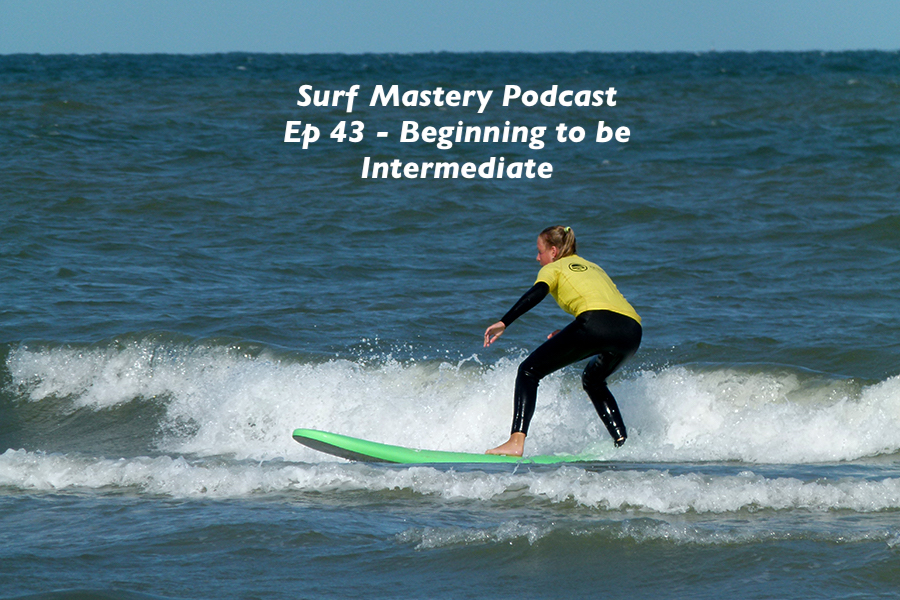
SHOW NOTES
Are you stuck surfing whitewater and wondering how to finally ride clean, unbroken waves?
If you're struggling to move beyond beginner surfing, this solo episode breaks down exactly what separates intermediates from beginners—and what simple shifts in perspective and practice can fast-track your progression.
Understand how reading the wave is more important than popping up quickly.
Learn the 7-step method to ride the face of the wave—no new board needed.
Discover the one mindset change that instantly helps you catch better waves with control.
Hit play now to stop guessing at your surfing growth and start surfing with more confidence, purpose, and progression.
Tips and concepts for the beginner surfer to progress.
OMBE Surfing course:
https://train.ombe.co/?via=surfmastery
Blog post: surfmastery.com/blog/2019/7/18/beginning-to-be-intermediate
Intro/Outro music https://www.katchafireofficial.com/
http://www.surfline.com/community/whoknows/whoknows.cfm?id=1174
Key Points
The episode will focus on answering listener questions about progressing from beginner to intermediate surfing.
A beginner surfer is defined as someone who has not yet paddled out alone and ridden a wave cleanly to its finish, whereas an intermediate surfer can paddle out alone, catch, and ride waves confidently using basic turns.
The transition from beginner to intermediate involves progressing from catching unbroken waves and riding them straight to the beach to riding along the face of the wave.
Reading the ocean is crucial at all levels of surfing, with the ability to catch and pop up on the right part of the wave being the most challenging aspect.
Beginner surfers should maintain the perspective that surfing begins as soon as they start pedaling for a wave, not just when they stand up.
To catch unbroken waves, surfers should look for a path to surf and understand that the pop-up is part of the surfing process, not a separate skill.
A seven-step process is recommended for transitioning to riding unbroken waves, starting from practicing turns while lying down and gradually progressing to standing up on unbroken waves.
Outline
Defining Beginner and Intermediate Surfers
The podcast host, Michael, addresses a common listener question about progressing from beginner to intermediate surfing.
Nick Carroll's definitions from a Surfline article are quoted to establish a baseline understanding.
A beginner surfer is defined as someone who cannot yet paddle out alone and catch a wave to ride cleanly to its finish.
An intermediate surfer can paddle out alone at familiar locations, catch waves, and ride them to completion both frontside and backside, using three basic turns: bottom turn, top turn, and cutback.
The focus is narrowed to the transition between these two stages for the purpose of the podcast.
Transition from Beginner to Intermediate
The final stage of a beginner surfer involves competently catching unbroken waves and riding straight to the beach.
The early stage of an intermediate surfer involves learning to catch unbroken waves and ride along the face of the wave.
Reading the ocean is emphasized as the foundation of surfing at all levels.
Catching the wave and popping up in the right spot is considered the most challenging aspect of surfing.
Once standing on the right part of the wave, the act of surfing becomes relatively easy.
Skills Developed as a Beginner
Beginner surfers have already started developing ocean-reading skills by navigating between whitewash and the beach.
They learn to identify obstacles like boils, foam, rocks, and other surfers while creating a path for their board.
Beginners develop a sense of feeling what the board is doing underneath them, both when lying down and standing up.
An important perspective gained as a beginner is that surfing begins as soon as paddling for a wave starts, not just when standing up.
The pop-up is considered part of surfing for beginners, who maintain board balance throughout the process.
Transitioning to Unbroken Waves
To catch unbroken waves, surfers must look for a path to surf the wave, similar to what they did as beginners.
Maintaining the perspective that surfing begins with paddling and that the pop-up is an integral part of surfing is crucial.
When paddling for an unbroken wave, surfers should look for a path and feel the wave's push along that path.
The goal is to stay on the chosen path, making adjustments as needed, and take time with the pop-up.
The path can be a straight line along the face of the wave or may require paddling straight towards the beach before turning to go along the wave.
Key Concepts for Progression
Surfers must modify their skill of reading water movement and feeling it beneath them for unbroken waves.
The ability to pop up slowly during the turbulence of a broken wave must be adapted to the acceleration and glide of an unbroken wave.
Initially, the goal is to ride along the face of part of the wave or one section of the wave.
During the pop-up process, maintaining speed and direction while keeping the board stable is essential.
Seven-Step Process for Progression
Step 1: Stay in beginner mode, lying down, and practice changing direction by leaning from side to side.
Step 2: Repeat the directional changes while on hands and knees or in a halfway pop-up position.
Step 3: Practice direction changes while standing up, still on whitewash.
Step 4: Practice riding along unbroken waves while lying down, focusing on finding a path along the wave or a section of it.
Step 5: Repeat step 4, but on hands and knees or in a halfway pop-up position.
Step 6: Practice riding along unbroken waves while standing up.
Step 7: Continue using the same beginner surfboard (e.g., 7-8 foot soft top) throughout this progression.
Transcription
Michael Frampton
Back to the Surf Mastery Podcast. Today will be the first non-interview episode I've released, and I'm going to use it to answer some listener questions. Actually, it's the same question from a lot of different listeners. And that question is, how do I progress from being a beginner surfer into an intermediate surfer?
So first we need to define those two categories. And I'm going to quote Nick Carroll from a Surfline article here. A beginner is a surfer who is yet to successfully paddle out alone and catch and ride a wave cleanly to its logical finish. An intermediate is a surfer who can successfully paddle out alone at a familiar location, catch and ride waves to a logical finish frontside and backside, confidently using three basic turns: the bottom turn, the top turn, and the cutback. Now that's a great definition, but we need to focus in on the transition between beginner and intermediate.
So I would say that the final stages of the beginner surfer would be competence in catching unbroken waves and going straight to the beach. And the early stage of the intermediate surfer would be learning to catch unbroken waves and to ride along the face of the wave.
So assuming that you can catch unbroken waves, stand up, and ride towards the beach with ease, then you're ready to start transitioning into intermediate. The first concept you need to understand is that reading the ocean is the foundation of surfing.
So no matter what level surfer you are, catching the wave and popping up in the right spot is the hardest thing in surfing. Now once you're standing up on your board on the right part of the wave, surfing is actually pretty easy. The way that you see and feel the ocean, that's the skill you need to develop the most no matter what level of surfer you are.
So as a beginner surfer, this is a skill that you've already started to develop. You're reading the water in front of you between the white water and the beach. You have to read the water. Now there's not much, it's pretty flat, but you know there's boils and foam and other lumps and sometimes rocks and people. So you are looking, you're looking for a path in which you want your board to go. And then you're feeling what the board is doing underneath you, whether you're lying down or standing up.
So you already are reading the ocean in order to successfully ride a wave. Learning to read unbroken waves is much harder. Now there's another perspective and skill that you've developed as a beginner that needs to be acknowledged so that you can retain it. And that's the concept that surfing begins as soon as you begin to paddle for a wave, not once you've stood up. The beginner surfer starts surfing as soon as they paddle for the wave. For the beginner, the pop-up is simply part of surfing. You go from lying down to on your hands to standing up. As you do that, no matter how long it takes you to do it, the beginner maintains the board balanced, giving you a nice platform to stand on to ride the wave. Inversely, for most intermediate and advanced surfers, surfing begins once they get to their feet. This is the worst perspective that you can have in surfing because it just downplays the importance of the entry and the pop-up.
So now in order to catch unbroken waves, you need to look for the same thing you were looking for as a beginner, a path into which to surf the wave. And you need to know that surfing begins once you start paddling for the wave and that the pop-up is simply part of surfing. Now if you can maintain those two things throughout your surfing journey, you're going to progress much quicker.
So basically, as you begin to paddle for the unbroken wave, you're looking for a path in which to surf. And then as you're paddling along that path, you'll feel the wave start to push you along that path without the need for paddling. Your goal now is to stay on that path and to adjust if need, and then just to take your time with the pop-up. Because remember, pop-up is part of surfing. You should be able to do it anywhere on the wave as a beginner surfing, you know, small gentle waves. Now the path that you're looking for can be a straight line. As you were as a beginner, you're looking at straight line towards the beach, but now the straight line will go along the face of the wave. Or you might have to paddle in pointing straight towards the beach and then do a slow turn and then go along the wave. Now at first, the goal is just going to be to go along the face of part of the wave or one section of the wave. And during the process of popping up, you just need to maintain your speed and direction, keeping the board stable.
So to summarize the concepts, the skill of reading the way water moves in front of you and feeling it underneath you must now be modified and learned in unbroken waves. And the skill that you have developed of being able to pop up slowly during the turbulence of the broken wave must now be modified to be able to do that during the acceleration and the glide of the unbroken wave. So those are the concepts you need to remember. Now here's some practical tips, a seven-step process.
So the first step is stay in beginner mode and stay lying down and just try and change direction. You're in the water, you're surfing towards the beach, stay lying down and just start doing turns from left to right. Just leaning to one side and leaning to the other. Just get a feel of what happens when you go from one rail to the other when you're lying down and see how that changes the direction and it changes the path you're on. Step two, try to do the same thing on your hands and knees or your hands and thighs or halfway through the pop-up. And then step three would be doing the same thing standing up, still on the white water. Step four would be practice going along the unbroken wave lying down.
So now you're going to be looking for that path and a straight line that's going along the wave or along the section of a wave, but stay lying down. There is no pressure to stand up. When you're lying down, you're more balanced and there's less distance to fall. Once you can do that, same thing, try on your hands and knees and then standing. That's it, seven-step process and stay on the same surfboard that you learned on. There's no need to change board, you know, eight, seven, eight-foot soft top is perfect. That's it, just a short episode. If you guys like the format, let me know. If you have more questions…
43 Beginning to be an Intermediate Surfer
For the passionate surfer—whether you're a weekend warrior, a surf dad, or an older surfer—this podcast is all about better surfing and deeper stoke. With expert surf coaching, surf training, and surfing tips, we’ll help you catch more waves, refine your paddling technique, and perfect your pop up on a surfboard. From surf workouts to handling wipeouts, chasing bigger waves, and mastering surf technique, we’re here to make sure you not only improve but truly enjoy surfing more—so you can get more out of every session and become a wiser surfer. Go from Beginner or intermediate Surfer to advanced.