
124 Surfing: Art or Sport? with Devon Howard
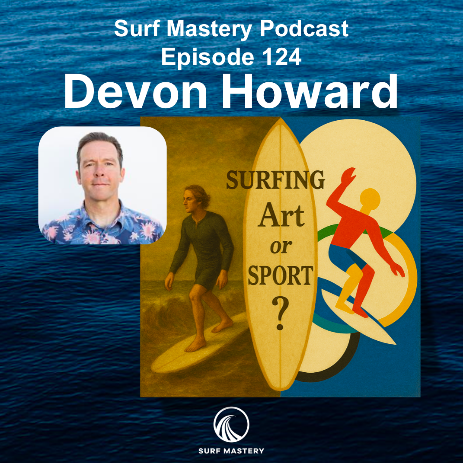
Is surfing a sport, an art, or something in between - and does it really matter?
If you've ever felt pressure to "perform" in the water or questioned your progress as a surfer, this episode will shift your mindset. Michael Frampton and Devon Howard unpack how redefining surfing as an art form - not just a competitive sport, it can transform both your approach and enjoyment, whether you're a beginner or a seasoned longboarder.
Discover why kids often learn to surf faster and more fearlessly than adults - and what that means for your own surfing journey.
Learn how to embrace surfing as a personal expression, tapping into flow states and style without the stress of performance.
Get practical tips on wave selection, lineup strategy, and choosing the right longboard or mid-length for your body and goals.
Tap into the deeper meaning of surfing and learn how shifting your mindset from sport to art can unlock more joy and progress - listen now.
Key Points:
Reading Waves & Lineup Tactics: Devon shares his triangulation method for better positioning and wave-catching efficiency - plus tips for navigating crowded breaks.
Nose Riding Fundamentals: Understand why board length and positioning are crucial, and get clear size guidelines based on your height and weight.
Board Selection Wisdom: From longboards to mid-lengths, discover how design choices impact both performance and style - and why collaboration with shapers like Wayne Rich matters.
Surf Philosophy: Explore the tension between competition and creativity, and how thinking of surfing as dance, art, or even martial art can transform your surfing mindset.
Check out this article: https://www.theinertia.com/surf/surfing-art-sport-debate/
p.s. DM Devon on Instagram about a discount code for Channel Island’s accessories; leg ropes, tail pads and board bags.
Transcript:
124 Devon Howard
Michael Frampton: …they're mad on football. So it's winter here in New Zealand, so it's just football, football, football.
Once the football season finishes and the, and the water gets warmer, we'll get back into surfing. I got the kids in swimming lessons every week, so just building their swimming fitness up.
Devon Howard: Yeah, our kids are swimming now. They're pretty young, but we have a pool nearby and to get 'em acquainted with the ocean, we've been getting 'em in swimming lessons just 'cause it's, the water's a little chilly here as you, as you know.
So getting really young kids psyched on low 60 Fahrenheit water is rough. Oh yeah.
Michael Frampton: Oh yeah. Swimming's important.
Swimming's you, you, I mean, the confidence in the water, right? Is,
yeah.
Michael Frampton: The biggest thing. And, and one thing that surprised me, like my kids, we spend a lot of time at the beach, , in the summertime and just their level of play, they don't care. , They started off just messing around in the shore break and then with a bodyboard, and then they jump on the front of my board and there was no pressure from me.
It was just like, we're at the beach, you guys do what you want. And then naturally they're like, oh, I wanna try your board dad. And now they're all surfing. That's great. And, and they naturally, one of them in particular is like obsessed with it and. But they don't care. It's like for, for them, surfing is not a sport at all.
There's no, there's no pressure on performance, anything like that. Right. And I think that's why they, they learn so well and why they sort of have no, there's no fear or shame or anxiety based around how they look in the water or anything. It's just pure fun. And two things surprised me on that is like a, is how long it takes to learn.
, I've been doing this with them, like my 13-year-old, he's only really just starting to sort of get surfing, like starting to sort of turn up and down on the wave face. And we've been doing that since he was four. You know, obviously there's far more gifted kids that pick it up really quick and, you know, the natural athletes and their obsessed parents and you know, some kids are competing once they're 11.
But I think for most kids it's, it's takes so long to learn surfing. And I think just knowing that. Takes a lot of, should take a lot of pressure off the adult learner who's listening to this.
Right?
Michael Frampton: It's like, give yourself a break, man. It takes a long time to learn surfing. And second of all, the fastest and best way to learn surfing is to kind of approach it like a kid in a way.
And Sure, my theory is that part of that is, don't think of it as a sport per se. Think of it as more of like an art or a lifestyle . Right. What are your thoughts on, on surfing in that regards? Is it a sport, is it an art? Does it matter?
Devon Howard: I don't, I've never thought of it as a sport, even though I, ironically, I worked for a sports league for a while at the World Surf League.
You can't give a simple answer to that because I think some aspects of surfing has become sport. , If you go, if we tune into the World Surf League later this week, they'll be at Jefferies Bay. The things that those surfers are doing, I think that's sport. I mean, it's, it's high level athleticism, , but it's mixed with art.
, In dance, which is an interesting thing. I suppose in some ways skateboarding is, you know, skateboarders have they really value style in their sport? I think that, I think skateboarders do call it a sport. But these conversations always are fraught with pitfalls because I'm, I'm not a, you know, my expertise isn't philosophy.
I'm, I'm sure a really great thinker could pick this thing apart, but from my simple look at it, I always have felt surfing is a, it's just a personal expression and it, it leans more toward art. It leans more toward dance. I know that sounds cheesy for some folks, but, , the type of surfing that interests me and I pursuing a lot of my friends do, I, I think it is not really sport.
Michael Frampton: , I, I agree with that a hundred percent. I would go further and argue that even in the WSL competition, I think most of the, the sport and air quotes is around the tactics and getting the waves. But once the surfers on the wave, the ones who get scored the most, are the most artistic. Mm-hmm. You know, like whether you watch John John with or without a jersey, he's, it's still very great.
He's still dancing with the ocean. Yeah.
Devon Howard: Yeah. And, and it is creative and I think because it's spontaneous, I guess other sports are spontaneous, you know, like a baseball game, any kind of balls comes flying at you, you have to react to it. There's not an exact plan, but you have practiced, um, a lot to react to that and to physically grab something where a surfboard, you have this other, you are catching something, you're catching the, the wave that's like catching a bulb.
But then you've got this other dimension where now you have the, it's a cliche, but the paintbrush. Um, and I, a lot of these surfers don't know what they're gonna do when they get to their feet. I don't, I don't know if you do, I mean, you kind of have things that you are in your bag of tricks or your repertoire that you lean on, but you don't always know you.
There's a lot of. Spontaneous react reaction to what's happening. So I think that's what art is. You know, if you sit, I used to draw a lot when I was younger, you know, you sit down and yeah, maybe you kind of have a game plan, but if, unless you're copying something, like you're looking at a still like a, you know, model or a landscape, I suppose you're, you know, you're copying that.
But if you are sitting down and not looking at anything and just going off peer feeling with no plan, um, that's artistry. And I, I, I think surfing's that way for a lot of people. For some people it's just survival. They're not, they're not really planning anything out. If you're newer to surfing, you're just like, get to your feet, make the drop, get to the channel, do it over again.
Michael Frampton: Mm-hmm. Yeah. I think a lot of. Things are like that, like surfing. Definitely one that sort of crosses the border between sport and art. I mean, you think of a a, an Olympic competition, gymnastics, right? It's gymnastics is essentially an art, unless even the judging itself is quite subjective.
No. Mm-hmm. A running race who finishes first? I mean, that's very objective. It's there's, you know, right. That's definitely a sport. And then even like a, a football game, who scores, who wins at the end? It's the black, it's pretty black and white. However, you might argue that Messi or Ronaldo, the way that they play with the ball is an art form.
The way that they probably draw energy from the audience and they like their, show me that it's a performance art for them. And anyone who's, you know, followed those great athletes would certainly describe the way they move is, is very artistic and the way they play the game. Um, right. I actually quite like to ask whether their perception of the game is more artistic as well.
'cause I, 'cause that's where I'm sort of coming from here is like the, the overarching question is why does it matter if it's a sporter or not? Like who cares? Let's just go surfing. Well, I think for, for a lot of people, especially me, sport is often defined and I grew up playing sport, but it was always competitive sport.
So the definition of sport for me has an element of competitiveness. Even though the Oxford dictionary definition of it doesn't include that, for me it's sort of always think of sport as something that's competitive. Whether that's an individualistic sport where you might be just competing against yourself when you're practicing or whatever.
But when, when you approach surfing or anything with an artistic perspective, then it becomes, no, this is creative. And you know, instead of three, instead of three to the beach. Because I used to think of surfing, like even though I wasn't in a competition, I used to think of surfing as I wanna rip the wave and three to the beach and sort of had these WSL speed power flow sort of outside influences on the way I should surf.
And you're watching surfing videos and you're surfing the latest shortboard and it was very much a sporting activity. And then when I sort of changed my perspective and thought of it, no, it's an art, it's for me, it's just becoming one with the wave and approached it. Yeah. From a more artistic perspective, I think a couple of things happened.
I, I just enjoyed it more. There was less pressure. Yeah. Actually started becoming more inflow and actually surfing with the wave better.
Devon Howard: Yeah. And it's funny, if you were to open up Surf magazine from, I don't know, 1966 or seven, the same exact conversations were happening because I might be misquoting 'em, but I believe it was Nat Young.
At some point, you know, he and the crew, a lot of crew were pulling back from competition and, , they were like, you look at the film evolution and, and that sort of late sixties period they were going to the farm and they were pulling back from putting the jersey on and having these discussions, you know, is pursuing and pushing, surfing in as a competitive sport, a mistake.
Are we forcing something upon, uh, a pursuit that's more akin to a performance art? I believe, I believe that's what he called it, was performance art, which would be closer to traditional dance. , You know, because at that time, let's just say late sixties, early seventies, the, the equipment. Hadn't gone anywhere near what it is now.
I mean, sure. In cartoons and dreams, they were imagining, um, flying through the air. I'm sure people were, but it was, it wouldn't, that wasn't happening until, uh, late seventies, early eighties where people started like getting really above the lip and then leaving, uh, and taking orbit. Uh, so you can really just think about it as, um, yeah, performance art and um, and then competitive surfing.
Uh, and, and the sport of surfing really, um, disappeared for a number of years. Through the early seventies into the mid seventies. By and large, the majority of surfing world wasn't participating in it. You look at surf magazines, they weren't pushing it super hard, but in the mid seventies, the board started getting.
More, um, performance focused. And you could argue what came first, you know, was it the competition that drew drove design, which, um, you know, increased the performance of the boards. 'cause in the mid seventies, there's shrinking the boards from those brewer single fin shapes, which were pretty limiting. Um, people were riding eggs in the early seventies.
Those were actually a lot more maneuverable than the Dick Brewer style boards that were popular because of Jerry Lopez. Jerry Lopez was God. And everyone wanted to surf like Jerry, even if it was waist high, wherever you were, it could be waist high Malibu. And people were riding seven foot Lopez guns, which was absurd.
Hmm. And so everything was style focused. It was still for sure art., But I think there was a fork in the road, so to speak, um, by mid to late seventies. Professional, you know, professional surfing was becoming a thing. The bronzed, Aussies, Sean Thompson, every, you know, we don't have to give a history lesson here, but astute listeners know that story.
And so surf brands are emerging and they're trying to sell product. And they sort of aligned themselves behind these elite quote, you know, surfer athletes and the type of surfing they were doing. You know, Shane Haran, you can go down the list of people. And then eventually Tom Kern, Martin Potter, Barton Lynch, they were getting in as many maneuvers as they could because they were being judged in a competition.
They were trying to win something. It was a subjectified sport, but it was still subjective. So it was always, no one was ever totally happy, but it was still being pushed toward a sport. And to get better, to win, to be a champion, you had to keep pushing performance more maneuvers, more radical. Then you had the other people who said the hell with that, that that is counter to what they believed in surfing.
And that would be your, um, Jim Banks. It would be the Wayne Lynch. It would be these sort of people that really stayed far from competition, pursued surf travel, and they kept that idea of it being an art alive. And like we're still having those discussions. We still, you know, on one side of things, now we have Michael February for example, and there's a whole list of people.
Um, although even to like, , Brendan Marson, Margo who's like my age in his early fifties, credible surfer. There's nothing on that side of things that are. Remotely related to competition. And I think everybody associates what they are doing at purely as art. I don't think anyone I, I'd be happy to hear who thinks that is sport.
And then we go back to our WSL example, you've got the jersey, you've got Jack Robinson, Alianca, you, you know, go down the whole list of people and that's what feels like sport to me. So it's interesting that we have two sides of it. And then ultimately whoever's listening or whoever's surfing and they, they sort of make a choice.
And I don't know, maybe the, is there a hybrid version of that? What, what would the hybrid be? I, I don't even know what you would call that, but,
Michael Frampton: I guess it depends on, I, I just think surfing is a sport for a very small percentage of surfers. It's the competitive ones. And then ironically, when they're surfing outside of competition and even when they're on a wave in their competition, it's still very much artistic.
And like you said, I think a performance art is a great definition. And Kelly Slater defined, I've heard him define surfing as a martial art, is simply because in martial arts you are playing with an outside force, , and in surfing as a performance art, but at the same time, you're also, you, you want to get as close to the most powerful part of the wave as well, so, right.
And in waves of consequence, at least you are, you're messing with danger, you know?
Devon Howard: Well, yeah. And I, I don't know, I don't have the definition of martial arts in front of me, but did it, does it go on, is there any other part of that where it involves like inflicting pain or damage because, uh, one side of surfing.
In the eighties when I was growing up, you wanted to rip and lacerate and destroy the wave, which is really funny.
Yeah. I think
Devon Howard: Brad Gerlach's talked about this before. I feel like I've heard him mention this and how the, that's one way to look at it. And the other is to have the surfing complement the, the wave.
It's not to, to take away from it or to destroy it, like going off the bottom and then r you know, Hmm. Taking the board so that you're throwing as much spray in the air. It could be like a I'm smashing that wave. I'm ripping, I'm tearing, I'm shrouding las. Yeah. Lacerating And where, go back to Michael February or Margot or any of those sorts of, , rastovich.
They are, there's a complimentary nature of the lines they choose and you never feel like they're destroying something or ripping it. I'm not, I'm not here to say what's right or wrong. It's just interesting.
Hmm.
Devon Howard: Uh, 'cause you, I never thought about martial arts, so I'm just kind of thinking that through out.
Um, 'cause there are types of martial arts that are more in, like, I assume Tai Chi is a type of martial arts. I, I think pretty sure it is. But that's just like this beautiful movement. Kung fu has beautiful movement. Um, but you use that outsource outside force of nature to technically to defend yourself.
Um, I guess if you're at, uh, ch pu, I don't know how to pronounce that. Everyone pronounces a different pu, um, that could kill you. Oh yeah. Pipeline.
Michael Frampton: Oof.
Devon Howard: Scary stuff.
Michael Frampton: Yeah. But its intention is not to, whereas in martial arts, if you're in a fight, someone's intention is to hurt you. Although, you know, in martial arts, when you, when you are practicing martial arts in a dojo with, with friends, the intention isn't to hurt at all.
It's to practice the art and to learn to flow with, you know, but then you, when you turn martial arts into a competition, say judo in the Olympic judo, yeah. Other guys maybe not trying to literally break your arm, but he wants to win. He wants to, you know, hurting you kind of part of that. So I think there's a sort of a subtle difference there between you sparring, sparring with a friend in order to become better so that you can defend yourself in a bad situation or you're in a judo competition, you wanna air quotes, kill the other person,
Devon Howard: right?
Michael Frampton: Yeah. But I get, and I guess you've got different approaches. I mean, you think of Pancho Sullivan's very much ripping and shredding the wave and you know, fast changes of direction and at the apex of the curve, which throws a lot of spray. But then you also look at Rob Machado and Smooth as you, like fast.
Yeah. But he also throws a hell of a lot of spray and you could argue that he's ripping the wave. Yeah. But he's doing it in a graceful way maybe.
Devon Howard: Yeah. Yeah. Uh, no, I, I agree. And a lot of, um,
I dunno
Devon Howard: if a lot of times, but I'll, I'll often hear people describe, , maybe we talked about this before, but that, that idea of that surfer stylish, did we talk about that before?
Yes. Yeah, yeah. Stylish style. Yep. It, it belies the, the rip actual ripping going on, you know, because sometimes that. Low bottom turn or that really coiled up cutback that's really smooth and flowing. Yeah. It is a type of ripping and it is pretty difficult to do. Um, but there's, you're still leaning toward artistry over sport of, i know when I was at the World Surf League, especially with long 'cause I was there to work on longboard surfing, but I feel like longboard surfing can sometimes be more challenging to, to be a sport because it's a lot of this movement up and down the board. And since it, you know, through like the Joel tutoring influence and, and cultural influences, it started leaning more toward a traditional long board judging criteria.
It. I, I would, I would have this conversation in my head like, are we at odds with ourself? Like we're trying to judge this thing. Um, we're trying to make as objective as possible, but it's, it's impossible because you, one judge can view somebody 'cause styles in the criteria where in short performance shortboarding, it's not in the criteria.
Hmm.
Devon Howard: It, it can create some interesting challenges. Like it's not easily identified as a sport. So I, I tried to explain to the judges, um, I wasn't a judge, but I was just sort of leading the whole crew and giving guidance on how are we gonna make this interesting? How are we gonna judge it as fair as possible?
And I would use, , dance competitions as, um, as sort of a guideline. And I think everyone agrees that like those beautiful dancers doing tango. Salsa you named the dance like that is, that is for sure art. I mean, it's just incredible form and beauty and you know, they're throwing numbers out on that and it's, it's all subjective.
So there it was, it was always this kind of, uh, it was this difficult thing of, , are we judging a sport? Are we judging performance art? And it was helpful for judges that were shortboard judges that didn't have a lot of experience with longboard surfing to step back and see it less as a competitive sport because it's pretty straight, it's a bit more straightforward with shortboarding, there still is a subjective nature to it, but when you don't have to lean on style, it's not written in the book.
It, I'm sure some judges, um, factor style in, but they're, they're going above and beyond what's in the parameters of the rule book. So it was just an interesting, , observation and, and in the end I think we got there by having those conversations about being open to this being leaning more toward art, which in, in, in we're a sports league.
We were at a sports league.
Michael Frampton: Yeah. I think that's a good conversation to have. 'cause it's important. Is it, there are a lot of similarities with dance. You know, like if you're judging a tango competition while the music they're playing is apt, first of all, it would, it would look strange if they were dancing to heavy metal.
It wouldn't be appropriate the, the what they're wearing. Right? And then that in terms of them being stylish, their movements are smooth, controlled, and in time with the other person and the music. Yeah, the, the,
Devon Howard: it's the, the style a lot of times is the balance of form with the movement so that the form is never lack of martial art.
It's never working against the movement. You know, you can, you, you can't imagine a, a black belt in any martial art where their arms are like going the wrong way. It's just not, it would be really awkward looking. And it's, it's the same with surfing, you know. And so the, the form, the function will follow the form and if they have a really good form, um, the surfing will will a lot of times be beautiful, where a lot, I, I feel like two brides, two rides are a good way to sort of like.
Forced pretty decent style. Like it's pretty apparent if you have awful style, if you're in a barrel.
Mm.
Devon Howard: But you know, a good amount of surfers can kind of pull it together and get that crouch down and sort of get the hands just right inside the barrel. But if they're like bent over it, legs are sort of straightish and they're bent over at the waist and sort of looking down at the board.
Oof. Ow It's really obvious that, um, style's way off. Form's way off. Definitely not artistic.
Michael Frampton: Yeah. And the wave's gonna hit you in the butt anyway.
Devon Howard: Yeah. Because you're gonna be in bit trouble.
Michael Frampton: Yeah. Yeah. And it's also, it's, it's, so, I guess it's also, you've gotta surf back to surfing. You've gotta surf appropriately to the waves that you're surfing.
So essentially you are in rhythm with the ocean and also. The, the surfboard that you choose to ride as well, which is like someone actually meant, because our last conversation was about style, which kind of weaves ni nicely into this conversation. And there was a comment on, on YouTube, someone said, oh, someone said you didn't infl, you didn't enforce or, put enough weight to the origin of the word style, which comes, comes from stylus, which is, , your pen as right.
It had a certain writing style, and of course it was the words you wrote, but also your, your handwriting and what, yeah, and the quality of the fountain pen or whatever type of pen that you chose to use as well. So I thought that was really interesting. Which comes back, which leads us into the surfboard.
So I think that that's gonna determine a lot of your style. And if you are going out on a performance shortboard, people are gonna look at you more like a sports person. But if you're out there on a, on a beautiful, beautiful log and you are going for, you know, form and style, you're gonna be seen as, as more of an artist as well actually.
Devon Howard: Yeah, I'd say that is probably a general rule. , At one, once upon a time there was style was really, you know, I think we're about close to the same age. So I grew up idolizing looking at people like Tom Curren in the eighties and nineties and Peak Tom Curren, early nineties, the search Beautiful search films.
Um, and then on the Shortboard side of things, you know, again, it comes back competition and sport has driven the departure to, to. Get away from style. 'cause not on the criteria, there's a focus on high performance maneuvers, but there's a return to that. And, and, and over the years there's been people sort of in there, but like a Joel Parkinson, um, who would get underscored because he looked too smooth, which is interesting.
Mm
mm
Devon Howard: And then, um, I think Ethan Ewing is a great example in recent times that the judges really react to it. The surf fans, if you follow the WSL, certainly you know that he's got a huge following. He's a favorite on all the podcasts that you and I listen to, everybody kind of sees him as a return to form, which is really quite nice.
I think that's, um, awesome. But at the end of the day, there's still no word or you're not required. To factor in style into the criteria. So it's interesting when you look at, it's not in the criteria, but clearly the style in the form is factoring into the score because he's doing these really radical maneuvers, but really polished, really beautiful form, no arms waving, everything's low and compressed like a Tom Curren or Rastovich, but two or three x, you know, like more like faster and more explosive and more corked out and twisted.
, But generally speaking, I think it's true what you're saying that you, you could associate that the average sort of stuff you're seeing out there, whether it's competition or just your local lineup, there's not a real focus on the art or or style. And because the board lends itself to. Pumping and ripping and sort of being in and out of tr proper trim.
Um, the, there's not that stability to have that good form for some, maybe a lot of people.
Hmm.
Devon Howard: But then on a log or a long board, or a mid, I'm sorry, a, um, mid length, it's more stable. The board's more in the water. You're not lifting it and pumping it and getting it out of the water as much. Um, so you've got a more stable foundation to kind of work out, you know, you're not under that sort of stress and pressure of making a board work, going down the line and then getting to the different parts of the wave with ease.
So I, I think it's true that a general rule could be for the average person, that the board is gonna have a big impact on your presentation. Well, the form, but just the way. You know, other, the rest of us see the way you're riding the wave. , Again, we're not surfing to make other people happier or to please other people, I think.
But good form, it feels great. When you're surfing, it's just like swinging a bat. You hit the ball and you connect, you know, or I don't play golf, but you, you get like a perfect swing. I know my friends at golf, so there's nothing like that feeling. You just know that that drive is going way down the field and it's going right where you want it to go.
I think that's good form, right? And then surfing good form. When you get a great bottom turn or great cutback and everything comes together, it feels awesome. And byproduct of that, as your friends might keep you a hoot or a hollerer in the channel.
Michael Frampton: Yeah. Yeah. I mean, labeling it as an art doesn't take away from the fact that we want to get better at all.
I mean, any musician who's played music is definitely an art form. And if you want to get better, you gotta practice. You know, you practice, you learn music theory, you practice in your bedroom by yourself. You, you might do it for hours and hours and in order to do one jam with a band and have that be artistic.
Yeah. So it definitely doesn't take away with our want, our desire to get better and, and certainly to get better for ourselves, not for some competition or, or how we look, just because it's, it's awesome to do that. The, I think just the simple fact is the, the better you are at surfing, the better it feels.
Devon Howard: Yeah. It's, , it's serious fun. You're, yeah. You know, because sometimes the word art could. In some people's mind could communicate a lack of seriousness. Like it, Hey, this thing doesn't matter. It's a pointless pursuit. There's nothing to be really taken that seriously. You know, you, you, you know, run into surfers who will, maybe they'll drop in on you or collide with you and go like, Hey man, take it easy.
Like, we're just having fun. Don't take it so seriously. Think, well, you know, a lot of us that have sort of dedicated our lives to it, we take the s the serious part of it is, is the practice, like the guy or girl and the guitar, um, you know, they're hours a day. They're, they're taking it seriously, but they're having a good time and they're, they're practicing over and over.
Just like someone in a martial arts jiujitsu studio that's hours and hours of training. Um, we're doing that as well. We don't get as much practice at it 'cause we're paddling so much and sitting a lot. It's actually quite precious the amount of time we get on the board. , That's why, back to the very beginning of the conversation, it just takes a long time.
That's why it's hard for kids, you know, it's a lot of patience, a lot of understanding and moving through the, the ocean. Um, and then when you actually get up and ride away, it's just a small fraction of your time in the ocean.
Michael Frampton: Yeah, that's, I mean, what happens between when the surfboard is under your arm and under your feet?
That's the hardest part of surfing.
Devon Howard: It depends how many people are talking to you in the lineup. How many sets in this, while they're talking to you about their real estate deal, you're like, let's surf. Yeah, let's get back. Let's, let's have some serious fun, you know, like I, that's what I always have seen surfing a as like, um, yeah. And, and, and I think, yeah, just like what I was saying earlier, sometimes the, the idea that being an art, I, I've talked to people who take, like, you know, these are professional surfers, people that dedicate their life to it.
And I'm explaining to them that it's a, it's an art or a dance. And, and some of these surfers didn't like that. They thought that it, it eroded or diminished the importance or the seriousness of what they were doing. They're like thinking to themselves like, well, I train and I, like, I go to the gym and I run and I do all these things so that I can be stronger and surf better.
And like art just sounds like something you do. Like you're doodling in a notepad and it just. Is a pointless endeavor. Um, so there, there, for some people, there's a disconnect with the idea of art. We're clearly all not on the same page on this. 'cause a lot of WSL fans, I'd be willing to bet, would say, uh, that, that, that it is a sport.
They do think it's an art, but if they had to choose, you know, they hear they're cheering for people with jerseys. , People that aren't into the WSL would take your stance where you, 'cause earlier you said, well, I think maybe more people would see it as, um, an art than a sport. But I I obviously we don't have the data on that.
It'd be, maybe you should do a survey. I, I did,
Michael Frampton: I did a small one on, on Instagram. It was, it was about 75 25. So more, uh, but obviously that's a small, that's my listeners. You know, when of course if you're talking to competitive surfers or even, even those who grew up as competitive surfers when they were younger, and, uh, they probably shaped their attitude when, even if they're not competing anymore,
Devon Howard: right?
Michael Frampton: , But I think taking, taking it seriously and training, and, and that doesn't mean it's not an art form. I mean, Goss, Neil Young has a nutritionist and a personal trainer, and do you know what I mean? Like, he wants to look after himself so that he can perform as art, right? Yeah. It's so can I'm take, still take art seriously?
Devon Howard: No, I just, I was only sharing that because I, I'm not saying that there's a lot of people that think that way, but I was a little surprised how I. You know, when you can feel the shift in the energy of somebody who's not liking what you're saying, they're like, oh,
yeah, yeah, yeah.
Devon Howard: And I had to kind of talk through it and, um, like, well, it's, no, it's not really the same, you know, like a, a fine painter or a jazz musician clearly is an artist, but, um Hmm.
Just had to kind of like re rethink that aspect of it that yeah, it can be an art and it can be, you can also take it pretty serious.
Michael Frampton: Yeah. Yeah. Well, I asked Donald Brink the same question and he was very much in the art camp, and, uh, sure, yeah. I mean, absolutely. And of course that segues into like, he's, when he shapes a board, it's an art piece, you know, and I think you guys at Channel Islands would agree is that there's a lot of.
There's a lot of passion and, and thought and care that goes into not just how the boards perform, but how they look and their longevity and all, all sorts. There's very much an an art, an art form, and I wanna talk about the new surfboard, but I, I wanna ask you one question before we talk about boards, which we touched on it, that we spend most of our time in the water, you know, trying to read the ocean, look for waves and paddling around.
Sure. Have you got any tips for people choosing the right waves and reading the ocean wave selection? Oh my gosh,
Devon Howard: that's a interesting one because, , I use a lot of good surfers use lineups. So when I get to a new break and I don't know what's going on, , it's definitely no art involved.
This is more like physics and science now where I. Putting on the cliff cap brain and looking at things, um, from a scientific, like naturalist point of view where surfers study, I think we study patterns. We don't think about it, but hunters, um, surfers that, you know, scientific observers, bird watchers, they study patterns.
And so when you arrive to the new break, you're, you know, let's say you don't have a friend there, you have no idea. The old days before the internet told us everything to do, um, we'd have to figure it out. And you just start watching and observing the patterns to see what's going on with the bottom and making a guess on, uh.
Sort of sometimes the safety of it. 'cause you could be at somewhere that's like a slab, that's a bit frightening. But if it looks, you can use tell right away if it's a, if it's a u, you know, user friendly wave. So then once you've established that, okay, this is a safe place to serve, , maybe I don't see any fin.
So I'm like, okay, there's also hopefully no sharks. And then, then you get out and I, I use lineups. Um, I quickly establish two points on the beach. You know, it's like the two fingers there. It's like with these two fingers, I'll see two palm trees and I'll see a set come in and the first thing I do is I look over my shoulder and I look in and I find two points and I observe about how far apart they are.
And then I'll look at the second and third wave and I'll look in and if they're still kind of happening in the same spot. I'm like, oh, okay. We're sort of in a zone and then I'll move around and try to find some, if I can get one of those, another object to actually line up with it. If I can't find something to perfectly line up, then I'll get used to like, okay, there's about that much space between those trees.
So if there's this much space, I know I'm like, you know, way off. If it's like over now, if it's like crossed over and gone the other way, I am way off. So I study the pattern that I don't think there's any art to it. I just think if you have good eyesight, you have to use it and have good recall. So, you know, not everybody has good recall.
You know, you, you see something happen and then you notice the pattern of it happening again and, and what has changed? Where did that. Thing that's happening move, or did it come in the exact same place? So that's what I'm doing. I'm triangulating, I mean, a lot. There's absolutely nothing new with that. Um, but I do, a lot of surfers I think don't use that.
, I'm, I'm not an expert of surfing around Kelly Slater, but the few times I've surfed next to him, I'm not his buddy or anything. I noticed that he does the same thing I do. I'm looking over my shoulder all the time and it's not because I'm worried about someone kicking my ass or that I cut someone off.
'cause that could be a reason to look over your shoulder. Like I, um, it's, I'm, I'm continuously interested, am I in the right position? And, and I surf a lot of crowded breaks. So switching from like a new break, like I'm trying to figure that pattern out and establish it. That's like the first thing, the most important thing I do, um, at, at home where it's really crowded.
I'm trying to understand the movements of the crowd with the current and where everybody's at. 'cause when the sets come, I want to, if, you know, unless I'm a visitor and it's not a break, I'm, it's not like my home break or something. , I wanna be on the top three waves. If it's my home break, if I'm visiting somewhere, I know I'm not gonna get the top three waves.
, I mean, unless you wanna be hated and everyone to hate you in the lineup you're visiting, you don't grab the set waves. But you can still, even if you're looking for scraps and leftovers, you still want to be aware of where you are and knowing that triangulation. So it's like if I'm on a spot like Malibu and.
Alan Sarlo, Andy Lyons, the Marshall Brothers, like all these people that surf there regularly, they're gonna get those waves. But I still wanna know where I am so that once those flurry of waves have come through and there's a few leftovers, those top dogs are out of the way. But I'm, I've ensured that I'm not way too far into the channel.
I'm still deep enough in a good spot where theoretically, I mean, it is Malibu, you're gonna get dropped in on, , you, you would be in pole position. So I'm, I'm, it's, it's kind of interesting that to that I spend almost as much time looking out to see as I do looking in.
Michael Frampton: Hmm. Yeah,
Devon Howard: no, that's a, that's a great lesson.
Maybe
Michael Frampton: that's a great point. And not only does triangulation help you stay from where you are, 'cause that's where the waves are breaking from, but it also makes sure that you're in the same spot to take all the observations as well. Sure. Which I think is, is important for, for getting to know the break and the patterns.
You never Yeah. You wanna be a static observer because Yeah. On some swells, the, oh, it's a different period. They're actually breaking. I usually sit here, but they're breaking over there. Uh, so at least I, at least you know where you are and where you usually sit and now you know this, this is a unique swell or it's a different period.
It's, it's breaking over there and you've got a new triangulation or a new observation. So there's lots of reasons to triangulate.
Devon Howard: Yeah. I don't know if I answered your question. I mean, it was
Michael Frampton: definitely
Devon Howard: that idea of what do you, you know, what do you do when you get out there and, and. And then there's also, you see a lot of people who don't really do any of those things and they do just fine.
I'm probably just overthinking it. Well,
they probably,
Devon Howard: but I don't know. I, I, I like the idea of trying to hone in on it. Um, I feel like really good surfers that are getting, some of the best waves really understand that where exactly where they are. They, they do look in.
Michael Frampton: I think you also get to a point at, at a break where you don't have to triangulate as much just 'cause you just know, oh, there's a boil there.
Whether you're conscious of it or not. You just kind of know where you are in a, in a, in a lineup. You get a intuitive sense for your positioning at, at a certain place. Um, yeah. Are you always just scanning the horizon, looking for the next set? You wanna see the set first or are you want ma la land? I do see waves.
Devon Howard: I do because the waves in Southern California, a lot of times are pretty inconsistent compared to other parts of the world. There's some pretty big lulls. Southwell especially, you know, you can have 10, 15 minute lulls of the really bomber waves. So, yeah, I think so. Um, and just trying to see. Yeah. 'cause if people are talking, they're not paying attention, I'll key in on that.
I'll notice they're not paying attention, so I'll do a little flutter kick and just sort of move a few inches one way or the other so that while they're not paying attention, I'm just a little bit closer.
Yeah.
Devon Howard: I'm, I'm not advocating or saying don't take your turn or snake people, but people can kind of work themselves out of the rotation but not paying attention.
Yeah, yeah, exactly.
Devon Howard: It's funny 'cause like, I find it obnoxious and annoying when people talk, um, a lot. I just, I think a lot of, a lot of people agree with this. My, I don't know if it's a generational thing, but surfing is a place to disconnect. We have. These things. We have all kinds of noise all day long, and the, the ocean's the perfect place.
It's like going to a yoga class and everybody's talking. It's like, what? Well, I'll just do this at home. Like I don't need, this is a place to, we can be together and we can connect and vibe off each other's energy. I'm not saying don't say hi to people. Say hi. Hello.
Michael Frampton: Yep.
Devon Howard: That's enough. Not, but then like, let's settle in.
It's like, it, it, I feel like the surfers in the sixties and seventies especially really understood that notion of meditation and just enjoying the quiet parts of surfing, like being okay with the downtime of a 20 minute lull and just sort of sitting there.
Michael Frampton: Yeah. Yeah. I, I totally agree with that. I used to be confused as when.
Try and talk to someone. Sometimes people won't even say hi. They just, they ignore you and just watch the horizon. But then in the car park, they're the nicest, friendliest people you've ever meet. And you just gotta realize, no, that's, that they're there to watch, that they wanna see that set come first, leave them alone.
And you should actually be doing the same thing, like focus in on the ocean. Like read the waves. Yeah. If you're feeling anxious, go in and catch the little ones. Just,
Devon Howard: well, you, you actually get pulled out of the rhythm when, when I've noticed, when a deep conversation takes place, invariably you're, you're pulled out of the rhythm of the ocean and you miss, because as you're talking, those other people do, the flutter kicks and they sort of slowly move into position.
Mm-hmm. It only takes a matter of inches or feet.
Yep.
Devon Howard: And shit. 20 minutes, people sort of forget whose turn it is. And if you're not focusing. That, that can be frustrating. So I, I'm, if I've ever been accused of being rude or too serious on the water, it's because I'm from that old school of be polite, say hi.
But it's okay to be, have like uncomfortable silence. It's like being in a car ride with someone. A lot of people get nervous and uncomfortable if there's more than like 10 seconds of silence.
Yep.
Devon Howard: And then they force a conversation and think, well, if the person next to me isn't talking to me, they must be mad at me.
It's not a waste. It's like, no, it's okay. Like, just be comfortable being, , in that silence that the, the movie theater thing says silence is golden. Yep.
No,
Devon Howard: I've had some friends say, dude, that's just way too harsh and extreme. Like you're in an environment where people are expecting to be really social and, and.
Talk story and whatever, you know, like just jibber, jabber, like
sometimes, I don't know. Yeah, sometimes not. I think
Devon Howard: there's a time and place like, yeah, it's like nehi and just your buddy, like there's no hard and fast rule, but I'm just only bringing this up because it, it factors into all of these things that are in play.
When you're in the lineup, you're trying to surf, you're trying to have fun, you're trying to be respectful. You're also trying to catch waves. 'cause some people are there to talk. That's great. I love it. Go right ahead and talk all you like It's actually good ground cover. The more people sitting there talking.
Mm-hmm.
Devon Howard: And not catching waves. Other people won't paddle out. That's too crowded. There's already 50 people out.
Yeah.
Devon Howard: But sometimes you'll find that half that crowd that has no interest really in getting that many waves. They're just kind of want to be out there.
Michael Frampton: They'll,
Devon Howard: they'll be happy to get a couple little scraps.
Michael Frampton: No, exactly. That's a good point. And you certainly don't judge someone's social character based on the way that they sit in the lineup. It's, um,
Devon Howard: so yeah. Well, somehow there's art involved in what we're talking about.
Michael Frampton: Oh, definitely.
Devon Howard: There's an art, there's an art to the dance of catching a wave and Oh yeah.
The art is how do you catch a wave without everybody hating you?
Michael Frampton: Um, make it look easy would be part of it, which is artistic in a way. Uh, be res, be respectful. Some, some people get away with it. Yeah. It's, it's a, that's a tricky comment. Well,
Devon Howard: it probably has all the answers in those self-help books of like, how to have people like you, you know, there's, there's just things you do right.
You're patient, you, you take your turn speaking in a room. You look people in the eye like all these sorts of things. And that sort of can factor into surfing. Now, if you're at like a hardcore lucked out spot where no one, like everyone's mad, you're there. No matter who you are and what you've done, that's a different story.
But on your sort of average run of the mill surf break, that's very well known, it's not a coveted secret spot. Uh, it's, I I always find it interesting how you kind of, the art of moving through that lineup and finding yourself on a wave.
Yeah. It's
Devon Howard: satisfying in a way when you've figured out that it's almost like the satisfaction of being on a hunt, which is like a human, it's built into us, whether you're a vegan or not, it's, sorry, it's built into us to hunt.
Mm-hmm.
Devon Howard: You're just hunting for berries. Yeah. Some, some are hunting for, you know. An elk.
Yep.
Devon Howard: But
yeah,
Devon Howard: there's something satisfying about the chase or cha and like how you get there and the, the kind of the game plan of like, you know, human beings for as long as we know that we've been here on this planet with work together and kind of Yeah.
Elk. Um, maybe not so much when you're getting berries. Um, and then surfing. We're all chasing the same elk, but in the end, only one of us wants to get So who gets the elk?
Michael Frampton: There's lots of elk. There's lot, there's lots of elk out there though. Yeah, there's definitely a co there's a combination of reading the ocean and reading the room.
Sure. Surfing in a, in a lineup and, uh, there is an element of like catching the wave or hunting the wave for sure. But I think once you are in a position where you're, you're just about to join the wave, then it's more about accepting the invitation to dance, then it is catching the wave.
Devon Howard: Sure.
Michael Frampton: Hmm. And I think that's a more artistic way of looking at it as well.
Right. It's right. It's often the way I coach people as well that are struggling to catch waves as well. Change your perspective. Don't just hunt down the waves and try and catch the wave. 'cause you end up sort of, uh, you're being less efficient with your movements if you're just accepting the invitation to dance and your dance partner's playing hard to get, then sort of gives a different perspective on, on catching waves.
Devon Howard: Yeah. If you want to get really woo woo on this, what, what about the. Um, I don't understand how this stuff works, but some people will call it the law of attraction. If you tap into the energy, like the energy we have as a human and what we attract, um, for example, if we're negative, um, low vibration, thinking about how bad everything is and how bad people are and that everyone's out to get you.
It is really interesting that that stuff just finds its way to you more and more the person that looks at things with a more positive, optimistic outlook. Great things seem to find their way. Now there's exceptions to that, of course. There's really great people that do that and get struck with cancer, unfortunately.
But I think by and large, there's a rule there and with catching waves and attracting waves. If you're like, ah, it's crowded, it's, I can't, ah, you know, you see people do that in a lineup and it just gets worse for them. Yep. They're the ones that get in an argument. They're picking a flight with somebody where the patient, people that are just really optimistic and believers that the wave's gonna come to them.
It, it comes to them. And then there's the, like, there's the other like, um, really amazing ones that I've always scratched my head. , I've surfed with this guy Victor Bernardo, not that long ago. If you don't know who he is, look him up. Phenomenal surfer. , Wherever he would go, the waves would be I, and I've seen Mikey February do this.
I've seen Tom Curren, I've surfed with Tom Curren. I watched it happen. Joel Tudor. There's just, it's more than just knowledge.
Hmm.
Devon Howard: There's some belief system there that is added into, yes, they have the knowledge, but I mean this happened to Britt Merrick not that long ago at Rin Con. Britt Merrick grew up at Rin Con, knows it better than just as well as any top local, right.
Mikey February's sitting next to him and Mikey's having a great session and Britt's like, Hey sit Mikey, sit here. This is the spot. And you know, Mikey's really polite. Oh, okay. Brit. And just a few minutes later, Brit sees outta the corner that Mikey just keeps paddling deeper, like another 150 feet to this kind of area that pretty tough to make unless you caught the wave up top and you came into it at Mach 20.
And then if you take off where Mikey is, you might get caught behind. And so you sort of like sit where Britt and most of the people sit and Mikey gets the wave of the day. Yeah. And it's like how it did these things and came to him in a way that didn't make sense to even the most knowledgeable local. I, I don't know what that means.
Um, maybe, maybe a a really somebody who understands how the universe works could explain that to me. But there's something about is it his belief? Is he lucky? Is he just that good that he figured out a break that he hardly surfed? He only like, barely ever surfed or Rincon before that.
Michael Frampton: Mm. But he is also put a lot of time in and a lot of, you know, there's a lot these surfers that, uh, that we see as magical and so good have actually put a lot of time and effort and I, I actually think, I remember surfing with Nathan Hedge.
At North Narab, but everyone's sitting there and then Nathan starts paddling like an animal. And everyone's like, well, I was like, what are you paddling for? And then five seconds later, everyone else sees the set and starts paddling. He just saw the set before everyone else. He just had a hyper focus on that sliver of ocean.
Or maybe it was an instinct thing just from his experienced or his pad pattern recognition is on a deeper level than us. So he saw a, a, a glint of a set further out the back than anyone else. Or maybe there is a logical way to explain it, or maybe it is a bit more woo woo, or I'm not, I'm not sure either.
Hmm.
Michael Frampton: It's interesting. But yeah, with the, the time we spend sitting there waiting and watching the ocean is, is a, is a big part of it. And of course, what we sit on, what we choose to sit on is a big part of it. And you see over my left shoulder here. Do you know, do you recognize who might have shaped that board?
Devon Howard: Is that a Wayne Rich?
Michael Frampton: It is a Wayne Rich. It's a harmonics. It
Devon Howard: looks like that's it's a harmonic
Michael Frampton: harmonic. 67. It is,
Devon Howard: yeah. Yeah. That's, that's a stringer configuration he likes to do. , I think part of his stringer influences from Renny Yater. Um, so there's a little, those that know Yater, there's sort of like a, a little nod to him without stringer those stick choices.
Um, and that's a great, great model. I've written it. It's awesome.
Michael Frampton: Yeah, yeah, yeah. That's a nine, eight. And, uh, you guys at Channel Lines have recently collaborated with Wayne. Can you tell us what brought Yeah. Wayne, why, why Wayne and what brought that on and how did, what was the outcome?
Devon Howard: Well, speaking of artists and artistry, um, Wayne would.
100% beyond that side of the equation. Um, Wayne is an artist. He's really into sacred geometry and like really like spiritual living. , He feels things deeply. So I think a lot of us that know him, that's what why we're attracted to him. 'cause he is that passionate. He does take things seriously. I've been at Channel Islands at which I was just talking to my wife last night.
I couldn't believe how long I've been working with Channel Islands, uh, came here in 2018. I'm like, wow. You ever have those moments where you just have, there's these timestamps where you started something, a friendship, a project, a relationship, and. And it's the things that go by that quick is usually you're enjoying them.
It's when you're in living hell that things drag on and take forever. So that's, I think, a good indication that we're having a really great time here. Um, and I've, I've ridden a lot of different boards. I wrote TMAs growing up for a long, long time. Unfortunately, he passed away a little over a decade ago, close to 15 years ago, pretty soon here.
And then I rode some friends boards, Tyler Hatzikian, Thomas Bexon, and a few others. Um, I was just sort of like a country list. Didn't really, you know, just kind of went and bought boards from whoever I was. Uh, Skip Fry. Got into those for a while. Um, the, the gliders, he calls 'em big boards. Other people call 'em gliders.
Oh. Which is another story for another time.
Yeah.
Devon Howard: Um, why they're called that and, . Yeah. And so just being here, we did the mid and then, um, some of the guys would give me a hard time. They would see me writing these other boards that I just mentioned and just a little like, mark you on ci. Like, well, we, we have, there hasn't been a new long board design at CI in like 20 some years.
They made a bunch of 'em in the nineties and early two thousands had this Mikey De Temple and other, so even Rob Machado had one, you know, and so they, they for sure had a go at it, but they sort of just leveled out. And long story short, selfishly, I, I wanted a board that the guys would give me a hard time on, and it had some channel analysts on it.
And so talked to Britt Merrick and it's, you know, he's like, Hey, this isn't in my wheelhouse. It's just not where his, where he is at. He wouldn't even know where to begin, but. He, he had talked about Wayne Rich being somebody who, who, you know, he is a friend of the community. Britt's known him since he was a teenager.
And, um, so it was like this perfect fit. We're here in Carpenteria, Wayne's a a a Rincon regular and been in this eight to five zone for many decades. And so, yeah, we just got together and we had a chat about what we wanted to do. So we made a board called the CI Log, which came out two years ago. And then this newest one we just came out with a few weeks ago, it's called the ci Nose Rider.
Sounds like a lazy name, but, um, it does exactly what the name says it does. So the, the log was a Australian style, what we call, um, in like, people call it involvement style. It's where you're really moving around in the pocket. It's more of a dance. It's not just hanging out in the nose all day and just standing up there.
It's, it's full tip to tail movement. And then the nose rider. Is geared more toward anyone that just wants to hang out on the nose. It's a great, like a Malibu, any point break, someone who's really hyper-focused on the nose, kinda like an air board. It's like, wanna do an air, get the neck beard too. Or you know, whatever model that is focused on that.
And then I think the coolest part about it is just weighing the decades of experience and connecting with someone who's that real. I mean, you know, you have his board, he's just like the ultimate underground character. He's just been this guy that, um, you never had aspirations to blow up and be the biggest thing.
And so I, I think we all feel real lucky that he was open to the idea of collaborating and , he has a lot of respect for Al Island. So it was just like a perfect fit. But I, I could bore you to tears about all the details of the board, but I think at the end of the day, it's just, it's a work of art. It is very functional.
And makes nose riding easier. And then, , our friends at True Ames who are in now, they moved to Caria, but just down the street. Chuck Ames is over there and Troy mother's head and they made a fin that goes with it and it, we had a nice spin in it, but when we were done with the process of making a fin that compliments a board specifically, that's a really fun process.
We did a bunch of, tried like almost a dozen different fins. It was over a number of months and made a few versions and then it made the board nose right, even better. So it's really noticeable. If I don't have that fin in it, it, the board still works great, but just works better. Everybody knows they've got a board at home.
If they have the wrong set of fins in it, it's a totally different board. It can almost be like a deal breaker and then you get in that right set of fins on your, in your board. Magic.
Michael Frampton: Yeah. So,
Devon Howard: yeah.
Michael Frampton: Oh, awesome.
Devon Howard: We that,
Michael Frampton: yeah. So it's the, no, the Nose Rider. Um, yeah. Arguably the best longboard shaper in the world working with Channel Islands.
It's pretty cool.
Devon Howard: I, I think it'd be hard. I, I don't think a lot of people would argue with that. It would, he's won the, um, you know, he is won that icons of foam shape off. He's, you know, he was just in a recent one. He was just in the final, he pretty much won it, according to most people. We don't get in those details, but another contest.
Yep. See, trying to make a contest out of an art, which is shaping surfboards. Really funny, isn't it?
Michael Frampton: It is funny. It is funny. Gosh, there, there, there's almost nothing you guys haven't done now. Oh gosh. I mean, if you could get skip Fry to do a, a big, a big board for Channel Islands, you'd have everything in your lineup.
Devon Howard: Yeah. That's a bridge too far. People might burn. People don't like those things. They off gliders. They're bad for the lineup. Longboards are bad enough. But I think, you know, it's interesting, like you don't see as many longboards as it used to. I think every, not everyone, lemme back up. A lot of people who would've ridden a high performance longboard or a longboard have jumped over to a mid length.
I think that's really cool. Where like 10 or 15 years ago, there was a bigger divide. There was high performance short boards, um, high performance longboards or logs, which kind of got popular about 20 years ago after the Tudor, the seedling and all that sort of stuff happened. And then God forbid you had subs, the, I mean, they were the most hated.
Yeah. Now
Devon Howard: the most hated might be foyers, but, um, so somehow the. On that, um, hierarchy of who's, who's the most hated, the, the, the traditional longboard has kind of maybe gone and rung up the ladder and kind of gained back some ground there. , But yeah, this is one of those things that's, you know, it's a timeless beauty and, high performance, short boards, they're always being driven by, by performance.
And that formula one mentality of trying to be ones, just whatever that incremental step ahead is of your competition, you'll take it. So those guys, Britt Merrick and that crew, they're always like 30 seconds of an inch. I'm like, you've gotta be kidding me. But Yago Dora the other day, like, chipped his fin at J Bay just barely chipped it.
He kept looking at his fins and he got out of the water and took that one fin at work. Any one of regular of us would've just kept surfing, but he felt it. Wow, interesting. So those people, yeah. Yeah. And then with traditional longboards, you don't need as much progression and refinement. So I think with what we're doing, it's like Wayne and I had these ideas.
We, we did about a year and a half of refinement and it's like, I don't know what else we could do to this board to make it any better. It's insane. That's like a really cool, that's a cool feeling when you work on a project, whatever it is, you build something, you build a home, you build a piece of art. Um.
Knowing that you did all you could to make it the best you could is it's really is like a satisfying feeling. Yeah,
Michael Frampton: yeah, yeah. Well, it makes sense to have a quiver of boards for different, you might not see logs in the lineup that much, but sometimes the waves is just, yeah, go surfing on a log or you don't go surfing.
Sometimes they're that small and weak. That's, it's nice to have that board, even if you're not a long boarder per se. It's nice to have one of those in your quiver. Yeah. I had a thought, I don't know if there's any merit to it, but if, if for example, you had let, let's say you had 10 surfboards ranging from performance, short boards all the way through to a, to a log to a long board.
If all of those surfboards were from the same manufacturer, would you have the consistency of the, the materials and the curing time and the sanders that would give some sort of, that, that would make those boards sort of gel together better in a way?
Devon Howard: I don't know if that's true. Um. I think what holds things together is like a rocker profile.
So like if you have a family of boards that share a similar rocker, but you can't really ever do that when you're going in the full range. You know, you, you're never gonna have that with a short board all the way to a log. They're just so different. So I like what you're thinking that, but maybe someone could argue that that's the case.
But over that stretch of a board, so much is changing. Just if, if you have a great rocker, you can have a great board, even if you botch the rail, I think. And, but going from a performance shortboard to a log, something that has a really hard refined edge to something with no edge, um, no, I don't think so.
But if you get it from the same shaper, who can do that for you, they're gonna know you as the surfer and learn who you are. So I think. From that sense, you could work with whoever your shaper is and get a complete quiver. Um, the problem with that, I, I just from my experience, is most shapers, um, they often build things that they love and are passionate about.
And it's really rare that you find somebody that can build a high performance shortboard and a log. Like, I think like a, I remember running into a guy years ago named Tim Stamps, who's down in, uh, Newport, and Tim's one of those guys I think, who can build a performance, shortboard, a fish, a mid link. Um, that, that's a really cool skillset to have.
Um, in our case at Channel Islands, we've got, we just have like a crew of talented people, so we're kind of lucky. It's like a, it's like a good baseball team or something that's got a stable of. Really talented people, and that's kind of fun, you know, getting to like, get in a band together that could like substitute in different band members for like different types of music.
I think that's pretty, that's really fun and it keeps us engaged. Like every day is really, it's really fun to go to work when there's more ideas than what you can execute on.
Michael Frampton: , The, the CI knows Rider any tips in terms of what size you order? Is there any rules around that? No, but I
Devon Howard: think, um, I think general rules of long boards. I think if you go around no less than three and a half feet over your height is not a bad place to be. You wouldn't want to go less than that.. A lot of times you won't find longboards that are under nine feet unless it's custom made.
Um, we had our friends in Japan that we made some for ordered eight eights, which was, I thought, an interesting size because a lot of them are like 5 6, 5 4. Yeah. The small frame people, uh, the common body type's a bit smaller in Japan. So, um, but you know, I think, you know, I'm six one, I'm riding a 9, 8, 9 10.
Yep. I, I probably could be riding a 10 footer.
Yeah.
Devon Howard: But I say I would never go less than the minimum is like having it be at least three and a half feet over, over your head. So you have that proportionality to get really good nose riding. It's hard to get insane nose rides on a short one. You, you can hang five on like an eight footer.
If a, a guy my size could, it would be really challenging to hang 10 on it.
Yeah. Yeah, you need
Devon Howard: the, the proportion of how the hydrodynamics and like how water needs to come up over the deck.
Mm-hmm.
Devon Howard: And the, the, the length of where the tail of the board is to where you are in the pocket. If it's a shorter distance, you can't physically get the board up and elevated and stuck in the wave face.
It just, I'm sure a physics major could explain it, but Yeah. I can just tell you in practice it's really difficult to do, but you could do it with your feet a little further apart.
Yeah. You could
Devon Howard: get a really five Yeah. Um, hanging 10 on an eight foot board, a guy my size would be tough, but somebody, I weigh almost 200 pounds.
Michael Frampton: Mm. Yeah. Well, I'm, I'm five 11 and a half and I'm 180 pounds, 80 kilos. And that's a nine eight that Wayne recommended. So we're kind of, um, that's a great, yeah, and I've got a nine, I've got a nine three as well. Longboard. It's, I struggled to nose ride that. It's too small. So there's a couple of guidelines for, for those out there that who are wondering.
Devon Howard: Yeah, that would be too small. You, you can't get in enough steps. It's like you can get like two or three steps and the guy your size will find that you, you know, like if I had another six inches I could get in that extra step. You're almost in an awkward, it puts you in an awkward position. Even if you could, once you get to the nose, you could physically hang 10 on a board that size, but the steps will feel a little bit off to you.
The rhythm of that dance would feel like a nine, seven for me. I, I'm. Six oh and a half. I'll take, I'll, I love taking credit for half. Uh, come back in a few years, I'll be shrunk. Six. But I remember on nine sixes and sevens, I would always just kind of have this weird last bit of the run to the nose. And then when I went to nine, nine, it sounds ridiculous, it was only a few inches, but it was just enough to iron all that out.
And the surf, the surfing and the footwork got smoother less. It was less kind of choppy. 'cause I, I would see myself going to the nose and then I would have to shorten or widen the step depending on what was happening. Yep. To get that foot placement.
Yep.
Devon Howard: , So I think if you're, I think if you're six foot and you're going for a nose rider, you're, you, you are 9, 8, 9, 10.
You could go 10. Oh. If you are like 5 8, 5 9, you're probably a nine, four to nine six person.
Yep.
Devon Howard: You're below that. Let's say you're like five, four to five, six. You're like a nine. Two or nine. Oh,
Michael Frampton: yep. Some good advice there.
Devon Howard: Yeah. Rough. This
Michael Frampton: and those. There's
Devon Howard: no rules. These are just guidelines.
Michael Frampton: Exactly. Surfing has no rules. , So if those who are listening who want to learn, uh, specifically about nose riding, we can go back to episode 41, which was Devon and I's Devon's original appearance on this podcast. And I just re-released that episode, , on YouTube. And, I wasn't filming the podcast back then, but, , Devon kindly sent through some footage, some nose riding and longboarding footage so you can watch, , Devon Nose Ride and Longboard Surf whilst listening to that conversation, which I sort of recut as well.
So it's a little bit shorter and it's available on YouTube at Surf Mastery, on the YouTube channel as well. , Have a link to that in the show notes. , Devon Howard, thank you so much for coming on again. Appreciate it.
Devon Howard: Thank you, , whoever is still with us, and, hopefully it made sense.
Michael Frampton: Well, like you said, , it's an age old conversation and it you know, sport art, it will continue on. But, , I think it's a, an important one to to talk about thinking about it deeply helped my surfing my experience of surfing, the way I look at surfing, board choice, , those deeper thoughts, those philosophical thoughts that we have about surfing in influence our surfing life a lot.
So thanks for weighing in. I appreciate it.
Devon Howard: Be Yeah, thanks for thinking of me. We will hopefully see you soon in the water.
Michael Frampton: All right, thanks Devon.
Devon Howard: Cheers.
The Surf Mastery Podcast:
For the passionate surfer—whether you're a weekend warrior, a surf dad, or an older surfer—this podcast is all about better surfing and deeper stoke. With expert surf coaching, surf training, and surfing tips, we’ll help you catch more waves, refine your paddling technique, and perfect your pop up on a surfboard. From surf workouts to handling wipeouts, chasing bigger waves, and mastering surf technique, we’re here to make sure you not only improve but truly enjoy surfing more—so you can get more out of every session and become a wiser surfer. Go from Beginner or intermediate Surfer to advanced