
137 James Russell - Mad Surf Stories
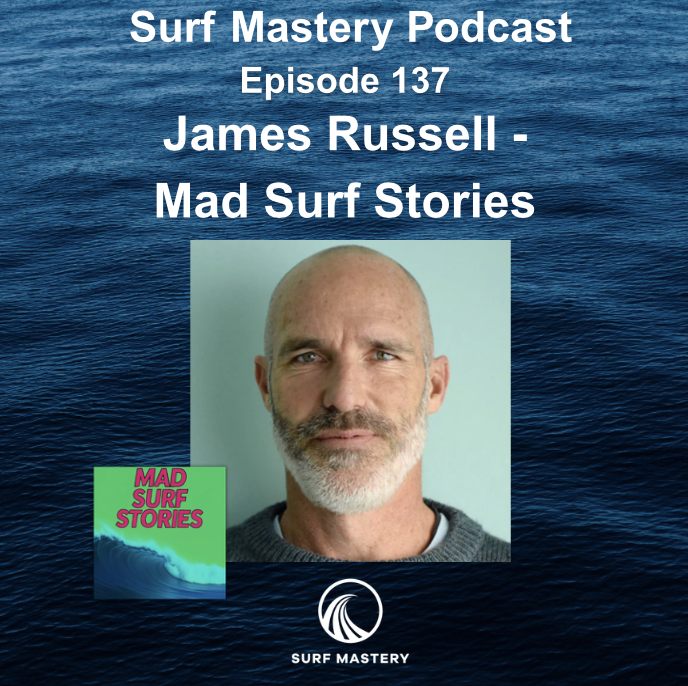
What would you do if one wild surf story could change how you travel, train, and survive in the ocean?
Michael talks with author James Russell about the real spark behind his podcast; Mad Surf Stories - those unforgettable car park conversations where local surfers share the kind of stories that never make the mainstream. From near-death experiences and ocean rescues to fear, aging, flow state, and the lessons hidden inside heavy surf moments, this conversation speaks to anyone who loves the ocean and wants to surf smarter, safer, and longer.
You’ll hear how storytelling preserves local surf lore, why surfers should take safety gear more seriously, and what happens when experience, fear, and age all collide in the lineup. James also shares insights from his own surfing life, his writing, and the deeper emotional threads that run through survival stories at sea.
Discover why real surf stories are often the best source of practical wisdom and hard-earned safety lessons
You’ll learn how fear, preparation, and mindset shape performance in the water, especially as surfers get older.
You’ll get a deeper appreciation for the psychology, risk, and addictive beauty of surfing and surf culture.
Press play to hear the stories, lessons, and mindset shifts that could help you surf with more awareness, confidence, and respect for the ocean.
James' Podcast "Mad Surf Stories" -
https://podcasts.apple.com/nz/podcast/mad-surf-stories-podcast/id1861306952
https://open.spotify.com/show/4tHYvt9btBdGgB5rwKv0jv?si=e69d777c95bf46cb
https://youtube.com/@madsurfstories?si=BH8FCHs6D_4RADAp
James' website:
https://dragonbrothersbooks.com
Transcript:
What inspired you to start the podcast?
Yeah, , I guess it's those car park conversations with surfers, , where you talk to somebody and they just tell you something crazy that's happened to someone.
And I thought. That's pretty cool. Like, to, to mine those stories would be awesome to be able to do that. , Yeah, I think that's kind of it really. 'cause they're, they're all local, you know, there's those legendary stories that might be, a Piha story or whatever, and everyone Piha knows it, but nobody else does.
Hmm. And , when you get a bit long in the tooth, like me, you, you come across quite a few of them. Yeah. But yeah, the, the challenges to, , to get people to talk really. 'cause some of the surfers are like, , maybe they've had a shocker and they're a bit ashamed of it. Mm. So that's, that's the challenge really.
But, , actually it's been really interesting 'cause a lot of the, , a lot of the kind of stories, there's been some quite good lessons come out of them, I think for, for listeners or for me or for whoever. Oh, definitely. . Good examples like Elliot Foot.
And he, , suggested that if you're going to Indo and you're gonna be taking these ferries between islands, you get yourself an E and you buy that ether in your own country rather than in Indonesia. 'cause then when it pings, it goes back to your own country and you know, those people are gonna. Be on top of it and they're gonna call the into authorities.
And I thought, you know, that's gold. That sort of info is, is gold, you know? Yeah, definitely. That he was swimming for two days, you know? Yeah. And, and it would've been.
I've already got one of those. 'cause I do a bit of, bit of hunting, so I always have one in, in the backpack. You, you are almost, you're almost silly not to have one nowadays with given what we know. And you just gotta realize that, I mean, any sort of tourism operator in most countries, you know, there's regulations and you know that the captain of the boat will have one of those on them, and there's regular maintenance schedules of their equipment, blah, blah.
None of that happens in Indonesia. So you, you kind of gotta have one of those with you just in case.
Yeah, but keep in mind, Michael, you've, you are coming from the point, you know, you go, you're a hunter, so you go hunting and you bring this with you. I hadn't even considered that. Like, I think I've, I think they only came on my radar about two years ago when I was in an outdoor shop and I saw one.
I was like, what's that? So I, I didn't even know what they were really, because I've never, you know, I've never done that much stuff. I've done, you know, I've done some stuff in the mountains, but I've been with other guys that, you know, they've probably got one in their pack, but they don't even think to mention it to me.
So. Yeah, a lot of people wouldn't even think about it. And plus they're quite expensive. Right. How much do you pay for one? , Five, 600, something like that. Yeah, I think, I think I was 400 and it's just a basic e perb, like a signal. But , you can get, Garmin have devices that are similar but a little bit bigger that actually double as satellite phones, so.
Right. You, even if you're out outside of normal signal and your iPhone's not gonna work, you've still got GPS signal. So you can immediately tell where you are and you can send a signal out, you can text message, I think you can even call on some of the more modern ones, and they're only a couple hundred bucks more and they have, you know, multiple uses.
Now it's just be good to have one just in your house, you know? Yeah. No, it's good. I, um, I haven't had a, a big. A little while, but I think I might make the investment before I do, you know? Yeah, it's funny. Surfers are funny, aren't they? You spend 1200 bucks on a new board, but yeah, I'm not gonna spend 800 bucks on a safety device that'll last, last me a lifetime in case something happens.
Well, come on. Yeah. Yeah. And by our nature, you know, we do, we go to these places and I mean, I guess no one's gonna surf with one, but, I wonder, you know, maybe, maybe one day that's, that could be a, that could be a good product to have when you're surfing. You know, something that if they get smaller and smaller, something that you could tuck into your wetsuit or something.
Yeah, , there's a guy here in Auckland that I've been trying to get a hold of, he was out surfing at Kar Beach and it was big and he got swept down the coast and he ended up just getting battered into the rocks like terribly, like the bones were sticking out of the wounds.
Oh. And he's so far hasn't agreed to talk to me, but hopefully he will. 'cause it's an amazing story. He ended up getting stranded on the rocks, , and the tide was coming in and he thought, okay, I'm just gonna have to jump back off and get back into this. And did that. He ended up getting washed down to another beach and was so broken up he couldn't even stand.
He just had to scratch out a giant help in the sand, which was seen by some people walking along the clifftop. Oh wow. And that's how he got rescued, you know. Oh, wow. Gnarly man. Incredible. Yeah, yeah. There's some crazy stories out there and no, it's pretty awesome that you're, you're doing this I've listened to every episode , and I think it's, I think it's awesome. Yeah. Great, nice to hear. Yeah. So let's start from the beginning, right? When did you start surfing? I was a late starter I think.
Like, you too, right? I started after I left school, I was down at Otago University. , And for your listeners that, dunno where that is, that's, , the bottom of New Zealand. So it's cold and plenty of swell from the Southern Ocean. . I was a pretty capable swimmer, pretty decent in the water, but yeah, never surfed, kind of never been on my radar and just fell in with a group of lads that were surfers.
And, , grabbed a, got a border and a wedding and never looked back. Just loved it. Yeah. Ah, cold water. I spent a lot of time like it, , I spent so many years just cartwheeling down the face of huge waves , and just freezing cold, you know, holes in my wetsuit kind of stuff. Snowing on the beach sometimes.
So I don't think I learned very quickly like it was a challenging situation to learn down there. 'cause there's. You know, it's often big, but, yeah, a lot of fun. Yeah, it's an amazing, amazing spot. Great waves. Oh yeah, describe to me your current relationship with the ocean and surfing.
Well, I'm a writer, an author, so I've primarily of children's books. But, these two here are my, , I've got two, , novels for adults as opposed to adult novels, but those are both surf. Novels and they were my, , lockdown project really during COVID. , And because I'm an author, I can drop everything and go surfing whenever I like.
I, I'm full-time. So, , I tend to do that. And then I'll, you know, I might work late at night or on the weekend or whatever, but if the surf's good, I can go. So, living in Auckland means you got access within an hour to both coasts. . Which is cool. We haven't had much on the east coast lately, but , west Coast is pretty consistent, and weirdly you'd think that Auckland would be quite crowded, but there's so many options, you know, so it's actually not that bad.
You can usually find a wave on your own or just with a couple others. So yeah, it's good. It's a good place to live. It's not incredible surf, but yeah, it's pretty good. Yeah. I lived in Auckland for a couple of years and got heaps of good relatively uncrowded waves. Yeah, yeah, yeah. I've got a few secret spots.
, I've got one on the east coast that you can only get to by boat, so when there's swell I'll go there. Yep. , And I've never, never surfed it with anybody else, so I, that's my, , I find the older I get the, the less I, uh, or the more I avoid crowds. So I don't tend to go to Raglin or any of those places very much.
, Just look for the spots that I know will be good and I don't mind if they take me a little bit of extra time to get there, a bit of a hike or boat ride or whatever. Yeah. So, uh, it's worth it, , and plus I've got the time and the means, you know, so it's good. Yeah. Adventure surfing. Yeah, yeah, I should get the right.
I went surfing and uh, I went surfing at the spot on the west coast. , And I was out, I was on my own. It was cooking, it was really good. And, um, just small, but really punchy. And, and then I looked, I looked back on the beach and the beach was kind of a long way away. It was a long sort of. Long flat beach and then suddenly drops off.
I saw this log where I thought was a log and there was heaps of seagulls on top of it, and I thought, oh yeah, that's interesting. And then all these people came around, the headland are wearing hazmat suits and carrying these big, you know, machetes and all kinds of stuff. And , it turns out the log was a enormous sperm whale.
That had washed up on the beach. Mm. And one of my mates is a, shark specialist and a under underwater cameraman. And he gave me, he told me, he said, don't surf there. Don't surf there for the next month or more. Because when the whales die on the beach, all of the kind of juices flow down into the sand and leach out into the sea.
And the sharks just love it, you know? Oh yeah. And I've seen sharks a couple of times at this place before. , But it was, again, a bit of a learning for me. You know, I had no idea that that was the case. That yeah, I mean, it, it makes sense really. But I didn't, I thought if they washed right, it was right up past the, , on the high tide mark.
I thought if it was up there all good, you know, I never really thought of the breakdown of the animal and how it goes out to see, you know? Yeah. That's another, another. Good. I didn't know that either actually. Yeah. Yeah. Avoid it. Avoid it until it's long rotted and gone, you know? Yeah. What were they doing in Hazmats when?
Oh, that was the iwi, you know, that was the, um, iwi. They were up from re and they were coming down and they were, , taking the jawbone of the whale out for carving. Um, but all the big chunks of blubber just get buried on the beach, so that all just breaks down and seeps out into the water.
Oh, gnarly. So do you have any personal mad surf stories?
Uh, nothing crazy, . Just the normal getting whipped out in a rip and freaking myself out for 20 minutes until I figure out a way to get back in. Just stuff like that, you know? Yeah. A few, uh, a few rescues have overturned kayaks and bits and pieces.
Oh yeah. But I reckon most, I reckon most surfers have saved a few people, you know? Mm. Yeah. I think we're a, I think we're a, , and in fact, I dunno if you listened to my episode with, um, will Allen, he's the, he was a doctor, he was a trainee doctor at the time in Dunedin. And a surfer. And he did this incredible rescue, , off Tyre mouth where they were just about to get in the water and they saw there was an upturn boat and they went out to it.
, Rescued a mom, a dad, and there was a, a young 12-year-old girl who was, whose life check the boat was completely upside down their life check. It was caught on something in the boat and he had to free her up. Then mouth to mouth with her on the way and CPR on the way back to shore. And unfortunately, one of the, , there was a baby still caught in the boat, , who died.
But um, yeah, so he's gone on to do a lot of work, , around drowning. , And a lot of training of surfers because he realizes that, , surfers are often the ones that come across these people first or may drag them out of the water first. So, yeah, that, that was an interesting one. . And I think, you know, it's like, I mean, I guess most people do a, a first aid course probably, , from time to time, you know, but as a surfer, having that staff and having that knowledge is.
You know, good chance you'll get to use it at some point. Yeah, I did all that stuff. I, as a qualified surf coach in Australia, went through all that stuff and, and then of course the breath hold training stuff for bigger waves. A lot of that sort of incorporated in it too, so I've never had to use it, I don't think, per se.
I can't think of an instance where I have had,, but invaluable, , information to, to have for sure. 'cause otherwise you just feel helpless. Right. And that's even worse. Yeah. Potentially. But yeah, that was, that was for sure. Yeah. That was an hourly story. Yeah. I listened to that one on the weekend actually.
I've listened to all of them. Yeah. There's been some pretty heavy, , kind of psychological implications from a lot of these guys that I've spoken to. Daniel Pool, who was caught in the Indian Ocean, the tsunami, the Boxing Day Tsunami. . When he had to, , when he had to wa he was kind of looking after his group of people and he walked past, he had to walk past a bust that had been overturned possibly with people in it, you know, and he still thinks about it to this day, whether.
He should have peeled off and tried to help those people rather than looking after his own group. You know? 'cause he kind of, he was kind of leading them really, and looking after them. Yeah. But yeah, a lot of, a lot of hard stuff to deal with, you know, and that And Will Ellen having to deal with the loss of that baby?
, Yeah, it's heavy. Some of the stories have been so heavy, like they've gone a whole lot deeper than I ever kind of thought, you know? Yeah, I need to, I need to uh, get a few more people, , that just have tales of awesome exploration. , I don't know, maybe taking a yacht through window or something like that, or traveling the African coast or whatever.
'cause most of them have been pretty heavy, , disasters. Really? Yeah. They have been. Yeah. But they're good. Like what, what's the South African guy who was like. His was the most gnarly, right. I reckon in, yeah. Turns survival. Yeah. Brett Archibald. Yeah. Yeah. His survival story. Wow. Like and he is such a good storytelling.
Yeah. Elliot and his mates. Yeah. Elliot and his mates had surfboards and they did two days and he did, he didn't have one. Right. So he just fell overboard when he was. He was throwing up on deck from a bad Cals only. Yeah. And then he blacked out and fell overboard. It's terrible. Oh yeah. Goodness. Oh, , his uniqueness of character is probably what saves him ultimately, right?
Yeah. Yeah. He would just, he would give up and then he'd go, no, I'm not giving up. And he'd, you'd swim to the surface again, you know? Yeah. It's incredible. Even the doctor said, like, what? He purposely swam into some jellyfish 'cause he wanted to give up and that's, you know, that allergic reaction gave him an adrenaline rush, which then made him fight again.
Yeah. You know, sends you on things like that. Like, like what, what a story. I came across his story on a, on another podcast and. I was blown away by it, but it was kind, it was called, um, and it's a good one to listen to. It's called Real survival stories. Dunno if you've come across it, but, you know, guys getting caught in the mountains or, you know, their hang gliding and their glider gets blown up into a cloud or all this mad stuff.
It's really good. But, , but the, the host of that podcast, um, this guy John Hopkins, he pretty much tells the story and then just drops in little, , little bits of recordings from the person that happened to. But I really liked Brett telling that story in his own words, you know? . It was, he's quite, quite a character, you know, and he's a good sense of humor, but he is just to hear, you know, that, that, that's the thing, like those stories in the carpark, when you hear it from the horse's mouth, it's just like, whoa.
It just blows you away. Oh yeah. There's another guy, there's another guy I wanna get hold of that, , that I don't even know his name. I can't even, I, I haven't been able to track him down like this. Never made, I don't think it ever made the news or anything, but. There's a place called Lake Ferry up in, , near Palace Bay.
Bottom of the North Island. Yep. And it's, I don't know if you've ever been there, but it's just the steepest, gnarliest beach. And when the waves like, you know, the, you sort of need the, , the water to empty out of this lake to create a little bar for the waves to break on. And then. That'll get blocked up again and the waves will wash this bar away and then it's just pounding on the beach.
But the problem with it is like, the waves can be amazing, but the problem is when you go to go in, because the, the beach is so steep, the waves just rear up right on the beach, slam into these stones and then suck back out. So you gotta time it perfectly to get up the beach. And I had a friend that went out on like a three foot day, three, four foot day, and he said it took him 20 minutes to get in.
And there was a guy that, , went out, it was like eight foot and he just couldn't get in. And it took, he was out there for hours, people, and he, his board broke and then people chucked him another one and it was just mayhem and he couldn't get in. I think, I think they send a chop to get him out of the water in the end, like he couldn't get in.
Yep. Wow. Crazy stuff. Yeah. So if you hear of him, Dylan might wanna talk to him. Yeah. Well may maybe he's listening in and he'll reach out. Yeah. Yeah. We surf, there's a similar, not as, the beach isn't as steep here along Marine Parade, but it is very steep shingle and we have river mouths. Yeah. That when the river floods, it pushes a, a u-shaped, , barreling wave or bar out there for the whale waves to barrel on.
And the waves get Really? Yeah. I've surfed, I've surfed. I know the one you're talking about. I've surfed. , That one. , There's a good story there too. Um, a young fellow who got whipped out in the, uh, in the river, and they picked him up 17 kilometers out to sea. Oh, wow. He's yet to talk to me too.
Yeah. Oh, okay. Oh, wow. You haven't heard that one? I thought that was legendary in your area. Oh, it doesn't, it doesn't ring a bell, but I'm not surprised. Yeah, well it was crack of dawn, you see, and he was on his own and it had been pouring with rain and the river was honking. You know, you gotta swim across the river or paddle across the river to get to the, to this break you're talking about.
Yeah. And he just didn't make the other side. He just oof gone. Yep. And next thing. And it was just howling offshore and he, he was almost blind when they picked him up. There's some footage of a, of the helicopter coming to get him. So someone was filming on the as they came in to pick him up. Yeah. And he was 17 Ks off offshore.
Oh, wow. And he tried to paddle to Cape Kidnappers and tried all kinds of stuff and just, just got nowhere. Oh, gnarly. Oh yeah. There's a lot of water coming out of those rivers when they flood, man. Yeah. Yeah. I've, I learned a pretty hard lesson there. You, you need the water for the bar, don't you? Exactly.
Yeah, . Oh yeah. When I was younger, I remember pulling up to a river mouth and it was flooded and there was a nice swell running, and the waves looked like they were pumping, like just top to bottom barrel, like pitch black inside the barrel. It's how you know, like the kind of pitches you draw at school.
Yeah, and there was no one surfing. And I was like, okay, I am out there. And I'd probably only been surfing for maybe three, four, maybe five years. And this was back when I was young. And i'd broken my leash, so the only leash, leg rope I had. Was was a longboard leash that had been stretched out, must have been 11 foot long, but it was the only le leg rope that I had.
And I was like, I'm out there paddled across. And I just remember paddling into my first attempt, or the only attempt, the first wave. And because the, the rivers. Pushing out and it creates the bar for the wave to break on, break on, but it actually creates a lot of draw. So it kind of breaks like an extreme, extreme rip bowl, which makes the wave better and more rippable and when it's manageable, but it also makes it a lot harder to paddle into.
Yeah. And I was so excited 'cause the waves looked pumping and I was inexperienced and I tried to paddle into this wave and immediately just went over the handlebars, slammed down into the gravel, and then I'm, now I'm in a flooded river. Getting sucked underneath and then the surfboard wraps around me like this and around my arms.
'cause I'd, I went to go and, you know, put my hands over my head, but I didn't have time. 'cause by the time my arms got to here, the surf, the leash, the leg ropes wrapped around my arms couldn't move. Starting, it's pulling tight and then the surfboard's like doing this 'cause it's wrapped around me. It's here.
I've still got a scar on my nose from it, so I'm getting, I'm wrapped up in my own leg rope of , couldn't move. My arms being dragged along the gravel bottom on a flooded river. Seconds after I thought I was gonna get the best barrel of my life. And yeah, I thought it was gone. I thought that was it.
I couldn't move. That's cool. I'm getting dragged under. I don't know how long I was under for, um, it was probably only 30 seconds, but it felt like minutes and I guess eventually I just got to a point where the river started to dissipate into the ocean. , And the tension on the leg rope started to ease and I was able to wriggle free and swim up.
I came up and everything was, like I had red glasses on and I didn't, you know, I didn't breathe in any water or anything. I was, I ended up being fine, but it was, yeah, you're on the edge. It was an intense experience. It was a hard lesson to learn. Yeah, I reckon that's freakish. That is freakish.
Yeah. Actually, I listened to one of your episodes, there just the other day. , And it was, can you still get better when you're, you know, when you're getting old? Because I'm 50, what am I 52 now? And I reckon I've kind of been getting better because I started late. I don't think I got to that really good level.
It took me a long time. So I, I don't know, maybe it's a good thing to start late 'cause it is quite enjoyable thinking that you're still getting better even when you're like. Nearly 50, but I reckon that's changed and started to go downhill a bit for sure in the last three years. But your episode was quite inspiring, but my boy, I've got two boys, one's 18, one's 16, and, uh, they like a bit of juice now, you know?
And the last time I went out with the two of them, it was big, you know, it was gruy and I got absolutely owned. I got a, got a huge one. Wiped out on a big one and then got two or three really beautiful ones right on the head, like they're kind of progressively smaller, these waves as I was coming in, which meant they just landed right on me and shit.
I was like, oh my, am I gonna die here? Like I was actually really, really worried and I cut. I just groveled and had to sit on the beach for a little while to collect myself, but it was quite a lesson. I was like, oh, could you know, 10 years ago that would've been all right? It would've been fine. It would've been rattled, but.
I was like, oh, that was close. You know, I was seeing stars here. Yeah. So that's, yeah. Getting old sucks. What are you gonna do? Yeah, it does, it does. But I mean, I, if you're gonna surf waves of consequence, you you have to train for it, don't we? I don't think at any age. I don't think it's escapable at any age.
Obviously when you're young, you're, you know, a bit more rubbery and, and fit naturally. But, uh, yeah. Yeah. I'm glad you found that episode inspiring. Yeah, tell me though, your breath hold. Can you increase your breath hold when you're my age? Of course. Yeah. Yeah, think so? Oh, definitely a hundred percent. I used to be able to do like two minutes underwater or even a little more, you know, 60 meters in a pool or something.
But now that's, yeah, I don't know. I can't do anything like that. You triple. Quadruple your breath. Hold within one training session if you're, if you want to. I've done that with Nam Baldwin. A lot of it's just mindset and having the ability to Yeah. Right. To control your nervous system.
'cause what uses up, what uses up all the oxygen is you freaking out. Yeah. Really. So if you, which is what I was doing. Yeah. Yeah. So going through a course. Like I, I went through back in the day with, with Nam where, you know, you sit down for a couple hours and you go through the science and then you jump in the pool and you go through the practicalities and you put it into practice.
Just changes the game really. So the answer is yeah, yeah. Right. Yeah, definitely. But, you know, go need to come over and have a session with you. Like I, I, I get quite, I'm quite fascinated with that fear side of things, i've done loads of sports, but I've never, I think surfing is the one that's given me the greatest level of fear.
'cause I mean, you know, I've done, I've, I've skied to a pretty high level and we were jumping off some pretty high stuff, but you sit at the top and you can, you can check all the factors and then you can psych yourself up and then you can go, you know? , But with, and I've done some whitewater kayaking, which was kind of scary, like when you go over waterfalls and things, but.
Surfing's a bit more outta control, right? 'cause you can't, you don't know what's gonna happen when you paddle over that wave and see what's coming at you. There's no control there. Even with a river and you're kayaking, you can sit up above a rapid for a while and get yourself sorted, pick your line, all of that stuff.
But, and, and you know that, that water is, even though you know, surfing is kind of a unique sport, and that two things are moving you and the medium that you are, you know, that you are working in and kayaking. It's moving as well, but it's moving in a uniform way. It doesn't, doesn't change, but waves, they're moving along and the, the bathymetry of the bottom changes, suddenly the just, , the bottom will drop out or whatever will happen.
. But that, that fear is, um, I've always found it fascinating. You know, I've never been a big wave rider, really. You know, I'm pretty uncomfortable once it gets up, past six foot, to be honest, like I'm like. I'm, I'm happy there, but anything bigger than that, I'm like, okay, leave this to the big boys and that, and I just can't believe, I, I just can't fathom how guys can go out and 15, 20 foot, you know?
I just, I don't even, it doesn't even compute for me. Oh, yeah. Like, I'm, I'm okay with it. I don't really want to do that, but I just can't believe how brave some people are. You know? But I guess that's, it's doing all those things right? Putting the training in place and doing the psychological stuff and getting the breath hold and the whole thing.
It doesn't just happen. You gotta build up to it. Yeah, there's a lot of work that goes on behind the scenes. I've only really done it once where I surfed an outer reef that was, you know, triple overhead. And when you surf the outer reefs, the swell itself is just moving so much faster. So it, it's, it's almost like a different sport.
And I trained for, I was in the gym, you know, three times a week for a year doing breath holding courses and training and. To leading up towards that winter to surf one of these swells. And I mean, I, I don't think I'd ever do it again. I don't regret nothing happened, nothing bad happened. , I got some of the best waves of my life and surfed the, some of the biggest waves of my life.
But the come down the next day, like, yeah. The body obviously really sore 'cause you're getting thrown around. But just the depression man from you, you, you end up going so high surfing these waves. 'cause it's like surfing but everything's intensified. And the depression the next day is something that I don't, in hindsight, I don't know if it was worth it when you weigh up the risk that you, you know, the work that took to get there, the risk that you're, you're taking to do it.
The come down afterwards and the desire to do it again. 'cause that adrenaline rush is next level. Like those guys that do big wave surfing like that on a regular basis, they're, they're, they are different animals, man. They're different machines. Yeah. Sounds like a drug addiction, doesn't it? It's certainly, well a lot of them end up, you know, doing that as well.
Yeah, true. A lot of stories in surfing of, of that as well. But I mean, yes, you can get better as as you get older, but I think it, it matters on how do you define better? Do you know? Do you know what I mean? Like, is it surfing a different Yeah. What, what is the style of surf? Because I think for years, myself included, I was a victim, maybe that's not the right word, but also.
The surf industry was telling me what board to ride, what style of surfing to do, do you know what I mean? I you constantly fear of being judged, so when you go no stuff, all that. I just want to, I just, I'm happy get taking a bigger board and going and surfing over there where no one else is surfing and catching the novelty waves, but getting 20 of them in 20 minutes.
Because no one else is there, rather than going over there and trying to get three to the beach off the crowd. So that's part of it too. , And you mentioned, yeah, I mean, PE people say buy a longboard, but I, I find longboarding boring as shit. I want to still ride my shortboard, still want to try and get barreled if I can.
, That's where, that's the super exciting stuff, but it's just annoying when you're like. On a good wave and you're like, oh, I might hit the lip here, and you'll just blow it and you just know because you haven't, you're not fit enough or you haven't done enough surfing or you, you're just getting old and your reactions are slow.
, My kids skateboarded and uh, when I was about 40, I reckon, or. Maybe, yeah, about 40. I was like, oh, I used to be able to do a bit of this. Go on the skateboard. Like the reactions when you fall, you just don't have those same, like they just sort of step off. But I would get flat onto the pavement, you know, that's, I was just, my reactions are way too slow.
. And there's nothing much you can do about that. I think, you know, that's just, just a factor of getting old. You probably get a little bit wiser as a surfer in terms of. Reading what a Wave's gonna do and setting up a little earlier, you know, in fact, I'm sure when you see Kelly Slater trying to do hes and stuff, he doesn't pull many of them off anymore.
. You know, but he, but put 'em in 10 foot pipe. He's like the man, you know, he can just slot it just beautifully. But when he is trying to do these tricky little maneuvers on small waves, he's just not quick enough. He doesn't have that reaction time like he used to. . Yeah. But he's a good example of someone who hasn't let go of, you know, he still wa he, I guess in, there's probably a small part of Kelly Slater's that still wants to be able to beat Philippe, Felipe Toledo and be as fast and as quick as him.
Yeah. And I'm sure that just though, really, like there's no way. Yeah. And it, whereas you look at someone like Skip Fry, who's just happy to, to Highline on a glider. Style in his, in his eighties, you know? Yeah. And he's, and Joel t will say he's the best surfer in the world. So it's, it kind of of does depend on your perspective and what you think better is, and it's, you do have to have quick reactions in some ways, but also I think as you get older, as a surfer, you get better at predicting the waves.
So there isn't a need for quick reactions because you're just better at predicting the wave anyway. Yeah. I guess it depends on what feels the best to you on a wave. Like what feels the best to me is if I go up and hit the lip and do a turn, I'll go shit that felt good. You know? That's what I like doing.
And it's, it's the, it's the stuff of a younger man really to do it really well. I mean, of course we can do it, but those, the guys that are doing it the best are the young men, you know? So I'm never gonna be able to hit the lip like I could when I was 40 or 45 maybe. 'cause I think I still was getting better at that point.
But. You know, it's only downhill from here. I think, like I'm happy to be proved wrong, but I think the more, if I want to maintain that, you've gotta train much harder, I reckon, as you get older. Oh yeah. In order to maintain the same level, you know, and that's, that's time and effort. And , someone will go, do you want a beer?
Come around for a beer or whatever. I'll be like, okay, you know? Here's some canon beer on a cracker, and I'll have a couple of those. Next thing you know, I get on the scales in a week and I'm like, oh geez, I put on a couple of kilos. Yeah, over Christmas, whatever. You just get a bit relaxed, I think, and you don't burn off the, you don't burn it all off like you used to, and it, it requires more effort, you know, requires more discipline, more effort, more time, probably, I think, than when you're a young man.
That's the way it goes though. I'm alright with it. I'm at peace. I know I don't sound like I am, but I am. I still enjoy it. Yeah, that's, I mean, that's the main thing, right? Yeah, exactly. Yeah. But you mentioned fear and that that does come a lot into it, especially, I think a lot of surfers don't even realize how scared they are because a lot of the, I think a lot of the fears that we have of surfing is, is sort of unconscious because your brain.
Whether you, you realize it or not, your brain knows how dangerous the ocean is. , You might not realize that you're essentially a victim of a shark attack or a tsunami to, to think of the extremes. But then of course, everyone knows there's a rogue set every hour. And there's, you maybe didn't read that rip properly or someone ditches their board in front of you or, I mean, the, the list of ways that things can go wrong when you're surfing is, is endless.
And whether you are consciously aware of that doesn't matter. 'cause your brain is, and if you haven't prepared or consciously thought through those risks, then that's essentially taking away from you entering a flow state. And when we enter a flow state. That's when your reaction times, uh, switched on and where you're not necessarily Yeah.
Thinking. So it is to do with that, and I think everyone feels that. Yeah. And you feel that sometimes when you surf. Right? Sometimes I, , it'll be big and I'll go to paddle in and then I'll pull back and I'll be like, oh, what I pull back for, you know, you know, I know that I'm scared. Like I, , the bottom's dropped out and I'm looking at a, you can see the reef, and I'm like, holy shit.
But then other times you're just like. You know, I, I don't, you don't seem to feel any fear. Like, and you just, your feet hit the middle of the board every time and it doesn't seem to make much sense, but I know what you mean. That flow state is awesome and it's kind of one of the, I guess one of those things that, it's one of those reasons that we keep coming back.
Surfing's such, like, there's so much hard work for kind of small reward. I mean, it's all, it's not small reward, but those times that you hit that flow state or get that perfect wave or get barreled or sew. For me anyway. They're so rare that it's like a gem, ? It's like a golden moment. It's like, oh my God, it's amazing.
You know, that, that, that happened today. You'd be buzzing for days after it, you know, after one. It could be one good wave. Yes, and I've got this really weird, um, I've talked to my mates about this. It's kind of weird. I, I can remember waves from when I was 18 or 19 or, you know, all of, you know, for the last 30 years I can remember particular waves that I've had.
And I tell them, they're like, what are you talking about? Like, I can't remember individual waves, but I can remember those waves. It's really weird. But it's just those times where everything comes together, you're like, whoa, I surfed that like a guy that's been much better than me. You know?
And that just like gives you that little glimpse of what, what might happen a bit more often if you keep going. Yeah. Yeah. You keep going. Sounds a bit like a drug addict, doesn't it? Yeah. But it's a, it's a healthy addiction vibe if you can manage it. Yeah, of course it is. Yeah. No, I'm save selfish creatures though, that's for sure.
Like I, you know, as a, I'm sure so many surfers will relate to this . Your misses will go, oh, , where are we going holidays this summer, or should we go there? And you're like, there's no, there's no serious thing. We're not going there. Oh yeah, that sounds all right. But what about this? And you'll manipulate and you'll squeeze and you'll suggest, and you'll go, oh, there's no batch.
, There's no batches available there. We better go to this other place instead. And you leave it too late so there's no accommodation or whatever. But we're terrible manipulative, , like drug addicts are, oh, that's all right. It's surfing. It's gotta be done. You gotta have something, right? Yeah.
Yeah. I do feel sorry for all those, , well, women and men, they have to suffer for, for their surfer in their life. Well, most people like the beach, right. Of course. Yeah. Yeah. There you go. That's, that's, that's all we, we've got all these, yeah, we've got all these incredible like great walks in New Zealand, like world renowned walks.
I haven't done a single one of them 'cause for the last 30 years, anytime I get a bit of time off, I go to the coast. Haven't done a single walk. Milford track the root band. Not a single of them. Terrible. Oh yeah. I think I'm the same. But you've probably been to more beaches than most people. Yeah, I'd say so.
Yeah. I got a, I got a chart on my wall of all the places I've surf and it's, it's pretty full. Yeah, exactly. Exactly. And it keeps you, you know, motivated to get up early and, you know, stay fit and strong, blah, blah, blah. Yeah. Yeah. And it's that, , it's that quest to find that, um. That empty wave, that perfect wave somewhere is just so strong.
Like with, without anyone else around. Actually, that's, so the, , my book mine that is the kind of, that's kind of the, uh, the motivation behind it. So have you read this? No. Have you read mine? So mine is, , I don't know if you remember about six or seven years ago, um, there was a guy called John Chow and he was an American missionary and he went to this island in the Indian Ocean called the, north Sentinel Island.
Do you hear of this? No. So North Sentinel is this, , tiny little island and the Enderman Sea. Indian Ocean. Yeah. And it's part of that group, of the Nicobar Islands. And it's, so they reckon the people that lived there have been there 60,000 years without any human contact from the outside or very little.
So John Chow went there 'cause he heard about them and he thought, well they need to be, you know, I'm a missionary. They need to be turned to Christianity. He turned up and they murdered him on the beach. And the Indian government, which, , administers that part of the world wouldn't even pick up his body.
So because they were, they just. Won't be contacted. If you try and go there, they'll fire at you with bows and arrows. They're amazing. When I heard about this, I just went down this rabbit hole, and if you look, if you go to North Sentel Island on Google Maps and you zoom in on it, and the south of the island are two of the best surfing setups I think I've ever seen.
It's like a mirror image breaking into this path and , it's perfect. And every time that Google updates this image, it's just better every time. It's unbelievable. It looks so good. So I was like, whoa, that's a good set setting for a book. But I had to come up with this. So I came up with this Aussie guy who's, his life's kind of turning to shit and Aussie, and he goes to Indo and he's just sickened by the tourists and the crowds and the filth, and he just keeps going up, up, up the archipelago.
, And he ends up going to, he meets this fisherman who can, who brings him to North Sentinel. And then I had to come up with this premise that would be believable. Why he would not be killed if he ended up on the island. And , I won't tell you, I won't tell you what that is, but he ends up on this island in every surfer's dream of paradise with nine different, perfect waves on it.
Wow. And , chaos ensues. So it's quite interesting. , Yeah, it's, it's been, it's been, , an awesome kind of journey with that book. Like it, you know, I, I. Get told about people that have taken it on, on board their surf charter for 10 days and it's gone through every single one of their mates, , as they're going around surfing these waves in this area.
So, , yeah, so that's one of the books. And the other one is Lines, which is set in Ireland. 'cause I lived in Ireland for eight years and , kind of got a little bit involved in the surf scene there. , I've set that one in a, kind of the backdrop as a kind of brutal Dublin criminal drug smuggling gang, , and the waves on the West coast.
So, yeah, they've been fun. Oh, cool. Yeah. I think I've listened to a few chapters inadvertently at the end of your, your podcast. Oh, yeah. Cool. I'll send you the book. Cool. I'll post it over to you. Yeah. Yeah. Cool. Is it the, the Aussie guy who came upon his father? I remember that chapter in the garage. Oh, right, yeah, yeah, yeah, yeah, yeah.
Gotcha. That was heavy. That's from mine. That one's from mine. Yeah. Yeah, yeah. Okay. Yeah, that was actually, weirdly, there's a, , I think there's a movie coming out, a Kevin Costner movie called Head Hunters. And apparently it's about a guy, a surfer in Indonesia who's real sick of everything and goes and finds this perfect paradise island with perfect surf on it.
Like, hold on a minute. That sounds like my story. So I'm waiting for it to come out before I sue. You know, you might get some royalties in the post. Yeah, yeah. Hopefully. I doubt it. So do I. You gotta, , you gotta go to LA and pitch your idea. Yeah. Too late probably. Yeah. There is, , some movie interest in the, , in the Lines book though.
Oh yeah. There's some people looking at making that to a film. That's kind of all I can say at the moment. Yep. And apparently if anything gets ever gets made into a film, it's a miracle. So I'm kind of crossing my fingers, but not really we'll. . Yeah. I think it's a lot to do with who you know in the industry.
Yeah. So it's getting the money. Yeah. Have all the guys with the good ideas, but unless someone goes, yep, yeah, I'll give you the money, it's not gonna, exactly. Yeah. Ideas are a dime a dozen, they say, and you only have to change something, what, 20% anyway. Right. And then you lose all. Legal rights anyway, so Dunno about that.
Yeah, I think that's the case. Kevin Costner, hopefully he only changed to 15%.
Oh, I say you're smarter than that. Yeah. Or his lawyers are. Yeah, they certainly are. That's how the world works. Well, , I encourage people to go out and listen to your podcast. Yeah, thanks. Yeah. Tell us what it's called and where to find it. It's called Mad Surf Stories. It's on, apple Podcasts. , It's on Spotify and put 'em on YouTube as well.
Awesome. , I've listened to every episode and I'm looking forward to hearing more. Yeah. And actually if anyone out there has got some mad surf stories, get in touch. I need some more. I've run out at the moment. I need some more people to come and have a chat to me. Okay. Have you reached out to Rob Bain?
Rob ba No, he's, what did he do? , He was surfing in New South Wales and jumped off his board, landed headfirst into a rock and basically scalp scalped himself. Oh, that's not good. Yeah, I think he broke his neck as well. Well, it's been a, he, I interviewed him years ago. It's been a while. It was a mad surf story.
Was he jumping off a rock or a boat? , You No, I'm just jumping off a wave. Oh, right. Oh no, that's not good. Yeah. Flyaway sort of thing. Yeah. Yep. Yeah, because you often do that, eh? When you, you like right at the end of the wave and you're like, oh, squeeze a bit more juice out of this. Yep. Next thing you know, look.
Ooh, that's shallow. Yep. Tom Carroll must have some mad surf stories. Yeah. Oh, there there'd be millions. Yeah, there millions. I just need them to get in touch really. Yeah. Yep. Okay. And how can they get in touch? It was, I got, you can email me James@dragonbrothersbooks.com.
Yep. And website's same. So if you listen to the podcast. Yeah. www.Dragonbrothersbooks.com. Yep. , And that'll take you to all of my books and stuff, but, , there's a contact form on there. Yeah. Yep. Oh, I'm sure there's at least one person listening that is willing to share a story or knows someone that can, , share Yeah, your email address or this episode too, so, yeah.
Yeah. Awesome. Please do. Yeah, and I look forward to hearing more. Nice one. Thanks Michael. Alright, James, thank you so much for coming on the show. Thanks having me. Alright. Sweet. Yeah. Thank you.
The Surf Mastery Podcast:
For the passionate surfer - whether you're a weekend warrior, a surf dad, or an older surfer - this podcast is all about better surfing and deeper stoke. With expert surf coaching, surf training, and surfing tips, we’ll help you catch more waves, refine your paddling technique, and perfect your pop up on a surfboard. From surf workouts to handling wipeouts, chasing bigger waves, and mastering surf technique, we’re here to make sure you not only improve but truly enjoy surfing more - so you can get more out of every session and become a wiser surfer. Go from Beginner or intermediate Surfer to advanced