
139 Play Forever with Dr. Kevin Stone: Healing, Longevity & the Future of Joint Health
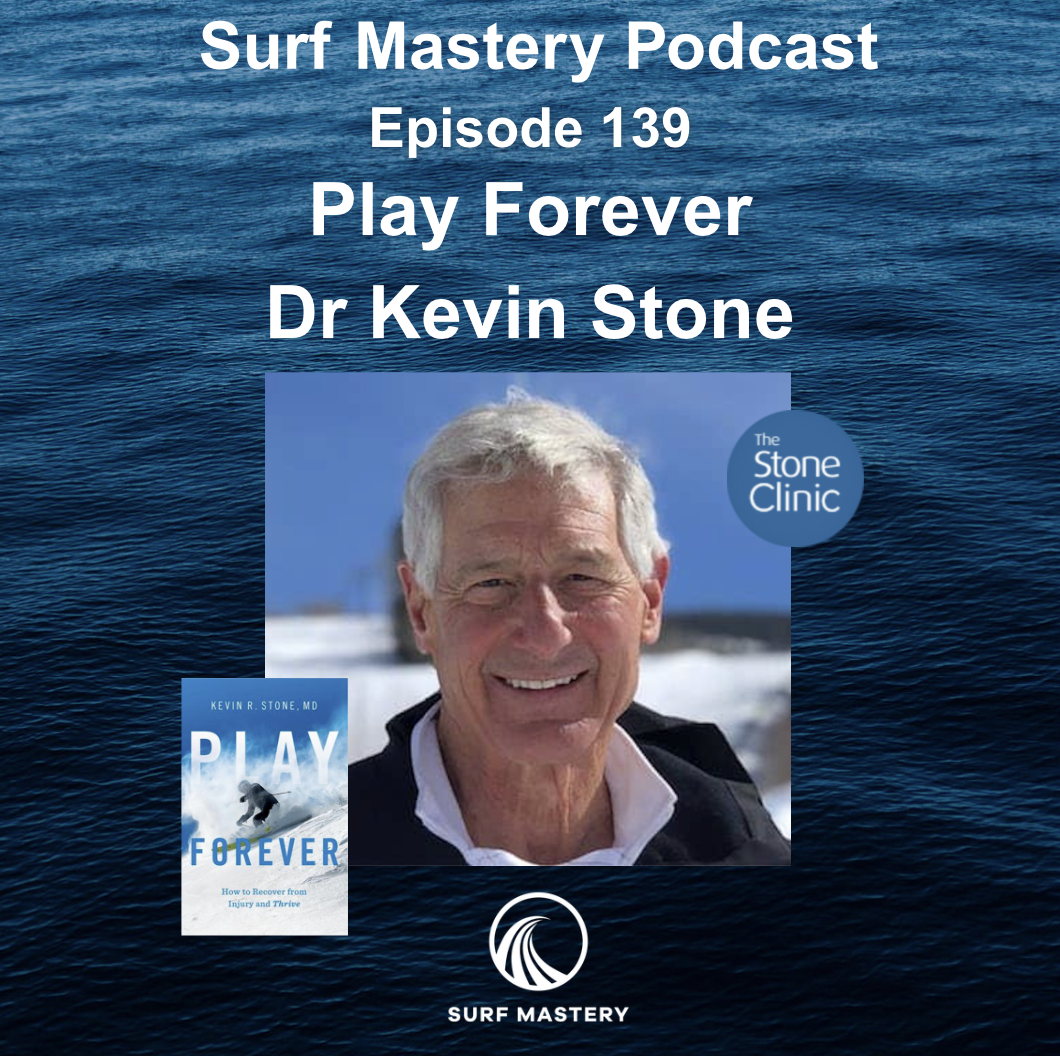
What if the key to recovering from injury and surfing well into your 80s isn’t resting more… but learning how to “play” better?
Orthopedic surgeon and sports medicine pioneer Dr. Kevin Stone explains why movement, balance, community, and even fun itself may be some of the most important ingredients in healing. From biologic joint repair and stem-cell science to the psychology of staying present in the water, this conversation explores how athletes can come back stronger instead of slowly breaking down.
In this episode, you’ll discover:
Why turning fitness into “play” instead of “work” can dramatically improve your consistency, mindset, and long-term health.
The cutting-edge advancements in biologic joint repair, PRP therapies, robotic surgery, and recovery techniques that are helping athletes avoid unnecessary surgeries and heal faster.
How balance, presence, and mental focus reduce injuries, and why distraction may be one of the biggest hidden causes of wipeouts and breakdowns as we age.
Press play now to learn how to recover smarter, stay active longer, and keep doing the sport you love for the rest of your life.
Play Forever Book:
Michael Frampton: , Dr. Kevin Stone, welcome to the Surf Mastery Podcast. Thank you so much for coming on board. You're welcome. So you have a book, and it's called Play Forever.
The subtitle is How to Recover from Injury and Thrive. Now, I do want to get into the title of the book, because it plays nicely into surfing, I think, because surfing is often seen as a sport. I personally think it's a sport for very few. Most of us surfers surf recreationally and for fun, and my philosophy is surfing is far closer to music than it is a sport.
So therefore, what do we do with an instrument? We play an instrument. So I'm always preaching to people, "Hey, we've got to go play surf." We don't go surfing for s- for a sport per se, unless you're a competitive athlete. So I like the title of your book for that reason, but my first question would be is what was the inspiration to write the book in the first place?
Dr Kevin. Stone: Well, lots
of them. First of all, I'm an orthopedic surgeon here in San Francisco, and so, and I see athletes from all over the world, lots of surfers, lots of skiers, lots of other athletes at all ages. , And one of the things we like to do is try to encourage people to use their injury as an excuse to come back fitter, faster, and stronger than they've been in years.
And so if they're gonna do that, it means they've gotta have the mindset to, exercise every day, to treat themselves like a pro athlete would, to line up all their resources, fitness coach, nutrition, psychological time- , and play time. And, , and so in order to do that, you've gotta really enjoy what you're doing.
You gotta enjoy the activities to be fit and to be fitter than you've ever been in years. And the only way you do that is if they're fun. And so we find that people will do things that are fun, and they tend not to do things that are not fun. So we try to encourage people to stop working out. Okay. We want them to play out.
And if it's playing, whether it's with weights, whether it's climbing a mountain, whether it's on a surfboard, you're gonna do it more, you're gonna enjoy it, you're gonna get the benefit from it. And if it's work, there is some negative things associated with that, and, and not all, not everything that we want to get out of the athlete, to get out of the injured person to help them come back better.
Michael Frampton: I like that. That's a great philosophy. Can you give me an example?
Dr Kevin. Stone: Sure. So you know that most people will do a sport if they do it socially. Most people do everything in life if they do it socially. You know, while surfing in general is seen, you know, as a loner sitting on a board, really it's a community on the water.
It's a community on the beach. And if you're with your friends, if you're with your community, you're there more often, you're on the water more often. You, you don't see the weather or the conditions as a barrier be- as much, because it's just fun being with your friends. And so I think that's applies to almost everything else you do.
If you're training for a sport, you're trying to build proprioception, muscle development skills, doing that with a partner, doing that with friends, doing that with a coach, doing that with a fitness instructor makes it so much more fun, makes it much more profitable in terms of how much gain you're gonna get out of it.
So look at life and look at exercise and look at sport as playtime. And if you can, you'll be enjoying it a- that much more. And that's why we want you to drop dead at age 100 playing the sport you love.
Michael Frampton: Yeah, okay. So if you've, you've got a really bad injury, and let's say to the point where you can't play golf and you have to go to a physiotherapist, you might be more inclined to choose a physical therapist who is a bit more fun than someone who's a bit more clinical.
Dr Kevin. Stone: Well, let me give you an example of that. So that physical therapist or that fitness coach, if they put a golf club in your hand during your rehab time, and you work on your putting, you're gonna have a lot more fun there, no matter what your injury, than if they don't. And so our job in- In orthopedic surgery and fitness training and helping people come back is how to understand what makes that person happy, what goals are meaningful for them physically, activity-wise, and be very creative about helping them spend much of their time in that space.
Michael Frampton: Yeah, I like that way of thinking. W- would you say that this book... W- would a physical therapist, learn some creative principles like the one you just mentioned to apply to their therapy from this book?
Dr Kevin. Stone: Yes.
Michael Frampton: Is, is it written for everyone or is it written for clinicians?
Dr Kevin. Stone: It's written for everyone. Yeah? Yeah. It's written for everyone. And, and it, it's really, uh, my effort at describing a philosophy in life of how you approach many things, mostly injury-related and recovery-related, but there's a number of other things thrown in there too in terms of meaning of life and, and how to get the most out of it.
What are, you know, how we view living a playful, fun, rewarding life, and how you use things that you otherwise would think as setbacks and turn them in your favor.
Michael Frampton: Let's go into the title, Play Forever. What's your definition of the word play?
Dr Kevin. Stone: Having fun at what you're doing. Nice and simple. And forever?
So that you drop dead playing the sport you love.
Michael Frampton: Love it. Everyone listening to this show wants to surf for as long as they can. You're talking to the right audience here. What's the worst thing we can do to sort of think the opposite way?
Dr Kevin. Stone: Well, if you turn fitness into work, which is why, you know, that we kind of avoid the word working out, uh, you, you take away some of the, as I said, the fun part of the, of being fit, of being healthy, of being positive, of, of enjoying life. So that's one thing. Number two, you know, the most common reason I see athletes injured is a mental error.
So you almost always know that you were going a little too fast, you did a move you shouldn't do, uh, you caught a wave in a position you probably shouldn't have been in. Every surfer I ever ask gets tumbled and injured. You know, "Did you know? What was your sort of thinking about before it happened?"
Almost always say, "You know, I sort of knew I was off position. I was off on the wave. I was just in the wrong spot. I just sort of knew before it happened." And that's usually distraction. And so if you can leave your cellphone at home, you can leave thoughts about your girlfriend, your boyfriend, your life, your work, if you can be in the moment of what you're doing, your likelihood of getting injured goes down tremendously.
If you're not in the moment, if your mind isn't in the game, if you're thinking about something else, you very commonly end up in my office. Mm-hmm. And my job is to help you not do that.
Michael Frampton: Which brings us back to play, 'cause if you were playing, you would be in the moment. So if movement is medicine, and part of your philosophy is the tissue can be, , preserved, which we'll get into, but, , then why are so many aging athletes, especially surfers, why are they breaking down?
Dr Kevin. Stone: It's a, there's lots of reasons why we're breaking down as we're all getting older. But, uh, as you know, you're generally losing muscle and bone as you age. And unfortunately, many people have been told to, they've had a total knee or they've had some other surgery or they've had arthritis, and they've been go- told to go home and rest their body parts so they don't wear it out, some verbiage like that.
And we, for the last 35 years of my practice here in San Francisco, have been telling patients exactly the opposite. So if I replace their knee joint with a partial knee or a total, or a total knee replacement, we're telling them, "We want you to increase your exercise, increase your loading, increase your muscle development."
And the reason is, as you age, you're losing muscle and bone. And so those components that we're putting in are more likely to come loose if you're not exercising and not building bone. So it's the opposite of the advice most people have given for a long time. And so in my entire practice, I've only seen one patient wear out their component from running.
And so why have all these patients been told, "Don't go run on your partial or total knee replacement"? So we've been giving the opposite advice. We- you know, a lot of things have come into play to help us do that for athletes. Robotic surgery has made a huge difference. The getting rid of bone cement and total joint replacements has b- made a big difference.
The ability to do partial knee replacements for so many athletes makes a huge difference because those knees feel more normal than does a total knee replacement. And the o- opportunity to do biologic joint replacement, where I put back a new meniscus, regrow the cartilage, replace the ligaments as necessary, you know, that's also been great for so many of our athletes who aren't anywhere near needing a partial or artificial joint replacement.
Michael Frampton: Let's talk about knees for a bit. I'm, I can speak from personal experience. I had a ACL reconstruction on my right knee in 2001. It was done by a young surgeon. I tore that graft. It needed to be revisited in 2005. And now, last year, 20 years on, um, I have, you know, bone-on-bone osteoarthritis,
what advice would you give to someone like me?
Dr Kevin. Stone: So we like to give advice based on good data. That data means I need a physical exam, X-ray, MRI, if possible. For our patients who are outside of San Francisco, they often will send in their X-rays and MRI. We do that as a complimentary service. You go to stoneclinic.com/consult, and you can upload your X-ray or MRI.
We can look at that and advise patients. So I like to give advice based on good data. Okay. However, I will tell you that 80% of patients who've been told that they need a total knee don't. And that's not just our own data. So they could either have a partial replacement or they could have a biologic replacement, replacing the meniscus or regrowing the cartilage.
If they do need a total knee, then again, we're doing these robotically now, and that means that we can get rid of the bone cement, the key component that, that led to loosening from so many of the patients in the past. By getting rid of the bone cement, the body grows into the porous undersurface of the implant, so it becomes part of you.
The only way you're gonna knock it loose is if you break your bone. So that's taken away all the concerns about letting people back to running and sport, hiking, and doing impact exercises. So in the things you described about your knee, I would ask you, "Look, send me an X-ray, send me a recent MRI. Get on the phone with me.
Let me look at your X-rays and MRI and over a Zoom, and I can counsel you with pretty good, you know, advice about what you should do best." Of course, if I can get my hands on your knee and examine you, so come in and see me here, but if you can't do that, then we talk to you on the phone. Okay. That, that's, that sounds really interesting.
Michael Frampton: Y- obviously you're on the, the cutting edge of s- things, The biologics, what's the, what's the future of that look like?
Dr Kevin. Stone: So we're in what I call the anabolic era of sports medicine, which means that every time we repair something, repair a ligament, repair a meniscus, we're almost always adding anabolics, growth factors from PRP, your own blood, or birth tissues that have a high concentration of mesenchymal stem cells or other growth factors, and hyaluronic acid, the lubricant of the joint.
So we're always potentiating our surgery if we have to do surgery, or our injuries for athletes who don't need surgery. We're adding these factors to augment or accelerate their healing response. Now, I'll give you a little short summary of what the status is of cells . So stem cells are pericytes.
They live on the walls of vessels, and you sitting there have billions of stem cells within your body. Yes, when you were younger, you had more than you have as you age, but you still have billions of them or you wouldn't be talking to me. My job as a physician and scientist is if I'm gonna give you a therapy, the therapy needs to mobilize your billions of stem cells to that site of injury.
So if you have a bruise, let's just say you, you hit your muscle on a, a step, and that bruise, the little bleeding into the body there sends out all these s- a siren call to all the stem cells in your body and says, "Hey, some come here," and direct the healing response. And that's the way nature works to first start with inflammation and then reorganization of the collagen tissues.
So when we inject cells, which we don't focus on so much anymore, we're trying to-- because they tend to die or not be enough cells to really affect change. What we're trying to do is inject chemokines or factors that recruit your body's own stem cells to that site. Mm. We also inject PRP and lubricants because they have potent anti-inflammatory, anti-fibrotic, meaning anti-scarring, anabolic, meaning they stimulate the lining cells of your joint to produce more lubrication.
And a- as I said, paragran effects or chemotactic effects, recruiting your body's own stem cells. So the science around- Augmenting healing or augmenting surgical procedures is accelerating rapidly now, and we're, we're part of doing research in that space and trying to figure out what's the best cocktail to give you as an athlete, uh, before surgery, to avoid surgery, or after surgery.
And we- we're doing that quite a bit now in almost all of these injuries.
Michael Frampton: Okay. For the listener who's listening, who's maybe suffering with some joint pain, it sounds, uh, if you go to your st- standard run-of-the-mill general practitioner, you get referred to a surgeon who wants to, you know, do whatever surgery they specialize in.
That can be quite depressing, to put it bluntly. But you, and what you've just been saying here and looking at your website, is you're giving a lot of hope. Your belief in the body's natural, you know, to stimulate the body's natural ability to heal and, , to encourage us to play and keep moving.
Dr Kevin. Stone: For sure.
And in New Zealand as well as here, the fantastic part of this story is that you have access to excellent doctors and excellent scientists who are looking at trying to figure out how do they help athletes come back, uh, better than they were before, healing these tissues. And so even surgeons, you'd be surprised.
You know, my goal is to keep people out of my operating room if I can, but if they have tissues that are broken, to repair those or replace them. We do lots of meniscus replacement here. Mm-hmm. That means when you tear your meniscus cartilage, if the surgeon can't repair it, if some of it has to be taken out, then we put them back in quite a bit, 'cause we've learned that when you lose the meniscus, you develop arthritis and pain.
And if we can help you avoid that or treat it after you've already lost it, that's a big contribution to your knee. , So even though we're, we're biased towards repairing tissues that are broken as fast as we possibly can so that you don't suffer all the breakdown effects over time, we are also developing these skills of augmenting healing.
And I'll give you an example. So in the past, for rotator cuff injuries in the shoulder, I treat shoulder, knee, and ankle injuries. So in the past, the rotator cuff tears that you hear so much about, we almost always would take them to surgery, uh, and repair them. And the problem was that about 30% of them would go on to fail, which is distressing to all of us.
It turns out now that almost every rotator cuff injury that I see- We inject with a cocktail of growth factors and lubrication and other things, start them on a rehab program, and then repair them later on if their rehab and injections have not been good enough to get them back to doing everything they wanna do.
And that's dramatically decreased our need to do shoulder surgery. And if I have to operate on them, uh, then I augment that surgical repair with this cocktail of things, trying to reduce that failure rate that we've seen in the past. And that's true in arthritic ankles. It's true in arthritic knees as well.
We're trying first to help the patient buy time if they can, and if not, if I have to repair it, then we augment the repair.
Michael Frampton: Where do you see the next five years go? Like, how, where- where's this heading?
Dr Kevin. Stone: So if you'd asked that question a year or two ago about AI, you would've been way wrong.
And if you asked that question about biologics and orthopedics and tissue repair, we'll probably be wrong as well. But we're excited about the work that we're doing. I have a public nonprofit research foundation as well, so we're looking at research on how do we make these injections work better? How do we get cartilage repair to work better?
How do we do better surgical techniques? And we post all that, by the way. There's a public website called stoneresearch.org, and you can learn about these research programs. But I would tell you that I think that the injections will get better and better at recruiting your body's stem cells so that you will heal faster from the injuries that we're seeing.
And so instead of all my athletes saying, "Hey, Doc, why does it take a year to come back from an ACL injury or an Achilles tendon rupture?" You know, I think we'll be accelerating that quite a bit, and we already are, but I think we'll do a much better job in the future.
Michael Frampton: Hmm. So the body has this ability to, to heal itself.
Why doesn't it? And why, why does it take something like an in- an injection of stimulants to get that going?
Dr Kevin. Stone: Because normal collagen healing takes about 12 months. And so if you have an incision or a cut on your arm or your knee or, , and you look at the color of that incision, it's kind of red when it's first been repaired, and over the course of time, over the course of 12 months usually, that reddish tissue goes down to about your normal color of your skin.
Sometimes not all the way, but that color change is collagen maturation. So it's taking the disorganized collagen fibers of scar, and it's remodeling them into oriented collagen fibers. And so that reorientation, that laying down of new collagen, uh, oriented, orienting it in the right form, is, can be augmented by an anabolic.
That stimulates those cells to lay down new collagen or lay down more crosslinks or organize it faster. And so what we're doing is taking nature's own healing response mechanism and simply adding to it, adding a little stimulant to it so it goes a little bit faster. .
Michael Frampton: Have you been inspired by any other books?
Any other books that you can think that back up your, your, your philosophy of play and, and, and longevity?
Dr Kevin. Stone: You know, not so much in that sense. , I think that, , I, I was influenced in my fellowship by a guy named Richard Steadman, who was a US Ski Team doc, and it helped me then care for the ski team as well. , And influenced by other physicians I saw early on.
My dad was a physician, my granddad was a physician. So I think I've seen all my life the, , the ability to help people, and I've been inspired by the patients that we've helped who have all cheated. And what that means is that we told them, you know, "Use a brace, use a cast, use crutches," and they would come back in the office a month or two later carrying their device that they were supposed to be wearing.
And so what happened was we learned from our athletes that many of our restrictions were too restrictive. And we learned what, where we could push, where we couldn't push. And so I think I've learned the most from my patients- , who took the advice I gave them and accelerated it. And I think those have been our best teachers.
Michael Frampton: You mentioned your grandfather and your father were physicians as well. Were they also surgeons, or what inspired you to get into this particular field?
Dr Kevin. Stone: They were not, but I injured my knee playing soccer for Harvard back in the, , late '70s, and, uh, the guy who repaired it was an orthopedic surgeon in the field house.
And, I admired him caring for the athletes. And, I set up my practice here in San Francisco similar to that, where there's a training room. And so their rehab team and physical therapy folks are all right next door to our normal orthopedic clinical exam rooms, our MRI and X-ray. So everything's all in one space, one area, and we can walk around and see the athletes at every stage, both immediately before surgery, after surgery, and then in rehab and fitness training.
, And so I think that inspiration for helping people not just recover from surgery or from injury, but to come back better than they've been in years, came from seeing that environment, thinking about how I could optimize it.
Michael Frampton: Hmm. Okay. So, and h- how's your knee nowadays?
Dr Kevin. Stone: Good. I'm still skiing and windsurfing and surfing on the beach and doing all the things I love to do.
Michael Frampton: Oh, that's good to hear. That's really good. Yeah. Yeah. , You mentioned, I've heard you talk about balance. How important is balance ?
Dr Kevin. Stone: So proprioception, which is the, the brain-body connection between where you're landing and where your feet are or where your body is in space, and therefore whether or not you're balanced or not, , is a critical task that can easily be trained, and we tend to forget to train it.
Yet it's so easy to train. Just standing on one leg on a pillow in your bedroom, you know, and just close your eyes and see how hard that is and see how good you are at it. It's the simplest way. For me, stand-up paddling, and for my patients, stand-up paddling is probably the funnest sport that we do for balance.
, I think just being on the board at every age, standing on a board on the water is something my 90-year-old patients can do and my younger patients can do, everybody in post-op rehab can do, many people can do. , So simple things like that are sportive, fun, playful, but are also- Building the thing that you tend to lose as you age
Michael Frampton: Hmm.
Do- y- you mentioned you got quite a holistic clinic there. , Are you targeting balance specifically through neurological training there, or is it all play-based?
Dr Kevin. Stone: Everything is integrated pretty well. , You can't return to sport unless you have a good sense of balance. And so, so many of the rehab exercises we're doing require it.
Michael Frampton: Hopefully this conversation has inspired some of my listeners to go out , and buy the book and dig deeper. But if you were to summarize it in one sentence, how would you do that?
Dr Kevin. Stone: Focusing on how to recover from injury. So if you are the, "Oh me, oh my, I'm injured.
Now my season's ruined," or whatever, "My life is ruined," you're not gonna do very well. But if you're that person who says, "Bummer, I injured my knee, but let me use this time to figure out how to come back better, how to train my core, how to train upper body. How to work around my knee injury," if it's a knee injury.
"How to, how to work on things that I really, before my injury, had, wasn't really spending the time or focused on or paid attention to," then you're the athlete who's gonna come back better than you were before. And all athletes get injured, and the great ones use that time as an opportunity to be better.
And so this book goes into lots of aspects about that. It also talks about, you know, specific orthopedic treatments and anabolic era stuff. Uh, some mind game stuff, other things that are fun.
Michael Frampton: Okay. And can you inform folks of your website, please?
Dr Kevin. Stone: Sure. So I'm at stoneclinic.com here in San Francisco. If they need a consult about an injury, look at stoneclinic.com/consult. We do that as a complimentary basis. Uh, if they're interested in the research, take a look at stone research.org. It's a public nonprofit research foundation. And we're just,
we're excited by what we do , and excited to help people play forever.
Michael Frampton: Yep. And is the book available on Amazon?
Dr Kevin. Stone: Yes.
Michael Frampton: Okay, excellent. So I will make sure that there are links to all of that, those things that, Dr. Stone just mentioned in the show notes. , Dr. Stone, thank you so much for your time today and, it's, this, the future is bright for joint health.
Dr Kevin. Stone: It sure is.
Michael Frampton: Yeah. Thank you so much.
Great to talk with you. You too. Take care. Yep.
The Surf Mastery Podcast:
For the passionate surfer - whether you're a weekend warrior, a surf dad, or an older surfer - this podcast is all about better surfing and deeper stoke. With expert surf coaching, surf training, and surfing tips, we’ll help you catch more waves, refine your paddling technique, and perfect your pop up on a surfboard. From surf workouts to handling wipeouts, chasing bigger waves, and mastering surf technique, we’re here to make sure you not only improve but truly enjoy surfing more - so you can get more out of every session and become a wiser surfer. Go from Beginner or intermediate Surfer to advanced