
142 Surfing Is Meant to Be Experienced: Lisa Davidsson on Fear, Progress, and Self-Mastery
What if becoming a better surfer has less to do with technique, and more to do with how you handle fear, frustration, pressure, and the need to perform?
Surfing has a way of exposing what’s happening between your ears. You can spend years improving your technique and still find yourself frustrated by slow progress, intimidated by bigger waves, comparing yourself to other surfers, or turning a bad session into a judgment about your ability.
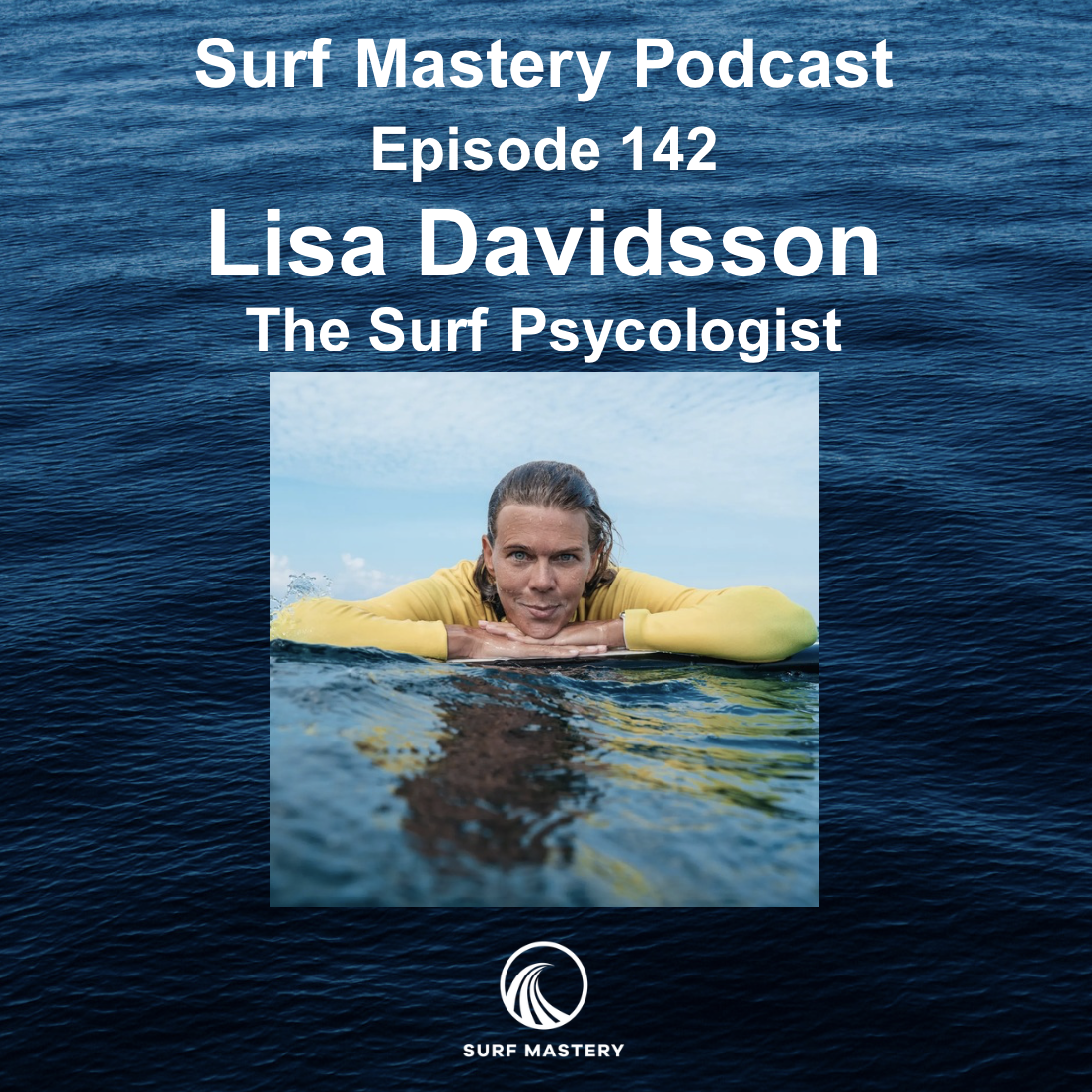
In this episode, surf psychologist Lisa Davidson explores the intersection of psychology, sport, and surfing. Lisa explains how shifting your relationship with performance can help you enjoy the ocean more, navigate fear more effectively, and keep progressing without making every session a test of your self-worth.
In this episode, you’ll discover:
How to shift your focus from outcomes you can’t control to the process, habits, and actions you can control.
How to interrupt frustration and overthinking in the lineup by reconnecting with your senses and bringing yourself back into the present moment.
Why making room for fun, play, and pressure-free surf sessions can strengthen your motivation, confidence, and long-term relationship with surfing.
Press play to learn how to work with your mind, not against it, so you can handle fear and frustration, enjoy the process of improving, and experience more of what surfing has to offer.
https://thesurfpsychologist.com/
https://www.instagram.com/thesurfpsychologist/
Transcript:
SMP142LisaD
Lisa: Yes, let's do it. Let's do it.
Host: I wanted to start by just reading to you some of your own words.
Oh, excellent. Says on, on your, on your w- on your website here- Mm ... uh, you're a licensed psychologist and hypnotherapist as well as a surfer. Um, mm-hmm. It, the, so the first paragraph you've written here, it says, "I didn't grow up surfing. I found the ocea- Yes ... "i found the ocean as an adult after years of studying the human mind and working in mental health with clinical neuropsychology and behavioral change.
Lisa: But long before I ever picked up a board, two threads were already shaping my life: a deep curiosity about how the brain works, and a love for sport as a path to self-mastery." Yes. That's quite a paragraph. Right. Right. I guess you want me to comment on that. First, I wanna say that I'm actually not a clinical psychologist, so I'm not a licensed psychologist as that.
But I do have my master's, and it's in clinical neuropsychology. That's what I focused on. Okay. So just a slight correction there. That line, I was working hard on that one. But it's, uh, it came to me when I was, thinking about, like, what is it that I actually do, you know?
Like, what is it, what's the essence of the work that I wanna, or the services that I wanna provide for people, and what do I think is really fascinating about the intersection of, you know, therapy, you know, psychology and sports,, and, , how I wanna help people. Which is really sits right there.
How can you get to know yourself and understand yourself and show up better for yourself in life, but through your sport, through mastering an activity, how does that help me see certain parts of myself and come into contact with certain parts of myself? And how can I, you know, tweak those parts, , to show up better and perform better, basically?
Host: Okay, so, so your love for psychology and the human brain came before surfing. So- Yes ... is it something that you studied after high school? Or during high school?
Lisa: Yes. So I, , yeah, I didn't study it in high school, but I I started with my bachelor's in, when was that?
Early 2000s. 2004 I might have started that my dad is a psychologist, I can add that. So that's... it's been... But I've always been a person who thinks a lot and wants to understand what other people, , are doing. But mainly from the perspective of, like, myself, my emotions, how, how I am being, , affected, met, you know, interact with other people, and to just, like, understand.
But I think it comes from some- like, more from a philosophical point of view, as in, , how do I understand life? ... What is important in life in order to live a good one, a happy one, ? And what is even a happy life, ? Deep questions. Yes. So I would say it start, like if the thread started really early, it started, , reading and reading,
'Cause through, 'cause, , my love for literature has been with me , my entire life, and I think it's the stories of people and how we, uh, yeah, love and life through, through literature. And, and I also read a bunch of philosophy when I was young, you know, teenage years, to, to kind of- Delve into these questions Mm-hmm.
Um- Hmm ... and then from there it grew into psychology as in like, and yeah, human behavior and how the brain works, 'cause I'm, you know, always been sort of a person who, the science-based and like these like, yeah, more interesting, like, or like quite hands-on and physical than more than philosophical, I guess.
So- Yeah ... in neuropsychology, sort of the more that thread when it comes to psychology, I guess. I don't know. Okay. But it also shifted into more of a, you know, other things later in life that are perhaps less, less structured, less research less, and more holistic, and yeah. Mm-hmm. So. Well, be- before we get to surfing- Mm-hmm
Host: at the end of that little paragraph I just read, it says, obviously a deep curiosity for how the brain works, you went into studying that. Yeah. But you also say here, and the, this is before you even discovered surfing, a love for sport as a path to self-mastery, and then you go on to mention horse riding.
Lisa: Now, is ho- Yes ... is horse, is, was horse riding sort of, h- h- how does- That was the sport. Yeah. That was that thread, yes. Exactly. Yeah, I, uh, I pretty much grew up on, on horseback. I started when I was eight. I had my own pony a- and all of it, you know? So from the age of 10, I think I spent every day in the stables, training, trying to, , qualify for the Sw- you know, Swedish championships and the European championships and things like that.
, So that was the work that I was putting. It was more important than anything else in my life, ? I had my eyes set on the Olympics. That's where I wanted to go. , But yeah, it, I didn't And you mentioned your father had a history of psychology. , Was he helping you in that regards as y- when you were involved with horses?
, Was h- was he inkling towards sports psychology at all, or was that something you discovered yourself, or? No, that was me, myself.
No, he's always been more from the, social, aspect of things, working with this, social system in Sweden and working with, , foster families and children and adolescents placed out of the s- home, institutions and things like that. So always been coming at it from much more of that side, and disabilities and, a- and things like that, much more than the self-mastery sort of, you know, performance sports side of things.
He's always been into sports, but, , yeah, work-wise. And that's also the work that we did, 'cause then later I, , worked for the family business, which was running those types of facilities and Work, yeah Okay, so you've been in the trenches a little bit, psychologically- Yes ... wise as well by the sounds.
Yes, it's pretty, it's pretty tough work. It's, , you know, working with teenagers who, who are on the neur- you know, like neurodivergent teenagers who had horrible upbringings and situations in life, and then to, , get through to them, to support them and create, you know, wanting to create these changes in their lives that they are really struggling to do because of how they grew up and also the, the neurological compositions they have that creates, makes life more challenging as well.
So that's, uh, that's really, really hard work. And, and from there to, to work with, with surfers, it feels a bit of a, it's a bit of a breeze. It's like, it's a bit lighter, which is, uh, what I like. Yeah, I don't, I don't wanna work that clinically anymore. , I've done enough of it.
I've done my years. Yes. ,
Host: Yeah. So when did surfing come into the picture?
Lisa: It came in my early 30s. , I did a semester, or about a year of studies. I did one semester of studies, but I did a, a year in San Diego, San Diego, California, and tried a bit of surfing then. And then a few, like one or two, three years later after I was there for school, I kept coming back 'cause I really loved, I loved the life in San Diego and I was, you know, searching for a way to not be in Sweden pretty much.
And I spent one summer there and decided to, to learn to surf. And then I stuck with it. I guess I found that, that thing in my life to pour my energy and self-mastery into, you know? It's, , I believe also that is one of the bigger corner stores, cornerstones of the good life is to have something that is not your, your relationships, and that is not your work, and that is, , for you, something to, that you can pour energy and, and love and meaning into.
Host: Yeah. So it was horses.
Lisa: Exactly. It was horses, and then it was, triathlons for a little bit, and then surfing. Mm-hmm. But, I think the triathlons was a little bit, , coexisting with the surfing while I was sort of landlocked in Sweden for a while. Or I wasn't landlocked, like it's close to the ocean, but there's no waves that are- Mm-hmm
particularly interesting. A lot of Swedish surfers would be upset with me for saying that, but All three of them. Yes, exactly. , But I think for a long time there was a, there was a big gap when I didn't really, you know, um, commit to any sport because it was basically from late high school years and those first years of uni and education and all of that.
I didn't really have that because basically my social life , and studies took up, and work took up all of that, 'cause, 'cause I pretty much worked continuously through my studies as well. So then I didn't have room for it. But it was, , I did lack that part in my life. It was too much, too much work and too much studies.
It, it didn't go very well. Like ended up- Hmm ... you know, with burnout and all of those kinds of lovely things.
Host: So. How, how far or how deep into your surfing journey did you realize that surfing was that thing that was gonna replace the, the horses, let's say?
Lisa: I mean, I th- yeah, when I like consciously realized it, I was probably, you know, five years in or something, , because I just hadn't reflected on it from that perspective necessarily.
, But I think people around me saw it and my family saw it way earlier. You know, like when you pack your bags and, and move to Bali and decide to, to live here, you know, really, really on the other side of the planet for, uh, surfing was the reason I picked here, you know. I was gonna move somewhere for sure, but yeah, that was the...
, and when we sold our family business and I, I couldn't work for a year and, , 'cause I had a non-compete and everything. So then I was like, "Okay, let's see what I wanna do," and I just went on a round the world surf trip. So and that was pretty early. I think I'd only surfed for like one or like two, two years or something.
And then obviously I wasn't living next to the... co- to surf, so I was one of those who only surfed when I traveled , and things like that. So- That kind of dedication, , was already there. Yeah.
Host: How would you describe your current relationship to surfing in the ocean, and how has it evolved over the years?
Lisa: . I mean, now it's also my work, right? So it gets a little bit more complicated when, when you mix in those elements, because it's no longer just for me. Like, there's elements of me being out there that sometimes feel like I'm, I'm in the office, you know? As in, like, um, watching for behaviors. I'm, I'm noticing things and I have thoughts about it and I'm like, "Oh, should I make a reel about that?"
You know, like so it's not, it's not completely just, , that joy and freedom and personal pursuit for me. Like, it's a... Anymore. So I would say that's how it, uh, how it shifted into that, where it is that. And if we go to it more currently, as in, like, it's not my highest priority. My highest priority is my work and, and building my business, and then after that comes surf.
So I still surf a bit, but I'm currently with it as in like, uh, I kinda just go to, yeah, to just get away a little bit, to have spent some time with myself and to be in the water and to move around. So I'm currently not in a, in a place where I'm, you know, trying to get a whole lot better or where I'm working on techniques or where it has that sort of place for me that's not very active.
Like, that comes and goes a little bit for me. And, and when it goes, it goes into the place where it's, um, I would say recovery. , Where it gives me, um, you know, reconnects with myself and with, you know, being present a- and not, you know, distracted by all of these other things. So it's, then it becomes that balancing force in my life where I just get to take a sigh of, of relief and just be for a bit.
And then I don't like to put the element of trying to get better or trying to perfect, trying to perform into that, you know? , So yeah. I would say that. It's there. , So you're, are, are you saying you're not trying to improve your surfing at the moment? No, not at the moment. But we're talking about, like, this will maybe go on for, like, a few weeks where that's not...
But I still kind of, yeah, I'm not working super actively towards that, uh, technique wise. I am working on surfing, being comfortable with surfing bigger waves. So, but that is not, like, a... For me, that's not, like, a performance element. It's a, it's an element of, you know, self-regulation and, um, what else should I kind of...
Yeah, it's more of a sort, yeah, more of the self-mastery than, I guess, like, how do I, how do I control my fear? How do I approach something consciously? So sure, there, there's still elements of pressure in, in showing up and doing all of this, but it's not so much like, "Oh, I need to get so much better at surfing."
I know there's, there's still an element there of, um, getting better at something. So I would say that's kind of what I'm working on, but I'm taking it very slow with it because I can't, don't have the, the mental space to put a lot of energy into it, 'cause I'm putting a lot of energy into my work and building my business and- Mm
Host: other things. Yeah. What, what's harder to read: the ocean or a horse? The ocean
Lisa: Much harder ... yes. Are there, do you think there's similarities? Because the thing is with most sports- Mm ... the, the playground is static. Yeah. It's always the same. Yeah. Surfing is obviously it's never the same- Mm ... ever, in any way almost. Mm. And I, I imagine a horse sort of is somewhere in between? Yeah. It's probably somewhere in between.
You're right. But I feel like I've always had a really good connection w- especially with my horse, you know? Like, I could arrive at the stables a- and, and my horse, pony knows it and comes galloping. You know, like, I show... You know. So there's, there's always been sort of a, deeper connection there when I can know and feel what's, what's going on, which can sound a little woo woo, but that's how I experi- that's my experience.
So whether that's what that's based in, I don't know. , But yeah, of course. I would say for me the elements of that was more like, 'Cause, , it's not a machine. It's, it's a horse that, , gets injured and has, has its things, , and doesn't want certain days. So it's like more that, that element of surrendering to that a little bit, as in there's not all parts that you can control.
, You don't... You can to s- more extent than you can control the ocean, but there's an element that you just have to accept and, and work with, you know? Mm. I think that's perhaps the, the biggest- Point, 'cause that also re- , relates back to yourself, right? As in how do I relate to that element, because I can't change it.
You know? Like, I can't change the ocean, and I can't change my horse as much either. You know? Like, I can influence it a bit more than I can influence the ocean, but what I can really do is work on how do I relate to it. Do I keep getting frustrated every time the conditions aren't the way I want 'em to, or do I just do what I can,
yeah, so managing your own expectations. Yeah. And- And manage how you relate and look at those things, because it's not, it's more than expectations, I would say. It's, yeah. Say, say more about that. It's more than- Well, I mean, expectations is sort of like, okay, I can't expect this or that, but it's also, like, how, how do I feel about the fact that I can't control certain things, what comes up in me when I can't really control the outcome of something, you know?
There's a sense of vulnerability there, especially i- in a place where you're trying, if you're really trying to get better at something. And what does getting better at something , mean for you? And then that is sort of exposed in, in that, in that element. So I believe it, it hits, like, deeper notes sometimes.
Host: Hmm. Yeah, so what does getting better mean for you?
Lisa: For me, it's, that's a, a journey that's, evolved through all of this. In the beginning, and I think o- what, if we look at the horse part, I definitely had a very, very strong attachment between my results and how I felt about myself and who I was, and that, that extended into, academics and school and everything.
, Results, it was everything. , If you're not delivering your shit, you know, like, you're not worth anything. Like, all of this work was for nothing and blah blah blah. Your whole life is, you can throw it in the bin, ? And so going from, from that into now, it still shows up for me, that sense of, oh, if I'm not g- good enough, like, I c- I can, you know, be a bit critical of myself and hard on myself, but not at all the same way I, I used to.
And I am shifting. But for me, it was not necessar- with surfing, it wasn't necessarily as much as, , being able to surf really well, 'cause also I started in my 30s, so I know that I, I don't think I'll consider myself as ever being able to surf really well. But for me, it's more like how do I show up for it,
If I really want something, do I put in the time? And so I- I'm more judgmental around myself i- in that, and, and also a little bit about when it comes to being tough and, and brave, , to charge. That's sort of more of a, a, an area where I can be a little bit hard on myself and look at it from a pers- performance sort of angle where I'm like, oh, not, not good enough.
But I've also let go mostly of that, and, uh, then I lean into to the parts of, , the enjoyment of it. Like, why... 'Cause I'm not out there to become the best of the best. I am out there to work on things, to, to be in a process of trying to get better at something that's really hard, and every time I go, I am doing that.
So, you know, there's a s- success just by, by going out, you know? Yeah, I love that. And you, you kind of already answered that question the way you said you were trying to, , learn to surf bigger waves. Mm. What's been your, your strongest barrier there? To going out surfing bigger waves? Oh, 'cause it's shit fucking scary.
Like, I... is, you know, I had some experiences early, early on in my surf career when you don't really know better and you go out and you just get, like, pummeled and dragged and held under. And, like, there was a moment where I was like, ", I don't know if I'm gonna survive this," ? And if you've had an experience like that, that sticks with you a little bit.
I'm worked a lot to, to, uh, not let that stop me, but it's still there to some point, you know? So sometimes I can get a little eh. , It's just scary, uh, for me, with the bigger waves, so. Good. But it's not, uh... Yeah, it's, uh... For me, that moment that really scares me, it's - I can tell you what the worst is.
, If I'm sitting all the way out, , like I'm sitting as, you know, where the bigger waves are going to break, and it's a deep reef break or something, so I'm quite far out, and I'm sitting there and I see something that looks like this is the biggest thing that's come through and I'm feeling like I'm in the wrong spot, , that's the moment that hits me the worst.
'Cause that's exactly that, , retriggering from that time when I thought I might die, because , I was in California. It was much bigger than I, you know, and stronger than I'd realized it could ever be, , paddling out. And I was on a bigger board, so I couldn't duck dive it or anything, so I had such a hard time getting through the break.
And I had to work so hard, so I was super gassed as I got out 'cause I finally made it, , out, ? And then , there's a rogue set, you know. Like, it's breaking further out, , and I'm just gotten out there just like... And then nope. Smashed, , and dragged. Dragged, dragged, dragged for, like, the whole set.
And I was just like, "Oh my God. Where's the lifeguard? Do I need to call anyone?" You know? And so that's why that's the thing, right? Like, , when I see it on the horizon and I'm just like, "Ugh," ? That's all,
Host: well, that's all contrasted by the desire to know what it feels like to actually ride a bigger wave.
Lisa: Mm-hmm. Yeah. Yeah. That's the hard part. That is the hard part. Yeah. I mean, for me, I don't necessarily want to ride it... Well, I want to, I want to be really comfortable in the bigger waves. Like, I don't wanna surf, like, super big waves or anything, but you know, like, six foot, seven foot, you know. So you get those, like, good solid waves, .
I wanna be super comfortable in that. Like, I want that to feel like the three, four-foot waves feel for me now, where I'm just like... , i don't even have to think about it, you know? It's just that's where I wanna get to so that that is super comfortable. Now that's, like, on the upper limit of my, , tolerance.
And so that's why I'm, I'm, you know, wanting to be comfortable in bigger waves, which means I need to go out in bigger conditions, so.
Host: Yeah. Hmm. Yeah. I think for most people, especially those listening to this podcast, it's not about- Yeah ... performance. It's not about surfing like a pro or anything.
It's just about- No ... little progressions, uh- Hmm ... in your own way and just enjoying surfing more and becoming more skilled to be able to surf- Yeah ... different varying conditions, which is- Yeah ... essentially what we're offered, right? The ocean's always different. Yeah. Sometimes it's big, sometimes it's small, sometimes it's windy.
Lisa: Yeah. Yeah, that's what I say to a lot of my clients, like, that , there's no, , real gain in just wanting to surf bigger waves to surf bigger waves. What you want is to be able to surf most of the conditions where you usually surf so that you're not limited in that sense. , It sucks if you can only surf, a few days a month because that's when, , you're getting the conditions that, that you're comfortable in.
That's... You want to be able to surf 90% or something, 80, 90% of what's out there comfortably. Yeah. Perhaps. I mean, it's not everyone's goal, but I would think that that's like- Yeah It's a good one to have, .
Host: When's, when's the last time you felt that fear when you were surfing because of the size of the waves?
Lisa: Like full fear when I was like, "Shoot, I shouldn't have gone out today." Maybe. Oh, yeah. I think it was, I was in Uluwatu. It was last year. , It wasn't full panic or anything, but, like, I knew it was gonna be s- a little bit of a bigger day, but I knew I deci- like, I knew it wasn't going to be, like, dangerous for me to go out.
So I had , consciously not looking at the waves. Like, I knew it was... , before I went in, I was just like, "It is what it is going to be out there." And I went out with a friend, so I was also like, "Okay," and, , "I'm not going to die." So sitting out there, and she's sitting, like, right where it's, , in the spot where it's breaking, and she's like, "Come over.
Come over. It's fine. It's nothing. It's nothing." I was like, "Nope. I'm going to sit right here until a set has rolled through," like, out in the, in the channel. And then of course there's a giant set coming in, and I'm just like... And she's getting smashed, and I was just like, "That's right. That's why I'm not sitting with you."
But I was, like, paddling for the horizon, just like, "Ah, get out." And then, and then, like, I sat, but then I was like, "Okay. Let me just sit here and get okay in these conditions. , Work a little bit on just, regulating myself in that." So I sat there for a little bit, and then after maybe 20 minutes, half an hour, I was just like, "Okay.
Now I've done enough of, of this work of trying to... You know, learning to be okay in this, and I feel good. I'm happy. It's time to go in." And then I just, , paddled to get in, in, in, and, and then just some white water in, and I was just like, "Nope." Went up and had a coconut, watched her get smashed a little bit more, and then, yeah.
Mm. I think that was the last time I had a little bit of that, "Eh."
Host: Would it be fair to say that that was a success?
Lisa: Um... I mean, I, I, I don't remember it as a, as a bad moment or anything in the way I, , pivoted. I, I had... I think I expected myself to, you know, maybe go for a few waves. So I think looking, if I'd looked at it critically from a, a sort of like an exercise in trying to, to accomplish something, I would say that it was a failure, but that isn't because of what I did out there, it's because I didn't plan that very well, you know?
I didn't have a, a, a great strategy for it, as in like if I really wanted to, work on being okay out there, I would've definitely, I should have looked at the conditions first so that I knew whether I was, that was going to be the case or whether I was gonna be able to surf something, and then had, yeah, more of a plan.
But I really wanted to go out because I promised my friend I was gonna go out on a bigger day with her at Uluwatu, , and I was just, and I knew that I needed to blindfold myself in order to actually get out there. So I think I, I was definitely I knew I was pushing the envelope a little bit i- in that, , sense, uh, in that I was putting myself in the risk of, , getting overwhelmed.
So I think I, uh, from a strategic point of view, I would've, uh, been a little bit more You know, planning it. It, 'cause, it, the thing is, had I known exactly how big it was when I was gonna paddle out, I could've, you know, with that expectation, I would've been more calm with it, because I would've like, "Okay, this is what's happening," you know?
, And made the conscious choice to go out in it, rather than having to like realize that when I'm out there, like, "No, I'm not surfing today, I am just handling these conditions." , But, yeah. ,
Host: Which is what you did. You said you managed to s- get out the back and find a sense of calmness-
Lisa: Yeah, yeah
so. I, I did. I did. So from like, from like how I went, yeah, sure, it was, it wasn't, it wasn't a failure. I mean, I also don't believe in neither success or failure. Um, but um-
Host: Oh. That's interesting. Yes. Right. Let's go into that.
Lisa: Well, yes. So, well, first of all, yeah, failure, because , what is... If we look at that, most people think that's, that's you putting, you know, uh, saying that something is good or something is bad, , relating back to your, to yourself.
, And it, m- it isn't, you know? 'Cause it's not static, you know? Like, if, if you don't, if you go out there and you don't achieve, uh, what you wanted to achieve, or your, y- the result, if you're in a competition, wasn't as good as, as you wanted it to, like, it's only if, you know... But what it is is like you're still in a process of going where you wanna go, you know?
And that is just one part. That's just one piece of the puzzle. It's just one day, and you're learning something. You're still on that road. Like, a failure is if like, nope, you didn't get it, and now you're walking away and never doing it again. That's a failure, you know? Um- Mm. But it never is a failure if you're not, if you're, you know, you're still in the process of it.
You're still working on getting where you wanna go. Like, if you're on your beth- deathbed and be like, "Yeah, no, I didn't succeed at that. I didn't do those things," but I think at that point n- most people are not, you're not actually looking at the outcome of things. You're going to look at the experience of things.
, And whether you showed up, whether you did it, whether you tried, that's where, where it's at, you know? Mm. So that's w- how I look at failure. It doesn't exist. It only, giving up is the only, perhaps the only failure that is there, but we can also decide that no, this isn't, this actually isn't what I wanna do.
We're allowed to change our mind. But then the interesting part of that is that you can't- You can't have, you can't deny failure and also, but allow success. Because success is just the other side of that coin, and that's you then, like, saying that. Because then you give that value to that outcome, and if you wanna move the value from the outcome to the process, it has to stay in the process no matter whether you're winning or losing.
Yeah, I like that. Yeah. Hmm. But we also have to remember, it, this doesn't mean that you're not supposed to be upset when things don't go your way or that you're not supposed to be happy when things go your way. That's a different thing, 'cause you are, you should definitely celebrate all your wins, and you should feel your losses 'cause you're not completely detached.
, You're just not lingering in those places and thinking that it means something about you, you know? Hmm. You're not a better person just because you keep winning all the time. You're good at what you're doing, but has nothing to do with who you are and your value as a person. That lies much more in how you show up and how you relate and what, you know, that, the process of things.
Yes. Yeah. So can you, uh, uh, can you hold your, yourself as a, a functional person as well as a functional surfer even if you had- Mm-hmm ... a terrible surf? You can f- Yeah ... feel those feelings of failure, but you know, and that's just on the road- Yeah ... kind of thing. Exactly.
Host: Hmm. So the surfing- So a lot of it's- ... or any sport- Yeah
is testing your, your path to self-mastery in a way.
Lisa: Exactly. 'Cause it, it really lies right there. Because if you have to detach yourself in order to do something, then you're not f- you're not supposed to do that either, . It's not just, you need to be able to linger in that place where it's worth everything, but it doesn't, it doesn't, kill you if you don't get it, and that is a very tightrope to wander, you know, to walk.
Host: Yeah. Yeah, it sure is. Hmm.
Lisa: And that's where the self-mastery lies because it's like, how do I want something so much that I'm willing to risk everything, but if I don't get it, everything wasn't lost?
Host: Hmm. What's the best surfing advice that you've, you've personally ever received?
Lisa: Like, in terms of how to be a better surfer?
Host: Anything. Anything. Mm-hmm. Could be as outside of the box as you want. Wh- what's the first thing that comes to mind when I ask that question?
Lisa: I mean, the, the first thing that comes to mind is what my coach always says. He always asks me, you know, you know, what is my, , happy, proud, positive, uh, grateful.
, I have to mention a few things that I'm, you know, that made me happy, that was positive, that I'm grateful about, ? It doesn't matter how, how the surf went. That's the most important thing to ask yourself after, you know? That's what's coming to mind because it's, it's about when it comes to getting better, it's not, it's not about, as much about looking at the things that you didn't do.
It's looking about the things that you did do. And, and the positive things, strengthen those, put, , boost that more than it is to stop doing, picking apart the things that you didn't do,
Host: . Is that because, uh, I've heard that the, the brain is hardwired to look for danger and to think about the negative s- sides of things up to nine- Mm
times more than the opposite. Is that true?
Lisa: I don't know about the number, but you are correct in that sense. I mean, we're wired for survival, right? Mm. So we're much more, it's much more valuable to know where the threats lie than where the opportunities lies. So you're kind of- That, yeah ...
Host: what your coach is saying w- we know that.
Hmm. So it's up to our prefrontal cortex to balance that equation out by reminding yourself of the positives and, and the, and the gratitude?
Lisa: Yeah. Yeah. Yeah, exactly. And that's a muscle we need to train, you know? You get better and better at seeing those things, 'cause it's constantly shifting the perspective to the things that you did do and the things that...
You can choose how you feel. I mean, uh, you know, you can, if you wanna feel miserable, look at the shit that you didn't do and the things that are not going right. If you wanna feel good, look about the things that you did do and the things that are doing good. And from a place of feeling good, you're much more inspired, much more motivated, things feel easier, and things are going to change.
Doesn't mean that you're giving up and that you're never go- you know, like, 'cause some people feel like, "Well, if I'm just happy all the time and looking at the things that are good, I'm never gonna get better. I'm never, you know, like, I'm never gonna push myself," and all of these things. And it's just like, it's just not true.
, We don't need to, like, beat ourself with a stick in order to, to move forward. Hmm. We can literally just do it from a place of, "I want that. That's exciting. Let's go over there."
Host: Hmm., So I know that one-on-one is obviously the best way to talk about, things in terms of one's surfing relationship and psychology, but- Yeah
are, given your work in this domain with surfers, are there some common- Mm ... do you have any common advice or best three tips or something like that for listeners out there that, uh, are curious?
Lisa: If we're going from, like, coming at it from the perspective of wanting to get better and more sort of the performance sports psychology end of things more than the holistic wellness , side of it, I would say that one of the most important or good things you can do for yourself is to shift the focus from outcome to process.
You can't control the outcome. You can't control how, , well you're going to perform in a, in a certain moment. But you can, 'cause, , that's up to a bunch of things, but you can control how hard you work on things, how disciplined you are with things, how well you take care of yourself, and all of these things.
So get really good at that part. You know, showing up, doing the work. Focus on the process. Get good at getting good. Hmm. That's, um...
Host: The, the journey, not the destination is the cliche.
Lisa: Yes, it's exactly the same. So I would say that that is, uh, you know, one of the key things to, to learn and to appreciate and be happy about and see, you know, satisfaction and fulfillment in that.
The other thing is also that, you know, like, work on, on not, you know, thinking that there's no such thing as failure. Like, give up that notion that there's success and, and failure to things. It, it lies in the same thing, right? Like, it's the process over the thing. Like, it's meant to be experienced.
Surfing is meant to be experienced. It's not meant to... It's not a, you know, for us who are not, professional surfers. It's a, that's why we're all out there. We're there to experience it. Hmm. , So remembering that, is a good idea. And then I would say when we're working really hard to, to get better at things, it's easy to get caught in that.
It's easy to get caught in, in just going out and working on things and being really, you know, sort of even with this, you know, the process over the outcome thing, to remember to have surfs that are not that, that are just fun, enjoyable, lighthearted. You know, maybe just going with friends. And it doesn't matter if you actually surf or not or, like, how well your waves go.
Just have every now and then a time when you go out in the ocean and none of those things matter, and it's just about enjoyment and play. Because it is- , those are the times when we rem- when we remember why we started, and where we're just laughing and just, like, pure enjoyment. Those are the surfs that strengthen your relationship to surf.
Because that is, that's when, you know, in a place of joy and happiness, that's when bonds are created, that's when motivation come up, and all of these things. That's the fuel for when to go out there and do the hard things.
Host: Mm. Yeah, and that's when we're present and we're in, more likely to be in a flow state and-
Lisa: Exactly, yeah.
Mm. Yeah, no, I like that. But I would say that flow state actually has an element of really applying yourself and trying to, to, to achieve something. 'Cause it sits right there at, like, not to a point where it's tension, but where it's a little bit hard, so you don't actually have to... You have to be in it in order to, um...
So, so this kind of surf is more when you really don't, like, you could literally just be playing on a, you know, foamy in the white water type session. Like, it doesn't have to be on that level, but it, you know, it's really no, no pressure, no nothing at all. But, and we can achieve that on certain, in, in certain elements.
, Like that also, you know, flow state, it- that's, that would be a surf that's actually great for that. I'm just saying that for some, we need to, like, lower the bar even more in order to really get into that play, because some are really sensitive to that performance element of things.
Host: . Well, that's why kids learn surfing so easily, 'cause they're just playing.
Lisa: There's no- They're just playing, yeah. Yeah. Yeah. And also their, all of their subconscious, they're, like, imprinting so, so quickly, um, into, you know, learning things, because they haven't, they're in those formative years, right? Mm. They're not struggling as much with that conscious- Yeah ... critical prefrontal cortex activity.
Host: Is the frustration of how long it takes to get better at surfing, i- is that a common trope from, from your clients?
Lisa: I would say. Um, I would say it is. I would say a lot, you know, cer- quite a few clients are coming, like they've surfed two or three years, and they're like, "Ah, why I'm not getting better?"
I was like, "Well, A, you probably are, you just can't see it, 'cause it's very small and incremental. And two, you're comparing surfing to other things in life that are linear and that has a static play field." So yeah, I would say that it is because they haven't understood how, you know, how hard it is and, like, the real effect of things being, you know, the ocean being the, the, the arena.
Mm. So yeah, they, but, and, and it usually also comes when they have, they're used to being able to learn things really quickly, master things quickly, get good at things. So it becomes a little bit of an identity challenge, because all of a sudden things are not the way it usually is. So then they're like, "Why do I suck at this," you know?
"When I'm, I can do everything else. Like, what does that say about me?" And then they think that, you know. So that's, that's the whole loop that can come with it.
Host: Yeah, and if that, happens when you're, whilst you're actually surfing, then y- you lose focus on reading the ocean, and then it all goes to hell.
Lisa: Hmm. Yeah. Yeah, yeah. And yeah, you, you, you lose presence, and you start to get tense and start to, like, you know, push and force things, and, uh,
it just doesn't work. ,
Host: I really like what you said before, surfing is meant to be experienced. Yeah. Yeah. That's a, a great, great mantra or quote.
Lisa: Yeah. Yeah, 'cause if, I mean, that's, that's why every- It, yeah. That's why everyone paddles out, right? Like, it's to be there and do it.
It's not to...
Host: the irony is, yeah, that's, you- You're right, but then next thing you know, you find yourself sitting out there in the ocean, and you can't get out of your head, and you're frustrated, and why is everyone else catching all the waves, and I can't even do
Lisa: just s- Yeah, exactly
little control. I think we've all been there at some point as surfers. Um. Yeah, for sure. For sure. Mm. Yeah, there's a lot to it. Yeah, it's hard, to, uh, get back to the moment there. . Yeah, it's hard. Yeah. I would say, , if I should just jump in with some advice there. Please. Well, the first thing is to notice when it's happening, right?
To notice when that spiral is happening, and then, um, I would say paddle away for a little bit and , notice other things. Put your brain to just, like, how does it feel? How does the water feel on my feet and my legs? How does the wind feel in my hair? So that you're kinda shifting out of, you're shifting out of that problem-solving, you know, very, like, conscious thought into an experience and into the feeling and back into the body, and that will be a way to get out of that, that loop.
. Just quickly interrupt it a little bit. Break the loop. Get back into the senses. Feel what you feel and, and, like, be present, anchor yourself in the moment. And then it, it's hard, and then try to paddle back and do it, but this is something that you need to kinda, like, practice and get good at, like switching out of that.
. But that is a, an exercise to, to start- ... training that. I think we've all experienced-
Host: Mm ... the opposite of that. When you're in... When you're surfing, you're in rhythm with the, with the ocean, you're having a great surf- Mm ... and then you go and say, "Oh, I'm just gonna go in and swap boards," or, "I'm gonna go in and have something to eat- Mm
and then come back out." Mm. And then often your second session is you're completely out of rhythm
Lisa: and- Yeah, because you are... Yeah. Then you put the expectation that it's gonna be exactly the same when you get out, and then it's not, but it's just 'cause you're expecting to. If you ha- if you were just like...
Yeah.
Host: Mm. But it can work both ways. Not attached to that. If, if you're having a bad session, then, yeah, reset. Yeah. Try again. Mm. Yeah, no, it's, it's, uh, it's tricky to talk about in such general, general terms because everyone's, psychology and situation and fears and frustrations are all so individual, and that's obvious- Yeah
obviously what you, you specialize in. Mm. So what is, what is your website, and what is your ideal client?
Lisa: Uh, my website, like what's my actual URL? Is that what you're asking? Well, it's the- So- ... thesurfpsychologist.com, correct? Yes, correct. That's it. Nice. Well, my ideal client is, uh, I would say it's someone who n- you know, like they already know that it, that it's not technique, it's not more time in the water.
It's, it's, you know, between the ears somewhere, you know? And they are open and i- interested in doing more of that work. There's also no real quick fixes. For most of these things that I work on, , it's quite, , deep personal things. So it's not a wh- it's... I can do a little bit of work with mindset, y- exercises, how to relate to things, what to do out there, how to think.
But I would say that that represents maybe 10, maybe 20% of your performance out there. That's very, you know, guesstimated numbers. The other work, which is more, which leans in more to like real therapy work, as in like, "Who am I? How do I feel about myself?" Um- Yeah, your self-esteem, how much you trust yourself, what are your triggers, what, you know, like, how much do you identify with performance?
How much does that tell you whether you're a lovable person or not, you know? How do I, you know, relate to other people? Am I constantly feeling judged and like I don't belong? These sits, like, really deep inside of us, these, you know, beliefs about ourselves. So to really shift performance when you're on that level, it needs to go into that kind of deeper work.
And then it becomes a lot more about who you are and not so much about what you're thinking when you're out there. So, uh, and that's my ideal client, who wants to do that kind of work, because that's, that's also the really interesting and rewarding work for me. And that's where things are going to shift a lot more.
Host: Yes. Yeah. Yes. Will help, help you to be present. Going that deep in our work will help you to be present everywhere, not just in the ocean.
Lisa: Exactly. That extends well beyond, well beyond surfing. Like, that's, um... So, so, you know. And someone who understands and knows that and sees the value of that work, that's my ideal client.
Mm. Yes. Mm. Or someone who's curious about it.
Host: And I, and I can say from personal experience that when I got into therapy, it was more, uh, it was more for relationship reasons. But I was surpri- Mm ... I was surprised about how doing that work affected other parts of my life, and I became- Yeah ... it was much easier to be present when I was surfing and-
Lisa: Yeah
Host: so yeah. I can- Yeah, exactly ... from experience. Yeah. So if you're listening to this and you're curious to find out more, you can go to thesurfpsychologist.com to find out more about Lisa and- Mm ... her work, et cetera. Yes, excellent. So thank you so much for coming on the show. Really appreciate it. And links to all the- You're welcome.
It was a pleasure. Yes. No, thank you so much. Links to everything will be in the show notes for those that are listening in the car. And, uh- Yeah ... appreciate everyone tuning in, and big thanks to Lisa for being a guest today. Thank you. You're welcome. Thank you.
The Surf Mastery Podcast:
For the passionate surfer - whether you're a weekend warrior, a surf dad, or an older surfer - this podcast is all about better surfing and deeper stoke. With expert surf coaching, surf training, and surfing tips, we’ll help you catch more waves, refine your paddling technique, and perfect your pop up on a surfboard. From surf workouts to handling wipeouts, chasing bigger waves, and mastering surf technique, we’re here to make sure you not only improve but truly enjoy surfing more - so you can get more out of every session and become a wiser surfer. Go from Beginner or intermediate Surfer to advanced