
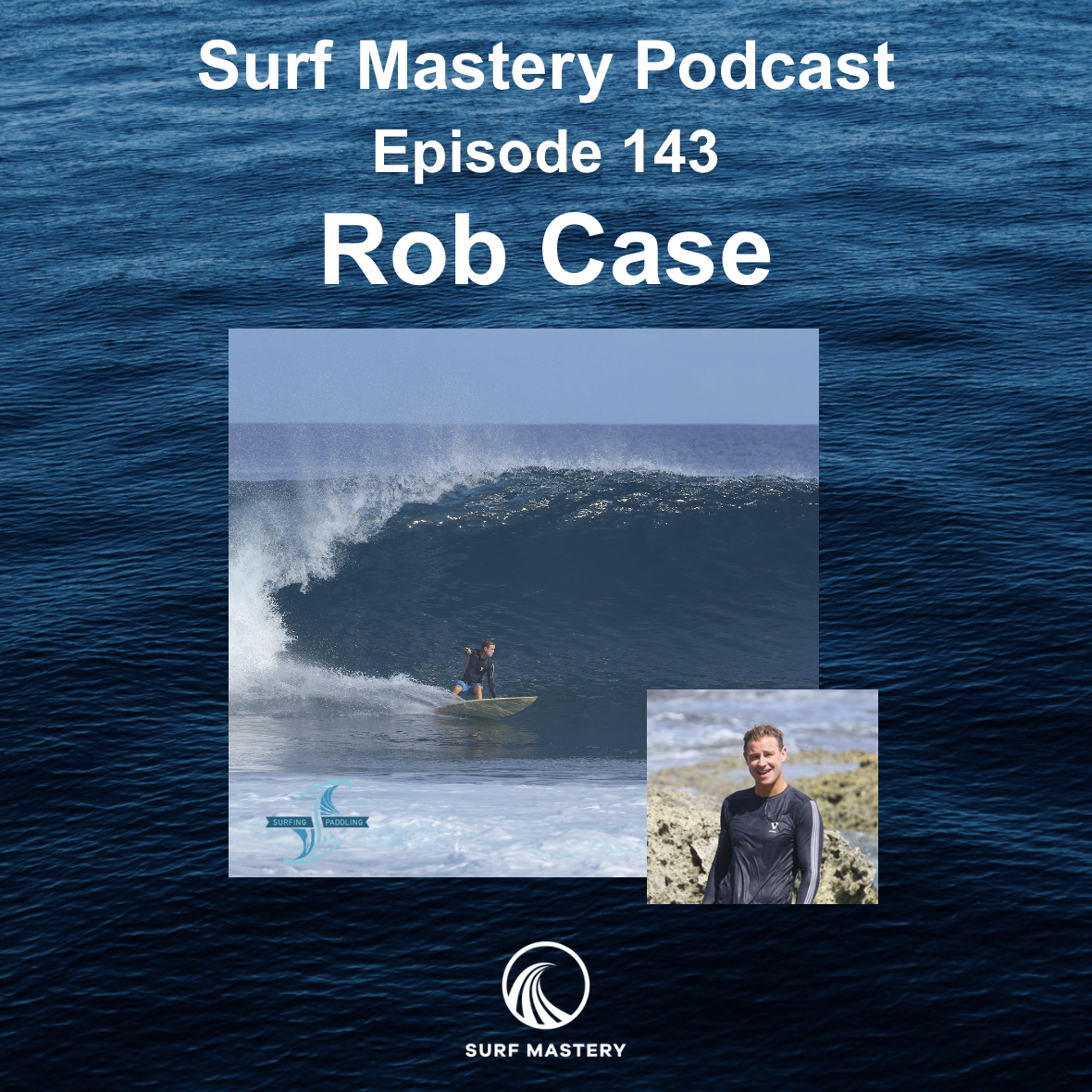
In this episode, two surf coaches and self-confessed surf nerds dive deep into the many different ways to become a better surfer. Joined by surfing paddling coach and swimming coach Rob Case, (https://www.surfingpaddling.com) we explore everything from the surprising lessons of bodysurfing to wave-reading strategies, barrel-riding confidence, vision and balance training, the importance of; swimming ability, truly understanding your local break, + much more.
To hear more from Rob Case check out episodes; 12, 91, and 126, of this podcast.
In this episode, you'll discover:
How experimenting with different boards, bodysurfing, and alternative approaches to riding waves can improve your timing, wave-reading ability, and overall surfing technique.
Why swimming confidence, vision and balance, and learning to stay composed during wipeouts and critical moments can make a significant difference to your surfing performance.
How paying closer attention to tides, swell direction, bathymetry, and the subtle characteristics of your local break can help you anticipate waves, make better decisions, and consistently catch more quality waves.
Hit play to discover how two experienced surf coaches approach surfing improvement from every angle, and walk away with fresh ideas to sharpen your skills, deepen your ocean awareness, and get more out of every session.
Rob:
https://www.surfingpaddling.com/
Rob's Instagram: https://www.instagram.com/surfingpaddling/?hl=en
For at home paddling fitness and a $30 discount on the Surf Basis paddle trainer: https://surfbasis.com
Transcript:
RobCase and Michael Frampton:
So what you been un- uh, into lately?
What have I been into lately? Dude,
'Cause last time we spoke you were into gliders. We still into gliders? Oh, dude, I... No. Yeah, of course. I just want longer. I wanna go bigger. I want- Just stretch it out ... yeah, I'm on, I got, it's an 11-footer and I wanna get a 12, and do you follow Tommy Whitt
No. No, but I, I know of him. There's Tom Whitt and Corey, is it Corey Colapinto? Oh, I follow Corey, yeah. Just the way that they surf those big boards just- Mm-hmm ... is mind-blowing, man. It's like they're like sprinting on - tight ropes is what it... It's just incredible, and you cannot appreciate what they're doing on those boards if you've never ridden one before too, because just the swing weight and the- Yeah
resistance to turning on them is just... they are incredible. Forget about Kelly Slater. I'm going Tommy Whitt is the GOAT. Yeah. It's just- What I enjoy most about them, uh, is the takeoff. They make the takeoff a maneuver. Oh, yeah. You know, the fade, fade right, fade left, kind of go back the other way, then get up, and then it's like a drop knee, and the whole thing comes around, and you're like, "Oh my gosh."
Yeah. It's incredible. Oh, it, it's, it really is. , Once you learn how to ride one, it's hard to, it's hard to get off them, man. It was quite a learning curve to learn how to ride them, 'cause it's a lot of surfboard. ... But then the thing is the, when the waves turn on here, and you jump I jumped back on a short board, , a couple of weeks ago, the waves kinda turned on, and just in- instantly just had a great surf on my short board.
I just think it just- Yeah ... the, the, the way that those big boards kind of force you to read the waves is just- Yeah ... it helps your surfing so much. I think that the, what's that old school movie? North Shore. Remember that movie? Yeah. Oh, yeah. When the guy's goes to Hawaii and gets a, a mentor and the first thing he does is just give him a, a 15-foot piece of wood.
He's like, "Start- Sure ... start with that." Yeah. They, they got it right. That, that's- Yeah ... that's it. If you wanna learn how to surf, there, there it is. Just go watch- Yeah ... that movie and just go the biggest board you can, and then just go down from there- Okay ... toward, towards a short board. . That's required watching for- Oh
all surfers. Yeah. I agree. Yeah. It's funny you say that because I just released an article that it was how do you motivate yourself on a really crappy day of surfing to go out. Mm. And I break up a, um, hour and a half session into three 30-minute sessions where the first 30 minutes you ride a bigger board.
Not quite a glider, but like maybe a mid-length. And then the, the next 30 you ride a short board, and then the next 30 you body surf. And what I always often find is when I go from the mid-length to the short board, I surf way better on the short board. And I think it's that same idea that you just, I think it also just slows you down.
And for me, growing up in the Kelly Slater era where I spazz out all the time with my short boarding, 'cause it's too easy to cheat. When you go from like a longer single fan or a mid-length or, or even a glider to a shorter board, you're like, "Oh, okay. I need to, I need to set this up more. I need to draw things out more."
Mm. And it's, it's, it's brilliant. You, what you're talking about is an extension to that, just a, something that's four feet longer than what I- Yeah ... what my longest one is. Are you, you, you don't have a, a longboard, like a log, like a, like a 9'6" or? I do. I do. But, , the spot that I do this at, uh, it's not really a longboard kind of spot.
It, the, the wave development's way too quick. Which reminds me, because I'm still on the foil journey that I'm on, I think we talked about that, and I wonder if the waves you look , for a glider, what I would look for for a foil, something that's a little bit slower and a more mellow bathymetry, and you can get into it way early.
Yeah, for sh- I, I don't see wh- But you can surf unbroken waves on a, on a foil, right? On a foil. Uh, once I'm up and riding, yes. But not I need a broken wave just to get me going. Oh, you're just paddling in? Yeah, I'm paddling. Oh. I'm not, I don't have the foil thing, or I don't have the foil assist thing.
Ah. , But, but the idea is once you're up and riding, you go out to the waves where they're not breaking, and you just- Yeah, yeah ... ride the swell. And that's how I think, like, I feel like the, the glider experiment's much better for your surfing than the foil experience on a similar wave. Like, you're getting in early.
Mm. Can you do turns without it breaking? Like, really slow turns with your glider? It depends on the wave. When you watch,, Tommy Whitt and Corey Colapinto, I think they're surfing San O or that kind of area, where you've got- Yeah ... those long period swells that kind of... So they can catch the wave very early, - Yeah
'cause there's some energy behind those swells. But the waves, uh, that where I'm surfing is sort of a lot less, wave period and, and energy in the ocean. So- Gotcha ... you kind of have to, the wave kind of has to be breaking. But the, the wave I- The m- main reason I surf the glider all the time is because the, the surf break that I surf here is, is very weak.
It's very weak. Okay. It's like a novelty sort of a wave. And the, you get the odd shortboarder out there, but you just see them pumping and- Yeah ... getting frustrated, and you're just cruising around on the glider. , But having said that, sometimes it's a spot that does turn on sometimes, and it gets hollow and fast.
I, I still surf the glider. Because you can get in so early, you can still- Yeah ... surf fast, deep waves. And even if you mistime it, you kind of learn how to just kind of hang on and set your line and sort of glide through the, the, the chaos in a way. Well, it make- makes it more exciting, 'cause you're like, "Oh."
Well, I think that's part of it, right? Yeah. It's sort of... I think the hardest part of short boarding is, is the paddling aspect, especially in a crowded lineup. You know, if you're not paddle fit and switched on with the con- with the- your local lineup, it's hard to get waves sometimes on a short board, 'cause your takeoff zone is very small.
With the glider, you see a set coming and you're like, you just paddle out to it. Hmm. And you just, you- It's so- There's so- And your takeoff zone is so much bigger. You know? Yeah. You can get in so much earlier, and if you know what you're doing, you can, you can take off late as well. But then actually surfing the board is, it's a, this, it's more technical.
- I'm sure. It, you need a button to just automatically shorten it all of a sudden. Yeah. Kind of. Well, the, the charm of it is the weight and the straight rails. It's kind of the charm. Yeah. So when you do, when you do get a full roundhouse cut back on a board like that, it's, there's no other feeling like it.
Wow. Does it speed up as you redirect it? Will it... I mean, I figure that radius has to be enormous. Are you going out into the flats for a roundhouse? Oh, yeah, yeah, yeah, yeah. Way out into the flats. Yeah, way out to the side, along, and then out into the front of the wave, the flats, to come back? Yeah, sometimes.
It's, it really depends, eh? Geez. Yeah. It's, I mean, the four-dimensional nature of a wave, you kinda, if you, if you pick your line and you read the wave right, the wave comes to you, right? Yeah, yeah. Kinda thing. The, it's, it's hard to, to bounce back off the white water, so you could've... Yeah, it's, it's hard to describe, yeah.
But the, just the, the momentum of the surfboard is so, there's just so much weight and momentum and, and like, there was, the, we had a, um, we had a, a 22nd period swell here a fe- uh, about a, a month ago, which is very rare. , But it, it coincided with a very strong wind. Mm-hmm. And the waves were pumping. It was, you know, a 22nd period.
It was only, like, sort of hip high, but 'cause the period was so long, it was very strong waves, and they were just sort of jacking up on this little reef v- beautifully. And I was the only one that could catch waves, because I was the only one that had a, enough surfboard that could cut through the chop and wasn't getting blown off.
Right. So I basically surfed the place to myself because- Right ... I was on such a big board, and it cuts through all of the chop and the wind. Yeah. So it's a- It's an interesting thought that the weight of a board, 'cause I think I've heard that , with tow surfboards they try to weigh them down a bit more to cut through.
Narrow them up and weigh them down to cut, cut through. Yeah. And so this is the more natural way of, of doing it at a paddling, paddling scenario. I agree. So- I think e- even like a high-performance short board, I, I prefer my short boards to have a bit more weight to them, you know? Yeah. Me too. I don't like those f- really thin...
I mean, w- if the waves are really nice and it's glassy, yeah, you wanna be on a thin, lightly glass short board. But h- it's, when is it like that really? It's not often. That's true. So I like a bit of weight to, to my board. - Yeah ... I really don't, I've never liked, , the epoxies, like the really light, fluffy epoxy surfboards.
Yeah. The we- I've never liked the feeling of those. So I think- I mean- ... the weight of a surfboard's important actually ... i'm surprised you don't like that. But , with weak waves, epoxies are so lively and light. But with any sort of chop, it rattles and it is not fun to surf. Yeah. I've also given up surfing short boards in weaker waves.
I was gonna say. That's the real reason. Yeah, it's funny. You've done bigger, and I was just talking to a client the other day how important it is to actually just get rid of the board and body surf. Mm. And I, and so I've been taking more clients out body surfing, which I've, I've been doing my whole life, body surfing, and the freedom that has.
As long as someone feels comfortable in water or in the ocean, it's a wonderful experience for them to not have to worry about a board- Mm ... you know, underwater or anything. Now you're worried about other people's boards, but you can go under people. - Just the other day we were out, and this guy was taking off right in front of us, and I was like, "All right.
Just dive down. Dive down. The guy's just gonna go right over us." Yeah. No problem, you know? Yeah. And with a surfboard it would've been like, "Oh, no." You know, that was the highest anxiety I always had, you know, learning to surf, was being in someone's way like that. Mm. With no board, you can just go right under and it increased the, the fun level a bit.
We also learned a lot about, you know, reading and riding waves as well. So what I'm hearing is you're at the two ends of the spectrum. 12-foot board and no board- ... teach you how to read a wave the best. Oh, definitely. Hell yeah. Yeah. It, it, it's interesting c- because there's a- I, there's only one surfer who I've come across who got world-class level and didn't start surfing until they were in their late teens.
Do you know who that is? Pat O'Connell? Pat O'Connell. Was it? Pat didn't start until, like, middle school. Oh. Maybe not late teens. But yeah, he... What did he move from, like, the Midwest, didn't he? I didn't know that. I'll have to- Yeah ... I should reach out. But no, his, , his filming partner, Wingnut. Oh, really? Yeah.
Here in Santa Cruz? Oh, man, I should've known that. Yeah. So he, but I, I, I remember when I first interviewed him, , I think he said he started surfing when he was 17, and I was like, "What?" I said to him, "That doesn't make any sense. How do you get to be that good at surfing and not start till you're 17?"
Like, almost didn't believe him. And he says- I know, but it's- ... "Oh, no, I've been, I've been body, I've been body surfing since I was five." Ah, there you go. Uh-huh. Well, of course. But again, he went to longboarding too, so nothing to a big old log. Yeah. Pretty much. Yeah, but his ability to read the ocean and be comfortable in the ocean is what would've allowed him to learn how to surf quickly and without fear probably, you know?
Yeah. That's the key. Yeah, I love that idea. , I, and again, I think the caveat there to anyone listening with, , with body surfing, you do need a certain comfort level. I've had a few clients that, I almost needed to pull them back, I'm like, "Hey, let's just learn how to float in a pool and get comfortable, you know, confident in the water before we go out to a, , 16-second swell that has some energy to it."
Even with, even with flippers, fins on, , y- it was a bit of panic that set in just for a moment. And then, then we got out of it, but it was okay. But I may have scarred him from, from body surfing. Maybe just a smidge. We'll see. Is that the key? , You need flippers to, to body surf? You don't need them.
, But it, it's certainly gonna help somebody that's never done it before because the flippers add just that extra propulsion to get into a wave. . What I like with flippers is that I can do, like, the dolphin start, where you come from underwater, and then the wave energy comes up and really pushes you out the face of the wave.
So, you know, anybody paddling out that doesn't see me take off, all of a sudden I'm shooting through the wave at them. They're like, "Ah." But then I catch an edge, and then I go down the line with it, and that's the most fun because you really feel the underwater power of the wave forming that pushes you out in front, which is really exciting and fun.
Hmm. I can't do that without fins. I haven't been able to. Hmm. Yeah. Body surfing is something I've never been able to really do. It doesn't even make sense to me. I see, I, I watch someone like Dave Rastovich, you've watched him body surf before. I watched him body surf, like, these tiny little waves. I'm like...
I, and I often try and do it, and sometimes I'll click into it, but not really. I don't... G- give me a, a quick and dirty tutorial of how to, , really b- how to body surf. Like, what am I missing? Any idea without seeing me? So I think the... Did you have fins when you went? No. Okay. So fins do make a, a, a big difference, and the ones I like are, , not straight across, but angled.
Mm-hmm. And those angled ones give you higher acceleration in a short amount of time, and that's really all you need. You don't need, like, free diving fins, which are long and efficient, and they go through the whole propulsion phase. We need just quick acceleration at the right moment. And so if you think about the same takeoff that you would do for a short board in terms of your runway, and now you shorten that runway because now you don't have a board.
So you're still looking for waves that open left, right, and you still want to get some momentum and acceleration into it, but everything's a shorter runway. So with your glider, it's a much longer runway, and then your short board's maybe a three to six second runway, and with body surfing, it's more like one to three second runway.
You actually don't want the, to get hit in the back To get started. Because now you, you don't have enough board to actually catch up to the peel of the wave at that point. Mm. You only have enough energy to go down straight, and then it's not as fun. But if you were to have, say, a three-second runway where you have some development of the wave and you're using those fins to accelerate right at that time, and then what I'll do is I'll use my inside arm, and I'll create my whole inside arm as, and all the way down my feet as the rail, uh, inside rail of the board.
And so now that'll act as my inside rail, and then I'll take my op- off rail or off board, off hand, and I'll sometimes put it behind me on the wave face. Mm-hmm. Right? And then my legs would be kind of split. So the one that's the rail of the, quote-unquote, board is stretched out in the, into the wave, and the other one's kind of balancing me- Yeah
right out to the side. And then from there, it's just a matter of trying to hold that line and keep the, keep as little drag as possible. And then you get, like, the guys in, in Maui that do all the spins and all that, but just for pure riding, making your inside body, your, your inside rail, the rail of your surfboard i- is, is all you need, and then try to keep that as streamlined as possible all the way through the ride.
Mm. And so I don't do much turning. I even tell surfers around me, I'm like, "Drop in on me. I'm not going very fast." Right? And I'll... If they drop in on me, I can just dive down and through the wave very easily and quickly. So the things that I teach a lot of my clients first are, are safety like that, when you take off, knowing how to duck through the wave and out the back, and then look around, make sure you're not in anybody else's way.
, So getting out cleanly and not hurting yourself, very important points- Yeah ... to body surfing. But yeah. Have you ever heard that, using, , your body as a rail line? Yeah. Yeah, it's, it- Yeah ... it's catching, it's catching the wave. Yeah. Oh, catching it. It's the har- Yeah, yeah ... that's the hardest part for body surfing that I've experienced.
Yeah. Sometimes I don't even paddle or take strokes, 'cause you could use the flippers for acceleration. Mm. Yeah. So it's like a, a... it's just a single stroke, and then you're extending your body. Yeah. And that's, it's, it really will change your experience. The, the, uh, the alternative without fins, and I've done it without fins, is you do need to get a couple strokes in, but just jumping off the bottom and getting into that position.
Mm. But you need, you need that acceleration, and unless you have big old feet that act like flippers, you're not really gonna get that acceleration in such a short amount of time. There's just too much drag. , I talk a lot about how when we're paddling, we're displacement vessels. We're not planing.
We're not on top of the water. On a glider, you might be- Mm ... if there's enough volume. But for the most part, at the speeds at which we paddle, we're completely displaced. Now you take that board away, and now you're really displaced. And so to go, to, to move from out of that hole to planing takes an enormous amount of energy.
And therefore, you need the, the kicking of the flippers gives you that acceleration to tap into the gravity just a little bit sooner. And then if you can do that, you can set your rail, which is your body- ... and get down that wave really nicely. And what I like about what it teaches short boarders mostly is the angle at which you have to go down and stay connected to the w- to the wave face in order to make steep, steep drops.
'Cause what a lot of people, I think, don't quite get with steep drops is how c- they need to actually connect the rail to the wave face early in the drop sequence, or else they get chucked out in front, and then there's a, too much air underneath them. And so if you're body surfing and you're getting chucked out front and there's air underneath you, it's a real simple fix, is as soon as you start getting that tipping point where, where you're heading down it, you immediately lock in at just a small angle, and then you can ride that s- that curve at a slight angle down, and then lock in to go down the line.
Mm. And it, it's rep after rep of doing that, and your brain starts to connect, oh, well, with a, with a short board, this is easy. It's, like, that much easier. And then with a bigger board, it's even easier 'cause you can get that whole sequence earlier. And then with a glider, it's even easier, right? So you just move the runway out and out and out and out and out.
. But you also mentioned, like, feeling the energy in the wave or under the wave with, with body surfing. I- is that y- you tapping into, uh, the similar sort of source as you would, uh, a foil? For the, for the underwater dolphin start? Absolutely. Mm-hmm. Like, that's w- that's when I feel that ... Because they say with foiling, you ride the top third of the wave, and that's where the energy is, and then you can go and use gravity to get down in front, but then you wanna come back up to that top third if you just wanted to ride out on the shoulder.
And with the dolphin start, with bod- uh, let me start with when you're body surfing down the line, it's more like the energy you would use, , when you're short board trimming or- Mm-hmm ... long board trimming. Mm-hmm. You know? Yeah. It's the wave coming up the wave face. It's that angle that you're at. , It's normal trim.
But when you're doing the dolphin start- You're literally like, I'm doing like dolphin kicking with my arms over my head and doing this kind of dolphin kick, and you don't feel anything, and then all of a sudden you feel this, this energy behind you that pulls up and forward, and then all of a sudden you shoot out the wave face.
That sounds cool. And then you have to catch yourself and then set your line. And sometimes you shoot out so fast you don't ha- you shoot so far out in front of the wave that you don't, it's just a full wipeout, which is also fun. Huh. Um, but yeah, it's a, it's, it's fun for people to be like shocked at. Like, you look like a dolphin coming out the front- Yeah
of the wave. Um, but, um, the feeling that you have of that top third of the wave and that orbital motion of the wave about to break, because the wave hasn't even broken yet. You're just feeling it as it's developing. You feel that top part, and it's pretty awesome. Huh. So w- you- you're out the back, you see a, a swell coming towards you, and you, when, when do you sort of, what's your goal?
Is to, is to have some momentum when the wave comes to you and be at the right sort of depth? Yeah. So if the trough in front of you, so if there's a swell coming up and the trough, you know when the, the trough kind of bottoms out right before you take a, say, a wave on a short board. During that point, I go underwater and I begin my underwater kick.
Hmm. Uh, and the underwater kick is not this, the, the flutter kick. It's the dolphin kick, like you see butterfly swimmers do, and I'm butterfly kicking, butterfly kicking, butterfly kicking, and then that's when the wave, uh, I'm basically at, at the midpoint of the w- of the swell. Mm-hmm. And that's when you feel that energy shoot you forward.
And so having just a little bit of momentum allows you to shoot out the front, and, and at that point, it's just a little flick of the fins, and boom, you're out the front. It's, it's, when you feel that energy, you're like, oh my gosh. The bigger the swell, the longer the period. You don't even need much of a flick to get out in front, 'cause it's so, it's, it'll almost shoot your whole body out the front.
And so you can kind of alter how much you kick at that point. So you stay close to the wave face when you emerge out the front of the wave, because if you shoot too much, then like I said, it's just basically carnage. You just end up out in the trough, and you have to dive down and through the wave. You don't actually get a good ride.
Hmm. But yeah, you should, you should, you should get some fins. I'll send you a link for some, some fins with that design. 'Cause you'll see a lot of different body surfing fins with different designs. There's kind of like the web design, which some people like that. I really like these ones that are angled, and the longer edge goes on the outside of your body Mm-hmm And so there is a right and left that you would wear.
Like body boarding fins. And there's some... Yeah, your bodyboard. There's something about that extra whip on the outside- Mm ... that accelerates you, and that's, that's what you need. You need the acceleration. Hmm. Yeah. I can only wear my fins for about 30 minutes before they cramp up my feet though. Yeah. Yeah.
But that's usually pretty good. I mean, 30 minutes, and, and my goal of my 30, 30, 30 is to catch 10 waves in each section. And so it's not about... Like, the whole goal is to, to motivate you to go out on a crappy day. And, you know, y- at that point you're not looking for quality of wave, you're just looking for wave count.
Yeah. And at the same time, while you're doing that, you end up with a few fun waves. Like, you, you force yourself out there, and then you realize, wow, I, I, out of maybe 30 waves that I caught, there were like five of them that actually ended up being pretty fun. Yeah. Yeah. And then you, you force yourself to go out, but you never, you never regret having done it.
Yeah, exactly. And you get kind of a workout out of it, like the heart rate is in that, like, I don't know, threshold or aerobic,, range if you're catching waves every, say, three minutes. Yeah. Yeah. And consistency is key. Yeah. Yeah. Yeah. So you're still surfing short boards a lot? Yeah. Yeah. , Our main break is, has a really fast wave development, so it's mostly short boards or maybe fun boards when it's small.
It's funny because as I'm learning to foil, I have to choose, am I gonna longboard or am I gonna foil? 'Cause it's about the same kind of waves that I'm looking for, and the same, at the same break here. And usually I'll make that decision once I get to the beach. So, uh, my car'll be full of just a bunch of different toys.
So then anybody that knows my car, please don't break into it, because I have, like, longboards, I have, you know, downwind foil, I have shortboard foil, I have, like, maybe a mid-length too, and different fins., But it's the q- it's the type, it's the tide usually makes a difference for me, , because I need a little bit fatter of a tide for a foil just to create the space.
I've tried at low tide and I've hit the bottom several times. , And then the, , I need a wave that does break. If I'm gonna prone surf foil, I need that wave to break just a little and then back off into deep water. Hmm. And that's all I'll need at that point. And then once you're up and foiling, there's no drag.
, And those aren't as much fun to ride on a longboard, 'cause y- you get up to your feet and then there's not really much else. But maybe a glider. Maybe I need a glider, Mike, 'cause there's this break that I love so much and I, I see guys on gliders catch it, like, 50 yards out, and just cruising. The thing's not even close to breaking.
Yeah. Sounds like you do. And they're going, they're going fast. Like, I'll c- I'll catch it maybe 20 yards out from the pack on a longboard, but I'm not going that fast. Hmm. Like, there's something about the way the glider is designed to go fast. Yeah, there's almost no rocker, and then there's just the straight rails.
So it's, yeah, there's s- s- no drag, you know? There's less drag. Yeah. And usually, like, I've, my 11-foot glider only has a seven-inch fin. Wow. So a small fin compared to the, you know, on a longboard, 10-foot longboard log, you might have a 10, a 10-inch fin that's fat as well. But mine's just a little- Yeah, it's draggy.
Does your fin have a ton of rake to it? Like, and is it flexible? No. So, like... No. No, it's sort of w- uh, no, it just looks, it looks like a sort of a, what you'd call a standard lo- small longboard fin. Okay. Or even a funboard. Just smaller. It's only seven inches. Yeah. It's quite, no, it's quite stiff. How, how narrow is your board?
Oh, I don't actually know. I'd actually know- I don't know the dimensions. It would be... It fits under my arm pretty easy, so it's probably no, it's probably no wider than 20. Yeah, that's pretty narrow for such a long board. Yeah. Which makes sense with the straight rails. 23. Or maybe it's 22. It, it might, because I've got a long board that's 23 and it's maybe slightly...
It's maybe more like 22, but it's thick. Yeah. It's thick. Lots of, lots of weight, lots of buoyancy. Huh. Yeah, no, get one. Yeah. I mean, uh, the people that are listening are thinking to get one. Don't go out and get- ... a glider unless you're experienced on a long board. Like I, I've worked my way up to the glider.
I didn't just go out and go short boarding to glider. I, you know, got a mid-length and then a long board, put, you know, a performance long board, and then I got a log. Yeah. And then, yep. So y- th- there's, there's a bit of a learning curve. , And it, it took me years before I was able to, um, be confident enough to surf it in a crowd.
. Yeah, and you're still taking it to a break where there are short boarders surfing? Yes. The break I surf is, like I said, it's a novelty wave. It's sort of- Okay ... like a poor man's Santa Fe, sort of this- Yeah, yeah ... different styles of waves kind of everywhere, and sometimes they link up, sometimes they don't.
So it kind of allows... If it's really crowded, I'm, I'm not gonna take my, my glider out there, you know. I'll just take a, a long board or even a, a fish or something. Uh-huh. Yeah. Yeah, there's a break here that, that, , the, the one that's good for foiling, it's great for long boarding, great for the glider.
Like it's Santa Fe, Northern California version. Mm. Yeah. Where it has that really slow bathymetry and just a rolling swell. Yeah. Yeah. When you're body surfing- I like that about that ... you would, you get such a different, perspective too, 'cause you're so close to the water's line, the water line. Yeah. You never, you never worry about, , if you're, if you've never not used to getting barreled, you're never worried about it parting or anything.
You're always inside the barrel. And then you realize, like, oh, it's not that bad, , getting blown up in the barrel. What's worse is getting the lip on your head, or, uh, or getting pitched out in front. So I've thought about this, you know, and I don't, I don't teach barrel riding, I don't teach anything past, you know, standing on your board.
But I would think that a great progression of barrel riding would be body surfing and then body boarding, 'cause you get comfortable b- being in there, and you can get really deep. But with body surfing especially, you're, you're never really coming out unless you ha- use a, a hand plane. Mm. And even that, like I'm, I'm so skeptical of those because of the potential to injure your shoulder.
Yeah. It pulls right up, and then- Oh ... you're, you're out for, for months. , But I would think boogie board would be kind of the next progression. Maybe even knee board after that, just so you're close to the wave face, and then a s- and then a surfboard. , But I don't know, that's a hypothesis. Yeah. We'd probably have to talk to a surf coach about that.
Yeah, that makes sense. Makes sense, 'cause often people are, , scared to get close to the wave face, and usually you get clipped by the, the lip. Yeah. You know, if your, if your forehand, it's the back of your head that, or your shoulders or something. Um, Clayton had a good tip, is, is it like, is when, when you're in the barrel, try and listen to- Oh, I like that
the wave. Yeah. But you don't, you, you don't wanna just lean in with just your head. You kinda wanna listen. Like you're cre- like you're getting close to a door, and you're trying to eaves- Yeah ... eavesdrop on someone, your whole body gets close. Yeah. And you don't wanna make a sound with your ear touching the...
You know, you just, you be- you're very gentle, but you wanna get really close and kind of listen to the, to the wave face. I think that helped me- Yeah ... a lot. Uh, and of course, you got your hand there sort of so you can judge distance and feel what's going on and- Right. I like that as, I like all that as kind of like a stage one.
And then stage two would be, and, and I even went through this phase, where you've made it in the barrel, and then you don't really know that all you need to do is hold the line, and so you kind of freak out and you dive. And I don't know if you went through this stage You know what I'm talking about? Oh, yeah.
Yes. Yeah, yeah, yeah. The, I've been to, barrel riding was hard for me. , The, you got that happening, your, your, your body kinda, you freeze and you freak out and you want- And you go, "Ha." Yeah. And you either stall yourself or ... For me, what my biggest thing with barrel riding is I could get in the barrel okay, but as soon as I was in the barrel, I'd tend to just go with the curve- Okay
of the lip. Uh-huh, yeah. It pulls you up. Mm. Something like that? Exactly. Yeah. And then you go around into, into the washing machine. It's like the worst- Yeah ... thing you can do in the barrel. Yeah. Yeah, yeah, yeah. And then I went, I've told this story before, maybe you probably haven't heard it, but then it w- was, went to visit New York and went to Ripley's Be- Believe It or Not, and at the end of that, , show or experience, there's this little, there's a little bridge that goes through a, a big tunnel, and the tunnel's spinning, and there's lots of little LED lights on the tunnel.
Yeah. And I took one step into this tunnel standing on this bridge, and I was completely disorientated. I thought I was going to fall, like up and over the rail of the bridge I was walking across. Whoa. Like a, a, had com- I was nauseous for the rest of the, I had to close my eyes and, and crawl on the floor back out of the thing.
Wow. It was, it was that intense. And that what, and that experience goes, "Oh, that's what happens when I get barreled." Yeah. It was just to the extreme, 'cause all the LEDs were sort of ... So my vision thought that everything, that I was sort of going this way, but my- Yeah ... so there's that mismatch of which causes, you know, motion sickness.
Yeah. Vertigo. Yeah. Yep. And then so, and, uh, uh, I had just met a functional neurologist and was getting into, um, some unique, you know, forms of training, which included vestibular and ocular vision and balance. Um, and I doubled down on that vision and balance training, and then on- and only then I could start to get barreled.
Wow. So, so, and, uh, there I c- I also went to Cloudbreak and was able to stay on the boat without getting, um, seasick as well. - What, uh, what sort of, like can you give an example of a drill that you did that helped with that? Oh, there's ... So you can think of it really simply is, so your eyes are controlled by six little muscles, , and you can control, you can train the strength, the mobility, the, the coordination, the control of those muscles just like any other muscle.
Uh-huh. Um, so but just by, uh, you know, if you think of that, a simple joint like the elbow, you might straighten And bend your elbow if you're having trouble with, uh, arm control, you know, it's shaking or whatever. You slowly, you know, learn how to control that, every aspect of the elbow flexion slowly, and then you might add some weight to it or some speed to it.
Uh-huh. And you do the same thing with your eyes. So it could be a, a... The most famous one is called a pencil push-up, where you look at something and then you bring it close in, so your eyes are converging and diverging. Okay. You've got your left, left and right. You're following, your eyes are moving left, up and down, angles, circles.
, Then you've got accommodation, which is looking at something close and then looking at something far away. Uh-huh. How quick, how quickly can you do that? Huh. Um, can you move your head while your eyes stay still? Yeah. So you've got all those movements, but the opposite. The eyes are staying focused on a, a static point, but your head is moving.
Vestibulo-ocular reflex, it's called. Something that chickens are famously good at, and you see the people moving the chicken, and the head still. So those are your basic eye, eye drills. , And you can add, you can add a s- , you could have a, a list of two, two lists of letters on one side spaced apart.
Uh-huh. And you might look at one letter and then flick your eyes to the next letter, and then look down. You, so you're, you've... And then naming as well. Uh-huh. So you've... And you can literally measure how many letters can you go through in a minute. So you can measure the ti- the, the speed of your vision as well.
Wow. Okay. And then you can train the speed of it using tempos and, uh, and then you've got a Brock string, which can do the same thing with, um, near, far, with accommodation and divergence, convergence. There's so many things you can do to train the accuracy, the control, and the speed of your vision. , So that's the visual part of it.
And the, the better your vision is, the better everything else is. Right. So you take any elite athlete in the world, and I guarantee you they can just do all that stuff very quickly, very efficiently. Huh. , And a lot of people, you know, a lot of institutes are doing that sort of training. It's just, it doesn't look good on Instagram because it kind of boring.
Right. , So there's your isolated vision drills, and then of course, you, you've got your, you know, can start ball, ball throwing and reaction tr- training drills. You're seeing those lights. Uh-huh. That sort of stuff. The advanced reaction and vision training is what you do see on Instagram people doing.
Yeah. Yeah. It's often r- often reaction-based. , And then you've got your vestibular training, which is, you know, in the simplest form is just close your eyes and stand on one leg. Yeah, I've done that. I th- so that's, I've done that and then, yeah, you can turn your head. Yep. Jim, Jim Segelnick would go through that all with me.
Yeah. But the, um, but the simplicity of the, the eye ones that you were, you were mentioning, how frequently were you doing this, and how long had you done it leading up to, say, that Cloudbreak trip? So I, I, when I really got into it, I would just do something in between each set at the gym. So while my arms or my lower body's resting, I'm doing some vision training, Oh, cool.
That's a good idea ... and, yeah, and then as well as doing little bursts of it. So with your vision and your balance training, you're best to do small bursts throughout the day, like a couple- Okay ... of minutes here and there. 'Cause your eyes can fatigue really quickly as well. Uh-huh. Uh-huh. Um- Yeah, every time I read.
Yep. There you go. , And then your o- and then single eye stuff as well, like you might not realize that one eye is working better than the other, so- Uh-huh ... syncing them up. And it's weird because it- So are you just covering an eye and doing it? Yep. Okay. Yep. As long as you don't squash the eyeball, you're fine.
You can use- Right ... your hand, you cup your hand. Sure. , Or you can get an eye patch. Um, and just seeing which eye is ... If you've got one eye that's a bit slower or not as quick to focus or whatever, you can isolate that eye, and when your vision is more balanced and symmetrical, and, , it makes a big difference in your posture too.
So you can think of the exaggerated v- if you've got an eye that's really suppressed, okay? Then so let's, let's say my left eye is suppressed, um- Uh-huh ... and I exaggerate it by covering it. Now when I walk, I'm gonna be, have my head turned slightly like this. Uh-huh. So my peripheral vision is capturing either side of my body with one eye.
Right. Which if you have a suppressed eye that's not literally blocked, but your brain knows, "Hey, I'd see better out of this eye," you're, you're gonna have a slight head turn to one side without even realizing it. Yeah. I was gonna say, totally unconscious. It's just the body adjusting for, uh, survival there, making sure that you can see.
Exactly. Exactly. That's- Wow ... it, it's fascinating stuff, and anyone who's listening who hasn't heard me, , go on about this is you go to Z-Health, go to zhealth.com, and they've got a whole bunch of free ... They teach functional neurology stuff to personal trainers, and they've got a whole bunch of free videos that you can get into the basics- Yeah
of vision and vestibular training, and it, it's cool just to add into your, into your normal training. , And then if you're having any sort of serious problems or you're serious about it, I do one-on-one stuff with, with clients on this and stuff, and then, but Z-Health also has, you know, a bunch of trainers that are based around the world that specialize in, in that.
And if you're, you know, having serious problems, there are, um, you know, physiotherapists and physical therapists that specialize in, you know, vertigo and balance issues. And, uh, you got behavioral optometry ch- as well- Mm ... which is another field which looks into, that's more sort of for people that are having trouble reading or driving or something.
It's amazing what, you know, behavioral optometrists will give you exercises to avoid having to get eyeglasses, for example. Really interesting field. Yeah. Yeah, no, that's really neat. It's- Long story short is when, when, when my vision and balance improved- Yeah ... then I wasn't getting seasick. I could go on a boat trip, and I could also get barreled without- Just wanting to just feel, I was just feeling completely disorientated.
Right, right. And that, that Rip- that Ripley's or not spinning tube experience really exaggerated and highlighted to me, oh, that's, that's what's going on with me. 'Cause there's people, you know, your standard American looking people, let's say, just walking through this tube unfazed. And I- Right ... I, I couldn't, I couldn't even be in there, you know?
I had to close my eyes and crawl out. Yeah. Yeah, and that, I, that's probably more you... I don't know, do you think that's more rare for surfers to have that? To- Or more the fear- I think- ... freeze response inside a barrel? I- if you are, and if you're disorientated, then you're gonna be scared Do you know what I mean? Yeah. I'm trying to relate it to my own experience when I was learning, and I just kept diving, and I couldn't stop the diving. Like, I wanted to get to body surfing- Mm ... which is what my brain was used to.
. I'm in the barrel, I'm in the barrel, I'm riding, I caught a good line, and then I, instead of holding the line and just trusting the wave would open up in front of me, I jump off in front and basically body surf until it closed out. Yeah, that sounds like a, a fear of the foam ball, a fear of what's behind you, right?
Yeah. Which is- Yeah, well, it took me- ... understandable ... a while to... Yeah. And then, and then actually, um- Every once in a while I'd get lucky and I'd hold the line, right? And I'd be like, "I got barrel. I came out. It was amazing." But then when I really started dialing b- barrel riding was at Surf Ranch. Mm. And there you trust the wave way more to stay open.
Yeah. And I realized just holding that line, holding that line, holding that line, and then coming out the bottom was, like, the best path. And then I started doing it at Ocean Beach and with bigger barrels, and I was like, "I'll just hold this line. Come out- Nice. Yeah, nice ... down below where... as opposed to going up or jumping.
And it just started, everything started clicking from there. Mm. So it's weird Yeah. It sounds like you didn't have... You, do you get seasick on boats? No. No, you don't have a sensory mismatch, so th- my issue wasn't definitely not yours. But the, so for those listening, you know, Matt Granger had a great, in one of the interviews with him, he said, "Just pull in to close out barrels and hold your position as if you're going to come out."
'Cause the worst thing you can do is open up your body, and then you're- Yeah. Then your limbs are getting pulled everywhere by the washing machine. But if you stay in that tucked position, your hands are in front of you, so if your board slips out, it's gonna stop it hitting your head. And if you do end up getting swallowed by the foam ball behind you, it's actually not that bad of a place to be.
The worst thing to do is to freak out and end up getting spun over. Yeah. , So- Or stand up through the lip. Yeah. Those are the worst things to do, especially if you're surfing reef breaks. Right. So, and just getting comfortable with the, with the tube swallowing you, but just having the wherewithal to hold that, 'cause it's actually quite a safe position, isn't it?
It's a very sort of- Yeah ... fighting stance, um, compact position to stay in a barrel. So, and then you're also, and commit, you, you know, commitment is, usually when people commit, they don't get hurt. It's when you're sort of on the fence is when people sort of tend to get hurt surfing. Yeah. So that's what I, that's the advice.
Gotta go all in. Yeah. Yeah, no, that was good. I wish I had heard that one before. That's a good one Yeah, tube riding is technical Yeah. What's, uh, what are some other kind of trends in surfing that you've been coming across lately, whether it's training or if it's, uh, you know, trips or kind of like the hot button that you've heard lately?
You're, you've got your, your nose a little bit closer than I do into the trends of surfing. I've got a guy, what's his name? Isaac Stant, I think is his name. He's got as his Instagram handle. He's this Hawaiian guy who's got the long, what does he call it? Longboard theory. Ah. Long rail theory or something, and he's surfing- He's surfing like 6'6"s and, right?
Step up, step up boards- Yeah, step up boards ... and smaller waves. Yeah, yeah. So similar to what we've kind of been talking about in a way. Yeah, yeah. But that sticking with that sort of short board style. , And it makes complete sense to me, so I like that way of thinking. Yeah. I've actually, in the last year or so, I went...
Two years ago, I went mid-length, and then I was like, "Man, that's just a lot of board." And so I kind of, similar to Isaac, I took an old step up, and I love the narrowness, I love the rocker, I love how thin it is, and I was like, "Oh, I have a 6'6" or a 6'5". What if I just made it a twin fin?" Like just two of its, and just take out the middle fin.
. And boy, oh, boy, it loosens it up real quick. Oh, yeah. And, and I found, uh, i- it handled really well up to about head high, couple feet overhead, and then soon as it was more powerful than that, I needed to put that, something in that last fin. But man, it's the sa- I saw, I think I've seen him, and I was like, "Oh my gosh, that's awesome.
That's brilliant. I love that." But again, it's just another tool. It's, doesn't mean that everybody needs to just do that. I just love that. That's why I asked you the trend thing, like what's new. I wanna try that. , I think the more stuff we try, the, the better off we are as surfers. It's gonna help us in riding waves.
Oh, yeah. Or, or at least help our motivation, you know, if we get bored with one thing. . But if you really wanna improve your short boarding technique, I think going on a longer short board is, , similar to the way that a, you know, a mid-length or a long board u- slows everything down. Yeah. But you're still on a thruster.
Yeah. So what I've found with it, it, I, I'll, I'll still just do a twin, but the longer rail line makes that radius of the turn longer- Hmm ... if it's a full roundhouse. And, uh, my, I, I've been trying to work on not cutting off my turns, so that helped me follow through all the way through the arc. Whether my timing when I get back to the whitewater is right or wrong, it didn't matter as long as I made it back there with speed and acceleration coming out of it.
Yeah. So for me, it helped an enormous amount with that. Um, but yeah, I, I love longer rail lines. And then I, there are times that I don't like longer rail lines. Yeah. Because you asked earlier, do- you're short boarding a lot. I'm back to short boarding a lot, yeah. Mm. Um, I got a, a small 5'8" twin from my shaper.
He's retiring, and so he's like, "What's a board that you don't have?" And I was like, "Oh, I'd love like a small performance twin fin." And so he shaped me this beautiful little board. It's, it, uh, works in small waves, it works in big waves, and I've really enjoyed riding that. 'Cause I, what I'll do is I'll chip in way outside on just like a little, just a little...
I just need a little bit of a ramp, and this board's wide enough to get me into that. And then from then on it's, it's game time. I, I love that little board. Fits every curve I put it into. Nice. Uh, that and then- Sounds like a Susami knife. It's quite nice. And then what I've also been surprised with since we last talked, I got a Donald Brink board- Yeah
and it's an A-sym. Mm-hmm. And I, I s- I just say, "Donald, the, these are the waves I'm surfing. They're, they're punchy, they're beach breaky. Just give me something that'll fit the curve, and that might be fun." And he gave me this tiny little thing with tons of rocker, and really, and pretty narrow. And he likes, I li- he knows I like boards narrow too.
Mm-hmm. And I thought, "Oh, this thing's only gonna work when the waves are punchy. Like, this just seems like this thing's just gonna sink otherwise." Yeah. And I've taken it out on small days, and it's incredibly fun and fast, and like- Yeah ... oh, my goodness. And I go back, I'm like, "How is this thing working, Donald?
Like, I don't get it." Like, the, to me, my physics brain, this board should not work in two to three flat, you know, two to three-foot waves that are super flat and slow. Mm-hmm. I was like, "Why, why do they work? Why is it working?" He's like, "Well, 'cause you're light." I was like, "Huh. Okay." That's all I said. I was like, "All right.
Kinda makes sense, but it's 'cause I'm light." Yeah. Well, he knew your weight when he shaped the board. Yeah. And he knows my stance too, so that was another thing we talked a lot about. Yeah. Was the stance width. Hmm. So he's, he's really fit that board nicely to, to, to me and my body. Yeah. Which is incredible.
Yeah. In terms of trend, you asked about trends though. Yeah. I mean, that's one of the, the A-syms is definitely kind of a trend still, isn't it? Yeah. I've got a A-sym Donald Brink. I, I quite like it. Um, but what's trending at the moment is a sense of entitlement.
Still, right? Hasn't that, that, I mean that's- Post-COVID, like- Yeah. I was gonna say, for locals that's been a trend for ages. But yeah, for, for the post-COVID surfers, yes, there's still that. For the newbies, yeah. You know, so, so- And I think it's some- we were ta- I was talking about this the other day with someone, how I feel like when they started The way he described it was people started and it was all about just wave, waves, waves, waves, waves, and it was just, you know, blinders on, waves, waves, waves, waves.
And then they'd go off on their own away from said starting instructor, and they'd still carry that mindset over- Hmm ... of wave, waves, waves, waves with no situational awareness about anything else that's around them. And unfortunately, there were so many of them doing that, that that's where you and I are sitting going like, "What?"
There's entitlement there, but it's... I, I think it's just, you know, an, an ignorance of what's going on around them That's, I think that's a big part of it. I heard someone else just, uh, uh, surfing is not a safe space. I think that kind of encompasses it. I think people going into surfing think, thinking that it's a safe space.
Mm-hmm. And then, and I, I think for surf school, it's kind of your job to make it feel like a safe space, right? Yeah. So I get, and what you sort of said about these, so I get why people have that attitude, but I think it, it is ignorant, 'cause surf- the ocean's a dangerous place. Yeah. And other surfers are dangerous.
You get a surfboard to the head, and, you know, it's, it's not fun. So you gotta be careful of your own board and other people's boards. , But I think that's the most ignorant thing to think is that surfing... People think that surfing should be a safe space. I think that's, pfft, that's, uh, a recipe for disaster.
And, uh, I, I, I think that's why a lot of old school surfers are getting frustrated with, , people thinking that it should be a safe space and that, that some old dude should give them a turn or, or, or whatever. But, uh, surfing doesn't work like that. No, it doesn't. No, it doesn't. Well, it d- And I feel like the older generation, they're, they're getting tired of fighting the battle, at least around here.
I've see, I see more of the older generation that used to really enforce go to all these obscure spots now, and, and they're nicer now. And I'm like, I'm like afraid to talk to them. But then when I talk to them, they're like, "Yeah, I just don't even wanna deal anymore." Hmm. And this was a guy that, like, used to enforce like crazy and scare the crap out of us as kids.
We wouldn't even go close to the guy. And here he is saying, "I'm just, I'm kind of over it. I'm tired." Yep. And no one's, no one's picked up the, picked up the torch to carry it on- Hmm ... around here at least. Yeah. I think it's, it balances out though, doesn't it? 'Cause you've got, there's a lot of breaks now where that's all you, that's all you're gonna get, so just don't go there.
Right. And then if you're, if you're a serious surfer and you wanna surf serious waves, then those people aren't there anyway. Yeah. It's the smaller days where everyone's kind of everywhere that's the, the frustrating ones, I think. Yeah, yeah. Is when you get those, those clashes that you see on Instagram and Well, you know what I like, like this is the, th- today is a holiday here in the States.
Hmm. And it's a holiday weekend, and we have a swell from Hurricane Marie, and it's going up and down the, the- Oh, yeah. What are you even doing here? ... California coast. Yeah. Well, this is why, this is why I'm talking with you. Yeah. I don't bother on these days. Like, it's such, and I, I, on Saturday morning, I had a client, and so I was like, all right, well- Here's what we're gonna do.
We're gonna get up super early and we're gonna get to this spot, we're gonna get a parking spot, and we're gonna go early and we're gonna get out of there. 'Cause it is an absolute zoo otherwise. We got there at 6:30 and we were, you know, one of three remaining parking spots at 6:30 in the morning.
Sunup's here at 6:30. Yeah. So I mean, everybody's on it, and that's the thing with Surfline is I have an alert not for when it's good to epic, which is like right now. They're like, "Good to epic." I'm like, "No, I'm not surfing that day. I'm gonna go, I'm gonna paddle my lagoon." I went foiling off, off my dock.
I'm gonna stay here. And I have surf alerts for when it's poor to fair. Mm. Because that's, those are the most fun days. I'll go to all the spots when it's poor to fair, 'cause nobody goes. But I feel like that's a bit of a, the thing. I get, I get texts from clients like, "Oh, what do you think about this spot now?"
I was like, "Yeah, it's gonna be good, but you're gonna be with about 50 other people- Mm-hmm ... that also got the notice." Yeah. So yeah, I don't... I got a bit of the swell. It was good, but I, uh, I, I went paddle boarding today and foiling instead. Yeah. Yeah. Seeking different types of waves, like when I interviewed, Aaron James.
He's a surfing philosopher, and he's talking about adventure surfing. That's where he just, that's the term he could've sort of coined, is like, "Oh, I'll just grab a bigger board and go just paddle round the cove or up the beach and just go and surf by myself." Some different sort of strange wave and adventure surfing he calls it, and it's sort of- Yeah.
It's a bit of, um... So I'm developing a level three now. So I have level one, level two, and th- this'll be level three, where half of it will be a version of adventure surfing, except we're not going to a break. We're taking paddleboards out to the ocean. We're gonna do downwinders. Oh, nice. And, uh, it's in terms of, you know, what does that train?
It trains ocean awareness, confidence, but also that, that three-stroke burst to get a new wave, and you just get that rep after rep after rep out there, and it's fun, and it's an adventure. So, so when you say paddleboard, what, like a s- Pr- prone, prone, prone paddle ... surf life-saving style, like massive. Yeah.
Yeah. So there's, um... He's been on the podcast before, Nick Franco. He's, he's gonna design a custom one for me and a stock one for my client, and then we're gonna basically go out. I'll have all the safety gear, 'cause I've done this several times on my own. And, uh, that's kinda like my philosophy is technique first, fitness second.
Hmm. Right? Because if you have great fitness but you're applying that force in the wrong direction, it's just sending you the wrong... It's a waste of energy. It's not effective. So once you get technique, now you get fitness on top of that, and the repetition of that same motion over and over again, and that's really what prone paddleboarding is.
It's, it's mostly fitness. You know, if you look at the guys that win those big races, it's fitness, but it's mental fortitude. Like I think probably 80% is mental fortitude, 'cause they're all super fit. So the thing that's the difference between the winners and those that don't win is that mental side of things.
And, and reading the ocean, reading the waves that they're, they have to ride., So that's what we're gonna bring in with level three. So it's interesting because, uh, where you're at You have a lot of that as a part of the culture in, in New Zealand and Australia. You have, you know, surf lifesaving. You guys are used to boards like that.
It's not that common up here. I mean, there are small pockets, small groups, that... And it's a small little culture of, , endurance athletes. , So I want to introduce it as a training tool for surfers, for regular surfers, that, yes, it's gonna get you fit for sure, but you can use it as that repetition of catching, that wave-catching sequence over and over and over again, and have fun.
And then it also increases your ocean awareness, 'cause we are going out into rough seas around the Bay Area, and it's gonna push their fear limit a bit, because currents are really strong, swell's really strong out there, wind is really strong when you're just off the coast even. So we'll, we'll do a couple point to points that I'll plan out, but even some round trips out and back.
And, uh, I'll put them into some, some challenging situations that I know they'll be able to get out of it. But hopefully that it, it helps them, kind of takes them to that next level. So we'll see how many people from level two will want to do level three. Mm. No, that sounds awesome, actually. I mean, the, the level at which- Those guys what, like the Molokai event between the islands, right?
Like, yeah, uh, they gotta be fit, but also the way that you read the ocean and you, the timing of your strokes and the little adjustments and lines and that must be a, there must be a lot to it, I imagine. Well, here's, here's what I'll, I'll, I, I wanna... Maybe I've told you this, but if you take a look at the Catalina Classic times and the average speed of the Catalina Classic winners or even just the, all the competitors versus the Molokai to Oahu.
The Molokai to Oahu has vastly different times all the time, and it's mostly due to how much swell action's happening in the channel. Mm. Whereas the Catalina Classic is pretty standard. It's a pretty flat course. Like, you're not really, you know, you probably, they're probably averaging about five miles an hour, which is really fast.
The Molokai to Oahu, some years they're averaging 8 to 10 miles an hour. Wow. Now let me, let me tell you, like, if you're gonna come out here and prone on a 12-foot prone board or even four foot, 14 foot, you're averaging maybe four and a half to five miles an hour, right, in flat water. Mm. So that's very close to the Catalina Classic.
Mm-hmm. They're going a little bit faster on average over, you know, 30 miles or whatever it is. Mm. The Molokai to Oahu is 8 to 10 miles an hour average. Yeah. And so this is what really helped me when I developed Level 2. I'm like, hey, listen, this, this is proof right here that y- How are they possibly averaging 8 to 10, meaning they're going faster than 10 miles an hour at times.
They have to be riding waves. They have to be using gravity. They have to have that transferred to them, and they get that acceleration. That's the only possible logical solution, uh, to, to that question. , And it's, it's fascinating. The, the, the Catalina Classic, even though it's a qualifier for M2O, it's much harder race physically and mentally, whereas the M2O, it is much more about reading waves and getting on good lines and not wiping out when you ride the wave, you know, keeping that momentum moving.
Uh, whereas Catalina is just put your head down and go. . And, and go and go. And my goodness, it is a, uh, it's a tough one mentally I think. Have you done it? Oh, no. Uh-uh. I don't have any desire to do those anymore. I've done the Northern California Championships here in, uh, in the Bay Area, and that was a really fun one.
We went around, went around Alcatraz, and then we went around the south tower of the Golden Gate Bridge. And that was crazy because you've heard of the, the, the, the currents under the Golden Gate Bridge. They can get up to like eight knots, like they're flying. So I'm sitting there and I'm in, I'm in a field.
I'm a prone paddleboarder- in a field of other suppers, so all different kinds of stand-up paddleboarders around me, with a few prone people in the, in the race as well. And I'm coming up on the south tower, and I'm on the inside of this tower, of the, the pylon of the tower of the Golden Gate Bridge, and it's totally calm where I'm at.
It's completely glassy. And so I tuck in right in there, and I'm looking out at the ocean, I'm looking ocean-bound, and I see a stand-up paddleboarder paddling to right to left in front of me. That's the direction he's pointing, but he's going left to right. He's going backwards. Yeah. Like, he's just getting pulled, and he's like cranking.
He's like, oh, and I'm looking at this thing like, "Oh my gosh, I need to go around this tower?" Mm-hmm. 'Cause the, the currents were going all over the place, and it was just one of those things where they just mistime the tides, and my goodness, it was crazy. So I pointed this long board Out to sea, and I just paddled a little bit more with my right arm than my left arm, and I, I didn't even turn the corner.
I just kinda kept pointing out to sea, kept pointing out to sea, kept pointing out to sea, and I just started moving left a little bit, little left. And then as soon as I cleared the, the, the pylon and the cement, I turned the bow of that thing around, and shm, just flew on back inside, 'cause the current was cranking that way.
It was so wild. But luckily, leading up to that, I had done... I'd gone around South Tower many times on training runs with groups, and you get to know kind of the different strategies of how do you get your board around this thing. Mm. 'Cause even in, in the training runs, you don't have to go around it, but in the race you do.
Mm. Um, and usually they try to set it up so that it's with the current, but it just depends on when you arrive there, you know? Mm. But yeah, fascinating, uh, little adventures all around here. , But yeah, I don't do races anymore 'cause I don't have the, I don't have the time or patience to train for some of those big ones.
Um, nor do I have the desire to push my mind to that limit anymore. Like, I'm good. I'm- Yeah. I'm, I'm satisfied. Yeah. You know? Yeah, those endurance races are nuts. Yeah. There's something, you know, and, and good on them that, you know, I think building that grit, and I've done that in my past, and I, I've got that feather in my cap, and I'm very happy with that.
I don't need to prove anything more to myself. Um, but yeah, man, the, um, again, I think the, the phys- everyone's physically about the same, but it's that mental side that really is, is fascinating to watch. I'm, I'm very fascinated by it, but no, don't wanna be a part of it. Mm. I'll help someone train for it.
I've helped several try, clients train for those, those, uh, those races from a technique point of view, but technique's very small when it comes to prone. Mm. You know, it's really the mental side and the fitness side that pushes you to that level. And reading the water. And reading the water, reading the waves.
Yeah, absolutely. Yeah. Yeah. Yeah. So that's why I think, you know, the, the downwinding and reading waves, it's extremely beneficial for surfers. Like, it's incredible, because we just don't get enough reps catching waves- While also thinking about technique, if that's makes sense. Because whenever I train someone, I say, "Don't think about your technique when you're catching a wave.
You know, train it outside of that environment, and then, and then the subconscious should take over." But there's just still not enough reps. People, you know, they'll, they'll hear me say, "Hey, these are the num- minimum number of reps you need to do." They'll do maybe a quarter of them. Hmm. You know, and that's, y- as a trainer, you know that.
Like, you give them more, and even if they arrive at half of what you give them, it's better than them not doing any. Yeah. But, um, yeah, I think prone is extremely helpful. Not in flat water. Flat water is just strictly fitness. Hmm. But if you go downwind and you got some shorter period swell, some wind, and it's quite freeing of the mind.
You're out in adventure. It's adventure surfing, as your, your buddy, you know, mentions. It's getting out and you're seeing the coastline from completely different perspectives, um, than you ever did before, and you get used to being further out away from land, and I think that's extreme- especially up here, that is extremely important at Ocean Beach, 'cause I've had many, many surfers that will, you know, s- a large swell is rising, and all of a sudden the currents start pulling them further out, pulling them further out, and then that, you know, sense of panic sets in.
And if you're used to being out that far, it's... Or if you're used to being twice as far out, that's like nothing. You know? Yeah. It's like, "I've seen, I've seen this perspective before. It's not bothering." Yeah. Yeah. Oh, it's intense, the- Yeah ... the way the ocean behaves out there, a little bit- Yeah ... further out.
The currents and the wind chops and, you know, like you said, watching that stand-up paddleboarder go backwards, it's... It was unnerving. Like, I had not seen that at that point, but at least I had enough reps under me to feel confident to get, to figure a way around. Yeah. Yeah. Yeah. Any other, uh, new trends that you've, you've come across?
Not really, man. I'm out of the loop. You know, I'm just f- actually just focused on trying to read the ocean better. That's- Yeah ... that's w- I think that's the key. That's the secret sauce, is just reading the waves, reading the ocean better. , Especially the way I surf, which is, you know, quite a novelty wave.
There's secondary and tertiary swells and backwashes and And if you choose the right wave, then you get a magic one. If you don't, you're on this fat wash, wish washy wave that has no power, and you gotta paddle back out and back in line. But if you choose the right one, and you can read the, the details, you get a good one.
And then obv- obviously timing of turns and all, all that. I'm trying to, you know, do, get no paddle takeoffs. Yeah. So all of my paddling is to put me in the right spot to just turn and cork and go- Yeah ... as well. So I'm just trying to read the ocean j- better and better really. Do you think, do you think, and this is more a phil- philosophical opinion or thought, do you think someone trying to learn the ocean better, it's better to just keep going back to the same spot, or is it more beneficial to get a variety of different looks at different spots?
Ooh, that's a good question. Uh, hmm. Probably staying at the same place, I think, and really getting one spot wired- Yeah ... would, I think, is the, probably the best answer. , But you have to travel as well. Um- I think, okay, so here's, I'll extend on that 'cause I, I'm in, I'm in agreement. I think going to the same spot over and over again and seeing it on different conditions, but with the caveat that you need to understand what the conditions are.
Like, what swells are in the water, what the tide is, you know, what the period is, what the directions are, what the sand is doing, if it's sand. Hmm. Like, what the general trend has been. Has it been blown away from, say, a rock, or has it filled in? Like, then after, say, a year of seeing all these different looks of the same spot, if you're also, you also kinda know what each condition was and what the result looked like, now you might be able to take some of those same pattern recognition and apply it somewhere else at that point.
'Cause I think what you're saying is like, okay, basically become a local at your local place, and that's why locals are really good at their break, 'cause they see the same conditions. I get that. But what I think the bridge a lot of locals miss, , explicitly is the why. Right. They're like, "Oh, yeah, there's, there's a south swell.
I'm gonna go here on this day or this time." And they really only get it for that, that break, but they can't apply that same logic of thinking somewhere else with a different, say, angled beach or different bathymetry. Mm. Trying to figure it out. Well, I was... Yeah. And you- That's my hypothesis. Yeah, but there's so- every time you go to your local, it's always different, even if it's the same on paper.
Right. Right. 100%. And the more you get, like you said, like I, I look at Surfline and I go into, there's a button you can push to go into the advanced swell where you see all of the swells on the water. Yeah. So if you've seen that, look for them in the water and realize- Exactly. Yeah ... how come every, how come every fourth set has more waves and better waves?
Well, maybe two of the swells are kind of syncing up at that time, or maybe- Yeah ... the tide is doing something, or the refraction from the headland up the thing is the timing with the swell and the side swell and Put even just the simple thing of when you're paddling in, put your chin on your board, and the different perspective you get of the surface of the water and the tertiary swells.
And then- I like that ... and then, you know, where are you gonna do a top turn? Well, you, if there's tertiary swell, then you're gonna have to time your top turn with the lump of the tertiary swell on the main swell. Yeah. And that's why short boarders can do roundhouse cutbacks on tiny waves is 'cause they s- they can see those little chops and tertiary swells and back washes or a rip bowl or whatever it is.
The, the, the, the finer... I use the analogy of like a m- of mountain biking. I've been getting into mountain biking a little bit. Ooh, be careful. Yes. But- Might take you out of surfing if you get injured ... but you've got a, you know, you've got a meter- ... you've got a three-foot wide track that you're going down, right?
Yeah. When you first start, you're like, you've gotta stay on that three-foot wide track and go down, and the better you get, the more you're like, "Okay, what's the fastest, safest line within that?" And it's where everyone else's tire marks are. And it's like, okay, well, can I get the center of my wheel in the center of that track?
And so you're, the way that you read the track becomes more and more nuanced and more and more detailed. Yeah. And you get more and more focused, and that's what allows you to go faster, right? Is you're not just flying down a three, uh, you're almost flying down a tightrope within- Right. Right ... and if you make a mistake, that's okay, 'cause you're on a three-foot wide track, but if you wanna go fast and accurate and smooth, then you've got to look.
So surfing's the same. It's like good surfers, they know exactly where their rail is going to go. Yeah. You, you, you watch- Except they don't see the track until like a second before they arrive. Yeah. 'Cause the track changes. The track is changing, but I think that's your experience. I, I, I think teaching people to look for things like that- Yeah
is, is mind-opening. Like, um, when, when I first learnt it, , looking for the, the details on the wave, it consumed a lot of my time, and then that, it's just like, right, driving a car, right? At first, everything's complicated, and, you know, a few months later, it's all sort of happens automatically. So I'm just forever trying to- The, I think the more detail-oriented you are- Uh-huh
the more of that other stuff becomes automatic. And like, for example, when I'm driving now, I'm trying to look at the shape of the stones on the tarmac. Do you know what I mean? Like, so I've started- Yeah ... moto- motorbike riding now, and when you're driving a car, you don't have to. But when you're riding a motorbike, you want- you're looking at the texture of the road.
Right. You know what I mean? You- Yeah, yeah ... you don't wanna look at a pothole. You wanna look at, to, you choo- as soon as you see a pothole, you gotta choose which side are you gonna go on. You don't wanna keep looking at it. Like surfing, if you see two surfers, don't look at one of them. Look in between them.
You know? Look where you wanna go. Yeah. So, but you take that onto a more and more detailed level, and you're looking, okay, I wanna do a bottom turn right there- Yeah ... where that little boil is on the break, or where that secondary swell lines up, or where the wind chop is. There's a gap in the wind chop, that's where I'm doing my bottom turn.
And I think it's highlighted when you see good surfers surf really fast through tricky, choppy conditions. Like, well, the only way that they're doing that is because they're reading the ocean on a very detailed level, and they're putting their rail in, in the smooth parts of, of the chaos. It's the only way that they do it, right?
I mean, I imagine it's- Yeah, and I'd say there's probably a bit of anticipation to make sure that the section's there when they arrive too. Oh, all, all of that. Yeah, yeah, yeah. And the, and the way that they're absorbing as well. Yeah. With their, their bodies are relaxed and they're absorbing it. Yeah. But they've gotta see it first to be relaxed- Yeah
enough to absorb it. So it all comes from what you're seeing. , That's why I think John John's, part of the reason he's so good is he sails. Yeah. So he's, when he's not surfing, he's reading the ocean still. Yeah. He's constantly looking at the conditions, and he's a photographer as well, so do you know what it is?
Attention to detail. Yeah. Attention to detail, yeah. Yeah. It's all about attention to detail and, and predicting. . So that's what I'm s- what focus on at the moment is more and more of that. And even the, like, the tides, like, high tide is, where I surf, it's best at high tide. Uh-huh. But it's not. It's actually best at about 1.2 meters.
Yeah. The magnitude- So if- ... of tide makes a difference. Yeah ... so if you've got a king tide that's up to 1.7, I turn up at mid tide, surf by myself- Uh-huh ... and then everyone turns up at high tide and it's swamped out. Right. It's like, well, I looked at the meters of the tide, and I realized it's actually not high or low tide that's better at this break.
It's, it's the actual level of water, and those fluctuate. Depending on where you live, they fluctuate more or less. Uh, m- some, some places don't fluctuate much. But where I live, you know, high tide can be 1.2 meters or it can be 1.8. Yeah. And that's- Yeah ... that's a big, big difference. So- Oh, it's a huge difference, and it's not just the bathymetry difference in shore.
But what I've noticed is that, and I've, I've thought about this the last few years, if you look down at your local spot from a map, if you start to zoom out further out to sea, and you try to imagine the bathymetry that's out there that's leading the swell in, and maybe the bathymetry even further out than that that's leading the swell in, tides affect that bathymetry and refraction as well.
And there's a spot in Santa Cruz, it's, it's wild. Everyone's like, "Oh, low tide Santa Cruz, low tide Santa Cruz, low tide Santa Cruz." But if the tide is too low, it actually causes the offshore bathymetry to pass a swell right by the whole east side. Hmm. And it's not until it hits, like, a one-foot low that swell starts to come in more frequently and larger, and people are like, "Well, what's going on?"
It's like, well, it's the offshore bathymetry. There's these canyons offshore, and there's something to do with that negative low tide that causes the bath- the refraction to s- pass right by. It still hits west side. It doesn't, it doesn't hit the east side as, as, uh, as frequently. And then once that's, like, one to three-foot magnitude, boy, oh, boy, that place lights up.
Hmm. Yeah. It's pretty wild. Yeah. It's the same where I surf. , At low tide, or high tide could be twice the height, the, twice the wave size. 'Cause at low ti- Yeah ... low tide, all that energy has been absorbed by the bathymetry further out to sea. Further out. Yeah, exactly. Yeah. 'Cause it's shallower. Or it doesn't refract, or it doesn't even refract in.
Yeah. Yeah, exactly. Yeah. Yeah. So the high tide, the swell can sort of has more freedom to, to come through 'cause there's more water level way out there. Yeah. Yeah, but people don't think about anything beyond their s- line of sight. Exactly. Like, all the stuff we're talking about there is way past where you can see.
You have to almost imagine it And how the swell is moving out there- Yeah ... using a map. And just, just take note. Yeah, take note. Yeah. Start thinking about these things. That's all right. Like, that's, I think is experienced surf- developing experience as a surfer is about, I think, all of those sort of sorts of details.
Yeah. And that's how you get better, 'cause you're not getting fitter or stronger so much when you're, when you're aging. It's more about maintaining what you've got and then improving- Yeah ... when you surf, how you surf, what board you surf, how you read the ocean. Yeah. All of that stuff. It's- Yeah, yeah ... that's the key.
Yeah. Wiser, wiser as we age. Yeah. I've been trying to think about ways to, to teach it as well, like, and, um, just that's where I'm, that's where I'm focused on myself and also sort of teaching people to, to read the ocean and just, just by pointing out things like we just talked about- Yeah ... what to start by looking for it.
If you can't see it- You, yes ... then you're not gonna be able to incorporate it into your surfing lexicon. That's right. You gotta see it first. - You gotta, you gotta take the Chandler approach and just sit on a rock and watch waves. Used to do that when I was young. We, remember we had time to finish surf- You finish surfing, you just sit there and watch as well.
Yeah, yeah. Yeah, uh, but, uh, but calling back to North Shore. Yeah. And also watching, when you're watching surfing Pause. Like if, for example, watch Kelly Slater do a bottom turn, pause, and imagine what he's looking at Ah What's in his visual field when he's looking up at the apex of his bottom turn, he looks up.
Half of his visual field is taken up by the breaking white water Right That's how far back he surfs Yeah For most of us, when, when we do a bottom turn and look up, it's all clean wave face Yeah, it's all clean. Yeah. Exactly But that's not what the pros do. They- Right ... half of their field is taken up by the l- uh, for them it looks like the lip's about to hit them Right But, but that's where the power of the wave is.
That's the, that's the power source at the bottom of the wave is closer to where the wave is breaking. So you, it's counterintuitive, right? There's more energy there, but it's scarier to be there. But because there's more energy there, you can squirt out, you can squirt speed out of there now Yeah So the way you watch surfing videos, think about what are they looking at.
Pause, what are they looking, what are they seeing? Yeah Why- I like that Yeah. Yeah, and even watching, like you might see a little bit of a, a, a lump in a wave down the line or a imperfection in the wave. You wa- I was walking, watching a video of Occy surf, and he sort of was just cruising, and he was waiting for this little, just a tiny little bit of a w- wind chop section, and that's where he placed his top turn Huh He could've done one and then, he could've done two, but he just waited a little bit for that section to come up, 'cause he knew it just had that much more.
Just little things like that. Just- Yeah ... trying to notice more stuff like that I like that. It's a good tip. Yeah. And I think last time you talked about how having a glider, it gives you confidence to ride further back Yes. Yeah. Everyone's made the mistake of, , going , too far out onto the shoulder and losing speed and bogging rail Yeah But how often have you d- how, how often have you faded your bottom turn too deep so that- Right
you lose speed and, you know, you put, you put yourself in harm's way or, not usually harm, but, you know, you're missing the wave Right If you don't make mistakes on either side, then how are you gonna know how far you can push your bottom turn? Yeah. How deep can you surf if you don't- Yeah ... try it? And a bigger board, 'cause of the momentum and the weight of it, you kinda get away with a bit more Yeah , and it, it's, you can get more comfortable.
But it's actually really hard to , to be in that whitewater and come out, so much chaos and foam and- Mm-hmm. I get eaten a lot. Get eaten by it. But it's being on that edge of disaster, like you said, that narrows that focus into that area that is that sweet spot where you're gonna get that squirt. Yeah.
But it's also when we learn to surf, that's what we specialize in, right? Is surfing the whitewater. Yeah. I think it's an underrated skill. I think a- anyone listening out here who g- if you take a, an eight-foot soft top and try and catch broken waves, it's harder than you think , the first few times you do it, you're gonna be like, "Oh man, this is..."
You look like, you look like a kook, like you, you're learning to surf. Yeah. So actually, I think, I always tell people that are progressing out of that, like don't forget how hard it is to surf to surf broken waves- Yeah ... and stay on your feet, and never lose sight of that, 'cause if you wanna get good, you're gonna put yourself in that position quite a few times.
And, and, , so if you s- put your bottom turn slightly too deep, you might have to get out of that little bit of whitewash. Right. . I'm always so impressed with some of these guys that come out of that white water and still are able to find their feet and ride out.
Yeah. 'Cause I almost always get eaten by the white water monster. Oh, yeah. Yeah. Yeah. Oh, it's a, it's underrated, uh, skill, for sure. Yeah. Did you watch Kelly at Tahiti? Oh, yeah. Just wow. Yeah. Inspirational. Yeah. Freak, he's a freak, that's for sure. - He reads the wave. He's reading the wave.
That's He's got the- Well, he, he made that adjustment too, like the, after his wipeouts, and Brad even mentioned it, Brad Gerlach mentioned it, he made that adjustment, and it put him in the perfect spot for those higher scores. Hmm. Incredible. Yeah, ex- exactly. , I think his, his ability to take a wipeout, or any- Yeah
good surfer, that's... You know, you or me put, we would've got, we would've hit the reef and got hurt, you know? Yeah. Right. But having the ability to... What, what happens when he disappears, we don't ever get to see that, right? Right. But that's, I think that's a very underrated and overlooked aspect of surfing, is the ability to, to take a wipeout, which we mentioned the, the barrel riding part of that.
Yeah. It's like- No, I think that, that should be a course all in itself, is how to wipe out safely- Hmm ... in all different situ- situations. Yeah. I think being committed is, is key 'cause in, in those sit- if you take those Kelly examples, he w- in each one of those situations where he fell off, he was committed, 100% committed.
He believed he could make it, which puts him in a better position. 'Cause if you back out too early, then you're gonna go over the falls. Yeah, you get tucked. Yeah. And if you hesitate part of the way through, you're gonna remove yourself from a flow state in which your reactions are fast. So if you stay committed, you're actually in a safer position, and you're actually more likely to remain in a flow state where you can react to whatever's happening- Mm
and avoid, and you hopefully, you know, if you do fall, you're staying in that flow state, and you're making those little minor adjustments to avoid getting caught up in, in, in a bad position and hitting the reef. And so just being, just trusting your decision and being committed is probably the better option than, than pulling out halfway through a, a-
a bad decision. Just stay committed. And then sometimes the, the best of the best, they stay committed, and they end up somehow, you know, floating over the foam ball or, or making, they fuck up the, the first part of the drop and then manage to regain the, the rail and pull up under the hood and get the, you know...
Kelly Slater's the master of creating that drama, right? Yeah, right. But that all comes from his, he's just committed. Yeah. Stays committed, which is safer, , f- for, for those reasons. So I always tell people, look, just y- you're best to commit rather than, than hesitate. And I think, like we said with the barrel, you hold your, hold your barrel riding position whether you're coming out or not.
Yeah, that's a, that's a good one. I, I feel like there's a whole nother area within surf coaching too that can help people on the mental side. 'Cause it's one thing to say, "Stay committed," but I know plenty of people where you could say that to them and that won't mean anything. There, there's, there's a mental block somewhere.
They need more help to get through that. Mm. And, and they almost need to build that confidence layer by layer to the point where they're now in a really hairy situation, and they can... They, they automatically continue to commit versus automatically hesitate. Yeah. Right? And it could be a two-foot wave, it could be a 20-foot wave, but everyone kinda hits that block, , or there are some that, that need that extra help.
Do you know anybody like that, that, that works on the s- the psychological side of fear for surfing specifically? There's one person whose name escapes me that I saw that specializes in it actually. Okay. - We'll loop back to that one because that's, I think, a good one. Yeah. Yeah. Actually rem- I think I reached out to get her on the show, but I, I'll follow...
It's reminded me, and I'll follow that up. But yeah, I think the fear is a, it's a big thing, isn't it? I mean, I think that's where the body surfing probably helps a lot, , removing something hard that could hit you. And then- Yeah ... and then, , what's that, , Tim Ferr- Remember Tim Ferriss? Yeah. That episode where he, , wanted to sur- learn surfing as quickly as possible, and that's the first thing that Laird got him to do.
He chose Laird as, as his teacher, and Laird just sent Tim out into the, into the shore break with no surfboard and said- Huh ... "If you can't, if you can't be comfortable there, and get over your fear of getting, you know, ragdolled through the, through the shore break, then there's no point in surfing." Right.
And it's like, yeah, Laird's actually pretty smart. Yeah, that's- Yeah, yeah. , In a torturous way. Yeah, that's... But I, I would even step back, 'cause Tim, Tim was a pretty athletic guy. Yeah. I'd step back to, uh, I've taught kids swim lessons, I've taught adult swim lessons, and I've seen, you know, real fear with water, and I've, I've seen surfers that want to learn surfing, but they're terrified of the water, and that's like a whole nother level of fear that- Mm
you have to go back to breaking, breaking this fear response of being horizontal in water. And that's very normal for us because our breathing holes are here on the front of our face. So if we are face down swimming, there's a very real fear response of wanting to push down to get our head up- Mm ... or have our head up so that our whole body drops.
And that's, it's also something I actually see when I diagnose people in level one in their baseline paddling stroke. I'll see when they push down, one of my first questions is, like, you know, "What's your, if I were to take this board away from you, how comfortable do you think you'd be in water?" And if I see a lot of pushing down- It's pretty good chance that they, you take that board away and they're, like, doing the same thing without the board.
Hmm. Right? And it's a, it's a human response, 'cause we need to breathe. And when you teach swimming, that's the first thing you actually need to train out of your subconscious, is this fear response of lifting your head up and pushing down. You need to act- You can train it out by just getting more and more comfortable being flat, face down in the water, and floating.
Hmm. And then floating onto your back. Hmm. So you can breathe, and then floating back onto your stomach. And you can break that habit of wanting to lift up, but you have to do it over and over and over again- Hmm ... so that your automatic response is not push down. It's stay flat, and then let the arm drift down, and then push back.
That makes- Pretty wild. Yeah, that makes a lot of sense. That's, uh... Huh. So g- if someone's got a, a real fear of water, then you'd almost wanna go take them right back to kids swimming lessons, right? Hundred, yeah, 100%. And I'll even see it with balance, like if, if someone's entering really wide, and we've talked about this in level one, just if you're too wide, to me, that's a signal that they're losing balance.
Like, they can't... They have to put their arm out. It's kinda like if you lose balance on land, your automatic response is put your arm out. So the problem with that is as soon as you put your arm out for balance, now it reduces its capacity to produce power and for propulsion. So I'd rather you put the balance somewhere else on your body, rather than your arms.
That would be the last place. But that's another kinda telltale sign that says maybe they're not comfortable in water, and so I'll do a test, , that snow angel drill test, where, you know, we just kinda do y- the, the balancing with our arms and our legs to see if they can e- even balance it using their core.
, And then I'll do maybe a, a fear test of, you know, getting them on a smaller board and see if they push down. And then it's a matter of, okay, th- that's definitely the cause. Now let's take the board away. . Interesting. Yeah, yeah. I never thought of it in that detail. That's, it makes a lot of sense.
Yeah. It's, I mean, that's my world, Mike, so I don't expect you to think too much about that. No, but in terms of, uh- But that's, I mean, that's... Yeah, paddling, like it's gets exposed immediately with paddling, and I saw it when I t- when I teach swim lessons as well, and it's very common. It's... And the old, the, as an adult, let's, let's just take swim lessons as an adult.
I have a friend who never learned to swim. You get him in, in water, and I say, "Okay, lift up your feet," and immediately panics. And I'm, and we're in a four-foot pool, in my pool. . I'm like, "Put your feet down." And it's like, okay, well, how do we reduce just that response of panic? Yeah. You need, you need to teach him how to float, how to float.
Basically, you're floating on your back, so you can always breathe, and you're holding onto the, to the side, and then you start to loosen that grip, loosen that grip, loosen that grip, and then the brain starts to relax that, "Okay, I'm safe in this position." Ex- yes. And then the next step is flip, flipping him over to- Yeah
to have that same response to the brain. Mm. So- That's the key, that's the key point is, is that once they understand it, that they are safe, they relax. Yeah. And I think it's, uh, uh, surfing's so amazing is that people like the person you described will be surfers. And then they'll, they'll wonder why, "Oh, why does it feel like I'm surfing through mud?"
It's like- Yes ... it's, "Why do I feel so slow? Why..." Well, this is, I've never thought of it on th- this level. There's the root cause of the problem. The root cause of the problem is this fear response- Yes ... or this uncomfortableness of being face down. And the problem with surfing is that you can almost skip that step and not realize that that's the root cause- Hmm
because you're on a board that's buoyant. Yes. And your passion for surfing is just stronger than that. Yeah, totally. Which will get you so far, but you can't, uh, y- you can't, you can't passion away your subconscious neurology. You've gotta go back and address those underlying, those underlying fears. I've, I've, I've recommended clients to go to therapy because of fear and, but I've never thought, oh, just can you even float on your back in a pool?
I've never... That's, that's great advice. Go get a, go get a swim lesson. Yeah. Yeah. Gosh, I wonder how, I know Occy was, had a fear of water 'cause he nearly drowned when he was five. Yeah. , I wonder if it was just force and repetition that got him over it, or whether he got swimming lessons or...
He'd be, that'd be a good question for him. That would be a good question. Um, and or even that, um, that one surfer in Endless Summer 2, in South Africa. Remember that, that kid Shaun Tomson taught? Do you remember that? Vaguely. He, yeah. He's like, "Yeah, I didn't know how to swim." So what do you mean you don't know how to swim?
You're out at, like, 10-foot J Bay.
That's crazy. Yeah. Oh, funny. Okay. There might be more people out in our lineups like that than, than we know. I would say so. And that, that would cause a lot of chaos as well, because that's why they go to the shoulder instead of toward the white water, and that's why they go out to the shoulder while they're riding instead of hanging back in the pocket.
And so it- it's almost finding out if that is the limiting factor in their brain. It has to be. Uh, yeah, it must be this, 'cause yeah, that's what, that's what the brain does. You have a- your brain knows that you're scared. You might not be conscious that you are scared to float in water and that you don't, and then you're not a good swimmer.
You're not, might not be very conscious of that, but your brain knows and it holds you back. It restricts you because of that. So if you might feel like, "Oh, I feel so slow. Why do the waves feel so fast? Why do I feel so slow to get to my feet? And why do I not, why can't I make a bo- deeper bottom turn?" Well, you haven't addressed your underlying subconscious fears of what's really going on.
And as soon as you do that, things, things really open up. I mean, look, all good surfers, they're incredibly comfortable in, in messed up situations. Yeah. Push, push pause at the bottom of a bottom turn of any good surfer on a decent sized wave, and that's a scary place to be. Sure. But look how, look how relaxed John John is doing a bottom turn at double overhead backdoor.
Yeah. His arms are j- it's like he's going for a stroll in the park. Yeah. You know? His reaction times are sharp because he's relaxed. His, he's in control because he's relaxed. Mm. Yeah. That's pretty wild. , See if you can get that interview with that, um- Yeah ... surf psychologist. I'd be really interested in that for sure.
Mm. See what, what she has to say about it. Yeah. Yeah, I, I did interview a psychologist. I haven't published it yet as well actually, but we didn't necessarily talk about that. It was more basic psychology stuff. But yeah, I'll, I'll follow up with the surf specific one. Mm. Cool, man. Well, sorry I took up two hours of your time.
Was it? Oh, shit it's been that long. Yeah. Okay. It's awesome. I actually do need to go. I have another client I have to get to, but, um- Cool ... it was a blast. Yeah. Thanks Rob. Appreciate it. And, uh... Oh, you've frozen. I don't know if you can hear me still. Yeah, I gotcha. Oh, yeah. Um, I look forward to hearing your kids' new album when it comes out.
Or not, I don't know. We'll- Yeah, when they, when they're a bit older, yeah. Yeah. But yeah, it's great talking with you, man. You too. All right, Rob. Thanks mate. Yeah, cheers. I'll let you go. Cool. See ya. Take care.
The Surf Mastery Podcast:
For the passionate surfer - whether you're a weekend warrior, a surf dad, or an older surfer - this podcast is all about better surfing and deeper stoke. With expert surf coaching, surf training, and surfing tips, we’ll help you catch more waves, refine your paddling technique, and perfect your pop up on a surfboard. From surf workouts to handling wipeouts, chasing bigger waves, and mastering surf technique, we’re here to make sure you not only improve but truly enjoy surfing more - so you can get more out of every session and become a wiser surfer. Go from Beginner or intermediate Surfer to advanced