
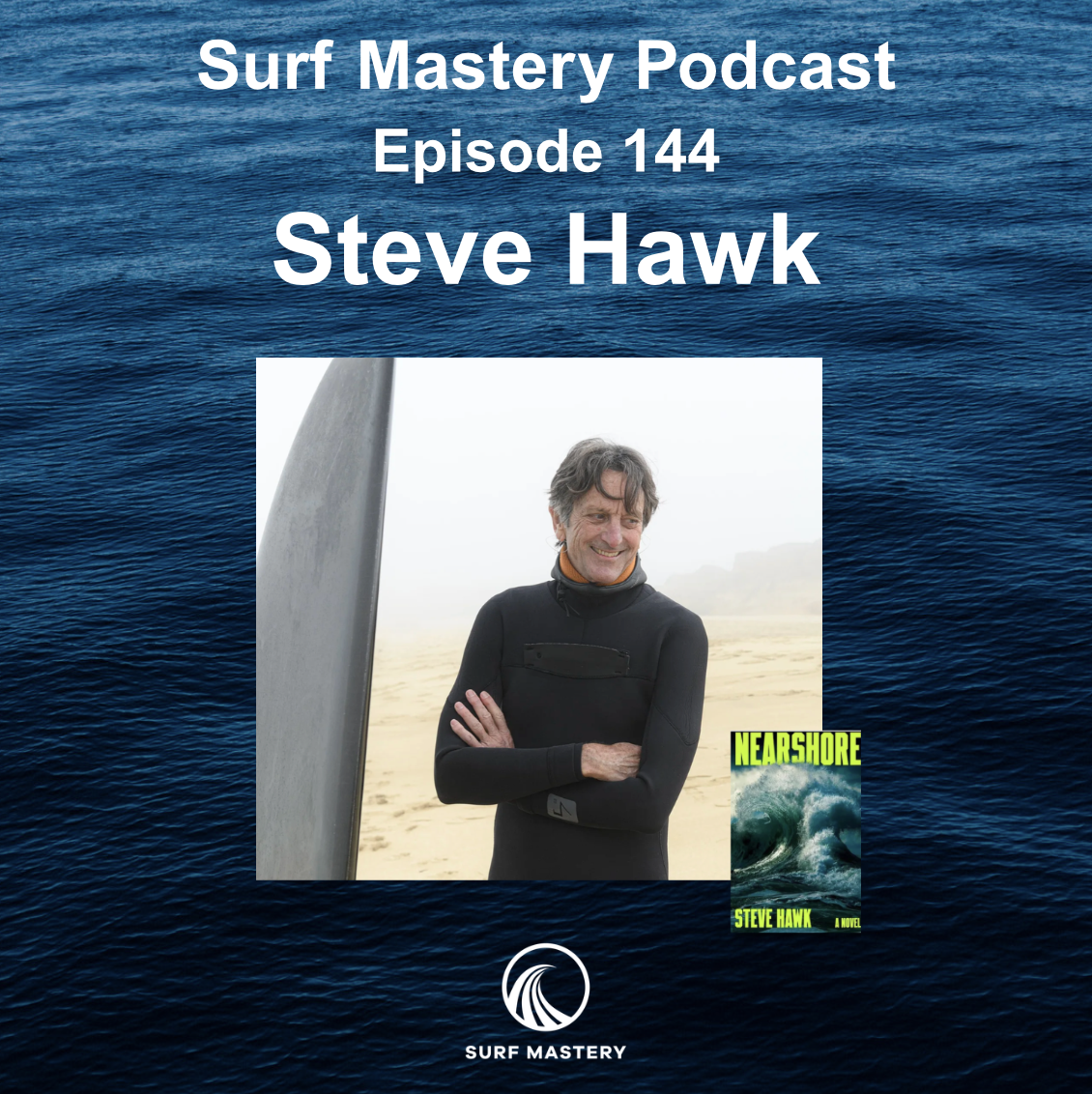
Former Surfer Magazine editor, lifelong surfer, and author Steve Hawk joins Michael Frampton for a conversation about the evolution of surfing, the hidden skills that make great surfers exceptional, and how our relationship with the ocean changes with age.
At 71, Steve has discovered that surfing isn't about catching the most waves or riding the smallest board. It's about understanding the ocean, making better decisions, and finding satisfaction in every session. Drawing on decades spent alongside some of the world's best surfers, he shares invaluable lessons that can help you improve your surfing, regardless of your age or ability.
In this episode, you'll discover:
Why the ability to read waves, anticipate changing conditions, and position yourself in the pocket can make a bigger difference to your surfing than physical fitness or technical ability alone.
Practical lessons Steve learned from surfing with legends like Shane Dorian and Dave Rastovich, including how to generate more speed, improve your turns, and avoid common mistakes that hold surfers back.
How to adapt your equipment, expectations, and approach to surfing as you age so you can continue challenging yourself, catching great waves, and enjoying the ocean for decades to come.
Press play to discover how decades of surfing wisdom can help you catch better waves, surf with greater confidence, and deepen your connection with the ocean at any age.
Steve's website:
https://www.stevehawkauthor.com
Steve's book "Nearshore" https://www.stevehawkauthor.com/nearshore
Steve's other podcast appearances:
https://www.stevehawkauthor.com/press-podcasts
Transcript:
Michael Frampton: Okay. It's on the east coast of the North Island.
Steve Hawk: Okay.
Michael Frampton: Not much, not much going on here. I'm not surprised you've never heard of it.
Steve Hawk: I've been to, so I've been to the North Island. I was in, , Hamilton.
Michael Frampton: Yes. Raglan. ,
Steve Hawk: Raglan. What's the... Is it called the Malia Peninsula? The-
Michael Frampton: Mahia?
Steve Hawk: Ma- Mahia Peninsula.
Michael Frampton: Yeah. Yes. I'm just south, just a couple hours south of there.
Steve Hawk: Okay.
Michael Frampton: Yep.
Steve Hawk: I was there with my brother in 84, 86, 5
Michael Frampton: Yeah
Steve Hawk: He was just turning into a pro skater and- he... So he was on the, he was part of the Bones Brigade, the-
Michael Frampton: Yes
Steve Hawk: , And so he, they did a tour of Australia, then he and I peeled off and spent a week or two, we rented a caravan and just surfed, and then he skated a little bit.
Michael Frampton: Yep.
Steve Hawk: But incredible country ...
Michael Frampton: yeah, I've met your brother before.
Steve Hawk: Oh, you have?
Michael Frampton: Yes.
Steve Hawk: , There in New Zealand?
Michael Frampton: No.
Gosh, I was living in New York City, and I started skating Chelsea Pier, , which was a relatively new skate park. This would've been, oh, circa 2012, 2013. And gosh, from memory, it was a Wednesday afternoon, and there was me and maybe two other people skating there, and Tony just turned up and start- By himself?
By himself, and just started skateboarding, just started warming up. And me and my friend Andrew were just there, and a couple other guys were there just skating with him, just taking turns, and he was warming up and, you know, it didn't take long for word to get round. And, you know, within sort of half an hour there was, you know, a crowd of people.
Um-
Steve Hawk: Yeah, yeah, cell phones.
Michael Frampton: Yeah, all that jazz. Yeah. Yep. , He was there, he was there just for, for a different event around the corner and just came to, you know, skate- Oh ... and I guess he knew everyone would turn up and,
Steve Hawk: Yeah. He, now he usually, he go, tries to go to skate parks really early in the morning-
Michael Frampton: Yep
Steve Hawk: , So he can kind of be by himself. Yeah. But it- If, if he wants to be ...
Michael Frampton: yeah.
Steve Hawk: Yeah.
Michael Frampton: But it was impressive. I mean, 2013, I don't know how old he was then, but he wasn't young. And this, you know, Chelsea Pier, it's got a 10, maybe 12 foot, like a big concrete bowl, and- Right ... I think he had a helmet on and knee pads, and that was all, I think.
And he took some- Yeah ... heavy spills. And I was like, "Oh no, he's..." And he just got up and kept going. I was like, oh my goodness, I could not... So of course. Yeah. Of course. I was... Why wouldn't it?
Steve Hawk: That's the one thing he knows how to do is, to, what to do, is to take a, take a hit, yeah.
Michael Frampton: Yes. Yeah. , Yes. And then obviously, uh, we have a mutual friend, Kyle
Steve Hawk: Yes,
Michael Frampton: yes Kyle Thiermann
Steve Hawk: I just was at his wedding
Michael Frampton: Very cool
Steve Hawk: This weekend, yeah
Michael Frampton: Yeah.
Oh my, congratulations and condolences to, to Kyle
Steve Hawk: It was, it was really, it was at a beautiful place up near Yosemite, , just spectacular setting. And you know, of course his young wife has just this gaggle of beautiful bridesmaids, and all of Kyle's surf buds were there, and then somehow I got asked to be one of the groomsmen.
And it was like I was literally twice the age of almost everybody else at, up on the s- up on the podium at one point, or the stage.
Michael Frampton: Yep. Oh, it makes you feel young though, eh?
Steve Hawk: No, not so
Michael Frampton: much
Steve Hawk: No?
Michael Frampton: So , how do you know Kyle?
Steve Hawk: , I ran into him at, several years ago, gosh, more than 10 years ago now I'd say, at, um, after a session at Maverick's, , where everybody gathered there as they will.
, And I I can see Maverick's from my house, so a lot of times at the end of a day, I'll go down to the local bar here where th- there's one spot where they all go after, where you can get, you can get a meal and, and beers, , just to kind of feel the buzz and look at videos and all that, 'cause , I'm not a Maverick's guy.
And, , somebody introduced me to him and said he had just started this podcast, and they said, "Hey, you should have talked to Steve about being on your podcast." And he and I got to talking, and I had, I had done a trip to Antarctica, , back in 2000.
Michael Frampton: Mm-hmm.
Steve Hawk: So he wanted to talk about that, so we spent almost a whole episode talking about that.
I think I was number 25 in his podcast.
Michael Frampton: Oh, okay. Yeah. So quite some time ago. Yep.
Steve Hawk: Some time ago. And then I came back again to talk about a piece I did for Surfer's Journal on Duke Kahanamoku.
Michael Frampton: Mm-hmm.
Steve Hawk: , Some ti- few, five, five, six years ago, and then came back again just last month to talk about my book.
Michael Frampton: Yep. Okay. Busy, busy.
Steve Hawk: Yeah.
Michael Frampton: Gosh. Yeah, , I'll do an introduction in post for this, but-
Steve Hawk: Sure. Yeah ...
Michael Frampton: I don't really wanna repeat what's already been done. Like, I, I know David, David Lee Scales- I, I'd
Steve Hawk: love that.
Michael Frampton: Yeah ... David Lee Scales- I'm trying to
Steve Hawk: save, save-
Michael Frampton: Yeah, yeah. So for those that are listening, I'll mention this in the, in, in, in the intro anyway, but for those that are listening that wanna hear Steve's backstory that don't know, uh, you can go and listen to David Lee Scales, his episode, which I'll link to in this, so to hear all your backstory and all that jazz.
And obviously- Yeah ... you did a, a second one with David, about your new book, which we'll probably touch on at some point. Right. And then you obviously you've done, you- you've talked to Kyle as well. So I'll link to all those previous episodes, - Great. Thanks ... in the podcast. Um, and there's no need to repeat any of that stuff here.
, All of my listeners I think are on top of those, those podcasts anyway, so... But I guess what I'd like to get into, you- you've been involved in the surf industry for a long time, both as a passionate surfer and then with- ... the magazine , and, and various other projects, and you're still surfing.
How, how has surfing culture changed over the years? And more specifically, do you think it's evolved or devolved?
Steve Hawk: Oh, evolved for sure evolved. And I think it's, it's better now. It's more, , at least in my experience, you know. Mm-hmm. I, I suspect if I was a local at Malibu, I'd have a different attitude about it or, you know, at, at Steamer Lane or something like that.
But just in terms of, um The vibe in the water to me these days, it... 'Cause I, I kind of surf out of the way spots, 'cause I just, I don't wanna go elbow to elbow with a bunch of hot young groms. , It's just, uh, it's more diverse for one thing. There are, there are many more women in the water than there were back when I started.
, Many more. And also, , the demographic has broadened substantially. You know, when I, when I learned to surf in the late '60s, early '70s, there was nobody surfing over the age of 30. You know, maybe you'd see someone now and then.
Michael Frampton: - Why do you
Steve Hawk: think that was? Why? Yeah. Well, because the sport was young.
You know, it had, it, it really hadn't, it, it, it, there were, there were some people who learned to surf in the '40s and '50s, but it didn't really blow up until the '60s. And so, you know, it was, there just, there kind of was no such thing as second generation surfers. Certainly no such thing as third generation surfers, unless you were, , Waikiki, say- Mm
with the Beach Boys.
Michael Frampton: Yeah, yeah.
Steve Hawk: , So it was all, it was just, and, and, and relatively few females. , So it was, it was just a big testosterone pit. , And it, it, I think part of my reaction to your, my response to your question might have to do with the fact that I've, I've gotten older, and I've mellowed, and I'm not as, uh, I'm not as fierce in the lineup.
I'm not, , I'm, I don't have as much FOMO, you know, when I'm out there. Like, did I get my share? So I, it, it could, it could, s- a lot of that could just be my personal perception based on my g- getting, mellowing with age.
Michael Frampton: Mm. Well, no, I like that answer. I, I think it's both. I think you're right in saying, like, you go places like Malibu, for example, which I lived for a while, and there certainly seems to be an aspect of devolution in some ways in terms of the attitude of some of the new crowd and just the, the overall busyness and entitlement attitude.
But also, obviously there's a, a massive increase in evolve, , in terms of, especially in terms of the equipment.
Steve Hawk: Yes. Especially in terms of equipment, yeah. People riding the appropriate boards for the appropriate wave.
Michael Frampton: Yeah. Well, just the r- and the refinement of, of all styles of boards a- and wetsuit technology, leashes and- Yeah
you know, the, the, the- Yeah ... the qu- wax quality. I mean, gosh, e- everything really.
Steve Hawk: All of it. Surf forecasting.
Michael Frampton: Yes.
Steve Hawk: Cameras. But I think that there's- There's no... Y- you kind of can't overstate how important the, the, the broadening of the age demo- demographic is. Mm. Because, like with so many things in society, when you've got kids, uh, interacting i- in a positive way with, with adults, and then those adults interacting in a positive way with their elders, or ki- or just trying to create some kind of social order, it, it's good for everybody.
Mm. It's good for the old people to be around the young people. It's good, it's good for the young people to be around the teenagers they, they look up to. You know, e- every 13-year-old wants to be 17, and every 17-year-old wants to be 21, you know?
Michael Frampton: Yeah,
Steve Hawk: And I think that... I, you know, so I, I, I know I'm pretty immersed in the skateboard culture as well because of my brother.
Michael Frampton: Mm.
Steve Hawk: And, , and I, it's particularly true in skateboarding. Sk- skateboard culture is just, uh, a beautiful thing these days, particularly compared to surfing.
Michael Frampton: Uh, yeah. '
Steve Hawk: Cause, you know, people aren't really fighting over a finite resource at a skate park like they are with waves.
Michael Frampton: Exactly,
Steve Hawk: yeah. Um, and, and the other thing, uh, that's interesting about skating that's so different from surfing is that skaters are pretty quick to calibrate how good someone is, and, and then not necessarily take advantage of that, but, , kind of cheer them on based on their skill level.
Michael Frampton: Mm.
Steve Hawk: Like, you know, skating's all about progression from, at every level. So, if you see a seven-year-old make a kickflip for the first time, you know, the, and, and start to get weepy and, and then, then suddenly have, you know, be surrounded by 13-year-olds and 16-year-olds and 18-year-olds, you know, you d- you don't get that in surfing.
Michael Frampton: Mm. No, you don't. Not at
Steve Hawk: all Because for one thing, it's really rare that your accomplishments are seen by other people. It's, it's much more of a solitary sport than I think we really think about. You- we all imagine we're being watched when we ride waves.
Michael Frampton: Yeah.
Steve Hawk: And, and I think a big part of that is that, um, everyone who sits on the beach looks seaward.
It's funny, I was at... I, I, I surf this little beach break by my house a lot, and just last week, as I was coming in from a session, there was a guy in a, in a beach chair facing inland. , And I, I don't know what, like, I thought, "This guy's, he's a weirdo." Like, who, who does that? So, so because when you're in the water, you just assume everyone's watching you.
But they're really not. You know, if it's in, if it's an afternoon here, it's backlit, everyone's wearing black wetsuits. Pretty much everyone's riding white surfboards. Like, no one, except your friends, can maybe tell.
Michael Frampton: Yeah. Yeah.
Steve Hawk: So you think you're being watched, but you're not. Which, which means that, like, you know, when you get your first legitimate tube ride, there's a really good chance no one's gonna see that.
Whereas the first time you drop into a quarter pipe at a skate park, if you've been trying it for a while and people realize, "Oh, hey, this guy's trying to drop in for the first time," which is, you know, that's a landmark moment. A lot of times, I mean, my favorite videos on YouTube right now are of parks stopping while everybody gathers around to watch some 10-year-old kid, you know, drop into a q- quarter pipe for the first time.
Like, that's just the bitchin-est thing.
That does not happen in the surf world.
Michael Frampton: Did it used to when there was far less people? No. No?
Steve Hawk: I don't think so. Yeah, I don't think so. May- may- maybe if, I don't know.
Michael Frampton: Hmm.
Steve Hawk: Like, I'm trying to think how many times I've been in a session with a friend, and I surf with friends all the time, where I've, I've thought, "God, dude, that, that might have been the best cutback you ever did."
Like, you know.
Michael Frampton: Yeah. Part of you's still hoping he doesn't make it so you can catch the last part of the wave.
Steve Hawk: Ex- exactly, yeah. You're like, you're probably seeing them from behind for the most part.
Michael Frampton: Yeah. Yeah. Yeah. Yeah, fun. No, you're right. I think the skateboard- skateboarding culture is so much nicer, especially in America.
Like, I was, when I, I used to love, when I moved to New York, I kinda gave up on surfing just because of the coldness really, and the lack of swell in the summer, and just fell in love with skating the Chelsea Pier, and just the culture is just so nice. Everyone just taking turns and encouraging and, you know, just-
Steve Hawk: Yeah
so nice Yeah. And, and, and, and, you know, they say now that partly because of the Olympics, something like 40 to 45% of, uh, all newcomers to the sport are female.
Michael Frampton: Oh, wow.
Steve Hawk: . So it's really- Yeah ... if you go to a park, there's a lot more. The, the, the, the women and girls aren't as intimidated as they used to be-
Michael Frampton: Hmm
Steve Hawk: 'cause they see each other there.
Michael Frampton: Yeah.
Steve Hawk: And, and, and that just becomes a, a virtuous cycle.
Michael Frampton: Hmm. Yes. And also, uh, one thing I noticed that you go to, when I used to sometimes go to Chelsea Skatepark on the weekends, there'd be quite a large chunk of 40, 50-year-olds turn up, and they're- Yeah ... still skating the bowl, you know?
Steve Hawk: Yeah. They like the bowls.
Michael Frampton: Yeah. Yeah, this is awesome. The old guys
Steve Hawk: like the bowls.
Michael Frampton: . They're all padded up and but still doing it, you know? You, you don't really see that so much here in New Zealand, uh, the older crew sort of staying involved in skateboarding. It's, you often see them- Yeah ... just sitting there watching their kids.
Still dressing like skateboarders, of course. Yeah. So d- how, how has your personal relationship with surfing and the ocean evolved over the years?
Steve Hawk: I think the big thing is that , I'm much more easily satisfied now I don't, I don't need to get 30 waves in a session, you know? If I get five or six good ones sometimes, that's fine. I, I have a, a, around here especially, where I live in Half Moon Bay, there's a lot of days when you stay on the beach wondering if you're gonna be able to paddle out, 'cause, you know, it's just, it's big and-
Michael Frampton: Mm
Steve Hawk: you have to find the seam and the rip and all that. And on days like that, , I have a, my best friend here, Kevin, , we just look at each other and say, "Hey, we just need one, right?" And, and sometimes that's all you get, but s- but if you say that in advance, then you come in satisfied. But, but almost invariably you end up getting five or 10 or, you know, so.
'Cause once you're out there, it kind of all kicks in.
Michael Frampton: So you're, you're managing expectations.
Steve Hawk: Managing expectations. The one thing that troubles me, though, is that I'm realizing that my, the, um, the window of where the re- ingredients are just right for me to wanna paddle out is e- ever narrowing.
You know? Like, it's, I, it, it, uh, if it looks like it's gonna be a tough paddle and it's just not that good, I'll think, "Oh, it's not worth it." , Or if it's too small and there's too many people out, I'll think, "No, it's not worth it." It, it's, I, I hear myself saying it's not worth it more often than I ever used to, for sure.
Part of that is just because I'm, I'm creaky. I'm 71.
So I have, I'm having lower back issues. Um, I don't have the stamina I used to have. You know, give me an hour and I'm, and I'm good.
Michael Frampton: Yep.
Steve Hawk: Yeah.
Michael Frampton: , Has the desire to surf, has it stayed the same at all? Like, the, the want. Obviously you're more satisfied with, with less, but is the desire to, to get that still the same?
Steve Hawk: , I, I would say it has diminished, and I don't know if that's just comes with that my desire for a lot of things has diminished, you know? But it's still there. It's like, now it's almost just embedded. It's almost, like, reflexive. Like, I have to go check the surf. I, you know- Mm ... it's part, just part of my routine.
When I go on a s- when I go on a surf trip. Mm. Um, after a while, uh, I'll think, "Well, I'm kinda sated right now. Like, I've, I've had my share of waves. , And I know it's, we, I know we're gonna be here till Friday, but it's Wednesday and maybe I'm ready to go home."
Michael Frampton: Mm.
Steve Hawk: That's, that, that has changed.
.
Steve Hawk: Yeah.
, I g- I get, I get sated sooner.
Michael Frampton: . But what if you pull up to the beach and it's three to four foot, glassy, there's an easy paddle out, it's not crowded. It's that feeling of, "Oh, I wanna be out there." Is that still the same, if it's conditions like that?
Th-
Steve Hawk: yeah. That, th- th- that's r- That's when I, there's, there's a 13-year-old inside of me for sure. Mm. You know, that, that, that kid is still there on those days when... And, and then it's like you can't get your wetsuit on fast enough, and you, you're worried, gotta get out there before the crowd gets it. And we, we have these beach breaks near my house that really only work about five months out of the year.
And on certain times in the winter, after we get a really big, like, maverick swell, they'll, those big swells will come in and be unsurfable at the beach break for a few days, but they'll chew up sandbars and, and cause these rips that'll stay in place for a week or so. And then, then they're like, they're like reef passes, but they're made from, from rips.
Michael Frampton: Yeah.
Steve Hawk: , You know, you jump in, you just jump in, and the rips takes you out, and those are the days I kind of live for around here. And, and when that's going, 'cause it's also, it's a mile and a half from my house. I know, I'll, I'll know 80% of the people in the water every time. , That's when I just can't get enough of it, for sure.
That- that's why, that, and that's when I get pissed that I, I, I don't have the stamina, and that my back starts to seize up.
Cause, you know, then, then I, then I'm just mad about being old.
Michael Frampton: Yeah. You had so much time within the surf culture and around so many good surfers, great surfers of all different shapes, sizes, et cetera, ages.
Is there anything that separates the great surfers from the average surfers, aside from athleticism and technique?
Steve Hawk: Well, the, the one thing, the, the few times I've really spent time on the road with, like, really good surfers, the, the thing that always gets me is how much time they spend in the water. You know, like eight hours a day.
Michael Frampton: Hmm.
Steve Hawk: The- their, their ability to just keep going and going and going, and then that's just about reps.
You know, it's just about putting in the, getting, gaining the muscle memory, st- somehow staying limber after being in the water for so long.
So I, I mean, I, I have to think that just having the willingness to spend hours and hours and hours at a time in the water is a, is a big, big part of it.
, And then also, one of the things I think that for me that I never learned to do is, um, that I know some surfers have this ability, is they'll, they'll think, "Okay, like I wanna, I wanna get better at my roundhouse cutbacks, and in order to do that I gotta remember to, , pump out a little bit farther onto the face, uh, try to get in a position where I'm almost grabbing my rail as I make the turn, hold my arm in a certain way," and, , and then treat it almost like you would, like you're at a skate park where it's a, it's a station and everything.
For me, once, once I paddle into a wave, any forethought I had about what I'm gonna do and how I'm gonna, it just disappears completely. Like, there's... I've only had one or two pieces of advice that I've really been able to deploy over the years. , And I, I, I don't know if that's just because I, I just get too excited, , and, and I, I'm much more interested in kinda reading the wave.
And I've never really wanted to compete, so I never felt like, "Oh, I need to do something that's gonna get that extra half point," or, that- Yeah, so to me that's a big one. Then the other thing, the first, I remember the first time I surfed with a pro was with Jamie Brisick-
Michael Frampton: Mm ...
Steve Hawk: when he was on tour.
And, somehow we ended up out at the Channel Islands in Santa, off Santa Barbara at this really fun wave. , And I, I had never been in the water with someone that, , who was that good, and I realized he was surfing, like, 15 feet closer to the curl than I was. You know, he, he just, he never went out on the face.
Mm. He was just, he was slamming the lip, air dropping down, going right back up into it. And, and whereas I was doing this kind of Santa Barbara cruise-y thing where I'd g- I'd try to go way out and then do, like, a down carve or something. And, , that's the other thing that really struck me when I first started surfing with good surfers, was how they, they play with the pocket.
Michael Frampton: Did that change the way you approached surfing at the time?
Steve Hawk: I, I, yeah, it did. It, I, I started trying to do it more, and I, and I got better at it, too, yeah.
Michael Frampton: Yeah, that's one big thing that I always, people that I coach or is trying to... , you gotta, you've got to be close to the power source.
Steve Hawk: Yeah.
Michael Frampton: I always tell them, p- pause any good surfing video at the bottom turn, and that surfer's, half of their vision is taken up by the white water.
That's how deep they're surfing. They're right- Yeah ... so if y- most people- Yeah ... look up and all they see is clean face, whereas Kelly Slater's- Yeah ... looking up and he's seeing white water. He's coming around-
Steve Hawk: Yeah ...
Michael Frampton: out, out of the power. So yeah, and it's, it's not easy to do. It's a scary place to be.
Steve Hawk: It is, yeah.
And, and you also gotta be willing to kinda trust you're gonna make the turn. And also it's, it, it's the scariest place to be, 'cause if you, if you it up, you're gonna get blown up in the lip, yeah. So I, I had, I had one piece of advice when I was working at Surfer that really, really improved my surfing m- uh, like almost overnight.
, And it was from Mike Lambresi, who's gone on to become a, a very good coach. He was, I think, US champ for a while. I'm not sure he ever did that, that well on tour. He w- but he was selling ads for Surfer when I was editing Surfer, and we would surf together sometimes. And, and he pulled me aside once and said, "Steve, look, when, when you do a cutback, you- you're doing the, the kind of M- MR, Mark Richards thing from the '70s where you, you, you spread your arms like this and kind of try to go around, you know?"
Mm-hmm. Like... And, , he said, he said, "L- like watch, watch a footage of Tom Curren doing a backside bottom turn. And, and his... It's his, his r- it's his trailing hand is actually leading the way."
He said, "So think about, think about not throwing your front shoulder around, but think about throwing your re- having your rear shoulder lead the way."
And then, and that kept me kind of centered on the board. I was able to hold my arc through the turns way longer. I actually started doing, like, legitimate roundhouses where I could come all the way around, hit the whitewater, and come back down. It was a game changer, that, just that one thing.
And somehow I was able to...
I, I did it a couple times, and then I, then it was in my... Then it started to get, , embedded in my muscle memory.
Michael Frampton: . What's the, what's the worst piece of surfing advice you've ever had?
Steve Hawk: Oh, God, there's a good question. Uh-
I, I think it was, , probably, um, r- ride a, ride a smaller board with less foam.
'Cause I went through a period, especially when I was up here in Northern California, where I was, I, my b- I was just really undergunned, and not, like, like just not catching waves, and still thinking I was at Trestles, you know, and gonna... Yeah.
You know, I, I, I had it, and, and I remember, like, , 'cause I was, I, I was working closely with Derek Hynd, that surfer, you know.
He was, riding for us, and we surfed together some, and he was alw- I think, p- pushing me to, um, reduce my volume of my boards. And, but I'm like, "Derek, come on. You were, you were, you were fifth in the world at one point. Like, like, you know?"
Michael Frampton: Yeah.
Steve Hawk: Uh.
Michael Frampton: Who's the most impressive surfer that you've surfed with?
Steve Hawk: , Up close, for sure it would be a trip I did to Indo. , My only trip I've done to Indo. I went to Kandui, , with Dorian and Rasta. And, and Dorian and I had surfed with a, a bunch, at other places. We traveled together a little bit. And, , a- and but seeing him... And so we got, we got, like, double overhead rifles.
We got rifles really good. Mm. And, uh, but, and Dorian was ripping, but Rasta just goes so fast, and he's just got such style.
, I, my jaw dropped. Like, I, I, I thought he was, wasn't on tour 'cause he wasn't, like, really good enough to be on tour. I came away thinking, "This guy's one of the top 10 surfers in the world, for sure."
Michael Frampton: Yeah.
Steve Hawk: Yeah, that was... And also just, just a, such a good bloke to be in the water with, you know?
Michael Frampton: Yeah.
Steve Hawk: Talking to the Indo way I have some.
Michael Frampton: Oh, he's- Yeah ... he's one of the GOATs. He's one of my favorite surfers. Yeah.
Steve Hawk: Right. Just s- such b- so beautiful to watch, yeah.
Michael Frampton: Just so connected to the wave.
Steve Hawk: Yeah, I'd, like I would never wanna see him in a wave pool.
Michael Frampton: I
Steve Hawk: can't, I can't ever imagine him going
Michael Frampton: to one. His, his ability- Yeah ...
Steve Hawk: his ability to read the variables and respond in the moment.
, So you know, on that trip that I just talked about, I talked Surfer Magazine into sending me, 'cause, uh, this was after I had left there, , and long after, like f- 15 years after.
But the, I w- was a Billabong Surf with a Pro thing, where you'd go to Kandui and surf with those guys, and then Billabong would have a videographer on the beach for, for every session. And then they'd come back and cut together your clips, and then you'd sit at a table with Rasta on one side and Dorian on the other, and then they would, they would analyze your clips and tell you what you were doing wrong.
Michael Frampton: Oh,
Steve Hawk: cool. Which is absolutely the most humbling experience that a surfer can have.
Michael Frampton: Oh ... what a, a cool experience, though.
Steve Hawk: It was, yeah. And, and, and so I, so I, I wrote this piece for Surfer about it, and I remember h- that's why I was- I, not only did I watch them coach me, but I, I sat there with my notebook and watched them coach, like, six or seven other guys as well.
And, , and there was this, there were some refrains. One was, surf, surf higher on the wave. Everybody was sort of going too- making the wrong decision to come all the way down to the bottom and just they were bleeding off their speed. And, that was the, that was a piece of advice that really helped me, 'cause you just, that, if you surf high, it kind of forces you to be closer to the pocket, and that's, and the, the, the steeper the wave is, the more gravity comes into play, the faster you're gonna go.
And then, then you decide what turns you're gonna do, instead of having the wave decide.
, Another piece was, if you're out and it's where it's pretty throaty, if the waves have some juice, when you spin to go, don't be casual. Paddle like an animal. Like, paddle like you mean it. Don't be embarrassed to just go as hard as you can.
, And then the other one was, which I still never learned, is, um, crouch, crouch through your turns. Yeah.
Michael Frampton: Yeah, stay low.
Steve Hawk: Stay low.
Michael Frampton: Hmm.
Steve Hawk: Stay low. Yeah. Yeah, that's- Yeah ... that's an issue I st- well, I'm getting worse at it, 'cause I, I can barely crouch on dry land these days, so.
Michael Frampton: What sort of board are you riding lately?
Steve Hawk: , So I've, I've gone up in size. Uh, I, I, my t- my two go... I have three go-to boards now. One is 6'8". It's a Neptune shaped by Sean Rhodes, who's a Mavericks guy, owns a, the NorCal Surf Shop in Pacifica. It's pretty cool. It's, it's got a big kind of Greenough f- center fin and then two, , smaller fins.
Michael Frampton: Mm-hmm.
Steve Hawk: , And then I have a, I have a 7'0" Trimcraft by, um, Brian Lovelace that I just love. 7'4". Yeah. 7'4". It's called a, it's called a Reball, and it's, it's almost like a double ender. It's got, like, a duck bill nose and a, and a, and a f- duck bill tail., And it's got a, again, a big kind of Greenough center fin, but then the two side bites that are kind of canted out like a Bonzer-
a little bit. And I don't know, something about that board and the rocker, it just, it, it fits my style really well. Um, and then, , I have a 7'0" Matt Moore that's almost looks like an intro longboard, blunt nose, blunt tail, super parallel rails, and that's for kind of more down the line, you know, softer point break waves.
Michael Frampton: Mm-hmm.
Steve Hawk: , Those are my three main boards right now.
What about you? What are you riding?
Michael Frampton: I ride a 11-foot Josh Hall mostly
Steve Hawk: 11 foot?
Michael Frampton: Mm-hmm. Yeah. I've fallen in love with the- Oh ... with the big boards, gliders.
Steve Hawk: Oh, wow.
Michael Frampton: Yes.
Steve Hawk: I, I, I can honestly say I've never ridden an 11-foot board.
Michael Frampton: Oh. I thought maybe Skip Frye would be one of your inspirations.
Steve Hawk: You know, I just, I never really learned to ride a longboard well. Oh, I also have a stand-up paddleboard that I- Mm-hmm
I use a lot- Oh, you got ... on small summer days. Yep. But that, and that's a bigger board.
Michael Frampton: Mm-hmm.
Steve Hawk: That's much better on my back.
Michael Frampton: Yes. Yeah. Where, where I surf mainly, the, the waves are pretty small and soft, so when the waves do turn on, I'll be on something a, a little smaller for sure. But, it's usually pretty small and soft where I, where I'm living at the moment, so.
Steve Hawk: Oh, okay. I see.
Michael Frampton: Big- Yeah ... big board suits me. There's a nice soft point break where I live, so can go,
Steve Hawk: go out and- You know, that, that's one thing. When you, when you ask about how s- surf culture has changed, when I was, uh, editing Surfer in the '90s, we, we wouldn't run a photo of a longboarder, like if, 'cause we were just worried about pissing off our readership.
It was ridiculous. You know, we ended up, I think we finally ran a cover shot of Joel Tudor, but we also had to have a shortboarder on it, so we had this, like, it said, "Can't we just get along?"
Michael Frampton: Yeah, I remember actually. Yeah.
Steve Hawk: Yeah. Um, and now I, I just, I'm, it makes me so happy when I look out at a lineup and you realize anybody can ride anything they want.
No one's gonna mock you, u- u- unless maybe you have a foamy. Then I think maybe you deserve a little bit of- ... grief. But I've li- I have a lot of friends who surf, who surf foamies ironically, you know.
Michael Frampton: Yes. Yeah. I surfed a foamy for a long time, actually. I hate to admit, but, . When I was surf coaching, I would take a, a 9'6" soft top, an INT out, , 'cause a lot of my surf coaching was more, more like an outfitter or a guide.
Steve Hawk: Mm-hmm.
Michael Frampton: Sort of helping- I see. I got that ... helping, helping people to sort of choose the right wave and read the waves, , rather than filming them and critiquing their technique so much. So it made sense- Well, that's
Steve Hawk: some- ...
Michael Frampton: to have that board. So-
Steve Hawk: That's something I'm interested in, 'cause I, I, I get into that a little bit in my new, my new book, which is that, , I have this, this notion that, , surfing is sort of, for the most part, kind of a sublingual pursuit.
, And I explore that, that theme in, in, in my novel a bit. And, and that surfers, , in general have this skill that, that they really will never articulate to anyone when it comes to learning how to read waves. , So when you say that you're out there on a longer board telling people how to read waves, like I can't...
That seems like a Sisyphean, pursuit because how in the world do you explain the five different swells in the water and the, that, like we learn that on the deepest, most subconscious level.
Michael Frampton: Mm-hmm.
Steve Hawk: , And, and even, even once, now that I've learned it, I'll still miss 20% of the waves I paddle for, 'cause I, I misread them a little bit, you know?
Mm-hmm. 'Cause it's all changing so fast.
Tr- trying to verbalize that in the moment- Did you do that?
Michael Frampton: I've been doing that for a long time now, and trying to refine that and teach people that.
Steve Hawk: The,
Michael Frampton: the, the first insight along that actually came from the second person I interviewed for this podcast back in 2015, was Tom Carroll. And, , I started working in the gym and was training him from a physical... It's my background as a, as a personal trainer.
, And then we went surfing one day, and the waves were waist high, high tide. I couldn't ca- I could not c- even catch the waves. And Tom's out there doing fast roundhouse cutbacks, and he's t- 15 years older than me. I'm just like, "Well, how?" And he's like, "Oh, you just gotta read the waves better. Like, I'm looking for the details, the, the, the, the way that the back washes and the side and the secondary swells and the chops are interacting with the main swell, and the way the rip bowl and..."
And I'd n- That was the first time that I'd ever heard anyone talk like that.
Steve Hawk: Right.
Michael Frampton: And, and from that moment on, that has been my fascination is just like, okay, yeah, I can work on my technique and my athleticism, but if I can't- Right ... choose the right wave and read the waves, then it's pointless. And that is by far the most, the best thing that has improved, not only the way I surf, but my enjoyment and understanding of surfing, is learning to read the ocean on an ever fine level.
Because it's, when you're sitting out the back, I don't know if you've noticed, but good surfers, they can be the nicest people in the car park, but y- you can't talk to them in the water. They are hyperfocused on that tiny sliver of horizon.
Steve Hawk: Yep.
Michael Frampton: And-
Steve Hawk: Yep ...
Michael Frampton: a good surfer, you'll, everyone will be sitting there looking at this tiny sliver of horizon, then all of a sudden the best surfer on the water starts paddling, and you're like, "Well, well, why are you paddling?"
And then five seconds later, everyone else notices the set, but that surfer's already seen that set coming, whether it w- Yeah ... and it literally, I think it, it could be just a little flicker of glint on the horizon. They might- Yeah ... not consciously know that's what they saw.
Steve Hawk: That's it. That's it.
Michael Frampton: But-
Steve Hawk: That's it.
Like, to, the, the- No, I've never heard anyone articulate it in the moment. Like, try to say, "Oh, here, I see what's coming. This is, like, it, it, it's, it's standing up outside, but actually that's just a wind swell on top of the real swell. That thing is gonna back off and this ground swell is loading up.
It's gonna actually break 15 feet farther in than where we're sitting, so I need to get in there. And, , and it looks like it's gonna be a right, but it's actually gonna turn into a left." You never say that shit out loud.
Michael Frampton: I do.
Steve Hawk: You do? Yeah. In the moment?
Michael Frampton: Not to myself, but if I'm coaching someone-
Steve Hawk: Yeah
Michael Frampton: it's, I'm sitting next to them and I'm saying, "What, wh- don't talk to me, look at the horizon. Look over there. Don't paddle for that wave. Can you see how, see how it's, i- i- it's not stretched out or , it's got a slightly different angle to the main swell? That guy, those guys are paddling for it, but you don't want it.
We're gonna wait for the wave that's, that's breaking slightly wide at a different angle, and it doesn't have one in front of it, and it's gonna hit the reef over there instead of where we're sitting. So start paddling for it." I, I'm con- That's the, more like a surf guide or a surf outfitter.
Steve Hawk: Wow.
Michael Frampton: That's the way I sort of work with clients, and that's the way I've been trying to...
i've got an online course that we go through photos , and, and different ways of looking at it, because m- my theory is that the earlier on that you can at least understand that's what you need to be doing when you're not surfing a wave- Yeah ... the faster, the, the faster you're gonna progress.
Steve Hawk: Yeah, .
Michael Frampton: Because that's what all good surfers are. They're obsessed and fascinated with looking for when's the next wave come, coming, where's it gonna break, should I catch it? Yeah. That's all they're thinking about. They're just scanning the horizon. And then when they're on the wave- They're looking, I'm not gonna put my rail there, I'm gonna put it there, , within millimeter perfection,
Steve Hawk: right.
Michael Frampton: Like, I'm not gonna, I'm not gonna do my bottom turn there, I'm gonna do it there, because there's a slight wind chop, or the water's not quite moving a- as much, or there's a boil there, or all those sort of finer details. That's what separates the great surfers from- Yeah ... from the, from the good ones or the average ones.
That's a really
Steve Hawk: good
Michael Frampton: point. Yeah.
Steve Hawk: But I have to tell you, if I was in the water sitting next to you hearing you coach someone like that, I might just tell you to shut up . I wouldn't want to hear it.
Michael Frampton: I, I try to st- stay away from other people when, when I'm doing that.
Steve Hawk: Okay, good.
Michael Frampton: . I don't do in-water coaching at all at the moment in, in any way. It's more online , 'cause I agree with you. Right. There's nothing, there's nothing worse than a surf coach infiltrating the lineup. , Although I have- Yeah ... been guilty of that in the past.
It's all online based, my coaching now. Okay, good to
Steve Hawk: know.
Michael Frampton: Good to
Steve Hawk: know. Yeah.
Michael Frampton: Yes. Yeah. Yeah, yeah.
... But reading- Mm-hmm ... reading the ocean and understanding surfing-
Steve Hawk: Yeah, yeah
Michael Frampton: that's where the magic is. That's the lifelong- Yeah ... pursuit. And if you're in it for the long haul- Definitely ... as your body degrades you, you have to learn to read the ocean better. W- whether that's surfing the wave or just paddling out, you know what I... When to paddle out. That's right.
Where to paddle out. The timing of the-
Steve Hawk: That's right. Yeah. And, and that's the one advantage I, I feel like that, that I have as being older.
Is I can, I can spot, like especially at a beach break where it all looks kinda random, I, I can spot where, oh, no, there's actually a sandbar right there. The sets are closing out, but if you're willing to take a few sets on the head and wait for the mid-size ones-
There, there's actually some d- some nuggets out there you can find. Like that, that kinda thing I didn't know 20 years ago for sure. And now I can, like I can find it.
You know, it's funny, I, I, I have a, a, I write about this in, in the book a little bit. I have this whole chapter on kind of the sublingual nature of surfing in, in- Mm
the, in the novel. And, uh, I saw a, , an interview once with, William Finnegan, who, you know, won the Pulitzer for Barbarian Days, who a lot of people think is, a- and I would agree, probably the most accomplished surf writer i- in history. , He won a Pulitzer. And he, he d- he does such, does such a good job of describing how waves work and how, what it's like to surf them, and all that stuff.
But for a podcast one time, I... This is what he said in this interview. He, some people mic'd him up and told him to, to walk them through a session. , So they were filming him, and he paddles out, and he gets some waves, and he comes back in, and the producer's like, "How come you didn't say anything?" And he goes, "Oh, I didn't?
Oh, shoot, I'm sorry." So he paddled back out, and he tried to talk a little bit, and the, and this time, the first wave he gets is, , the best wave of the day for him. And he gets to his feet, and he goes down the line, and the only word that comes out of his mouth is, "Nice, nice, nice, nice." So the, the, one could argue the most articulate surfer alive you know, the, the person best, best equipped to describe surfing, , c- in the moment couldn't, couldn't say it, couldn't say what he was doing.
Michael Frampton: The, the experience of surfing you, you certainly cannot put into words.
Steve Hawk: No. Yeah. So I did, so I, I, and I just wrote a novel that has, s- surfing is sort of at the core of it. It's about a surfer. There's stuff about nuclear terrorism and Silicon Valley and, and there's some, some other themes.
But, , there's a lot of surf talk in it, and a lot of scenes of guys, you know, getting out of their wetsuits and putting on their wetsuits and... But I, I, I realized that, um, my least favorite part of any book about surfing is when they actually write the stuff of people riding waves. So I only have one sentence where you actually see someone up and riding on a wave.
In a 70,000-word book about surfing.
Michael Frampton: Yeah, yeah, no. Photos and video do that justice. Oh well.
Steve Hawk: Well, and when, at the magazine, that's what I, that's what I would tell writers all the time. Like, "You don't need to tell us what the waves are like."
Michael Frampton: Mm. "
Steve Hawk: We see. Yeah. Tell us what happened on shore."
Michael Frampton: Yeah. Yeah.
That's what I would tell, that's what I tell clients as well, is that when you're surfing the wave, that you don't wanna be thinking of any of that stuff. Sure. , Unless you're specifically, you know, working on something, then you might spend- Oh, uh,
Steve Hawk: one thing. Yeah, yeah
Michael Frampton: might spend some time doing that. You know, to ha- need to have a, like any sport athlete, right? You, you, if you play tennis, there's, there's the game of tennis. You're not thinking of anything, you're just playing. And then of course, when you're working with your coach one-on-one, that's when you're working on the stuff.
So-
Steve Hawk: Yeah. Right ...
i, when I was on Kandui with Dorian, he, he s- told me or one of the other, uh, surfers that when he was working, like, on one thing, like, uh, you know, staying low through a bottom turn or something, he would put a piece of tape on the nose of his board and write on it
Work on your bottom turns or whatever- Yeah ... it was.
Cause otherwise you forget.
Michael Frampton: Yeah, it's hard to, to not lose yourself in the moment when you're surfing. That's, that's why we do
Steve Hawk: it, right? Yeah. And b- and because, because the moment is the, is the whole thing when you surf, right?
It's like this wave, this wave's only gonna do this once. And this, it's this moment in time and space that's gonna happen just this once. Mm. And somehow we've developed a skill to put ourselves there. So the fact that you're gonna... You know, when you're paddling into a wave and you realize, "Oh, my God, I've got this.
Like, I'm, I'm actually doing this thing"-
Then all kind of logical thought just goes out the window.
I just wanna ride this thing.
Michael Frampton: Exactly. I
Steve Hawk: wanna have fun.
Michael Frampton: Yeah... I know you started, your relationship with the ocean began quite early in life through body surfing- Yeah
right?
Steve Hawk: Yeah, when I was, like, five, yeah.
Michael Frampton: Yeah. So, see, I didn't... I don't think I even went to the ocean until I was, like, 17. So I never really had that sort of, that childhood of reading the o- or understanding the ocean at all, so I sort of ha- had a, a different experience and approach. I think that's why my way of, you know, talking about it and teaching surfing's quite unique.
, And it's something when I, when I m- finally moved to the northern beaches in Australia, I realized that all the young surfers, you know, before they were, you know, before they were teenagers, they were playing in the ocean, surfing, bodyboarding with uncles and dads and stuff.
Steve Hawk: Yeah.
Michael Frampton: And they're, and they were getting all of that stuff.
Their, their dads were saying, "No, go paddle over there. See, there's, that, that set over there." Or, "Don't go, don't paddle out now." Yeah. "Wait for an hour for the tide." Or, and then at home they're watching Endless Summer and talking about surfing, and they're sitting in front of the computer reading the isobar charts or, and tide charts.
And so all that stuff happened when they were young, and they'd, and by the time they're, you know, in their 20s and they're, you know, a surf coach or helping other people, they can't articulate any of that stuff.
Steve Hawk: That's right. Yeah. Yeah.
Michael Frampton: But because I came to surfing late and I had to sort of learn all that stuff in my 20s- That makes sense.
Yeah ... so that's why most people listening to this podcast, uh, sort of didn't learn surfing until later in life, so- Hmm ... they, they're craving. They, they didn't grow up- Yeah ... in a surfing rich environment as a kid, so- Yeah ... they missed out on all that stuff. So-
Steve Hawk: Right ...
Michael Frampton: it's essentially, I think, what this sort of, this, this podcast is about.
And, uh, hmm.
Steve Hawk: So, so it's funny you should say that because when we were talking about the, the demographic, demographic shift earlier and, you know, why I feel like surfing is evolving rather than devolving, , the other really big difference is the number of people who are taking it up later in life. Like that, that did not happen back in the-
Back when I was learning. If you didn't learn to surf by the time you were 15, you weren't gonna learn to surf. And nowadays the beach breaks, there's a couple of beach breaks maybe 10 miles north of my house in Lindemar, a place called Lindemar in Pacifica, which is the beginner bl- break in the Bay Area.
It's just, it's big fancy SUVs and, you know, tech bros and their girlfriends who, in their 30s and 40s, on foamies, uh, you know, just, just picking it up for the first time. . And, and, and bragging about it, you know? Like, going to work and, "Yeah, we surfed yesterday." And I think I, that also is great, you know, 'cause it's, it's pretty hard to get mad in the lineup at, at, you know, some- someone who's taken up a pretty difficult sport that late in life.
, And re- especially if they realize, you know, hey, like, "Hey, I don't wanna get in your way. I'm just, I'm out here, out trying to have fun," and,
Michael Frampton: Yes, I agree. It's the, it's the ones that don't realize that that are the problem.
Steve Hawk: Yeah, yeah. Who, who, who are maybe, like, two years in, who are just learning how to kind of trim and, yeah, th- those are the ones that-
Michael Frampton: Yes
Steve Hawk: you might, might need to talking to now and then.
Michael Frampton: Exactly. I think that aspect of surf culture will balance itself out.
Steve Hawk: Mm-hmm.
Michael Frampton: I think it's... E- even my time in Malibu sort of, uh, s- there was, there seemed to be less and less soft tops in the way out the back at Malibu. Malibu's a weird one because it's, I mean, it's o- in my opinion, it's one of the best high-performance short boarding waves in the world, 'cause it's so easy to read and to ride, and it's so...
The way that the swell comes in, it just comes in so beautifully and accessibly. So you can, as a beginner, paddle out the back at head-high Malibu and catch a wave technically, but- Right ... you probably shouldn't be there if y- if you're not competent and aware- Right ... of the culture there. So there's, I think there's a fine line between the appropriateness of the level of surfing, and just 'cause a wave is easy to catch doesn't mean that you should be there per se.
I think Malibu sort of is the antithesis of, of, of that divide, and I think the culture's gonna sort itself out hopefully.
Steve Hawk: Yeah, it's funny when you say that too, 'cause when you go back and look at the early footage of Malibu from the '50s and '60s, that same thing was true even then. You know, you'd see Micky Dora going full speed ahead, and then just any number of kooks-
Michael Frampton: Hmm.
Steve Hawk: Interesting ... that just have learned how to get to their feet, you know, kinda dropping in, and he's just going, blowing by them all.
Michael Frampton: Hmm.
Steve Hawk: Um, that's, that's been a, a factor from day one out there, I think.
Michael Frampton: Uh, interesting.
Steve Hawk: Be- be- because, because it is such a user-friendly wave.
Michael Frampton: Yeah. You
Steve Hawk: know, it's, it's really, really beginner-friendly.
Michael Frampton: Yeah. , It's those types of beginner-friendly waves that are the, the ones that seem to cop it most. You know, he... There's obviously a- Yeah ... a lot of waves where it just doesn't ha- you know, a pipeline, it's not gonna happen so much out there because it's just s- such a heavy, fast wave. It kinda sorts- Right
the, the men out from the boys there on its own, just from the nature it is.
Steve Hawk: That happens. I think that happens als- elsewhere as well.
.. You know, uh, uh, li- like, you know, Mavericks for instance, you know, there's n- unless you really know what you're doing, you're not gonna go out there on a big day.
Michael Frampton: Yeah.
Steve Hawk: There's a, there's, uh, the beach break in San Francisco that's famous, you know, Ocean Beach, which is-
Will hold its shape up to 20 foot, , but does not have channels. You know, like it, it, I really rarely worry about people drowning out there because you have to be in really good shape just to get out there on a big day.
You know, it just, it just keeps you near shore. But there are a lot of surfers out there who are in great shape, but really don't surf that well. So it's the only place I know where you'll see somebody s- you know, stroke into a big wave, like two and a half, three times overhead, and then s- be slow to their feet, and then kind of just hold on as they go down the line.
Like, how did that happen? Um- Yeah ... that doesn't happen m- much around the world. Yeah. And then, then they come in, they take their wetsuits off, and they're just, you know, they're like gods. They're, they're super fit. They're just kooks.
That's not true of everybody. There are a lot of really good surfers at Ocean Beach.
Now, don't get me wrong. Like- .. really good surfers. But-
There's also a surprising number of Barneys out there on giant days.
Michael Frampton: Yeah. Yeah. Sometimes people's confidence outweighs their skill.
Steve Hawk: Yes.
Michael Frampton: Yes.
Steve Hawk: Yeah.
Michael Frampton: Surfing, it takes a long time to, to really un- understand and learn surfing at a level where you can, you know, surf a, a, a range of conditions.
Steve Hawk: It does.
Michael Frampton: Mm.
Steve Hawk: , Yeah, so these days for the most part, I just try to look for the, the waves that are a little bit hidden and n- maybe not as good as the crowded lineups. You know, that's, that's my go-to.
Michael Frampton: Yeah, I'm in the same camp. If it's knee high, I just enjoy the ch- Exactly
the ch- the challenge of trying to-
Steve Hawk: Yeah ...
Michael Frampton: catch and read the, a small wave and, and just- I agree ... make it, make it.
Steve Hawk: Yeah. A- and get your board going as fast as it can go on that little wave.
Michael Frampton: Yeah, just little- Yeah ... things like that.
Steve Hawk: And, and I have to admit that there's, there's some ego involved in it for me, too.
You know, like, part of me thinks I need to prove to myself that I can still do it. Like I need to, I, I, it, it, if I come in from a challenging day at one of the beach breaks around here, you know, if, if it's like kind of a one and a half to double overhead and pretty thumpy, and I get a couple, you know, I'm like, "Okay, I can still do it."
Phew. You know?
Michael Frampton: Um- This may be not so much as, as much ego as you think though, I would say.
Steve Hawk: I'm not, I'm not sure what going on there. It, it f- it feels like a shallow thing.
Michael Frampton: Mm.
Steve Hawk: You know? It, it feels like a, some- something I need for my s- .. yeah, I'm not sure what it is. But it, it f- it feels ego driven in some ways.
Michael Frampton: I think there's far more to it than that. I would say that it's longev- it's more longevity driven. Mm-hmm. Like it's that, that will to l- to not only keep living but to, to, to live with a certain amount of, fun and integrity and y- you know, you have to have a certain amount of challenge in your life.
It's like the fruit, right? As soon as, as soon as the fruit is ripe, it starts to rot. So if you're not continuing to grow in some way- Yeah ... or, and challenge yourself-
Steve Hawk: Yeah ...
Michael Frampton: it's like the old lady that struggles to carry the shopping up the stairs. Well, gosh, you know what? Maybe don't help her 'cause that might be the weekly ritual that's keeping her bone density alive.
Steve Hawk: Mm-hmm.
Michael Frampton: And she might s- That's good ... you go to help her and she's like, "No. Oh, I can do it myself," that's not her ego, that's her will to, to maintain skeletal s- strength. Do you know what I mean? Is it so-
Steve Hawk: Okay. I'm gonna, I, I'm gonna put that in my hip pocket and, and, and,, use that as my excuse for my wife now when she's, uh, telling me.
Michael Frampton: All right. Don't quote me on that. Oh, funny. So what, what, what was the, uh, inspiration for the book?
Steve Hawk: , I, well, you know, I'd, I'd been a journalist my whole career. From right out of college I got -- I started working on newspapers, and, , I spent about 10 years as a newspaper reporter, and then I got the job to become the editor of Surfer, which I did through the '90s.
And then, I, , I was at Surfline b- being -- I was editorial director there for a few -- couple of years, , when it first launched. And then, , I moved on and I was editor of, , the magazine of the Sierra Club, which is a, a large environmental organization here in the US. The largest., And then I, I d- I was in television for a little bit.
-- But I had always in the back of my mind wanted to write a novel, like, just as -- that was a bucket list thing for a, , for a, a, someone who'd written his whole life. But ever since I was little, that's something I'd wanted to do. And I had dabbled in fiction a little bit, but then I got this job on a television show when I worked with a guy who's one of the great writers in Hollywood, named David Milch, who did the show called Deadwood and one called NYPD Blue.
And I started writing fiction, , and w- with a guy who really knew how to write fiction, and whose, whose main goal was to write stuff that would sort of touch you and, and move your spirit, rather than kind of just lightly entertain you. , And he felt strongly that, again, the best, the best fiction, the best storytelling hits, hits the audience on a level that they don't quite understand.
Like, it's, it's a subconscious impact. , And he also felt strongly that a lot of his best stuff he didn't really even know where it came from. He just got ... You know, he had a scene and he started writing and then, then that's -- the, the muse fi- finds you.
, My last full-time job I was working at, at Stanford University, which is one of the big colleges here in California.
And, I was at their business school editing their magazine, , 'cause at that point I c- I, I knew how to put a magazine together, so I could just kinda take that skill. Very long distance between Surfer and Stanford Business. While I was there I took a fiction writing class, 'cause they would pay for it, 'cause I was a full-time employee.
And, and as part of that I, I did a ride-along with a guy who's a lifeguard here in Half Moon Bay, state lifeguard, who has some horror stories to tell, 'cause they, the, it, it's -- he covers a 20-mile stretch, and m- a lot of the year he's the only guy. So he's, he's recovered many more bodies than he's, than, than he's saved-
Michael Frampton: Mm
Steve Hawk: people and, uh, was, was kind of suffering from some PT- PTSD from all that. Um-
Michael Frampton: I
Steve Hawk: bet, yeah ... and, , he told me one story about rescuing this, trying to rescue people off this boat that had lost its steering at full speed and started spinning and, and everybody got thrown overboard. , And so I wrote that chapter for this class, and then I, and then I had this idea to do something about Silicon Valley.
Because Silicon Valley actually started at Stanford University. Like, all the earliest companies that were the founding of Silicon Valley were from people who st- who graduated from or worked at Stanford at one
Michael Frampton: point.
Steve Hawk: So that's kind of ground zero for the tech world. And I, I wanted to do some stuff about the,, the clash between the tech world and society, and between those rich people and our coast.
Cause a lot of them have bought up land up here, and they, and they don't, they don't want people to tread on their property. So I, I, I saw a bunch of themes I could work on there, and then I wanted to have a pretty, , gripping narrative engine, like a plot. Uh, so I decided to, to do this thing with, nuclear terrorism.
Then I, so I did a... Because I was a journalist for so long, I did a shit ton of research into nuclear terrorism, talked to a bunch of, kinda leading experts and journalists in that world, and realized that it's actually way more plausible and likely than anyone realizes-
Right now. Because the, the, um, the hardest part about making a nuclear bomb is getting the, the fissile material, the, either the, the enriched uranium or the plutonium.
The mechanics of the bomb itself are pretty easy. Like, that, that... And that's public record. A lot of people could actually build the bomb itself. But it's the making of the, of the enriched uranium that's the hard part. And then- Hmm ... but that is also becoming easier and easier with these gas centrifuges.
Which is why America bombed Iran, because they had these gas centrifuges that they were using to make U-235, like atom by atom. , I kinda became an armchair expert on that subject, but then also, the more I talked to people, the more I realized, pe- people at the very top, like who, who know this shit, I realized, yeah, this is actually something that we should all be worried about.
, That there's- Hmm ... a chance that a very wealthy non-state actor, like a terrorist group or a lunatic billionaire, could actually assemble the centrifuges to enrich enough uranium for a bomb the size of the one that destroyed Hiroshima-
Michael Frampton: Hmm ...
Steve Hawk: in about three months.
Michael Frampton: Wow, okay.
I'm intrigued. Yeah.
Steve Hawk: , So there's a lot of stuff on nuclear to, just the mechanics of nuclear bombs in the book too.
Yeah, so it st- it started just kind of, I just wanted to write it. I wanted to write fiction, and then I, I realized, thanks to working with this guy Milch, that you just have to, don't worry too much about outlining it. Just dive into it, and the story will find you, or you'll find the story.
Michael Frampton: Yep.
Steve Hawk: And then, then I, I knew I had to have characters who had interesting conflicts and, and, , complicated relationships. And, but I drew a lot from my life in the book.
Michael Frampton: What did you- Um- ... personally learn from the process of writing the book?
Steve Hawk: The, the biggest lesson I learned that, that I wish I had known when I was younger, 'cause I would-- I might have started my career as a novelist earlier-
Was that, uh, um, you don't really have to have a complete outline to write a good novel. In fact, I think a lot of my favorite novels didn't have complete outlines. They had, they had some idea where they were gonna go, and they-- Like I, I knew I, I had-- I wanted to have a couple of, of, , kinda high action set pieces that were sorta cinematic that would like maybe look good in a movie.
And I wanted to have, , you know, the good guy and the bad guy come together at some point in some fashion. And w-who's gonna win? You don't know. But you j- if, if you don't just start writing, you'll never get there. Like, you can't just write an outline. You have to actually create a scene, put the chara- put two characters together, get them talking, and then all of a sudden once you're in it, and you're on like, on that freeway, and you're, you're kind of-- you have the momentum, that's when you-- that's when things just start to happen where you completely surprise yourself.
Yeah. It's, it's a magical-- It feels a lot like surfing actually it- when, when it's working, you know? You-- 'cause you, you lose, you lose all sense of time, you do things that you never expected to do. Then you can, you have to, you have to, you have to catch it while it's there.
Um, the, the, as my, as my mentor David Milch used to say, the, the muse has to know where to find you.
Like, you can't... It's not gonna happen when you're driving around. You have to be someplace where you can write it down, you know, and you have to be in the moment.
Michael Frampton: Mm.
Steve Hawk: There was a great quote from, uh, a singer-songwriter I love named Tom Waits.
I don't know if you've ever heard his stuff.
, He, he writes beautiful lyrics, - I heard an interview with him once where he said, "Yeah, sometimes I'll be driving and, um, and an idea will come to me and I'll, and I'll just shout like, 'Not now!'" Like, "No. Wait till I get home where I can capture this," you know, I can sing into my-
Michael Frampton: Mm.
Steve Hawk: Yeah.
Michael Frampton: Yeah.
Steve Hawk: Not now.
Michael Frampton: It's like if John Prine and Iggy Pop had a baby, Tom. Kind of. Tom
Steve Hawk: Waits.
Michael Frampton: Yeah.
Steve Hawk: Yes. That's a good... Yeah.
And then the other, the other analogy a, a, a friend of mine who's a novelist, uh, told me that really helped a lot.
, It's not, it wasn't from him. It's from, I think, uh, EL Doctorow, the novelist, where he said that writing a novel is like driving on a mountain road at night. You know where you're going, and you're gonna trust the road's gonna get you there, but you can only see as far in front of you as your headlights.
Michael Frampton: Mm.
Steve Hawk: And so don't, don't w- just if you can't see around the next bend, write till you get there, and then, then you'll see around that bend.
Michael Frampton: I guess all the- And then, ... all the planning and the story arc, all that sort of stuff, that comes in the editing process, right?
Steve Hawk: Um, well, it, what happens a lot of times is, like, I'll, I'll think, "Okay, I know, I know I want these two to sort of solve this problem.
I'm not sure how they're gonna solve the problem. I'm not sure which of the two is gonna solve the problem. I'm not sure if they're gonna fight over it or, or negotiate over it or, you know, seduce each other over it, or however, however that's gonna work." Until you're in the moment and you try really hard to, to think in the way that the characters actually would think in that moment, just be honest to the characters and their pasts and all that, , then that's when the, the really cool surprising stuff happens.
Michael Frampton: Hm.
Steve Hawk: Which you don't get to do with nonfiction, right? 'Cause nonfiction you have to be true to what you actually recorded and what you actually saw.
Michael Frampton: Mm.
Steve Hawk: You can't make shit up. Um.
So it's, it's really hard to write- Using all the, the tactics of fiction when you're writing nonfiction. It's hard to, to deploy those tools- Mm
because you're beholden to your notebook Um,
Michael Frampton: do you have a, a, a favorite author or novel?
Steve Hawk: , Yeah, I would say, um, I, I have a few. The one writer who I really have fallen in love with over the last 15 years is Cormac McCarthy, , who wrote, uh, The Road, , which is this post-apocalyptic kind of horror book, , set after a nuclear...
Set in a nuclear winter. He also wrote No Country for Old Men- Mm ... which was made into a movie.
Michael Frampton: Mm-hmm.
Steve Hawk: , And I actually kind of stole the structure for my novel from No Country in, just in terms of there's, like, five characters who each y- you see at various points the world from their point of view.
Each one gets a chapter, so I did that.
Michael Frampton: Mm-hmm.
Steve Hawk: Uh, or th- they each get several chapters. , And then but there's a, there's a plot right from the beginning. A guy finds $4 million in the desert after he stumbles upon a shootout, and then that's the engine that drives the whole thing right off the bat. , But the other thing that, that McCarthy did in that book was the, the main character is this sheriff, who's played by Tommy Lee Jones in the movie, Sheriff Bell.
Michael Frampton: Mm.
Steve Hawk: And, , in the book, there are about eight chapters where the Sheriff Bell is just talking conversationally to some, like, off-camera interviewer, and it's just him talking in this really thick West Texas accent. Um, you know, this real drawl kind of thing. , So I thought, "Well, I can do that," 'cause I, I don't know how to talk like a sh- sheriff Texas, but I can talk like Spicoli.
You know, like I know how surfers talk. So th- I have about 12 chapters where it's from the point of view of the lifeguard as if he's talking to a buddy, and it's kind of a lot of surf chatter in that.
Michael Frampton: , Where can people, uh, purchase this book?
Steve Hawk: Uh, Amazon. , You know, if you're overseas, I'm not sure that if they have it in local bookstores in New Zealand and Australia.
Where, where's your aud- most of your audience?
Michael Frampton: Most of my audience is in America and Australia.
Steve Hawk: Oh, it is? Okay.
Michael Frampton: Yeah.
Steve Hawk: Well, in America, I encourage everybody to just go to their local independent bookseller and order it, 'cause almost everyone can do that. Most, in fact, most of them have websites. You can order it and then just go pick it up, uh, 'cause I think that, uh, you know, I love supporting local bookstores.
, But you can get it through Amazon or Barnes & Noble. Uh, there's aud- there's an audio version of it. There's an e-book version of it. It's, it's through, Viking Books, which is an imprint of Penguin Random House. So it's one of the big five publishers.
Michael Frampton: Mm-hmm. Okay, cool. Um- And do you h- do you have a personal website as well?
Steve Hawk: I do, yeah. It's, it's, uh, stevehawkauthor.com.
There's, there's buttons all over that to buy the book. In fact, you can buy, you can buy, um, autographed copies off that website, 'cause I, I go to my local bookstore here in Half Moon Bay every couple weeks and sign a bunch of copies, and then they'll, they'll mail them out.
Michael Frampton: Okay, great. I'll put a link to that in the show notes of this episode for- Cool. Yeah, thanks ... those that are listening. Yeah.
Yeah. , Can I ask you, if I say tell me a funny story or a funny character in the surfing world, what comes to mind?,
Steve Hawk: I think the most, uh kind of spontaneously funny sh- showman I ever got to really hang out with would be Brad Gerlach. Especially when, when he, when the c- when he knows the camera's on and he's on, he j- he just has, he has this other, , gear that he hits, and where he, he's thinking fast, and he's, , I got to work with him on a couple, on, on a TV show, and, watched him, - I watched his audition tape for this, this sh- TV show. It was a m- primetime network show that I, I wrote an episode of. It w- had surfing in it, obviously. And, in his audition tape, he's reading the script, read this surf dialogue that I had written, , and his, his girlfriend's off-camera shooting him, and finally he just goes, goes, "Oh, I can't.
I don't know, man. I can't." He goes, "Oh, fuck it. I'm just gonna, just keep it running, and I'm just gonna, I'm gonna say this as I would say it." And then he, and he just launches into the kind of hitting the same points that I had written, but just in his own words. And all of a sudden it was just like he, he was an actor.
Hmm. Like, he was just so real and in the moment. , And the, and I watched that audition tape with the producers who were gonna decide whether to hire him for this part. It was just a bit part in this one episode. And they both were like, "Uh, I don't know." In fact, E- Emilio Estevez was directing this episode for some reason.
I don't know why, but. And, and Emilio and this, and the, and the other guy, they, they, at the end of it, they go, "Jesus, you know, I think we should give him a shot. Like, 'cause he might work some magic here, you know?" And sure enough, they got him on, and he, he did this thing where he just, Emilio had him just talk, uh, at, at, off, he was kinda interviewing him off camera.
Hmm. And Brad just started talking like he would really talk, but he was, he was hitting all the plot points we wanted him to. And it just, it worked. Like, it was, it was one of the best... He, he almost had, like, the best screen time of anybody else on the show that episode.
And at the same time, when I was at Surfer, after I got to know him, I thought, "Oh, this is the funniest dude around. Like, Brad, I want you to write, like, here's a bunch of photos. Just write captions for us," you know? And as soon as he sat down and started, like, he was back to high school Composition 101. Like- Hmm
he just could not do it. Just like- I mean, I was like, "You know what? Here. Sh- I'm gonna show you the slides. You talk, and I'll turn on my tape recorder."
Michael Frampton: Oh, yeah. I like Brad. He's been on the show before. I think I asked him one question, and he spoke for an hour and a half.
Steve Hawk: Exactly.
Michael Frampton: Yeah. That's Brad.
Steve Hawk: And, and it was probably w- one of the most interesting hour and a half t- entertaining you had, probably.
Michael Frampton: Oh, yeah. Oh, definitely. Yeah, fascinating character. , What was the show that, the, the show you were talking about?
Steve Hawk: It was called, , it was a CBS show called Numbers. It was this, uh, this weird show about an FBI agent whose brother was a math genius, and every episode had to have a thing where the math genius helps to solve a crime using math.
And I, and I had him do it with wave energy and currents and things like that. Mm. Yeah.
Michael Frampton: Oh, yeah? Oh, very cool. But-
Steve Hawk: I j- I had just happened to know the guy, the, the couple that created the show, so I got, I had an in there.
Michael Frampton: Yep. I'll have to look that up. Cool. Well, Steve, I've taken enough of your time. You've been very generous.
Thank you so much.
Steve Hawk: Thank you. Thank you so much for having me. I really, really appreciate it. Um- Of course ... very, that was, that w- it felt like a half hour, and it was way more.
Michael Frampton: Yes, it was. So that's a good sign. Indeed. Yeah, I'll put links to, uh, your book and, uh, your website on the show notes. Thanks everyone for tuning in, and again, thank you for your time, Steve.
Thanks.
Steve Hawk: Okay, Michael. Thank you. Bye.
The Surf Mastery Podcast:
For the passionate surfer - whether you're a weekend warrior, a surf dad, or an older surfer - this podcast is all about better surfing and deeper stoke. With expert surf coaching, surf training, and surfing tips, we’ll help you catch more waves, refine your paddling technique, and perfect your pop up on a surfboard. From surf workouts to handling wipeouts, chasing bigger waves, and mastering surf technique, we’re here to make sure you not only improve but truly enjoy surfing more - so you can get more out of every session and become a wiser surfer. Go from Beginner or intermediate Surfer to advanced