
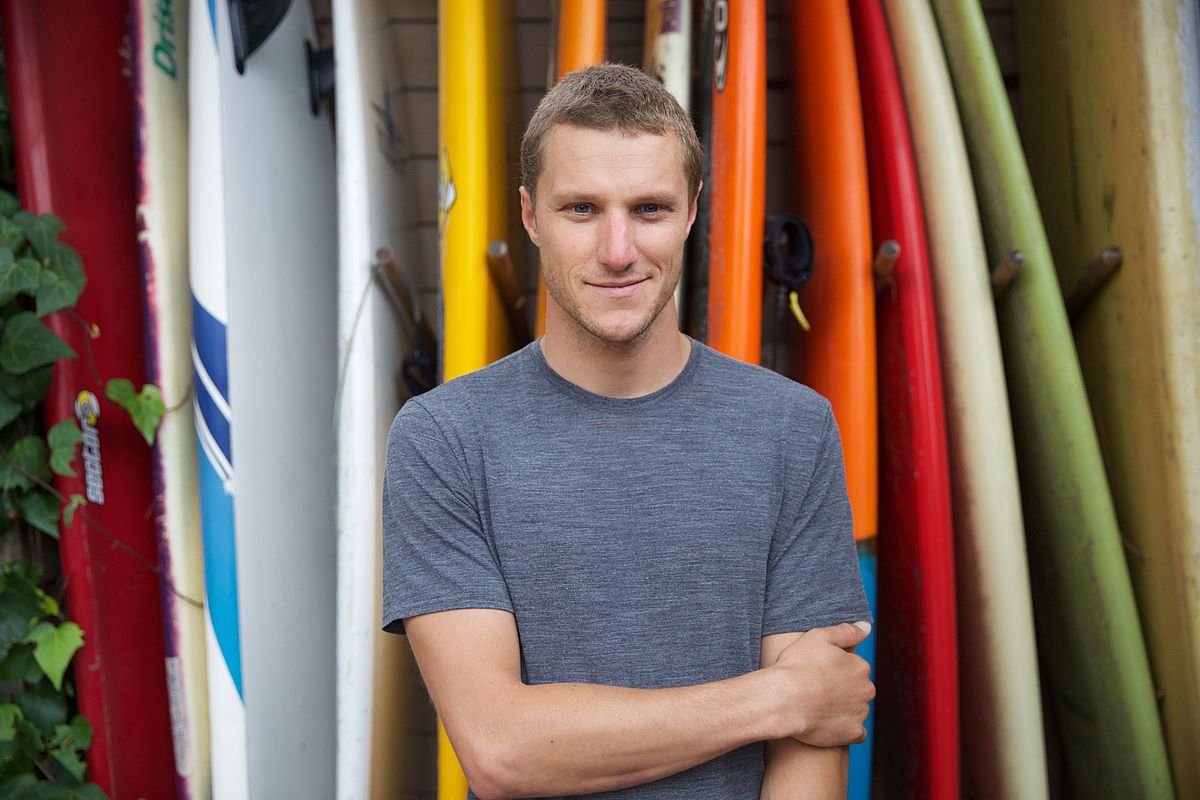
027: KYLE THIERMANN - Pro Surfer, Podcaster, Filmmaker.
Show Notes:
What if slowing down—not speeding up—is the real secret to becoming a better surfer?
In a surf world obsessed with progression and performance, pro surfer and filmmaker Kyle Thiermann offers a refreshing perspective: surfing as self-reflection. Whether you're battling impatience in the lineup or stuck on a plateau in your skills, Kyle’s insights into slowing down, noticing more, and redefining success will resonate deeply.
Learn how riding single fins and surfing slower can lead to faster progress and deeper enjoyment.
Discover why setting small, realistic goals can unlock big leaps in performance and confidence.
Hear how Kyle applies the same hyper-awareness from hunting and podcasting to his surfing—and how you can do the same.
Listen now to transform how you think about progression in surfing, and learn how slowing down could be the key to finally leveling up.
Kyle Thiermann is a professional surfer, podcaster, and filmmaker from California. He creates gonzo-style mini-documentaries about current issues happening all over the world. Tune in to his podcast for conversations with fascinating people he meets along the way. Kyle rips small waves and charges big waves, and he wants to keep getting better. He shares some insights into how he got so good and how he plans to improve.
Check out his podcast on iTunes or here: http://www.kyle.surf/podcast/
Kyle's TED talk: https://www.youtube.com/watch?v=EQIt2JUF-sg
http://surfingforchange.com/
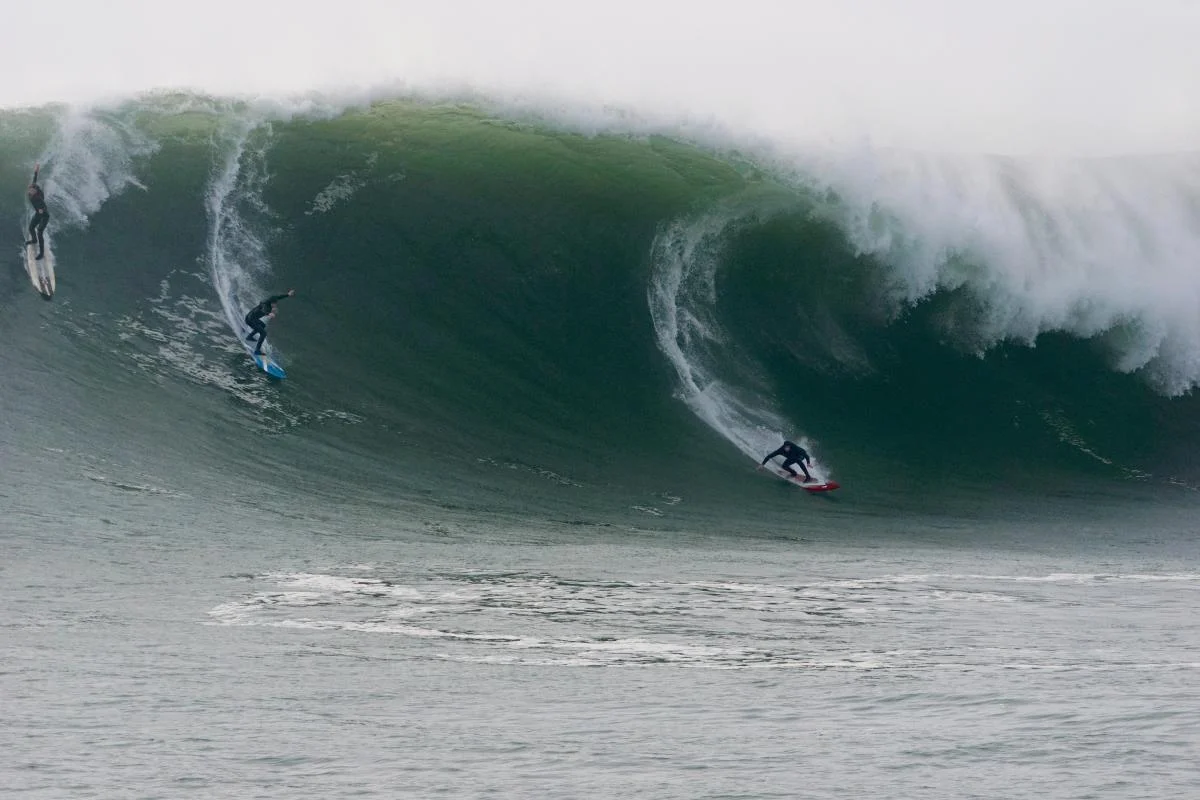
Kyle at Mavricks
Key Points
Kyle discussed how riding a single fin surfboard forces him to slow down and focus on the fundamentals of surfing, like bottom turns.
Kyle mentioned that surfing heavier waves like Puerto Escondido taught him to read the ocean better and notice details like rip currents and wave formations.
Kyle talked about the importance of having surfing mentors, like Tyler Fox, who taught him when to say no to surfing in dangerous conditions.
Kyle discussed how visualizing and preparing mentally for upcoming surf sessions can help slow down time and notice more details while surfing.
Kyle emphasized the value of learning new skills like hunting to regain a beginner's mindset and stay engaged in the learning process.
Kyle reflected on the deeper meaning of surfing as a way to connect with nature and notice more in life.
Kyle encouraged getting in the ocean regularly, whether surfing, swimming, or just being present, as a way to appreciate living on a "water planet."
Outline
Philosophy on Surfing and Life
Kyle Tierman emphasizes the importance of slowing down and noticing more in both surfing and daily experiences.
Single fin surfboards force a focus on fundamentals, particularly the bottom turn.
Good surfing is seen as graceful rather than just fast, with enjoyment found in pushing against the wave's energy.
Surfing serves as a mirror for life, revealing areas of strength and weakness.
Different surfing experiences bring reflection and newness, similar to traveling and getting out of one's comfort zone.
Surfing Progression and Fundamentals
Initial struggles involved trying to catch up to more talented peers by attempting advanced maneuvers before mastering basics.
Over time, the value of slowing down and focusing on fundamentals became clear.
Noticing more while surfing includes reading waves, understanding ocean conditions, and being aware of one’s position on the wave.
Reviewing footage has been instrumental in improving technique, especially in heavy wave conditions like Puerto Escondido, Mexico.
Learning from Skilled Surfers
Surrounding oneself with skilled surfers is strongly advocated for improvement.
Experiences learning from mentors like Tyler Fox, especially for big wave surfing at Mavericks, are shared.
The importance of saying no to dangerous conditions is stressed, exemplified by a foggy day at Mavericks when safety concerns led to not surfing.
Learning from professional surfers like Nat Young highlights the significant difference in speed and approach between average and elite surfers.
A combination of grit, talent, and quick learning ability contributes to becoming an exceptional surfer.
Mental Aspects of Surfing
The podcast delves into the mental aspects of surfing, including flow states, visualization, and focus.
Top surfers like Kelly Slater and Mick Fanning demonstrate incredible awareness and detail in their surfing.
Mick Fanning practices visualizing waves after intense workouts to prepare for competitions.
Setting realistic, short-term goals for surfing sessions helps maintain motivation and track progress.
Staying present and focused in the water is compared to the heightened awareness required in hunting.
Variety in Surfing Experiences
Maintaining variety in surfing experiences keeps the activity engaging and promotes continued learning.
Recent forays into longboarding highlight how being a beginner at a new style removes ego and allows quicker improvement.
Keeping surfing interesting is likened to maintaining a healthy relationship through trying new experiences and approaches.
Experiences with spearfishing provide a new perspective on familiar surf spots.
Philosophical Reflections on Surfing
Surfing is viewed as simultaneously pointless and profoundly meaningful.
It is seen as a way to connect with nature and notice more about the world and oneself.
Surfing’s apparent lack of consequence (outside of big wave scenarios) allows for experimentation and learning applicable to other life areas.
Mental health benefits of surfing are emphasized, encouraging engagement with the ocean in any capacity.
Recognizing Earth as primarily a water planet underscores the importance of experiencing it fully.
Transcription
Before you put your phone down, please make sure you're subscribed and rate and review. Go on, give us a quick rating and a review. Doesn't take long.
Today's guest has his own podcast. His name's Kyle Tierman. So go ahead and look up his podcast while you've got your phone there. K-Y-L-E T-H-I-E-R-M-A-N-N, The Kyle Thiermann Show. As well as being a podcaster, he's a pro surfer and a filmmaker. And in today's interview, he shares some gold. Enjoy!
Michael Frampton
So why single fins?
Kyle Thiermann
Single fins force me to slow down. And my big issue in Surfing and life has always been that I move too quickly. One of my favorite things about getting older is that I am realizing the joy of slowing down. I'm realizing the joy of drinking in life slowly and enjoying a wave slowly. I sometimes feel like the purpose of my life is simply to notice more. And single fins allow me to do that. And I think that every time I ride a single fin, it forces me to think about my bottom turn, which is the fundamental of Surfing. And I can't cheat with a triple bottom turn. And I think that one of the big mistakes I made early on in Surfing was that I tried to rip too early. And I was riding these little boards and I was growing up as a Grom in Santa Cruz with a great talent pool of surfers. I grew up with Nat Young and a guy named Kyle Boothman who's now a well-known filmmaker and a really good surfers. And I've always felt like I was two steps behind them. So I was always trying to catch up. I was always trying to learn the next trick. And as a result, my Surfing really suffered because I didn't slow down and focus on the fundamentals first.
Michael Frampton
So a single fin allows you to focus on the fundamentals more by slowing things down?
Kyle Thiermann
Yeah.
Michael Frampton
What does it force you to slow down? What do you mean by slow down? Because I thought good Surfing was fast surfing.
Kyle Thiermann
No, good surfing is graceful surfing, I think. And like you need to... Surfing is a sport where you are pushing against the wave and the wave is pushing back. And depending on the craft that you're using, you're going to be able to push with different pressure and different angles. So the single fin forces me to push and think about where I am positioned on the wave to generate speed more than gyrating, which you can do on a thruster. It's just fun. It's groovy. I feel cool when I ride a single fin. Yeah. Tuck that back knee in. Just go straight. I'll go on a wave. I won't even do a turn. I'll just go straight the whole way. My friend will be like, what did you do on that wave? Nothing. It was the best wave ever.
Michael Frampton
Interesting. So it sounds like for you the progression in Surfing is noticing more of what's happening when you're surfing?
Kyle Thiermann
Yeah. Yeah, it's noticing more about what's happening and noticing more about myself. I think that Surfing is this great mirror for myself. It shows me where I'm doing good in life. It shows me where I'm doing bad. Surfing big waves is a huge mirror for myself. There's no faking it when you get pulled down by a big wave. Either you're going to be able to stay composed in that situation or you're not. And I really love those kinds of moments. And it doesn't need to be a big wave that allows for a huge amount of reflection to happen. But anything where I... Any kind of newness. I would liken Surfing different kinds of boards with traveling. Because it gets you out of your comfort zone. All of a sudden you're seeing a new street halfway around the world and you're realizing, this isn't my street. It forces me to constantly think and keep my mind going. It's one of the best parts of life.
Michael Frampton
How would you describe your relationship with Surfing?
Kyle Thiermann
It's like an abusive relationship. I think that I have gained a much better relationship with Surfing in the past few years as I've sought out some mentors.
Michael Frampton
Surfing mentors?
Kyle Thiermann
Surfing mentors, yeah. I think that I always, from a young age, I had this false belief that if I got to a certain level of Surfing, then I would be okay with my surfing. Like, once I learn air reverses, then I'll be okay. Once I learn how to do a really good cutback, then I'll be okay. But it was largely, like, I was seeking something and trying to get better, but I wasn't trying to get better purely from a place of curiosity. It was from this place of, like, I'll show them. I'm going to get good. I had this kind of chip on my shoulder and created adversarial relationships in my life that probably didn't really exist. And as a result, I'd be really hard on myself. Like, I remember being, like, 14, 15 years old, like, losing in an NSSA contest and just feeling like it was the end of the world. Like, my sense of self was shattered as a result. And I look back at that and I laugh at those situations now. But it's been, I think that now what noticing more has done for my Surfing is it's allowed me to make smaller circles. So if I now am surfing a wave like Puerto Escondido, and if you're surfing Puerto Escondido, there are a lot of closeout barrels that you get. If I fall in that barrel, I try and dissect what I did wrong. And it's not so much the thought, I am a bad Surfing now as a result of falling on that wave. It's, okay, what did I do wrong? And I think that the best surfers are the ones that can kind of look at Surfing through a sober lens. They look at their own surfing through a sober lens. And same with comics. You know, you look at the best comics, they're not, they are willing to look at a set. They went on stage, they bombed, they're able to dissect it and say, okay, what did I do wrong? How can I do something different? And if we're able to take our ego out of the craft, and it's this constant push and pull of the ego, right, then that's what allows us to get better.
Michael Frampton
And that sober lens, is that often reviewing the footage?
Kyle Thiermann
I wish I could review footage more, man. I always benefit so much from that. Watching footage of myself Surfing is like, it's probably the equivalent of going out and going on a date with a girl and thinking, I did so good, I was killing it, it was amazing. And then you listen to the audio and you're like, man, it wasn't exactly how I thought it would be.
Michael Frampton
Have you recorded a few dates?
Kyle Thiermann
No. I still haven't been able to pull that one off. I felt like my Surfing got a lot better in, there have been three stages in my Surfing, if I really want to look at where I feel like I got a lot better. And began to really enjoy it more. The first was when I started taking trips with a good friend of mine named Kyle Boothman. He's an incredible tube rider and we spend a lot of time down in Mexico Surfing beach breaks. And before that point, I had never really surfers heavy waves. Santa Cruz is a spot that has a lot of point breaks and we do get heavy days, but by and large you're not Surfing a barreling wave. And he invited me to come down on a few of these trips and I had never seen waves that did what they did in a spot like Puerto Escondido. I had never seen waves that moved at that speed and demanded that kind of fast thinking. And we brought a filmer down there with us on those first trips and I noticed that a big mistake I was making early on was I would drop in straight to the waves. And then I would bottom turn to try and pull up into the barrel and the wave would have passed me by. So after reviewing days and days of footage and dropping into waves, not even making it into the barrel, I figured out, okay, to surfers these kinds of waves I need to get on a rail and really push it from the second that I drop in the wave, I need to be getting to the shoulder. And I really need to be noticing the waves more. I need to be reading the waves and if there's any kind of chunder on the lip, on the inside, it's going to be a close out barrel. So the amount of just messing up and then trying to read the waves better and looking at the footage, it opened up this whole new door for me which is Surfing heavier waves. And what I really like about surfing heavier waves is that it just raises the stakes a bit. And before I started Surfing I wanted to be a pro skater. And skateboarding is a sport where you have a lot of consequences on a daily basis. If you're trying to hurl yourself over a 10 stair, you really don't want to fall too many times. And there is that moment of deciding that you're going to do it. It's kind of just that, okay, screw it, we're going to make it happen, we're doing this. So I had that mindset from an early age. But technically speaking I always felt like I was a few steps behind my friends who were doing air reverses at 13 years old and I still couldn't figure out how to make it happen. But then when I started going down to these heavy beach breaks, I felt like I was able to use my strengths from skateboarding more and simplify the process. And man, on one of those early trips, I don't even think I made it out of a barrel. One of the first trips that I went on to Puerto Escondido, I came home with my tail between my legs. But then it fascinated me so much that I came back and that first experience of getting a proper big barrel where you drop in and you're standing in this room of water. And to feel the air back spit, that was something that I had never experienced before where the air sucks in, the vortex goes, and then that was a special experience for me. And when that happened, I felt like, okay, I found something that's going to be keeping me here for a really long time.
Michael Frampton
All that hard work was worth it. All those closeout barrels.
Kyle Thiermann
Yeah. You need to learn how to enjoy the process. There are a lot of waves around our world that demand a huge amount of patience. We spend weeks of our lives working for seconds of pleasure. And especially at these big beach breaks where you can be sitting out there for three hours and not even paddle into a wave. Either you're going to be into that kind of stuff or you're not. And being an impatient person, I find that it's really good for me to put myself in those situations and force myself to be patient and force myself to notice more. I keep coming back to Puerto because I do think that it is a wave that has just taught me so much. Even when I'm not riding waves, sitting out in the lineup, noticing where a rip starts forming. And then thinking, okay, if this rip is sucking right here, there might be a set that shows up ten minutes later. So it's this constant cat and mouse game in Puerto. And you see someone like Greg Long or Rusty Long, those guys are some of the best at Puerto Escondido. They're constantly noticing what is happening up and down the beach. And it's not by chance that they tend to get the best waves of the day. It's because they're constantly noticing. Even when they're not riding a wave, they're figuring out where the rips are happening. They're checking the day before to see where the bars are forming. Because it's a wave where new bars pop up and disappear every single day. And that kind of stuff is super cool to me.
Michael Frampton
So they're never just sitting out the back, lost in thought, waiting for a set. They're constantly looking, what's the tide doing, where's the rips. Looking at the horizon, looking for any sort of signal for that wave they're waiting for.
Kyle Thiermann
Yeah, it seems like it.
Michael Frampton
Is that how you would describe your experience of sitting out the back? Or are you just lost in thought?
Kyle Thiermann
You try not to be lost in thought because then you get a big wave on the head if you're not paying attention. But it's funny, Surfing heavier waves is an experience where you're sitting for a really long time. And then there's this moment of intensity that comes at any point. It's kind of like hunting. Hunting is a really boring experience for 99% of the time that you're there. You're either sitting or you're walking slowly. And then at any moment, you better be noticing what the wind is doing, where the animal might be. And at any moment, then this wildly intense experience presents itself. And I think that that's very similar with Surfing heavier waves.
Michael Frampton
So you've done some hunting?
Kyle Thiermann
I have. Yeah. In the last year, I've become more interested in hunting. It's something that gets me out into the mountains. In California, we have beautiful mountains. There was never any impetus for me to go spend time in the mountains. I was always a beach kid. And just in this last year, I had some friends who were getting into bow hunting. And doing my podcast, I've had a few hunters on. And I really enjoyed the experience of getting out there. And again, it forces me to notice more in a way that I wouldn't if I was just going on a hike. You need to be very quiet when you're hunting. You want to step with your feet in a flat fashion. And you want to constantly be paying attention to what the wind is doing. Because a lot of the animals that I hunt can smell a lot better than they can see. So you always want to remain downwind from them. So there is this process of constantly feeling and noticing and being attuned to your natural surroundings that is important.
Michael Frampton
Do you think that same lesson applies to Surfing? And that—I mean, you're a great surfers. But so from what you've learned from Surfing, has that helped you to be a better hunter? Or to pick up hunting quicker than if you hadn't have had that?
Kyle Thiermann
I think that the best lesson I can impart for both hunting and Surfing is that I try and surround myself with people who are better than me. Like that single lesson of just, okay, if you want to get better at something, spend time with people who have that skill and are willing to teach you. So for me, I constantly just bribe people who I want to get better. I'm like, hey, I'll hook you up with a Patagonia jacket if you teach me how to hunt. Or like, hey, what is it that I can teach you that then will make it worth it for you to teach me? They say that if you're the smartest person in the room, you're in the wrong room. And whether it comes to hunting or Surfing, that's what I try to do. So like, for example, when I became interested in Surfing Mavericks a few years ago, I was living with a guy named Tyler Fox. He makes it to the final in the Mavericks contest most years, and he's very calculated, and he's a very smart big wave surfers. And I just said, hey, man, what can I do? He's a friend of mine, so he was willing to teach me. But I said, what can I do that will get you to teach me? Because Mavericks is a wave, too, where you don't want to make too many mistakes. And I could see early on that I have this bad habit of just being like, YOLO, let's make it happen. We'll send it and learn the hard way. But it can really cramp your style falling on a big wave out there. And I wanted to do it in a responsible way. And Tyler, a guy who trains for big wave Surfing, and you rarely see him fall. He's a guy who rides nine-foot boards out at Mavericks. He rides some of the smallest boards out there, and he actually surfers the wave. If you see Tyler drop into a wave, he's usually in a very critical spot, and he rides the wave the way it's supposed to be ridden. And I've never had any interest in catching the biggest wave ever. My desire in Surfing bigger waves is to ride the waves well. And usually I don't do that, but it really does help. It has helped to have him serve as kind of a mentor for me. And learning how to say no, that's part of it, man. Like I said, Surfing is this constant mirror for me in my life where I'm pushing myself and then I'm learning about myself. I remember an experience last year where the swell was projected to be really big. And Tyler and I usually drive up to Mavericks together. So I put my board in his car, and we were driving up early in the morning before the light came up. And it's really difficult to tell how big the waves are at Mavericks before you get out there. Sometimes if you're driving up Highway 1 and it's daytime, you can kind of get a good perspective on how big it's going to be that day. But a lot of times you're driving up before it gets light, so you are kind of shooting in the dark. And we got up there, and there's this bluff that you can look at the waves from. And Mavericks is a wave that's really far out. And the light was just coming up. And when the light started coming up, we could see that it was really thick fog. It was that kind of fog where you can barely even see the sun. It's just that white ball in the distance. And one of the most dangerous things that can happen to you at Mavericks is getting washed through the rocks and having people not see you. And fog makes Surfing out there exponentially more dangerous because you can fall on a wave, get sucked through the rocks, and then no one's going to see you. And I really wanted to surfers. There hadn't been a day of Surfing big waves in a long time. And I was standing there with Tyler, and he said, it's too dangerous. We're not Surfing today. And I said, okay. And we turned around, and we went home. And sometimes I think that a lesson like that taught me more about surfing, and I didn't even surfers. So learning how to say no and learning how to slow down, as I said, is this kind of thread throughout my life that I'm constantly pushing.
Michael Frampton
Yeah. You don't want to have a Surfing that you'd regret.
Kyle Thiermann
Yeah. Yeah, well, it can really take it out of you, man. Like, if you have a ––– one of my biggest fears is being put in a situation that I really haven't prepared for and having it come back on me. You know, having someone die and having it be my fault, like having there have been something that I could have done. You know, like having someone ––– whether that's in Surfing or in life, someone just falling down and, shit, I didn't learn CPR. Shit, I could have gained that skill from someone else. They could have taught me that, but I was too lazy to learn that skill. So for me at this point, the reason that I love podcasting so much is I get to sit down with people who would never make time otherwise, and I get to ask them questions, and they impart knowledge that can be really useful.
Michael Frampton
So you mentioned mentors a couple of times. Yeah. You obviously mentioned your big wave mentor or one of them. Do you have any small wave or normal everyday Surfing mentors?
Kyle Thiermann
Absolutely. Tyler Fox is someone who is a really good small wave surfers. He was in the top 100 on the QS and was right there for a while to be able to make it on the world tour. So he teaches me a lot in Surfing small waves as well. And, yeah, you know, it ebbs and flows. I feel like sometimes in my surfing I'm just maintaining and just going out more for my own sanity than I am really pushing and progressing. And I find that the times when I really am pushing myself tend to be on surfers trips where I'm Surfing a new wave and I'm needing to, you know, as I said, traveling. You're constantly needing to figure out what if you're serving a new wave, it can't just be routine anymore. So I find that whenever I travel, I get better at Surfing and really hone in on the craft more. And it probably sounds really simple or overly simple to say, but a lot of what I focus on is going back to the basics again and again, focusing on my bottom turn, focusing on my wave selection. If I can keep those two things in my mind, then I'm probably going to have a better session, slowing down.
Michael Frampton
When you go on a trip and you learn to surfers a new wave, you come back to your home break and Surfing easier?
Kyle Thiermann
My God, my home break sucks. Damn, I don't even want to surfers. No. Yeah, right. When we focus deeply on any skill, we're going to get better at it. It's like the difference between getting a Spanish tutor once a week and immersing yourself in Nicaragua and living with a family for a month and not speaking any English. You're going to get a lot better when you immerse yourself in that skill. And I've found that for me, if I want to learn a skill quickly, it's better for me to immerse myself in it for two weeks than it is to have this kind of topical learning method. Yeah, so it ebbs and flows. In Santa Cruz, we have pretty darn good waves in the wintertime, so I tend to focus on my Surfing more then. And I take trips whenever possible. But yeah, it's strange, you know, because there is a point when Surfing isn't the most important thing in my life. It's a big part of my life, but I realized pretty early on that I was not going to be good enough to make it to the world tour and be a competitive, professional surfers. And I think that it's important to always have a sober view of how good we really are and when we should start focusing on other aspects of our life more. That doesn't mean that we need to stop Surfing. And largely, as soon as I kind of let that go, I've been able to enjoy my Surfing a lot more because my identity wasn't as attached to it. I have no problem saying, yeah, I'm a good surfers. But, you know, when I go, like just last week, I went and surfed this beach break up north in Santa Cruz with Nat Young. And just to see his approach, we're Surfing the exact same wave, to see the speed at which he rides the wave and his approach, it's just like, fuck, I just don't have that. You know, like, and I probably will never have that. And I can make these incremental improvements in my life. But I'm okay with that. You know, there are things that I am better than him at. And that's totally cool.
Michael Frampton
Do you think Nat just takes more in from the present moment? Do you think that's why he's better in that situation?
Kyle Thiermann
I think that he, from a very early age, spent a lot of time getting better, and he learned how to learn at a really young age. He was the guy who would paddle out, and he would not go in until he learned that trick. And he was the guy who, from a very young age, would focus on Surfing bad waves when the rest of us were just surfing right-hand point breaks. And that allowed him to gain a lot more versatility in his approach and his ability to ride a bunch of different waves. I think he's just a gamer with whatever he does. Whether it's Surfing or ping pong or Monopoly. Like, when we were kids, we would pick up a new game every couple weeks, and within a couple weeks, he would be the best at it. It wouldn't matter what it was. He would just spend more time figuring it out. And then he would become the best, and he would move on to the next thing. So I've always really respected that about him. He's got a lot of grit.
Michael Frampton
Do you think that he's able to focus more deeply than others? More of a general question. The surfers who are on that next level, do you think they just have next level focus?
Kyle Thiermann
I think it's a combination of things. I think that there's a huge amount that has to do with grit and how far you're willing to go to become really good. I think that a lot of it has to do... It's interesting, right? That question of what makes people good at things. What makes people world class at things. I would say that a huge amount of it has to do with grit and talent too. Some people just have it. They're in rhythm with the ocean. People who have never really had to work on their styles. They're the ones who just have that rhythm. And hats off to them. The ones who have that connection. And we Dall-E those people. The Dan Malloys. Someone who can just ride any piece of equipment and make it look beautiful. And you can tell that they're not thinking in the same way as someone like me is constantly. Kind of figuring it out. What do you think?
Michael Frampton
I think it's... The more I look into it, I think it's... You know about flow states? And time slows down. You see things in more detail. I think all athletes have the ability... The better the athlete, the better the ability to go deeper into flow states, where time slows down even more, where they notice more. I mean, you take... We've all heard Kelly Slater in a post heat interview. He describes that we can't even see when we're watching the slow motion replay. He saw some warble on the wave that you can't even see it on the replay. Or I've heard him describe that he didn't like a photo of his because of the way his little finger was held to return. So he was working on what he was doing with his hands to return. The level of detail and awareness is just so much more intense and focused.
Kyle Thiermann
Yeah. I had the chance to have Mick Fanning on my podcast, and he was talking about how one thing that really changed for him during a season was... He started visualizing upcoming events after workouts. He would do a really difficult workout, and then when he was sweaty and exhausted and Chopu was coming up next, he would sit down and he would think about dropping into a wave there. And he would think about where his hands were, and he would think about what the wave would be doing, and how it would feel to get spit out of a big barrel. And then he said that when he went to an event like Chopu, he felt like time would slow down in a way that he could notice more because he had visualized it before. So I think that a huge amount of it is detail, and a big part of it too is visualization. How much do you really believe in yourself? How much do you truly know that you can do it? And that ebbs and flows with every athlete. It's rare that a professional surfers doesn't at least have a year where they bobble and then get it back. But I think that a lot of that has to do with confidence and belief. And when we can engineer states through visualization, that tends to really help. Because your body doesn't know the difference. If you're really thinking about dropping into that wave and pulling into the barrel exactly the way you want to, when you go out and do it, your body thinks I've been here before.
Michael Frampton
Yeah, and that relaxes the brain and then flow states flow. When I think of the best waves I've surfers, it's always been where time slowed down the most. And I've had that confirmed through footage. I've seen footage of wow, it felt like I was Surfing so fast and it looked horrible. And then I think, well, that wave felt slow, but it looked better. But I was more detailed and time was slowed down for me. I saw more. There's one big thing that I learned from Tom Carroll interviewing him. He said you've got to look for the details. We're talking about Surfing small waves. I saw him in his 50s, and we went surfing, and he was just doing roundhouse cutbacks on these little knee-high waves. I couldn't even catch the waves. And it just blew my mind, and I thought, how? And he said it's the details. He's looking at what the wind chop's doing, what the secondary swell's doing, what the backwash is doing. He's so focused on the now.
Kyle Thiermann
Well, they say that if you learn how to surfers a small wave, then you can surfers a big wave, but not vice versa. And that's probably because there's so much detail that is put in, that happens when you're Surfing a two-foot slop. You're really looking for those little energy pockets because the wave's not pushing you along with this infinite amount of energy, where you can surf a big wave and wherever you put yourself, the wave's going to continue to push you along. But there is that kind of detail in noticing how to surfers a small wave. Sure are hard. Yeah. God. I'm always just so impressed with people who can go at that speed. I think that's the difference between a good surfers and a great surfer. You don't really see it when you're looking at the replays or when you're looking on TV at the events, because all the surfers are Surfing so fast, you don't have anything to compare it to. But man, if you're out Surfing your home break and Mick Fanning paddles out, whoo-wee, that guy's going at a different speed than everyone else. Yeah.
Michael Frampton
It's amazing. Especially when the waves are tiny and everyone's struggling to catch the waves on their fatboards, and a pro comes out on this little paper-thin wafer and just tears it apart. It's so amazing. Yeah. They make Surfing look like it can be so much more fun. Right. And that's what drives me to get better. I'm not a competitor, and most of the listeners aren't. Right. They just want to get better at Surfing the bad waves they surf every day and to get better so that they can go to Uluwatu or so they can go and surfers Cloud Break. Right. They want to get better so they can create those opportunities to surfers these waves and maybe one day get a stand-up barrel.
Kyle Thiermann
Yeah. I think that one key to happiness is setting short-term goals for yourself and achieving them. It allows us to break life down into daily chunks, and it helps me to not get so overwhelmed. Right. I have this practice that I do every day where I think about three things that would make my day great in the morning. I write them down, and then in the evening, I write down what are three great things that happened today and what are three things I could have done better. And that simple practice allows me to make smaller circles in my life. When it comes to Surfing, I respect what you do because you are helping people break it down, and getting better doesn't seem so amorphous and big when you can point out the details for people. I've started to do that with my Surfing too. Before I paddle out now, I really set expectations for myself. I will think today is going to be a good session if I catch three good waves, or today is going to be a good session if I get a barrel. I set different expectations based on the day.
Michael Frampton
So they are realistic.
Kyle Thiermann
So they are realistic. My expectation for paddling out at a crowded wave point break in Santa Cruz is usually I'm going to catch three waves and then I'm going to go in. Whereas Mavericks is a wave where I'm constantly needing to recalibrate my expectations. It can not only be disappointing to set too high of expectations, but it can be really dangerous too. So a wave like Mavericks, an expectation that I might set for myself is to focus on my breath the whole session. Just something to make it that small that I have something to focus on. I heard a really good tennis player once say that when they feel overwhelmed and it's match point, they think about their feet. I always really like that. Anything that we can do to make it smaller and more manageable can allow us to move through the experience with more grace.
Michael Frampton
Bring it back to the body rather than lost in thought. Because if you're lost in thought, you lose your focus and you miss the wave or you get caught on the side.
Kyle Thiermann
Yeah. Don't want to be asleep at the wheel. It's amazing how difficult it is to hold focus.
Michael Frampton
It is.
Kyle Thiermann
Gosh, our minds. You ever see that Simpsons episode where Marge is like, Homer, are you even listening to me? And then it goes inside Homer's brain and it's this monkey with tambourines going ch-ch. I sometimes feel like that in most of my life.
Michael Frampton
I think we all do. I liked your hunting analogy before because I grew up hunting.
Kyle Thiermann
You did?
Michael Frampton
And that's one thing, you might go for a four-hour walk, and as soon as you get lost in thought, that's when the animal runs in front of you and it's gone. Yeah. And you learn that very quickly. Yeah. So you have to be always aware of the wind, how you're walking, what you are looking for. And it seems like hunting is something so primal within us that for me at least, it's easier to have that kind of hyper focus when I'm hunting because it seems it's more primal, I guess. Whereas Surfing is so, I mean it's just surfing really, isn't it? It's just catching some waves. Like hunting is primal in us, you know? If we didn't get that animal, we couldn't feed our family. It's ingrained in our neurology. So I think if you can bring that hyper focus to your Surfing, that's what I'm learning more nowadays. I did a hunting trip recently in New Zealand, and it kind of just reminded me of that hyper focus that happens almost naturally. Maybe it's because I grew up or maybe it's the primal instinct, but I've been bringing that hyper awareness into my Surfing and really hunting waves, hunting the details. And I'm finding that is getting me into the flow more.
Kyle Thiermann
Yeah. What were you hunting?
Michael Frampton
Deer.
Kyle Thiermann
Deer. They have access to deer out there?
Michael Frampton
No, you would call elk here, I guess. Red deer, we call them in New Zealand.
Kyle Thiermann
Wow. Cool.
Michael Frampton
Yeah. I hear there's very good hunting and fishing out there as well. I have a friend named Justin Lee, who's a Hawaiian spear fisherman. He took a trip out to New Zealand and he sent me this photo of this school of yellowtail circling around him and he's about to take his drop. And it's this aerial photo of hundreds of yellowtail circling around. I'd really like to get out there.
Kyle Thiermann
Yeah, it's paradise. It's so untouched.
Michael Frampton
Yeah. It's fun to... I'm not very good at hunting, so it stays new for me. There is this point of exponential learning that happens when you start a new skill. Whereas Surfing, it's like at this point, it's very small details. For me to get 1% better at Surfing is way more difficult than it is for me to get 1% better at hunting because it's just so new for me. I'm just taking it all in. I'm a beginner again. I always find that when I become crotchety, it's time for me to learn a new skill. Find something that I suck at and get better at it.
Michael Frampton
So that's why going back to Surfing, jumping on a single fin kind of gives you that new...
Kyle Thiermann
Feeling. Totally. Yeah. And longboarding too. I oscillate between Santa Cruz and LA and I just got this beautiful 9'6 longboard shaped by a guy named Travis Reynolds. I keep it down here and I've been Surfing Malibu. I've never really been a longboarder, but man, it's fun. My gosh. Just going straight and trimming on a wave is such a blast. I suck at longboarding. I can do it, but I'm not expected to be good at it at all. Which allows me to get better more quickly because I don't have any ego attached to it.
Michael Frampton
Yeah. I started longboarding six months ago too, and I wish I'd started earlier.
Kyle Thiermann
My God.
Michael Frampton
Yeah. All... And it's so good for your shortboarding too because as soon as you jump on a shortboard, it's like...
Kyle Thiermann
The little hipster kids had it figured out from day one.
Michael Frampton
Yeah.
Kyle Thiermann
It keeps it fun, right? Think about relationships in that way. Anytime you're in a relationship with someone and it becomes repetitive and you begin to take your partner for granted, you're in trouble. You'll hear about it. You'll hear about it. And if you really want to keep that relationship spicy, you're constantly doing new experiences together. You're saying new things. You're writing love letters. You're doing whatever you can to keep that newness and that romance alive. So whatever I can do to keep the romance in Surfing alive, I will do.
Michael Frampton
Like that. Yeah. I think being a little bit guilty in the past of keeping it too scientific and too clinical. Yeah. Whereas you've got to throw some creativity in there as well. Yeah. Just get an old longboard. Learn how to ride it.
Kyle Thiermann
Yeah. I mean, look. We're not designing the Hubble telescope here. We're not engineers. Surfing is an art and there's a beauty to it. It's one of the most pointless activities ever. What are we doing? We're going out and we're surfing a couple of waves for absolutely no reason. Like what? If aliens came down and they were to look at human Surfing, they'd probably think it was pretty cool because it is so pointless. And we'd better keep that joy and that romance involved. Otherwise, we're just robots.
Michael Frampton
Yeah. It is pointless. But what has Surfing taught you about things that aren't pointless?
Kyle Thiermann
Well, now we're getting into some very deep questions around the point of life and why are we even here. We're here for 80 or 90 years if we're lucky. We're going to meet some people. We're going to have some experiences that are going to teach us about ourselves. We're either going to leave the campsite a little bit nicer than we found it or we're not. And then we're going to be gone. And everyone we know is going to be gone and everyone that they know is going to be gone. And everything that we've ever said is probably going to be forgotten and made obsolete at a certain point. So why are we here? What is the real point? You could say that Surfing is one of the most profoundly meaningful experiences because we are dancing with nature. We are really immersing ourselves in the natural world in a way that we rarely get to do. So from a value standpoint, I value our natural world, and many surfers do. There's a reason why so many surfers are environmentalists because we interact with nature on such a deep level. And meaning can be brought to our lives in many ways. And as I said before, I sometimes feel like the meaning of my life is just to notice more. And Surfing is a really beautiful way for me to notice more. So I don't mean to say that Surfing is meaningless. But I like to throw that out there because life is so important. We better not take it too seriously.
Michael Frampton
I think it's the meaningless of Surfing that allows us to experiment. If you're not surfing big waves, there's not really any consequences to trying a new board or trying a new technique. And like you alluded to, it teaches you to have that same mindset in other areas of your life. So Surfing can almost be like the testing ground.
Kyle Thiermann
Yeah, absolutely. It keeps us sane. I surfers more for my mental state than I do for my physical state. I'm just being able to get out there and get in the ocean and dive underwater. And even something as like I started spearfishing two years ago. And I go spearfish waves that I've surfers my entire life. But now I'm looking at the reef from a new perspective that I've never seen before. I have this new target. And I always have to chuckle because I'm going in the exact same spot that I've gone my entire life. But it's this completely new experience by shifting that goal just a little bit, even though I'm in the same environment. And that's what's so freaking cool about the ocean is that we can experience it in any capacity that we want. Forever. I'm going to be 90 years old just floating out there, naked, saggy, can't stand up on a wave, but I'll be on my boogie board. Riding into shore. Still enjoying it. Final words. Man, I enjoy this conversation. It's fun to geek out on Surfing. And you know, get out in the water every single day. I think that's the best thing that we can do. It's church out there. So get out, even if you're on a boogie board or you're swimming or you're just getting into Surfing. Or if you're the best surfers in the world listening to this. You know, when you think about planet Earth, it's mostly water. We're here on these little patches of dirt. To be able to just pay that kind of respect and understanding that we really do live on a blue planet. We live on a water planet. So let's experience it as fully as possible. I think is cool. I like having that thought as much as possible.
Michael Frampton
Cool. Kyle, thank you for your time.
Kyle Thiermann
Yeah, thanks for having me. Cool.
Michael Frampton
Thanks for being a part of it.
Thanks for tuning in to the Surf Mastery Podcast. Again, I'm your host, Michael Frampton. Make sure you subscribe so you can keep up to date with the latest interviews. Please share with your friends. Check us out on Facebook at Surfers Mastery Surf. And if you're on iTunes, please go and give us a little rating. That'd be awesome. Until next time, keep Surfing.
27 Kyle Thiermann - Pro Surfer, Podcaster, Filmaker
For the passionate surfer—whether you're a weekend warrior, a surf dad, or an older surfer—this podcast is all about better surfing and deeper stoke. With expert surf coaching, surf training, and surfing tips, we’ll help you catch more waves, refine your paddling technique, and perfect your pop up on a surfboard. From surf workouts to handling wipeouts, chasing bigger waves, and mastering surf technique, we’re here to make sure you not only improve but truly enjoy surfing more—so you can get more out of every session and become a wiser surfer. Go from Beginner or intermediate Surfer to advanced.