
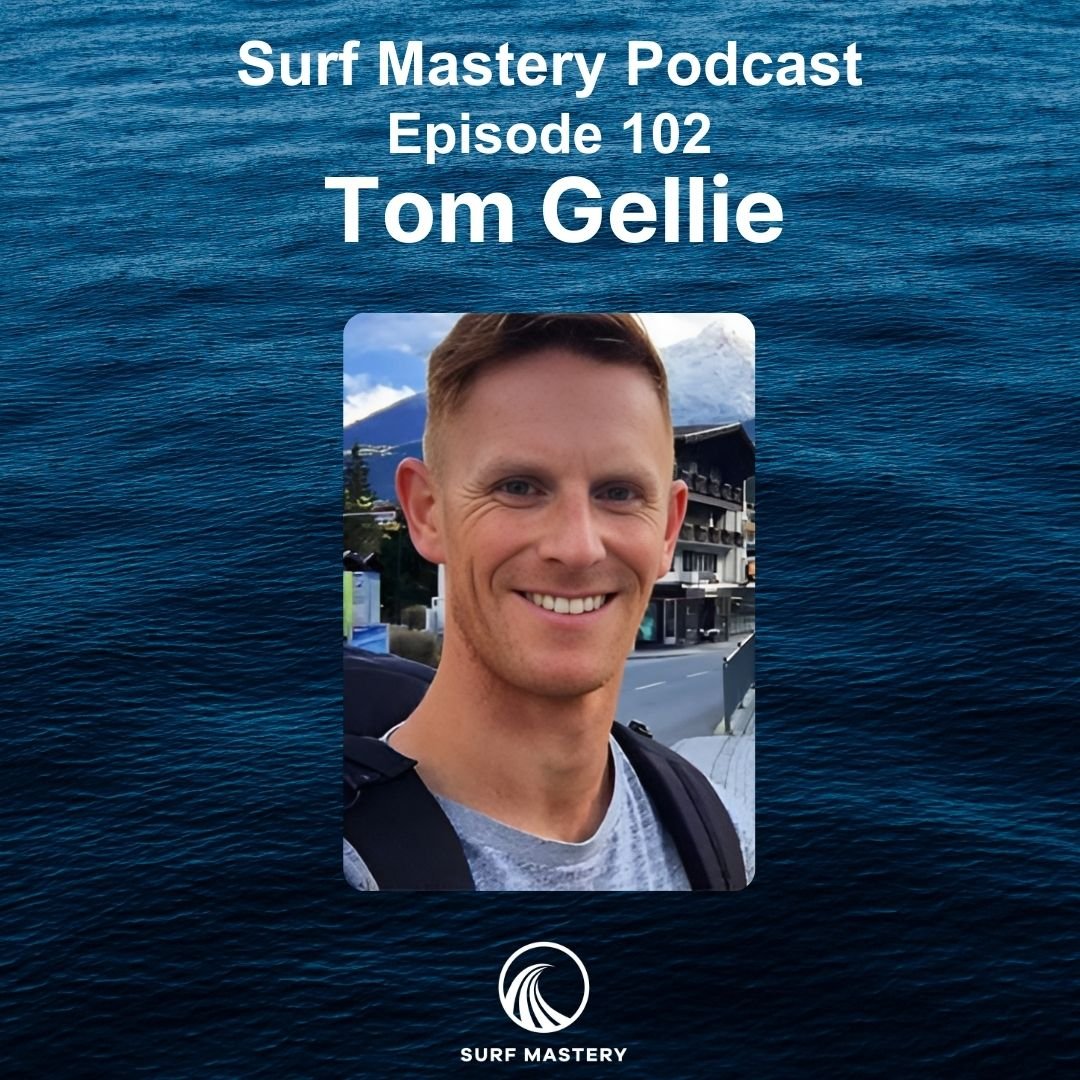
102 Tom Gellie- Why Expert Advice is Often Not Helpful when Learning to Surf (or Ski)
Why does your coach keep yelling “bend your knees”—but your surfing still feels stiff and unstable?
In this episode, elite ski coach and biomechanics expert Tom Gellie breaks down the real reason most surfers struggle with body movement: they don’t understand their stance, how their body moves, or what athletic posture actually means. Whether you’re a total beginner or a surf coach yourself, this conversation flips the script on technique, progress, and long-term learning.
Discover how body awareness and kinesthetic intelligence matter more than strength for better surfing
Learn why athletic stance isn’t just about “bending your knees”—and how to actually cue it correctly
Explore how constraints-based learning and dry land training can supercharge your surf progress
Press play to uncover a smarter, more effective way to improve your surfing—backed by science, movement wisdom, and lived experience from skiing to surfing.
For more insights and tips from Tom Gellie: Follow Tom Gellie:
Website: Big Picture Skiing
Instagram: @bigpictureskiing
YouTube: Big Picture Skiing Channel
Follow Michael Frampton:
Instagram: @surfmastery
Website: Surf Mastery
Key Points
The concept of finding a single approach or technique that addresses multiple issues, termed as 'hitting all the birds with one stone,' is discussed in relation to coaching and learning.
The challenges of teaching skiing techniques and the difficulties of finding a universal approach to coaching, especially when students have different backgrounds and levels of experience, are highlighted.
The importance of taking a 'big picture' approach to coaching, considering various perspectives and methods, is emphasized.
The athletic stance in skiing and surfing, its importance, and the challenges in teaching it are discussed, highlighting the need for coaches to find different ways to cue students effectively.
The discussion on the effectiveness of short-term versus long-term coaching, emphasizing the importance of managing expectations and the need for a long-term approach to see significant progress.
The value of constraints-based learning in coaching, where coaches create environments that force students to discover the correct techniques on their own rather than being told what to do, is explored.
The role of body awareness and kinesthetic intelligence in learning sports techniques, emphasizing that these are more critical than physical strength for performance, is discussed.
The influence of the gait cycle on understanding body mechanics and its application in sports coaching, particularly in skiing and surfing, is highlighted.
Outline
Podcast Introduction
Michael Frampton introduces the Surf Mastery Podcast and welcomes Tom Gelley as the guest.
Michael mentions Tom's background as a ski instructor, body worker, and functional movement practitioner.
Michael highlights Tom's online skiing teachings available at Big Picture Skiing and his Instagram presence.
Michael promotes a new Flat Rock wetsuit, describing its comfort, warmth, and fit, and offers a discount code MASTER15 for listeners.
Michael notes the international shipping availability of Flat Rock wetsuits.
Tom's Podcast Journey
Tom started podcasting around the same time as Michael, motivated by the desire to share conversations and insights from the ski world.
Tom chose the name 'Big Picture Skiing' to reflect his approach of considering all angles and perspectives in problem-solving.
Tom's Surfing Journey
Tom began surfing in January 2021, motivated by the desire to relate to his skiing students and improve his own skiing through a new learning experience.
Tom's previous experience with kite surfing influenced his decision to start surfing.
Tom emphasizes the importance of going through frustration and different approaches to overcome challenges in learning surfing.
Skiing Background
Tom started skiing at a young age, taking family trips to the Australian Alps.
After university, Tom moved to Canada to pursue skiing, working in a rental shop and teaching skiing.
Tom's experience in Canada allowed for significant progress in skiing due to the quality of snow and less busy instructor environment.
Athletic Stance in Skiing and Surfing
Tom discusses the importance of the athletic stance in both skiing and surfing, emphasizing the need for a balanced and flexible position.
Tom shares personal experiences and coaching insights on how to teach and improve the athletic stance.
Tom highlights the similarities and differences in the athletic stance between skiing and surfing.
Coaching Philosophy and Approach
Tom advocates for a long-term coaching approach, emphasizing the importance of managing expectations and being open to different outcomes.
Tom shares an example of helping a client improve their skiing technique by challenging preconceived notions and encouraging experimentation.
Tom discusses the value of constraints-based learning, where coaches create environments that force learners to discover solutions themselves.
Surf Culture and Community
Tom and Michael discuss the unique aspects of surf culture, including the limited resource nature of waves and the varying levels of friendliness among surfers.
They note the contrast between the supportive environment at wave pools and the sometimes competitive atmosphere at natural surf breaks.
Tom expresses a desire for more friendly interactions among surfers, similar to the camaraderie often found in skiing communities.
Technicality in Coaching
Michael and Tom debate the level of technicality in surf coaching compared to other sports like skiing.
Tom shares insights from his interview with Sasha Rierich, a former US ski team coach, about constraints-based learning and its application in coaching.
Tom emphasizes the importance of allowing learners to discover solutions through guided experiences rather than direct instruction.
Body Awareness and Kinesthetic Intelligence
Tom discusses the concept of kinesthetic intelligence (KQ) and its importance in sports performance.
He highlights the role of body awareness in improving technique and performance, often trumping raw strength.
Tom recommends activities like surf skating and dry land training to enhance body awareness and technique.
Gait and Movement Patterns
Tom introduces the concept of the gait cycle and its importance in understanding body movement and function.
He references Gary Ward's book 'What the Foot?' as a valuable resource for learning about the foot, gait, and their connection to overall body health.
Tom emphasizes the interconnectedness of body parts and the importance of identifying patterns in movement to address issues effectively.
Transcription
Michael Frampton
Welcome back or welcome to the Self Mastery podcast. I'm your host, Michael Frampton. Today's guest is Tom Gellie. Tom has a really interesting introduction to his newfound passion for surfing as an adult learner. Because Tom isn't a ski instructor, a very experienced and sought-after ski instructor at that, as well as a body worker, a functional movement and biomechanical practitioner. He's also been podcasting for a long time, so he's very well spoken. And I really, really enjoyed this conversation with Tom. We could have gone on and on and spoken for a lot longer, so I know everyone here will enjoy this one. You can check out a bit more of Tom at bigpictureskiing.com, because Tom also teaches a lot of his skiing stuff online and, of course, Instagram of the same name. There'll be links to everything Tom in the show notes to this episode. And of course, you can check out my website, surfmastery.com. But just before I fade in that interview, I wanted to talk about a new wetsuit I got recently from—I'll hold it up here if you're watching on YouTube. This is a Flatrock wetsuit. You may have seen people wearing these. Quite new in the wetsuit game, and gosh, it is hands down the most comfortable wetsuit I have ever worn.
Michael Frampton
It's made from Japanese limestone neoprene, and it feels like a cross between silk and butter, and it fits so good. So stoked with this new wetsuit. And it's just slightly more expensive than a Need Essentials wetsuit, so it's not an expensive wetsuit. But gosh, it's a lot warmer and better fitting and more comfortable than a Need Essentials wetsuit. I'll give it that for sure. And I actually wore—this is the 2/3 version I've got. I've had it for a little bit, and then I went to go surfing the other day in the middle of winter here in New Zealand, and my 4/3 O'Neill, which is about twice the price, had a hole in it in the crotch, so I couldn't wear that. So I grabbed this thinking, oh, I'll just go for a quick surf. It doesn't matter if I get cold. And I was really surprised with how warm this 2/3 wetsuit was. The wind did not cut through it like it would my Need Essentials 2/3. So yeah, anyway, awesome wetsuit and the guys at Flatrock have been kind enough to give my listeners a discount on a wetsuit.
Michael Frampton
So if you go to flatrock.com.au and we've got a coupon code at checkout, which is MASTER15—so that's MASTER15—sorry, that's flatrockwetsuits.com.au, new flatrockwetsuits.com.au. I will have a link to that website in the show notes though, and as well as I'll write down that coupon code for a 15% discount, which is MASTER15. So yeah, it's also another way to support this show. Next time you buy a wetsuit, give it a crack. Great wetsuits. The fitting—I got a medium. I'm a medium in O'Neill, and I am in a medium with my Need Essentials as well. And sizing-wise, great wetsuits. They also ship internationally as well, so it doesn't matter whether you're in California or Australia or New Zealand or wherever you're listening from. They ship internationally, and mine turned up pretty quick and it's a great wetsuit. So yeah, go and check out Flatrock Wetsuits. Ecomcrew discount code MASTER15 for that. And then, without further ado, I will fade in my conversation with Tom Gellie of Big Picture Skiing. You started your skiing podcast back in 2015, and that's when I started this podcast.
Tom Gellie
Yeah, right. Okay. Well, same, same sort of time. Yeah. What was the incentive behind you doing it? What was the main reason?
Michael Frampton
So I mean, I started surfing, you know, I was a white trash dairy farmer. And then when I left school, I discovered surfing, and the beaches that me and my friend would surf at, there was no one else surfing around. It was all self-taught, just on whatever board the local salesman decided to sell us. Didn't stop us though. We were so passionate about it. And, you know, obviously we picked up a little bit from magazines and that. And then, you know, fast forward 15 years and I ended up living in Palm Beach and scored a job with Matt Grainger at the High Performance Center. And just around the corner from you, right? And you said you're in the Ravine? Yeah. And that was my first real introduction into, you know, the surf coaching world. And then obviously being surrounded by really good waves and really good surfers and people that, you know, I get listed their surfing performance quite high up. And it wasn't just what I was learning, you know, as through the journey of becoming a surf coach and getting surf coaching myself. It was the conversations I was having with everyone around. So I kind of thought, oh, podcasting was new back then. I was like, oh, I should share these conversations.
Tom Gellie
That's right. Not everyone gets the chance. Like I haven't had that sort of chance like you have to be around people like Matt Grainger on probably a daily basis, and then his friends who surf at a really high level. And then all those things could be in a car, could be sitting, you know, because there's no surf, you're just sitting there talking. Those are gold. And that's what I realized. Same in the ski world happens. And it's really neat, in this day and age, how we can share that stuff.
Michael Frampton
Exactly. So Big Picture Skiing—why did you choose that name?
Tom Gellie
I chose that name because I wanted something that sort of represented that I—when I think about something, I really try and look at it from all angles. And definitely at that point when I sort of started it, which was actually just when COVID hit. So my job as a sort of functional body worker type person, I had a pretty successful practice. People coming in, couldn't put hands on people anymore. And I was going through this period of really just realizing, like the way I saw things, you know? Like I was like, oh, I know how to fix people with knee pain, you know? Because I'd figured out this one method modality and it had worked, worked, worked. But then it would come to a point where it would stop working, and I'd have to, like, find new ways. And so I just had so many experiences where I realized there's just so many different ways of looking at the same thing. And the more you can do that, the better you are at dealing with people when they come to you with their particular problem. Like the old "don’t use a hammer for everything" saying. So yeah, I was trying to look for a name that encompassed that. Like, I want to teach you and view the way you approach skiing from the big picture—right out here—so I can see it from all angles.
Michael Frampton
So when did surfing come into the picture?
Tom Gellie
Not long after that, because we moved from the inner part of Sydney to the Northern Beaches to North Narrabeen in January 2021. And I'd spent a lot of time, you know, being an Aussie, we spent a lot of time in summer holidays at the beach and body surfing, boogie boarding, that sort of stuff. So I was familiar with waves, but now being near the ocean, it's like, this—I'm going to give it a go. I'm going to take up surfing. Because actually, I was into kite surfing. And so we were sort of closer to Botany Bay in Sydney, so kite surfing was an easier thing to do. And I loved it and I thought I'd keep doing that. But then, yeah, North Narrabeen, which is a classic break, was just—get in the car for three minutes and I'm there. So I decided to take it on. And also, and I should say, a really important piece—I knew because skiing was growing and I just really wanted to find something that I could relate to my students in a learning sense. Because my—as you probably know—the better you get, you're kind of just, well, there's no point in remembering. If what you're trying to do is just get good at something, once you get good at something, you shouldn't think about it. You should just do it. Thinking can ruin things. But I need to go backwards in my skiing to help people. And like, what am I actually doing here? Surfing really helped me be on the same page in terms of how it takes a lot of time. It takes going through frustration periods. It takes looking for different angles at approaching the same problem you're trying to overcome. So that was a big motivating factor. But then of course got the feeling for it, and I just do it because I love it as well.
Michael Frampton
Oh, that's interesting. I bet you've got some interesting perspectives on your surfing journey. But before we get to that, obviously skiing has been in your world a lot longer. When did you start skiing?
Tom Gellie
We would take family trips, sort of for a week every year since I was, you know, one year old. I was in my dad's backpack ski touring around the Australian Alps, if you can call them that. And so we would do that every year. But something inside of me always wanted to go to Canada. I can't explain—it wasn't like a book. I didn't read a book or whatever. But after finishing university in Albury, I was like, I'm going to Canada. I'm not getting another job. I'm going to see what it's like over there and get in some really good quality snow. So I went to British Columbia, had no job because the way uni lined up I had to stick around. So all the jobs had been taken. So I just got a flight, got on the internet, found a job in a rental shop at Silver Star. That's when the skiing really took off, because then I started doing seasons. So that was 2006, and I did back-to-back winters—so Canada, Australia, Canada or North America somewhere and Australia. And that was cool because your progress just goes through the roof when you are teaching it, but also on snow every day. And Canada is great because it's not super busy as an instructor, so I had so much time to just go and ski for myself and learn from others and get better.
Michael Frampton
Okay, so do you think that that journey, like being passionate about skiing and being involved on the coaching side and the technical side as well as just loving it—how did that help you as a surfer?
Tom Gellie
Massively. Do you know what? I think one of the biggest things I've learned in coaching is—back to the Big Picture sort of name thing again—is a lot of people, like when they watch something like you performing a cutback, they put words to it and describe what it is from their perspective. Okay, so they're looking at you doing something. So then when they describe it, they describe it from how they're viewing it. But then the experience of that is not at all the way it's kind of described often by the coach or the person. So, you know, look at where the arm is. Look at how they drive and compress here and extend here. They can often be—like, sometimes that can work for people, but often that's just through a process of just a lot of time and repetition. And you get these little gold pieces somewhere where you feel something. So I just realized that when someone says to me, "This is what you need to do," I'll take that, but I'll park it. Kind of, you know, if there's a sphere around me of ideas—in part of the sphere—and then keep searching off the side of that to what else could he be trying to—or she, if she's coaching me—get me to do. And could I think of it differently? And in my experience of it, would that be different? And maybe I can give an example from the ski world in terms of stance.
Tom Gellie
So athletic stance in skiing—so important. Just as in surfing. Like, you get in a really good athletic position and it can make things much better and work a whole lot better. So you classically teach people about this position, like the flex in the ankles, the knee, the angle of the upper body, where the hands are. And while that's one way of teaching it, you can also cue it up in different ways. Like, you know, when you lean out, like when you start adding turn forces—you're leaning over, like in a surf turn or a ski turn—leaning right over. There's forces added on you. Some of those things force you into the athletic position naturally, as opposed to you faking this stance that everyone, you know, gets you to stand on a Bosu ball or something and stand here. And so yeah, I'm always looking for the simplest, most potent thing that kills so many birds with one stone. If they're seeing that my stance is not right, but also this is wrong and this is wrong—can I find the one kind of concept or thing that gets all those birds? And so searching for those types of things is what I've been doing with my surfing.
Tom Gellie
And I think it's going pretty well. I mean, it's hard to improve later in life, but I think I was telling you, I went to the wave pool for the first time yesterday in Sydney and finally got to, you know, like 21 waves in the hour period, which just never happens in real life. And it was so cool to be able to just practice the same thing over and over again and then see the video, which is even more cool for me, because I was like, I'm going to buy all the videos. Go home. And I'd had my coach from surfing video me over the last few years as well, and I can see the change. And then now I'm looking at, you know, for when I do something kind of more in the direction that I want to go—okay, cool. What did that turn, what did that wave feel like? Go through a process of going deeper on it.
Michael Frampton
Interesting. The athletic stance for skiing—is it the same as, obviously, you know, the way you hold your—
Tom Gellie
Skis and standing.
Michael Frampton
—side into a—
Tom Gellie
Boot, etc.
Michael Frampton
—is different. But maybe from the knees up, is there a lot of similarities in that athletic stance?
Tom Gellie
Absolutely. Yeah. Like, I don't know, so much of the time, like early on in looking at my surfing, I'd get really annoyed because I knew all this stuff about athletic stance and what should be there. And for instance, instead of compressing down through the whole stance, I'll do the cheat's way, which would be I would just drop my head lower, round my back. And so the knees and hips aren't—like the hip joint is not really going lower, the hips themselves aren't going lower—but I feel like I'm getting lower. You know, coach is like, compress. Yeah, exactly. Yeah, yeah, compress, compress, all this stuff. And I got so annoyed at that for so long when they would say that. Like, I had a guy coach me who was a really upper-level coach, and we'd look at the video, and I was obviously not doing things right. I was basically just going across the wave, barely using the top or the bottom at all. And he pointed out, he's like, well, you know, right there there's a section where you could have just made a really good, like, turn back to the pocket and then out. And I'm like, I don't even know how to. How do you even do that? So I just got frustrated, like, his things and like, you got to compress here and all these new words and vocabulary coming in that I just had no way to relate it to what I already knew. But then luckily found this guy.
Tom Gellie
Tony was more at my level of coaching, not just used to coaching people who had already gone through a lot of experience. And he likes the snow, and he was always trying to relate it back to skiing. So I had something that was tangible, a felt sense. Okay, it's not exactly like that, but it's very similar to this, Tom. Yeah. And then also on the positive would just point out when I was getting things right. Because it's so easy to point out, like, you're doing this wrong, you're doing this wrong. But if you can show a student—I’ve definitely learned this from skiing—like if you give them a task, like say it is the athletic stance: this time when you get lower, just see if you can do it. Feel your knees actually flex. Feel your hips get lower instead of just your head getting lower. And they just do it like 3%. You just grab onto that and you go, see? You did it. And all they're doing out of everything is focusing on that. And they can then go out and do it again and do it for five, six, seven percent better. It's a lot.
Michael Frampton
There. I would describe the athletic stance as a position where you feel balanced and able to move in any direction without moving in the opposite direction first. How would you—
Tom Gellie
Yes.
Michael Frampton
Is that yours?
Tom Gellie
I like that description. Yeah. I really like that. But I would say—this is interesting—I like the big picture thing. Like, that is just a really good description. And we always want to, like, be able to boil it down so maybe we can put it somewhere. The athletic stance description in two sentences is this. Whereas I think if you can just—like, that is definitely a really good description of it—but then it can be some other things. And if you could come up with ten different ways to describe it, then you're going to resonate with more people. Do you know what I mean? Like if the language you use, like in your mind, that makes perfect sense and everything, you know what you're talking about without having to make a different—like go backwards first before moving. Like those things—there's a whole lot kind of behind that.
Michael Frampton
Yeah. It's a technical way of—it's a coach's—that’s how you would describe it to a coach maybe. Yeah.
Tom Gellie
Yeah, yeah, exactly. Like, I've just realized that. Because when you get something right—or say you're coaching me, Michael, over a couple of weeks, four sessions—we just worked on my stance and it started getting better. By the end of that, those sessions, discussions, chats over message, that whole time we combine it down to maybe me saying the same thing. And you just have to say to me in week three, Tom, let's just work on that athletic stance. Remember, before you were moving back to go forward again? And I would be able to take that whole amount of time and words and knowledge, compress it like a potent potion—it's a distillation of a lot more stuff—then it's potent. But I think you can only get those after going through, you know, hearing it, thinking it over, dreaming about it, sleeping. And I think coaches sometimes forget that. Because you might then go, boom. Had this month with Tom. Look where he was. Look where he is now. So much better. And he understands this. And then I'm just going to say that to James next week—got him for a month—and expect the same result just by saying that, you know? That's where I think we can get caught up. Does that make sense?
Michael Frampton
Totally. And it certainly highlights a point that if you're a client looking for a coach and working with a coach, it's not a—it's not going to—three hours is not going to change anything. It's going to take ten hours before you even know what you're going to change.
Tom Gellie
Yep. There can be those moments. I think, you know, as a coach, you’ve probably had it where you get that client who's ready. Maybe they've had a whole bunch of history beforehand, and they just needed to hear the right thing from you at that moment. That, of course, happens. And then they probably think you're amazing. But it's also the lead-up and possibly all those other things, and you've just spun it in the right way. So there's that. But I absolutely agree with the long-term approach. And part of my philosophy with coaching is making sure people have in their minds, like, an expectation. Do you remember the movie Lock, Stock and Two Smoking Barrels? In that one Guy Ritchie film, I'm pretty sure it's in that one, there's this quote where the guy goes—he's like, "Expectations, they're the mother of all f-ups." So people coming in, like, expecting within this certain amount of time they're going to do this—not good. If you just get your expectations lower and long-term and just see what happens, be open-minded to the result being this, this, A, B, C—not sure—but I'm just going to go through the experience. I find that's a much better way of doing it.
Tom Gellie
Yeah, I prefer coaching people over a season so we can then get the vocabulary, get through some stumbling blocks. There's always prior knowledge that gets in the way. Like, that's a huge, huge barrier. I find that if you can discover those—like a preconceived idea that, say, maybe they heard someone with a lot of status or even maybe their favorite pro surfer on a video said, you know, like, "You got to do this—bear down with your toes with the bottom turn" and really whatever. And so they've always done that. And anything that is not saying that, they kind of throw out the window. Those situations can really get people stuck and not make them progress. So yeah, I'm always looking out. I'll give an example of one from the ski world, because that's where obviously I've got experience. I was working with this client from Park City, Utah, and he's been skiing all his life. Really good skier, does ski racing, has had coaches from the U.S. team coach him. He's, you know, he's connected, so he can get anyone—anyone he really needs—to help him with his skiing. And anyway, we do some online coaching work where he's sending me videos, I'm sending him feedback back. And partway through I go, why are you not dragging your inside pole? Looks like you're deliberately trying to keep your inside ski pole from touching the snow at all points.
Tom Gellie
And he said, well, I was told by this high-level coach that I should never do that. That's bad technique. And I said, next time you go out, just let it drag. And the reason is you're going to get feeling from it. You're not going to lean on it, but you're going to get feeling through that pole to where your body is leaned over in a turn. Just like how we like to touch the water when you lean over with the cup—it just helps when you're looking straight ahead to have a feeling of where you are in space. Straight away, next day he tries this pole drag. Wow, so much better. I feel more relaxed in the turn. I feel like I can go further, lean it over further, more comfortable. Fixed a whole bunch of things. It's like, I can't believe I'd been doing for years, you know, trying to avoid that because someone told me it was the wrong thing to do.
Michael Frampton
Yes, that person maybe had a bad experience. His pole got caught, and maybe he had a high level of body awareness, and he didn't need that pole to be there. And it worked for him. Just like the surf—just like the surf you mentioned. Oh, when I do a bottom turn, it feels like my toes are digging in. Well, might not feel like that for everyone.
Tom Gellie
Yeah. Yeah, exactly. Yeah. It might just be whatever it is. You've got to be able to like—and I think the joy of sport and doing things is when you get those feelings. Because funnily enough, the other day, it wasn't in the wave pool, it was at North Narrabeen. I had a bottom turn where I felt my toes, like, really dig into the board. And I'd never felt that before. Like, I'd pushed through the balls of my feet, but never to the point of pushing over and the toes in. And the board behaved differently. And however many turns and waves I've caught—never felt that. And for some reason, that happened then. But I remembered this YouTube video of this guy—and my coach sending me, "Watch this, it's a really good one on the bottom turn." It's a classic old one. And anyway, so now that has clicked really, really well. So it's just kind of funny timing that. But I love finding those epiphany kind of feeling moments. Once you get it, then you can repeat it. You just got to get yourself in the situation or give your student the environment to feel it. And then they're off to the races.
Michael Frampton
Back to your initial—I'm going to guess, because of your history with skiing and biomechanics and technique, I'm going to guess that you approached surfing with a pretty reasonable athletic stance right from the get-go. So that part of your surfing—
Tom Gellie
So yeah.
Michael Frampton
So that part of your surfing, um, you were sort of ahead of the game in a way. So which aspect, as a beginner surfer—like new to it—maybe you just think back to your first year, what were some of the biggest roadblocks and the biggest plateaus and learning curves?
Tom Gellie
Yeah, I mean, I think having the wave pool—if that was back in the beginning—that would have helped. Because I think the biggest difference between learning to surf and skiing is that skiing, you can just go up a lift, down the same run, and do it over and over and over again. You can even stop and just do part of a turn—like just do the top half and then stop, or the bottom half and then stop, or do all those things, be able to break it down. I was always trying to find—I was just like, I just wish I could do that in surfing. Like, I just want to just do a bottom turn and then stop and not be brought on with all the other things going on, and just do it again and do it again, and then do it to the right and then to the left. That was the most frustrating thing for me, because I knew how important—and when I teach skiing, I break that down for people and I force them into just doing it, doing it to find that feeling. And then they can go link turns and keep searching for it and spend more time doing it. So it was the amount of repetitions that was very frustrating. The surf we have locally here is kind of challenging. Like, you’ve got to make—it’s not like there are really point breaks or anything like that. So you take off, get maybe a chance to do one maneuver. So just being able to do a bottom turn and a cutback or something took so many waves for that to happen.
Tom Gellie
Oh yes. Actually, you know what? A big thing—because I'd also done a lot of snowboarding—I would bog the rail so much because I’d put too much weight on my front foot. I was just so used to keeping the weight really even on a snowboard that I would just try and do the same on a surfboard. So that was a problem. But then it's funny that, you know, we talk about this and I'm just starting to get to the point now where I'm figuring out that now I've gone too far to the back foot. Because I know you've spoken to Clayton, and early on I found him and he was really helpful, by the way, in how he talks about, like, people just don't stand on the front foot enough. And now I finally get that. But I needed to go through what a lot of other people went through, which is back foot and realizing how you can really turn the board very sharp off the back foot and all this stuff. I just went straight into it with probably hardly much speed, just trying to rail this thing from snowboarding. So yeah, I made that shift. Now I need to start coming back into that. And because I look at videos of really good surfers and their bottom turn—how much more the front of the board is in the water when it’s on rail versus mine—and I can see I'm losing speed to come back up the wave. Yeah. So that was frustrating. Bogging rail so much.
Michael Frampton
That note, like the front foot, it's also so dependent on where your front foot is as well. Tell me about that.
Tom Gellie
So, yeah. Here we go. I'm going to get it. I'm going to get some help.
Michael Frampton
So every surfboard has like a center point or a balance point or a pivot point, right? Usually the widest point of the surfboard. Now, if your foot is at 45 degrees directly in the center of that pivot point, then your front foot is not good enough. It could be the heel of the front foot, right?
Tom Gellie
That's behind. You're still behind.
Michael Frampton
So you're still behind the center point. But then, if you really want to drive more of that front of the rail of the board in the water, you're going to have to put a lot more weight on the toe, on the forefoot of the front foot. So that heel-toe—so you might have, you could even have 80, 90% of your weight on the front foot but still have complete control back over the rocker of the board. Does that make sense? But if that foot's two inches forward, you're going to have to go all the way to your back foot, and then all of a sudden you're moving more, and vice versa if that, if that—
Tom Gellie
—the fore and aft being controlled completely in the front foot.
Michael Frampton
Yeah.
Tom Gellie
And it makes sense.
Michael Frampton
And if the stance isn't wide enough, then you're going to put all of your weight on the front and find it frustrating because nothing happens, because your foot actually just needs to be forward an inch more. But that's just something that is obviously avoided with skiing and snowboarding because you're locked into your bike. You set that up. You set your bindings up right before you even get on the board.
Tom Gellie
Yeah. You can't change that. Your foot is where it is. And you learn to use the front of the foot and the back of the foot, but you can't move that entire foot, as you said. So then I'm just now thinking like, okay, I really want to go out now. Like you've said that, I want to go out now and play with this. Be more mindful of where I place my front foot, other than just intuitively. I've been probably moving it around at different points, but deliberate with it. So what I'd be looking for then is some guidance, say from you on, okay, well like maybe even mark—like would you mark it with a texta?
Michael Frampton
Yeah. Okay. Find the wide point of your board or—yeah—and probably the best way to do it is if you surf a wave and you're like, oh man, that board just—something clicked on that wave. Before you pull off, look down at your foot and then put your thumb in front of your toe and just scrape a big mark in the wax and go, bam! That's where my front foot needs to be, because that's the most accurate. Now obviously measuring the board and putting a line through the wax of where that midpoint is, okay, that's a good way to start. Or should it be? Is it right? Because maybe it's not literally the widest part of the board. It depends on, you know, there's the rocker and the contour. Every board is different. So it might not literally be the widest part of the board where the pivot point is, but it's going to be very close to there. So that's a good guideline to start thinking of.
Tom Gellie
That's gold, what you said there. Because I could picture taking off, having a good couple of turns, and then actually not being taken out by the lip or something and being able to ride out. Now my cue is going to be: if that felt good, I'm going to look and try and figure out where my foot was. And same goes if I have a bad one. I'm going to do the same thing. I'm going to go slow so then I can compare and go, right, okay, what Mike was talking about—I can really see that because my foot was in a totally different position. Love it. Yeah.
Michael Frampton
There's so much, like you said, there's so many more variables. And surfing can be, you know—so many more. Yeah. I mean, the mountain obviously changes day to day with the snow and stuff, but nowhere as much as every individual wave and ocean conditions. Every time you pop up, your feet might be in a slightly different place, especially if you're not surfing that much. Yeah.
Tom Gellie
And the other thing I must say that I was thinking about—you’d probably ask these questions—skiing versus surfing experience with other people around. And probably where I'm located in the world, North Narrabeen is maybe not a great starting point for feeling like people are your friends at that break. Luckily, I've gotten to know a lot more in the community, but I'm still very much aware of this. But even so, even elsewhere, that was one thing I wish would be different. Because if you go skiing, it just feels a lot friendlier. I could be like, you know, the beginner person—I'm not going to look down at them. If they just talk to me, I go, wow, that was really cool, and what are you doing there? Or another good skier that I've never met before. And in surfing, it just seems people—even on like a really nice morning, there’s two people out, like I’m out there and there's another guy out there—just feels very much like people don't talk to you. And I'm not sure. There's probably a whole bunch of reasons, you know, like, this is my time to get away from the family and work, and I don't want to talk to people. You know, other things like, this is my wave—all that sort of stuff going on. But I find that that really frustrates me, actually. And yeah, it was awesome at the wave pool actually, because I went there with a friend. But then there were, you know, six other strangers I'd never met. And as it gets going, everyone's more supportive and cheering for each other—different levels we're all at. And probably just because everyone—there’s a wave, another wave coming, there’s a respectful line. Even if you're better than me, you're not going to drop in on me because you don't need to. And that part, I just wish there was more of that because, yeah, I'd love to go out in the morning to just the feel of being out in the surf to be more friendly in general. Do you find that?
Michael Frampton
Oh, totally. The surf culture is unique in that way. I think it is partly simply because each wave is such a limited resource. So obviously the wave pool takes that out of the equation. But it's also, you know, in the last ten years there's been an influx of surfers. So the old salty dogs that are out there—oh, it should have been like this back in the day—that sort of vibe is out there a lot. For some people, it's, yeah, I don't want to talk to you because I just want to zone into the ocean, and who's this guy? Like, sort of thing and all of those things. But you know, you've heard the advice, oh, it's just hours in the water. If you want to get better at surfing, you've just got to spend time in the water. Part of that—actually, probably the biggest reason why that’s true—is that's because you get recognized. Everyone gets to know who you are, then you—
Tom Gellie
Don't drop in on you.
Michael Frampton
Exactly. Yeah. Yeah. Yeah. Simple as that, really. They recognize your face. Because you probably find it—every time I go out, there are these three dudes that are always out there and they always get the waves. Well, that's not a coincidence, because they've always been out there for hours every day for 20 years, and that's why they get them. Not only do they read that beach really well, everyone knows who they are, and everyone respects the amount of time they've put in the water. And so that's a big part of it. I think the wave pool is the driving range for surfing. And it's going to change the game, especially for coaches and stuff, because I also—I listened to one of your podcast episodes when someone else was interviewing you. And the one big thing it highlighted for me is that surf coaching is nowhere near as technical as other sports. Like, the technical—you guys were talking about such detailed technicalities that it's like, man, because surfing is such a limited resource, we just don't have the luxury of thinking about our inside edge at the apex of a bottom turn 20 times in a row, like you might do in half a day skiing.
Tom Gellie
Yes. Yes, I totally agree. Now, so again, perspective on that. I've taken some really positive things from the surf coaching world into my skiing in terms of keeping things simple and not overcomplicating things. And I'll tell you maybe a story here. I interviewed this guy Sasha Rearick, and Sasha is the former US ski team coach. And he was sort of around where there's this girl, Mikaela Shiffrin, and Ted Ligety—so world champions, really great skiers—and he was a really interesting person to interview. And one of the things in this conversation that I took away was his focus now on constraints-based learning. And so the idea with constraints-based learning is you try and find—and you don't give people the answer. So you don't tell me, Tom, you need to keep your back straighter. You create an environment or a situation where I'm forced into doing that. Through this experience, I'm going to do that because of how you've set it up for me. You've guided me. You've put me in this position to experience it. And so it's far more powerful because I will discover it and do it as a result of something else. It's there because it's necessary and needed. And I've really taken this sort of tack now in my coaching and looked right into this deeper, and really believe it's the way you want to do things. And I think a lot of that is going on in surfing because you can't get too involved. You know, with skiing I can ski with you next to me, Michael—stop, we can have a conversation on the lift. But if you're coaching me, usually you're on the beach and I'm out in the water for 20 minutes, and then you come in so you can kind of get in my ear, and—
Tom Gellie
And you very much want to do that as a coach. You want to tell people the answers, like just do it. While there's certain parts of that that's helpful, really, the coach should be there again as the guide to go, what do I need to change in this experience or the cue to just make them feel it? And that's what I should do. Don't give them the answer. Just like, you know, I've got a six-year-old son. Same thing. You know, he's probably ready to tie his shoes, and I just—like, I got to let him do it. You know, show him, let him figure it out. And same with maths. Like, I got homework, I just want to go get dinner done and go to bed. I'll just help you and give you, you know, more of the answers instead of letting the person struggle. It's just how we learn. We need to go through that. And so, positives in the surf world—I’ve taken a lot of, like, seeing that in action. Like they don't get into such detail, yet these people are still achieving mastery and amazing stuff and great performance. Yeah. So that's a cool takeaway I've had. Whereas you're probably seeing it from the other end because you're seeing a lot of generalizations and then you're seeing, wow, they're talking about angles of 0.5 degrees, like inside the boot and how that makes a difference.
Michael Frampton
And yeah, it's a good perspective. So I'm just trying to think of an example. Like, let's say someone's surfing with just pin straight legs. So instead of telling them to compress a little bit, you might say, pretend to surf in a room that's slightly shorter than you are, or something like that. Is it an example?
Tom Gellie
Yeah, that would be an example. I would—because I want them to feel it, not just have a mental image.
Michael Frampton
The presence is such a common—which we sort of touched on before—where people just dip their head forward and feel like they're actually compressed. How would you constraints-based—
Tom Gellie
How would you put it? Yeah. How would you put a constraint on that? So the first thing—I mean, you've got different things you can change. So you can always try and look for the environment. So obviously tricky with surfing, waves again, because it's different every day and the tides and all that sort of stuff. But if you can change where they are surfing—so maybe the poo stance is because the wave is too steep or something like that and they can't relax, or the board they're on is forcing it. So the equipment factors—if you can find those things that then let them discover it more themselves, that would be great. The other thing that I'm thinking of—because the obvious would be just stand up straight as a board—you know, the other thing would be, take what you're doing wrong and make it even more wrong. Because these people don't realize it's a wrong thing. They're in their poo stance surfing, and they're doing that because it feels comfortable. Right? They feel safe. They feel good.
Tom Gellie
So then tell them to do even more of a poo stance, and they'll feel something hopefully different and go, oh, it's that. It's more in that direction, like pushing my hips, whatever it is. I thought I was getting lower, but it's back to again, me and my head being low instead of my hips getting lower and my back staying straighter. That was a really cool thing that I've had a lot of success with—is take the thing that's wrong, don't try and fix it, make it even more wrong. Have you ever done that with someone? Because most of the time we wouldn't be like, hey, you've got this poo stance, don't do it. Whereas if you say, I want you to do it even more—I want you to have the most ridiculous poo stance—and then they'll probably come up and go, wow, yeah, that felt odd and weird. Then they can go, you've got an end of the spectrum now. And it's like, now just go—you can't go any more that way, any more wrong—go the other direction. Yeah.
Michael Frampton
No.
Tom Gellie
And that's a concept in constraints-based learning. It's one of the ones they've shown is really—yeah, it's really useful.
Michael Frampton
Like when you let your kid eat as much chocolate cake as they want and then they make themselves sick.
Tom Gellie
Exactly.
Michael Frampton
And then they realize, oh, it's actually not good. It's not good for me. I'm only going to have one piece next time.
Tom Gellie
Yeah, that is a concept. I think finding the end ranges, the spectrum of something—and it doesn't have to be movement, it could be anything, like you said: food, feeling hungry versus totally full—until you know where those ends are and you really—like, that's where you learn a lesson, is the end ranges. So back to when I was doing a lot—like, my main job was working with people with pain problems, chronic pain. They'd been to see everyone else in Sydney, no one had an answer for them. A lot of the time things were—they got stuck in one part of this spectrum of movement, so their back could only move one way, or their knee could only move one way because of an old injury that caused them to stay there or something. That was scary, and it was just about getting them—sometimes they couldn't go the opposite direction. So if you go further into the wrong one, almost like pulling a tight rubber band even more, it pulls and then snaps them back out into the direction they actually need to go into.
Michael Frampton
Yeah, that makes sense. I like that.
Tom Gellie
Gives you more options as a coach, right? Because if you're like, this is not working—stand up straight, back straighter, more weight on the front foot, that sort of stuff—it's not working. Do the opposite. Do the opposite. I told this story the other day—I did a webinar for all the Thredbo ski instructors to kick off the season—and I told them about this moment. So back in 2014, I just made the Australian demonstration team. And that's like the top instructors in Australia, and every country around the world has this kind of selected group to represent the country and show what our technique is about. So here I am, and I'm in Canada, and I think I'm pretty hot stuff because I’ve made this team and I know everything there is to know about skiing. And, you know, people must be looking at me on the lift as I ski down. And, you know, this one particular morning I was doing this run where the chairlift runs over the top of it so people can, like, watch you. And I was like, yeah, sweet, I'm crushing this. And I stop and I turn around and I look up the slope, and there's this guy coming down who is just way better than me.
Tom Gellie
He's quicker, he's more refined, he's definitely got way more skills than me. And I go, whoa! I need to find out who this guy is. So he comes down and I go over to him and I say, hey, that was really impressive skiing. Like, who are you? What are you doing here? And he goes, uh, hello, my name is Fritz. And Fritz is this Austrian ski instructor. I go, I'd love to have some time to ski with you. If we can make that happen, I'd be really grateful. He's like, yeah, sure. I have to work now, but let's catch up, you know, a couple of days’ time and go for a ski. So a couple of days later, we go skiing and we have a fantastic time. And I'm just in awe of this guy because we're skiing these really challenging runs and he's on like GS skis, which are longer, thinner skis, stiff race skis. It’d be the equivalent of, like, a surfer just being able to surf really mushy waves on a high-performance board that shouldn't be able to generate speed and do all this stuff—we'd all be sinking and not able to do anything. So he's doing these impressive turns, but particularly the short turn—really fast. I was never as good at my short turns and I wanted to get better at them.
Tom Gellie
And so at the end of this time with him, I say, Fritz, how did you get so good at your short turns? And he sort of mentions this guy in the ski world—this guy Richie Berger—who's like a kind of legend, one of the best ski instructors, skiers you'll ever see. Versatile, everywhere. He’s like, I did some training with him. Okay, cool. Anything you did in particular that really helped your short turns? He says, oh—and I said, and what about for me? Like, particularly anything you see with me? He goes, Tom, you need to rotate your upper body. And in the ski world, doing that—what I learned—was not to do it. Like, that’s a wrong thing. You should not do that. So suddenly I'm there confronted with some advice that is completely against everything that I've believed in and has got me to where I'm at. My association would say this is a wrong thing to do. Don’t do it. And he said, I’ve got to go now, Tom. I'll catch you later. So I'm left there in the middle of this run going, well, jeez. Okay, here's some advice. Totally seems wrong. I've got two options.
Tom Gellie
I can try it, or I can just keep doing what I'm doing. So luckily, I try it for a few runs, and it feels different. Feeling some new things I've not felt before, but I wasn't sure if it was the right thing because I couldn't see myself and I'm like, oh, this is going to look wrong. And when I get back to Australia, they're going to say, you can't ski like that. That's not our technique. So I'm conflicted in my mind about this. So I go get my wife and I say, Jenny, can you just video me? I need to see if this is really kooky and weird or if it's good. So she says, fine, whatever—she's always sick of videoing me. So I ski down, video doing these short turns, rotating, doing the wrong thing. And then I say, give me the camera, give me the camera. I go look at it, and I play it back, and it does not look like I'm rotating. It doesn't look like I'm doing an error. You know, it'd be like the stance thing. Imagine saying like, you know, Tom, you need to do even more poo stance in your surf stance. Like what? That’s the wrong thing though. And so as I'm doing this rotation thing, and it's looking better, and nothing’s looking wrong, and so confirms that what Fritz tells me is something I need to go work on.
Tom Gellie
So then I spent the rest of that season implementing that, playing with it, and it changed my world completely. Because this thing that everyone says is wrong was suddenly right. And I understood more about context. And sometimes just the timing of something can make something good or bad. There was that in there. And it was like, my skill level at the time needed this opposing idea. But it was transformative to realize and be way more open-minded to these things that you perceive are wrong. And yeah, so I'm kind of interested—I wonder what would happen if I went out even tomorrow and did more poo stance in my—yeah, I know, it's like, I wonder what would happen if you do it. Because it's very hard when you're good at something to also make an error—to like pretend to surf like the person is—because there's always a reason they're doing it. Back again, like they're doing that because they feel safe. How can you put them in an environment, a situation, that gets them to feel something new and discover it on their own?
Michael Frampton
I think that—that’s—I’m wondering what it's like for skiing, but when it comes to changing someone's stance in surfing, it's quite important to make that stance stronger and more self-aware outside of surfing. So on dry land training, for example.
Tom Gellie
Totally. Totally. Like the surf skating, that’s definitely helped me. I went to a pump track once after seeing one of Clayton's videos and him demonstrate. That was really helpful too, when instead of just talking about it, he took someone who wasn't front foot enough on his simulated wave thing for the surf skate, and he fixed him. And I went, okay, cool, I don't have that ball, but I can go to a pump track. Went to a pump track, tried it on the surf skate, got a new feeling to simulate a dry land—oh, that's where I need to be. Back to the front foot kind of position and still flexed in my joints but more upright in my upper body. Not hunched over. Yeah. Those simulation things—they're unreal, aren't they?
Michael Frampton
Oh, yeah. And even before you get into skating, like if you're trying to coach someone to be more on the front foot with a better stance, their body just might not have much self-awareness or strength in that position. Full stop. So no amount of coaching is going to allow them to get there unless they can stand in front of a mirror and do it first. Yeah, yeah. Like with skiing, you find that as well.
Tom Gellie
Oh, massively. And I'll take this from this guy, Thomas Meyers. He's sort of big in the bodywork world, talks about fascia—like connectivity of the whole body—and he talks about, yeah, Anatomy Trains. Yeah, yeah. He talks about KQ. So we've got IQ—intelligence sort of rating—and KQ is like kinesthetic intelligence, so your body intelligence. So many people, like the people who pick up sports fast—like your friend, and he's like, "Try surfing" and just picks it up straight away—he's probably got a very high level of KQ. Whereas, you know, the one who doesn't, grew up playing video games, didn't move a lot just for whatever reason—you can build that. You can improve your kinesthetic intelligence, which is what you're talking about—going and doing exercises, going to the gym, doing movements in front of a camera, in front of a mirror to realize, like, I'm doing this but it's not what I want it to look like. Oh, I need to feel this muscle stretch instead of that one. That's huge. And that's a big part of, actually, Big Picture Skiing. I have a lot of videos on movement, and I actually think that body awareness trumps strength. Massively. Massively.
Tom Gellie
Like take kids, for example. There are kids who can—seven, eight years old—make turns better than a lot of adults, and they're not very strong. They haven't gone to the gym, done nothing like that. But they've spent a bunch of time feeling into their body. And when you're younger, if you're moving a lot, you tend to have a high level of kinesthetic intelligence. And so I think a lot of people go down the wrong road of building strength instead of building body awareness first. Yeah. So I have such a good example of that—like some of the best surfers I've seen look like skinny, you know, scarecrow people. So, you know, there's not much, but then they can pull these amazing turns through just positioning their body in the right way and timing things at the right time. So that part—absolutely. The way I see it is this: body awareness—people need to work on it, and it's very easy to do. You've just got to start doing it.
Michael Frampton
Yeah. No, I totally agree with that. Any major advancements I've made is in body awareness, and strength and body awareness are so interwoven anyway. Like, some people—totally, yes—some people would argue that there isn’t a difference. Especially when you look at someone who's like—what's that guy? Have you seen the guy Anatoly, doing all the gym—like he goes into a gym and he just out-deadlifts everyone and he's dressed as a janitor. You know, he's just—
Tom Gellie
I'm not seeing that, but I can imagine what that would—yeah. Surprising everybody.
Michael Frampton
Yes. Yeah. Just has great bodyweight-to-strength ratio. Because big can mean strong, but you don’t have to be big to be strong. Bodybuilders are big because they're training to be big, not training to be strong. You look at a gymnast—they’re very muscular, but they’re not big. They just have great posture, they have great body awareness, and that’s why they’re strong—not because they’re huge.
Tom Gellie
Yeah. Yeah. And I think that's what I mean. Like, if you get the body awareness right and then you start using your body—you’re just surfing more—and you can then tip the board over more and you can do these different maneuvers which require you to flex and bend, but with good awareness. Then, like, as soon as the joints bend and move, you're stimulating muscles. They’re going to have to grow stronger to deal with the situations you’re putting them in. Same with gymnastics. A lot of that—you know, hanging off bars, flipping, jumping off things—that requires—they don’t need external weights with things. Whereas I just see it like when people just generally do squats, that like—and then, you know, if they don’t have stuff set right in terms of body awareness, using the joints really well, then they can fix problems by being stronger, using strength to get out of certain situations instead of finesse and awareness. That’s probably why I'm saying that trumps it. And then all you just need to do is go find an activity which forces you to do more and more and more of it. Well, then you can add weights on top of it. Go for it. But, you know, get the foundation right—like a good house. Don’t fix a falling-down house by slamming more hard bits of wood all around it and drilling more screws in and everything. Fix it all, make it neat and working, and then you can be more efficient in the structure.
Michael Frampton
It seems like good technique—closely related to just good gait.
Tom Gellie
Yeah, absolutely. That was—yeah, yeah, I’ve learned a ton from gait, actually. There's this guy—and people should look up this book—it’s called What the Foot? One of the best books about—if you want to learn about your own body and the gait cycle and how that’s connected. It’s written by a guy named Gary Ward. And I read this book after hearing Gary speak on this podcast about the foot and everything, because I was right into the foot and skiing. Wanted to find experts, knew more. So read this book and then found every single video I could find on the internet at the time that this guy had produced or someone had interviewed him and just soaked up every bit of information because he was in the UK, I’m on the Australian side of the world, so I didn’t have access to him. And learned so much stuff and started piecing together—like walking is the most natural thing we do. And what Gary talks about is that—basically, he breaks down—most people break the gait cycle into six different phases. So, you know, heel strike, transition phase, shift phase, propulsion phase, swing.
Tom Gellie
Phase five—sorry, got that wrong. And in each of these phases and through all this phase—so when you put your left foot down and the right, and by the time the left foot comes down again—you go through every single possible joint range of motion movement in all planes available in that joint in between the left foot going down and then the left foot coming down again. And so he’s mapped—this is the most incredible thing about it—he’s mapped every single joint in the body from the big toe to the talus, hip, spine, scapula, wrists, everything, the neck, and how at heel strike on the left foot, you know, your chain reaction—ankle, yeah—your ankle should be dorsiflexing and inverting, the big toe should be extending, the knee joint should be internally rotating and extending, the hip joint should be flexing and externally rotating. Like—and so you’re given this map. And through the courses he does, you go through getting this into your brain. And so—I’ve lost a bit of it now—but I used to have this map so I could watch someone come in. They’d come into my studio to get treated for their knees or something.
Tom Gellie
I’d watch them and I’d film them and I’d put it together and I’d go, right, left heel strike. The knee is doing not the right thing it should at this moment in terms of his perfect model of gait. So there’s your entrance into fixing that person’s possible—or it’s an entrance point. And maybe it’s like they’ve come with knee pain, but you watch that the neck is shifting or rotating the wrong way when it should be going the other way. And so you stop talking about that knee and you go, what happened to your head? Yeah. Oh, nothing—20 years ago, like fell off a cliff and nearly died, but it's fine now, like I’ve no problems. You know? Yes, you do. Because your head, like, doesn’t get over your left foot when it should. It needs to. And this could be why your knee is stuffed. Because you’re just protecting your head or whatever it is. Anyway, yeah. The gait cycle is amazing like that. That helped me understand how everything’s connected and then look for patterns up and down the chain to try and figure something out.
Michael Frampton
Sounds very similar to Gary Gray’s work.
Tom Gellie
Yeah. Similar. Similar. That’s funny—both Garys. But I would also say very, very different. Like really, you should get the book What the Foot? It’ll—yeah. Let me know. It’s—uh—it’s that. In terms of transformative things and people that have influenced and helped my life, that is one I would—when I’m, you know, at the end of my life thanking people—he’ll be one of them. Mhm. A change in my life.
Michael Frampton
Yeah. Yeah, I’ll definitely check him out for sure. Yeah. Oh man, it's just coming up to the hour. We could just keep talking. That went fast. I’ve got to go pick up my—I’ve got to go pick my kids up. So—but we should—we could do another one at some point though. And thank you so much for your time.
Tom Gellie
Oh, thank you for, yeah, bringing me on. I know I'm not a pro surfer or surf coach, but hopefully some different perspective helped. Just like surfing has helped my skiing, it’s certainly helped my coaching, my skiing as well. Like massively. Looking for different ideas on how to approach the same thing. Yeah.
Michael Frampton
Yeah, we needed an hour. People know. What’s your website?
Tom Gellie
Bigpictureskiing.com. So if you just search Big Picture Skiing, there’s a podcast, there’s a YouTube channel, the Instagram as well—all the same things. Check me out there first. A lot of people go through the social media route to find out who I am. And then if you're really interested, all the deep dive videos on skiing are on the Big Picture Skiing app and website.
Michael Frampton
Okay. Awesome. Tom, thank you.
Tom Gellie
Thank you very much, Michael, for the time.
Michael Frampton
All right, dude. Thanks for that. Thank you for tuning in to the Surf Mastery Podcast. If you enjoyed this episode, please share it with a friend. Also, the best way that you can help support and grow the show is to subscribe, rate, and review on whatever app you're using—be it Spotify, Apple Podcasts. And of course, we are now on YouTube, so you can watch the video version of this podcast on YouTube. Be sure to check that out. Also, go to surfmastery.com for more surfing tips via the blog. You can also book in a personal online surf coaching session with me also at surfmastery.com. There are two free downloadable PDFs: one with the five best tips from this show and one with the five best exercises to improve your surfing. So go to surfmastery.com. On the homepage, there you’ll see them. Until next time, keep surfing.
Why Expert Advice is Often Not Helpful when Learning to Surf (or Ski) with Tom Gellie
For the passionate surfer—whether you're a weekend warrior, a surf dad, or an older surfer—this podcast is all about better surfing and deeper stoke. With expert surf coaching, surf training, and surfing tips, we’ll help you catch more waves, refine your paddling technique, and perfect your pop up on a surfboard. From surf workouts to handling wipeouts, chasing bigger waves, and mastering surf technique, we’re here to make sure you not only improve but truly enjoy surfing more—so you can get more out of every session and become a wiser surfer. Go from Beginner or intermediate Surfer to advanced.