
012: ROB CASE - Surfing Paddling Coach
Available On All Platforms:
Show Notes: Mastering Surf Paddling Efficiency with Rob Case
Ever wondered why some surfers seem to glide effortlessly while you’re paddling with all your might? What if mastering a few key techniques could change the way you surf forever?
In this episode, we dive deep with Rob Case, creator of XSwim and the Surfing Paddling Academy, as he unpacks the often-overlooked art of paddling. Whether you're struggling to catch waves, want to improve your endurance, or prevent shoulder injuries, Rob's expertise is here to help. With decades of experience in competitive swimming and surfing, Rob shares insights that can make every paddle more efficient and enjoyable.
Here’s what you’ll gain from tuning in:
Learn how to reduce resistive drag and eliminate common paddling mistakes for effortless wave-catching.
Discover how proper paddling technique prevents long-term shoulder injuries, saving you from unnecessary downtime.
Understand the secrets of wave positioning and timing to maximize your time on the water and surf like the pros.
Hit play now to transform your paddling technique, catch more waves, and elevate your surfing game with expert tips from Rob Case.
Rob breaks down efficient paddling technique so you can paddle faster, for longer and keep your shoulders healthy. We talk about yawing, hydrodynamics, hand placement & entry, and much more, enjoy.
Show Notes:
http://www.xswimfit.com/
www.surfingpaddling.com
https://www.youtube.com/user/XSWIMFIT
Key Points
Rob explained the concept of "yawing" in surfing paddling, which refers to the side-to-side slithering motion that reduces efficiency and speed.
Rob discussed the importance of proper paddling technique to prevent shoulder injuries and improve paddling efficiency.
Rob highlighted two common paddling mistakes: entering the water with the thumb down and applying force during the initial "lift phase" of the underwater arm stroke.
Rob explained the "Bernoulli principle" and how it relates to the lift phase during paddling.
Rob emphasized the importance of positioning and timing when catching waves, which he plans to cover in an upcoming course.
Rob discussed the role of gravity in catching waves, rather than solely relying on paddling speed.
Rob encouraged sharing knowledge and techniques within the surfing community to promote progress and enjoyment for all.
Outline
Rob Case's Background and Expertise
Rob Case is the creator of XSwim and the Surfing Paddling Academy, with over 30 years of experience in competitive and recreational swimming.
His background includes pool and long-distance open water swimming, surfing, water polo, triathlons, lifeguarding, swim instruction, and surfing instruction.
This extensive experience has led to their expertise in surfing paddle techniques, focusing on improving paddling efficiency for surfers.
They have developed videos and programs aimed at enhancing surfers' paddling technique, efficiency, and overall surfing experience.
Yawing in Paddling
Yawing is a common mistake where the surfer moves through the water in a snake-like motion, wasting energy and reducing speed.
This occurs when the back and front of the board move in opposite directions sideways.
To minimize yawing, surfers should align their head, body, and board along one axis and rotate around that axis while moving forward.
The technique involves digging the rail deeper on both sides to prevent the yawing action.
Maintaining a thin lateral profile while paddling reduces resistive drag as water is much denser than air.
Lateral and Horizontal Balance in Paddling
Efficient paddling requires maintaining lateral balance by keeping a thin profile from the front view, which reduces drag.
Horizontal balance involves proper positioning on the board and correct head position.
These techniques are fundamental because they focus on reducing resistive drag rather than increasing propulsion.
Reducing drag is crucial since excessive drag cannot be overcome by strength alone.
Significant improvements in paddling efficiency can be achieved by focusing on reducing resistive drag through proper technique.
Common Paddling Mistakes
Entering the water with the thumb down, often carried over from swimming, can lead to shoulder injuries due to the flatter body position in surfing.
The correction is entering the water with a flat hand, fingers first.
Applying force immediately upon hand entry can cause upward propulsion instead of forward movement.
Surfers should allow their hand and forearm to drop naturally to about a 45-degree angle before applying force.
Incorrect arm extension during the lift phase on shortboards lengthens the waterline, making the surfer more efficient, but this technique adds unnecessary drag on longboards.
While casual paddling doesn't require much leg movement, a two-beat kick (one kick per arm stroke) can be beneficial when sprinting or catching waves.
Developing Proper Muscle Memory
Developing proper muscle memory requires conscious practice and repetition of correct techniques.
Changing habits necessitates focused attention, even for experienced swimmers and surfers.
Periodic practice drills help reinforce proper form.
Advanced technology, including underwater cameras with near-live feedback, helps clients quickly identify and correct technique issues.
Preventing Injuries Through Proper Technique
Proper paddling technique improves efficiency and helps prevent injuries, particularly to the shoulders.
Certain mistakes, such as entering with the thumb down or applying force too early, can lead to long-term shoulder problems.
Subtle adjustments to technique can alleviate pain and avoid potential surgeries.
Advanced Concepts in Paddling Efficiency
The Bernoulli principle relates to lift and propulsion in the water, though recent studies suggest its role in swimming may be less significant than previously thought.
Waterline length impacts paddling efficiency, explaining why different techniques are used for shortboards versus longboards.
Goals for Helping Surfers Catch More Waves
The goal is to help surfers catch more waves by focusing on three main components: technique, fitness, and positioning/timing.
Technique involves efficient paddling and movement in the water.
Fitness develops the physical capacity to perform techniques consistently.
Positioning and timing involve understanding wave dynamics and optimal positioning for catching waves.
Various programs and resources, including one-on-one coaching sessions, online courses, and free YouTube videos, are offered to help surfers improve in these areas.
Advocating Knowledge Sharing Within the Surfing Community
Sharing knowledge within the surfing community enhances the overall experience in the lineup for everyone.
By helping others improve their skills, particularly in paddling, a more positive and progressive surfing culture is fostered.
Encouraging surfers to pass on what they learn about technique, fitness, or wave reading contributes to this goal.
Transcription
Is a thousand times more dense than air.
Welcome to the Surf Mastery Podcast. We interview the world's best surfers and the people behind them to provide you with education and inspiration to surf better.
All about reducing resistive drag.
Michael Frampton
All right, welcome to the Surf Mastery Podcast. Today my guest is Rob Case. Rob is the creator of XSwim and the Surfing Paddling Academy. Rob has over 30 years' experience as a competitive and recreational pool and long-distance open water swimmer. Rob's obviously a surfer, water polo, triathlete, lifeguard, swim instructor, surfing instructor. Rob's spent a lot of time in the water, and what I really like about what Rob is doing is, let me put it this way, Rob, I came across a couple of your videos a couple of years ago where you break down how good surfing paddle. And I was sort of always the guy that, you know, someone would, like a young kid, paddle past me, and I'm paddling as hard as I could and I couldn't figure it out. I was like, man, he just must be fitter or stronger than me.
And then I came across your videos and a concept called yawing. And as soon as I realized what yawing was and started to correct my yawing, wow, it just changed the way I paddle a surfboard, and I just have more energy in the water. My paddling's more efficient, I'm catching more waves, it's that simple.
So I think a lot of, in the surfing coaching world, in the surf fitness world, we don't talk about paddling technique and paddling efficiency enough. So let's start there. Let's educate folks out there on what exactly yawing is.
Rob Case
Yeah, thanks. I actually appreciate that story because it's pretty common with a lot of the clients that I come across where paddling really hasn't been on their mind until somebody passes them or they just get so fed up and frustrated with it that they're not catching waves or they're not getting out. Then it finally becomes something that is important to them. And I find that a little bit funny because if you look at the whole entire surfing experience, from suiting up and waxing your board to getting out there and riding waves and coming back, paddling and sitting on your board actually make up a majority of the time out there.
So it's quite important. I just think it's often overlooked. And to answer your question, yawing is when you're kind of slithering through the water like a snake, you're going from side to side. And we all know that to get the fastest, to get from point A to point B, is in a straight line.
So yawing is not actually gonna help us with speed or efficiency and spending extra energy to get to where we're going. So that's what yawing really is. And it's funny you mentioned that one video because that's really just one technique of the many that I teach that are kind of eye-openers for people.
So it's really been fun the last few years working with clients and piecing apart specifically what their issue is and trying to correct it and making their whole surfing experience actually more fun. And I've even had clients come back and say, I thought you'd help me get paddling to be bearable, but I'm actually enjoying myself when I paddle.
So that's always a nice thing to hear for sure.
Michael Frampton
Yeah, so yawing is kind of like fishtailing. Like when the back of the board and the front of the board are moving in opposite directions sideways.
Rob Case
That's right. And then as you're moving forward because of that, you're basically slithering. And actually, a lot of standup paddle boarders experience yawing naturally because they're paddling on one side and then they have to paddle on the other side. And if they don't have a big enough fin, then that's exactly what they're gonna be doing. They're gonna be yawing back and forth and slithering along their way.
Michael Frampton
So I mean, that obviously is naturally gonna happen as you shift your weight and paddle from left to right arm. So what, I mean, obviously there has to be some sort of movement in the surfboard as you shift your weight from left to right as you're paddling.
So what should we do? Yeah.
Rob Case
So you're always gonna have a little bit of yaw, but we wanna try and minimize it because if you try and picture you and your board moving through the water and you're trying to move efficiently in a straight line, if you're moving outside of this kind of border on your shoulders, like imagine your two shoulders are two barriers and you're moving outside of that, you're swinging your body outside those lines. So if we can align our head, our body, and our board along one axis and actually rotate around that axis moving forward, so basically dig your rail in a little bit deeper on both sides, we're gonna be rotating around that axis and we're gonna prevent that yawing action from happening.
A lot of swimmers do this naturally because basically there's no board and so your body is the board, your body is the vessel. And so we have to rotate around this axis that goes basically from our head down to our tailbone all the way down to our feet. And as soon as we break outside of that axis, let's say we take too wide of a stroke or too narrow of a stroke, we've now broken that axis and now we're gonna start yawing and that's not gonna be efficient paddling.
Michael Frampton
Okay, so instead of yawing, the weight shift that happens as we paddle needs to create a slight roll instead of a slight yaw.
Rob Case
That's right. And again, that's only one aspect of it, that's kind of what I call lateral balance.
So that's if you're looking at the way you're paddling from the front, so if you're paddling straight at me, you want your lateral profile or the width of that profile to be very thin and streamlined because what people don't realize is that water is a thousand times more dense than air. And so if you can imagine yourself biking against the wind, what do you try to do when you're biking against the wind? You make aerodynamic.
Michael Frampton
It.
Rob Case
Yeah, aerodynamic and small, right? So if water is a thousand times more dense than air and we have to make ourselves hydrodynamic and aerodynamic for the water basically and cut through the water, one way to do that is to keep that lateral profile or how wide your profile is to be very thin. And that rotation keeps you from going outside that lateral profile and that keeps you from yawing.
So the rotation is really the only way, one, you can get your hand up out of the water without slapping it or going wide. I see a lot of surfing when they do their recovery, swing their arm wide. And that's one of the causes of yawing. As you swing your arm wide, what does the rest of your body do? It follows along with that motion and it kind of slides.
So when you're rotating, you can actually lift your elbow up high behind you and lead with your elbow within your lateral profile. So your hand just kind of follows behind you and you stay within that lateral profile, nice and streamlined. And that's just the lateral balance aspect of it.
And then there's horizontal balance, of course, which is where you're positioned on the board and how you hold your head. And those are actually the first two major techniques that we try and teach in the Surfing Paddling Academy because they're two of the most important because it's all about reducing resistive drag. And if we can reduce resistive drag, then adding propulsion ends up being very easy. But you can't have the other way around. You can't add propulsion and lift weights and become this big hulky paddler and say, I'm gonna paddle like crazy. If you're dragging 600 pounds of drag behind you, whether it's lateral or horizontal.
So a lot of people will gain the biggest gains in paddling efficiency by reducing resistive drag.
Michael Frampton
Okay, awesome. And for folks listening that didn't quite get that, Rob's got some really good YouTube videos, which I'll link to in the show notes that break it down even more and you get a visual for it as well. I'd highly recommend that every single surfer out there watches. There's three videos in particular I've got in mind where he breaks down the yawing and the high elbows and head position, and you're kind of writing on the screen and you break it down so well. It's such valuable information.
I mean, I guess a lot of surfing naturally just do it, but I think most of us out there, we kind of need to understand these concepts and practice them.
Rob Case
Yeah, it's funny how everyone talks about muscle memory, and even though muscle memory really doesn't have anything to do with your muscles, it has everything to do with your brain. And in order to kind of change that habit, the wonderful thing about swimming and actually surfing paddling is with water, we have to develop this feeling.
So our brain needs to recognize this feeling of how we're supposed to be doing it right. Right now, everybody has a feeling of whatever habit they developed, whether it's right or wrong. And so in order to change a habit, you need to do certain drills or you need to really consciously think about it.
And then when you do that often enough, that short-term conscious thinking becomes unconscious. So the more and more that you do it and more repetition, everyone says practice makes perfect, but really it should be perfect practice makes perfect.
So the more you do it right, then the less you actually have to think about it. So even though I've been swimming competitively since I was three, I still do drills from time to time just to remind my brain of what it feels like to do the correct motion on a consistent basis. And now I can go out and I can paddle and I can swim and I don't have to think about the movements consciously, but when you are changing that habit, when we're trying to become more efficient with our paddling and save energy so that we can go out and catch more waves and last longer in the lineup, then we do have to put a little bit of work into it. And that's usually the drill work that I put in place.
In the videos, I provide a few drills, and especially in the Paddling Academy online, I do a lot of drills.
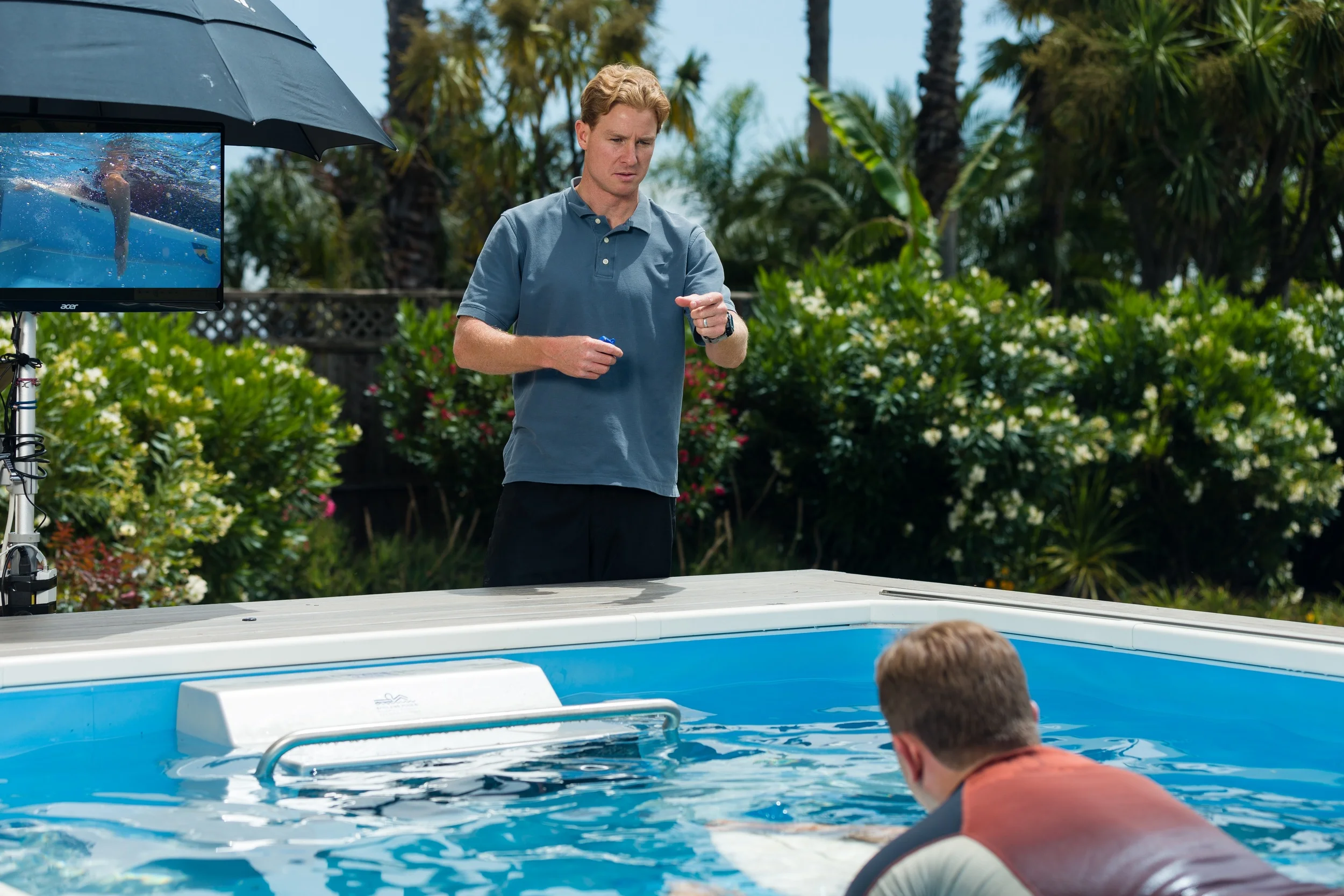
And then people that come here to our facility here in the San Francisco Bay Area, I have live stroke analysis. So we get in an endless pool. We actually have an underwater camera that is almost live.
So it's about a one-second delay, but I can see right then and there when people are doing something slightly off, and I can stop them and say, here, try this. And they can immediately get that feeling so that the brain starts to make the connection between doing what's right from wrong and the feeling that is associated with both of those.
So it's actually, I totally nerd out on the technology. I love this coaching technique, whereas before I was in a pool. And I'd have to walk to the end of the pool with the camera, download the film, then review it. By then that feeling has completely lost. They've lost that feeling in their body and their brain.
So they can't relate it as quickly. So what I've been able to accomplish in just one session here, which is about an hour, I accomplish over four or five sessions in a pool.
And then for multiple clients, people that come back over and over again, two or three sessions here is months' worth of work in a pool. So it's, again, I totally nerd out about this stuff.
So I apologize if I sound a little bit nerdy in that sense, but it's really exciting for me and it's exciting for the clients to see that difference and feel that difference.
Michael Frampton
Yeah, as surfing, it's such a unique opportunity to stand up on a wave. I think that's why it takes so long to improve one's surfing because we don't, like golfers have driving ranges. We don't really have that yet, maybe soon with the wave pools. But the better we can paddle, the more waves we're gonna catch.
So it's that simple. And so you obviously see a lot of clients one-on-one, and I'm guessing a lot of those are quite experienced surfing. And what's the most common paddling mistake you see in that type of surfer?
Rob Case
That's a great question. I actually do a whole video series on biggest mistakes. And there's a few that come to mind from that series, whether it's experienced or beginner.
Some of the really most common ones that I even see in pros, one is entering with your thumb down. And a lot of people are taught that from swimming. And in swimming, it's fine. It's okay to enter with your thumb down. But in surfing, it's actually going to hurt the shoulder in the long run because you're twisting the shoulder inward and your body's flat.
So if you were to just sit there and do that right now, it's kind of an awkward motion. If you're just to sit straight up and twist your thumb down and bring your elbow, it kind of, I'm doing it right now, it kind of hurts my shoulder a little bit just to do that.
So in swimming, why that's okay is because in swimming, you rotate your body a lot more. So your body's not flat. Your body is actually turned. You always swim on your side. Nobody ever swims on their flat body. While surfing, this is one of the major differences that I found in the research that I've done is that with surfing, well, we're flat. We're mostly flat. And even though we have that rotation from rail to rail, we don't nearly have as much rotation as a swimmer does.
So if we're taking that same entry into the water with our thumb first, we're, one, we're causing that twist in our arm, which could long-term, if we do that enough times, if you imagine the number of times you've paddled or a number of strokes in a lifetime, that could lead to some long-term shoulder damage. So entering flat is the simple fix to that.
So enter flat with your fingertips first because it's the most tapered part of your body and then extend out. So the thumb down is one of the most common ones I see. And it's mostly just because, and I sometimes run into people in the lineup, I say, hey, were you a former swimmer or are you a swimmer? And they're like, yeah. And I'm like, that makes sense. Or they've seen it from other pros doing it. The other reason why it's kind of worthless to enter with your thumb down is that because you end up flattening your hand for your underwater arm stroke anyway.
So it's actually an extra movement. So why not just eliminate that movement, enter with a flat hand, and then you're ready and set up for that underwater arm stroke.
And then another really big mistake that will affect the shoulder, and I'm kind of pointing these two out because one of the goals of the program is to prevent shoulder injury so we can basically surf for life, is during the first phase of the underwater arm stroke, which many people call the catch. I call it the lift phase. It's actually, there's a phase before the catch that is quite important. If you're on a shortboard and you're entering flat now and you're extending forward your arm before you drop your hand and forearm down to the sea floor or down to the pool, bottom of the pool, that moment from going flat to about 45 degrees, you don't wanna apply any force. You don't actually want to enter and immediately apply force down in your stroke. That's another thing I see all the time with experienced surfing. They feel like they need to take a stroke immediately in order to move quickly through the water. And that's just not the case with a lot of the research I've done and a lot of the one-on-ones that I've done.
So what you'd rather do is just allow that hand and forearm to drop naturally. And a good way of thinking about this is if you're ever in your car and you're driving on the road and you stick your hand out, like when you were a kid and you stick your hand out of the window and you kind of ride the wind with your hand up and down. When you lift it up and you pitch it up, the air catches underneath your hand and it pushes your arm up. When you kind of tilt it down, it hits the top of your hand and it pushes your whole arm and hand down that way.
So that's, imagine now that the air is not air, but it's water. So as the water approaches and as your hand enters, if you pitch your fingers down, if you pitch your hand down a little bit, your hand and arm are gonna naturally go down.
So you don't need to apply any force in that first phase of the underwater arm stroke or the lift phase. So don't apply force during that, just let it drop naturally. Because when you're pushing down, if you are pushing down, one problem is now you're using your rotator cuff muscles, which are not the ones that we wanna paddle with. Those are our stabilizing muscles. We don't wanna hurt those.
So that's gonna prevent that injury from happening. And two, if you do apply force down, simple physics, action-reaction.
So if you push down, where do you go? You go up, not forward.
So it really doesn't help on two fronts by applying any force in that first phase. So extending a little bit more, letting your hand and forearm drop down to about 45, keep your elbow high. Now you can catch the water. And that's what I call the front propulsive phase. And that's where most of the power in your stroke actually comes from.
And then there's two more phases to the underwater arm stroke, but those are really the two biggest mistakes I see in experienced surfing: applying force in that first phase and entering with your thumb down.
Michael Frampton
Okay, so not only does working on your paddling technique increase your paddling speed and efficiency, but it would save yourself from some long-term overuse, you know, what we call surfer's shoulder.
Rob Case
Yeah. And it's funny because I haven't had any problems with shoulders, but I've run into people, especially surfing, that have shoulder problems all the time. And just those subtle adjustments sometimes take away the pain and avoid any long-term surgeries. And surgeries nowadays are expensive.
So, and let alone time out of the water as well. So you're trying to recover and you're trying to, you're certainly trying to rehab it. And it's hard.
So I do what I can. I'm not a physical therapist by any means.
So I always refer out to a physical therapist and I work with one here locally. And I always ask people if they've had any problems with their shoulders. And we kind of just take it from there to see if we can remedy the situation.
Michael Frampton
Okay. I guess that if you were to start paddling hard as soon as that hand enters the water, like you said, you propel your body up, which essentially is gonna drop the back half of the board down and create even more resistance.
Rob Case
There you go. Spoken like a true master of paddling there. That's exactly it.
So, and then if you're adding more resistance in the back, then you're making an even worse case for yourself. So there are times where the lift phase is completely skipped altogether. And those are with longboards or prone paddle boards.
So you wouldn't extend your hand because it would just be causing more drag and no propulsion. But on a shortboard, the reason we extend our hand out is because we are in the water, we are sunk in the water. And there's this fundamental concept of boat building, actually came from a hydrodynamicist named William Froude, that realized that longer boats move faster. But the key here was longer boats at the waterline.
So the length at the waterline, if it's longer, then it moves faster and more efficiently. So if you imagine you on a shortboard, let's say a low-volume shortboard, where's the waterline? The waterline is your body because you're underwater, you're practically underwater. You have a little bit of the board out of the water, but the waterline itself is you. Whereas on a longboard, where's the waterline? The waterline is the whole rail of the board depending on how long your longboard is.
So if you're trying to extend your hand in that lift phase on a longboard, all you're doing is adding drag without any benefit. You're not lengthening the vessel, you're not making it longer and more efficient, you're actually just adding drag. But on a shortboard, that's why we have the lift phase.
That's why we extend our hand out. We're actually lengthening our waterline and letting the water go by us and extending our board.
So it's as if we're making our 5'10" shortboard into a 6'1" shortboard instead. And it doesn't act exactly like a longer board because when we take a stroke, we lose that waterline. But the idea is to extend that vessel so that we can be more efficient and stretch out our strokes. And it helps us take fewer strokes and save more energy.
So it's pretty amazing watching it, using the endless pool here at our house. When someone is paddling in it and we have a certain current going, let's say it's a 1:30 per 100-meter pace, and they just leave their arm out there, it's amazing — the aha moment. They're like, wait a minute, I'm not drifting back.
Well, no, you're not drifting back as long as you're streamlined, as long as you're extending that waterline. So that's kind of the fundamental concept there and the difference between a longboard and a shortboard as well.
So with a shortboard, you can extend that lift phase. On a longboard, you skip the lift phase altogether and you go right to that front propulsive or that catch phase.
And then the other place where you would skip or at least shorten the lift phase a great deal is when we're catching a wave, when we're sprinting and we need a high stroke rate and we just need to get really fast speed going. That's the other kind of scenario where you'd skip that extension of the arm.
Michael Frampton
Okay. Now, what about, how should we hold our feet? A lot of surfing will cross their legs. Do you recommend that?
Rob Case
Yeah, I don't mind that. If you're casually paddling out, the feet are just basically drag in the water.
So if you're trying to conserve energy, really the best way to do is stay nice and relaxed. You can cross your feet, you can lift them out. They can be kind of at the top of the water a little bit because your body really is leading and breaking the frontal resistance.
So the feet are kind of just dragging behind. But the idea is either you lift them out or you do like a two-beat kick, like a rhythmic kick.
So for every stroke, you take a kick essentially. So it's two beats. It's like boom, stroke. When you're sprinting, I suggest, and studies have shown, that kicking actually does, in fact, increase velocity. What the studies don't show is whether the velocity comes from reduction in resistive drag, meaning when you're kicking, you actually bring that back half of your board and body up out of the water while you kick. Whether it's that resistive drag or the kicking is actually providing propulsive force.
So swim studies have shown it's a little bit of both, but they're still not even sure. But we don't need to know exactly what the reason is. We just need to know that it works. And so when you are sprinting, when you're catching a wave, kicking is a suggested technique as long as you can stay balanced elsewhere. And why don't we kick all the time?
Well, I think that's pretty obvious because we wear ourselves out. Kicking does get quite exhausting.
So if you're kicking for five, six seconds when you're catching a wave, that's not gonna break the bank in terms of depleting your energy for the whole session. Yeah.
Michael Frampton
What's the Bern — you have to correct my pronunciation — the Bernoulli principle?
Rob Case
Bernoulli. So Bernoulli principle basically is that lift that I'm talking about. And it's a principle where it comes from an airplane wing actually. And recent studies have shown that swimming doesn't use the Bernoulli principle as much as everyone originally thought when Doc Councilman started doing the research back in the 50s. And McClisco started to continue to use it into the 80s and 90s. But short answer, Bernoulli is it's that lift.
So when I was talking about your hand being outside the window and you lifting or pitching your hand up and down while you're driving, that's Bernoulli's principle. The air hits the bottom, it lifts up. The air hits the top, it pushes it down. And so the way we use Bernoulli's principle or some aspect of it is in that lift phase where we're extending it. And because we're extending it and water is starting to hit a little bit on the bottom of the hand and a little bit on the top, if we kept our hand completely flat, no pitch in the hand or the wrist at all, then we would actually provide a little bit of lift just in that one or two split seconds. But like I said before, once you kind of get that little lift, then you wanna pitch your hand down so that you can get into that front propulsive phase.
So you can take a stroke and add propulsion. So Bernoulli, you can kind of get a sense for what it feels like. One, by sticking your hand out the window. And two, another kind of a fun drill to do is when you're out there waiting for waves, lay down on your stomach, put your hands over your head, and just scull in and out.
So sculling is when you're kind of keeping your hands flat and you're bringing them in and you're taking them out and you're pushing the water in and out over your head. And what's interesting about this drill is that you end up moving forward. And people are like, well, wait a minute. You always talk about action-reaction. You're pushing backwards so that you can move forward, right, in our arm stroke. With the Bernoulli principle or this lifting and the sculling, you're actually pushing to the side and you're still moving forward. And so that's a little bit of why that happens, a little bit of the Bernoulli principle, but recent studies have shown that it's not 100% due to that principle.
So it's an ongoing process even in the swim world. Yeah.
Michael Frampton
Okay. You've got a lot of free videos for folks to check out, which is awesome. You've even got some stuff, you're kind of breaking down some duck diving stuff as well.
So much information, so much free information you've got on your blog, on your website, on your YouTube channel. So I highly recommend every surfer goes and checks that out. And like you mentioned, you're working one-on-one with people. Where exactly are you doing that?
Rob Case
We're located about 20 minutes north of San Francisco, California. So people in the Bay Area here will come up for a session or two, and we usually space them out within about a month.
So every four weeks, I have someone come back. That way it gives them plenty of time to work on kind of the assignments that I give them, the things that we worked on, and then we can move on to kind of the next thing. And I've had a few clients fly in from — I have one flying in from London next month. I have a couple flying in from Brazil and a few from Australia actually. While they're in the Bay Area, they decided to book a session and come up here and check it out.
So it's been really beneficial on my side to work one-on-one. I love working one-on-one and seeing the change happen.
And then the people that can't make it here and take the online course or they watch the YouTube videos or go through the training at surfingpaddling.com, I get a lot of feedback from them. It's been great. It's been a lot of fun and quite a passion project of mine.
Michael Frampton
Yeah. For those surfers that aren't lucky enough to surf every day, but have access to a swimming pool, you've got some awesome online programs to keep them surf fit as well.
Rob Case
Yeah. So I kind of break down my overall goal as trying to help people catch more waves because if we can all catch more waves, we're all gonna have a lot more fun in the lineup. And really the first part of that is technique. Technique is, you can be as fit as a fiddle, but if your technique's bad, as we talked about earlier, you could either get injured or you would burn energy where you don't need to burn energy.
So if you can get the technique down first, then at the fitness level, you can make those same movements with even less effort and catch even more waves. And then really the third kind of aspect of it is positioning and timing. You need to be able to time your drop and position yourself in the right place on the wave.
So if you combine those three together, you can catch a lot of waves. And that's really kind of where my mindset is. I've listened to a lot of some of your podcasts and some other areas where most of the pro surfers say, hey, listen, the only difference between you and me is that I've caught more waves than you. And it's true, it's practice. It's that repetition. And so if you get the technique down, which is the Surfing Paddling Academy, my X-Swim for Surfers program is the fitness aspect of it where we keep you in the water because a lot of fitness programs are land-based and you lose that feeling of the water that I talked about. And that feeling is very important for your brain to make that connection. But if you're, I'm a swimmer and I hate swimming.
You know, I really started to enjoy swimming only when I started surfing and playing water polo because now I had a purpose for swimming. So the X-Swim workouts, there's a swimming aspect to it, but there's a lot of dry land and what I call transitional movements, which are the types of movements that we use when we are actually riding a wave.
So a lot of leg work, a lot of balance work, a lot of flexibility work, and agility training. So it's Surfing Paddling Academy, X-Swim for the fitness, or really any fitness program that you fancy, just as long as you're getting fit and you're making those movements easier.
And then the last kind of phase is the positioning and timing. I'm in the process of building that class right now, actually.
Michael Frampton
So what do you mean by positioning and timing? You mean catching the wave?
Rob Case
Yeah, exactly. So, you know, you can have the greatest technique and you can be fit, but if you're not in the right spot on the wave or the most optimal spot on the wave, you're not gonna catch it.
So one of the things that a lot of my clients have asked about is when I'm surfing a steep wave, for example, how should I drop in versus kind of a flatter or what I call like a burgery wave, what we call a burger, mush burger. So there are different places you can be on those waves and there are different ways that you can drop in on those. And I got kind of the idea from a friend of mine who used to surf professionally, and I could paddle circles around the guy, both because I was more fit and because of the technique. But he would take two paddles and catch a wave. And I was always amazed by that. It was because he just knew where to be and knew where to catch the wave.
And so I've been researching a lot of different pros' techniques, where they line up, where they set up, how they time their paddles. And another kind of aha moment was something that Slater said down at Bells a couple of years back. He was saying that if you look at the wall of Bells Beach or a Bells wave, you have to take a mid-face bottom turn. You go all the way down, you lose all the speed. And if you look at it from the side, he's like, that's kind of where I got that idea. If you look at the wave from the side or the transition from top to bottom, every wave has a different transition.
Whereas with skateboarding, like a skateboarding ramp, the transition's always the same. Well, with surfing, that's what makes surfing so awesome. It's that we always have to deal with all these different types of transitions. And so that's another kind of part of it. When you look at a wave, how do you study a wave? How do you determine what sort of transition you're dealing with? And when should I pop up versus really having no idea and just going out there blind?
Michael Frampton
Yeah, I guess it's like anything else. You know, if you really want to master something, you have to really start looking at the details. Yeah.
I mean, you're in the midst of it now, but I'm imagining you're kind of looking at, you know, which arm is the last stroke before the pop-up? Is that...?
Rob Case
Yeah, actually a little bit of that, absolutely. Yeah, the timing of it really has to do with the speed of the wave too and how fast it moves. When you look at, you know, what, a decade or decade and a half ago, they weren't paddling into Jaws. They weren't paddling into Piahi because they thought it was moving too fast. And so a part of that innovation has been the boards, but where they're positioning themselves at that break.
So they've kind of, a lot of the pros have broken down those walls at places like Chopu, and in the early days, even Pipe, you know, when there were the longboarders and they finally got the thruster, and they were able to kind of cut down the face of the wave a little bit more and grab the rail. So a lot of it has to do with the design, but it has to do with how they're positioning themselves when they're paddling, how long they paddle for, and how fast they're going with the wave.
I think a big misconception that I hear a lot is, you know, I keep missing a wave because I'm not paddling fast enough. And I'm looking at them going, well, you know, paddling just helps you catch the wave. It doesn't catch the wave. Gravity is what catches the wave.
So you dropping out of the sky, whether it's a steep wave or a very mushy wave, it's really gravity that does it. And I came to this realization because if you look at the speed at which prone paddle boarders paddle versus how fast waves move... So prone paddle boarders in the Molokai to Oahu paddle board race, they average about eight miles an hour in the unlimited category. That is very fast. I go out here on my lagoon and I average about five miles per hour on my prone in flat water. And that, I think I'm like sprinting.
So how do they move so quickly in that race? How do they move eight to 10 miles an hour in that race when the fastest swimmers in the world move four miles an hour? And if you're flat water on a prone paddle board, you may be hitting five or six miles an hour. How are they hitting eight to 10?
Well, they're riding the waves. They're riding the swells.
So it doesn't have as much to do with paddling as many people think in terms of catching a wave. It has to do with gravity. That's the majority force that's happening. Paddling sets you up in a position so that you can possibly catch it earlier and set up your line the way that you want to.
So if you're not paddling at all versus somebody that paddles or takes six to eight strokes... A good example, me and my buddy, where I came up with the idea, he takes two strokes, I take five or six. But for me, I'm not as good a surfer as him.
So I need more time to set my line and really to identify what line I want to take. Where do I want to set my bottom turn? Where do I want to set my top turn or pull in? Whereas he can take two strokes and immediately find that line that he wants.
So there's so much of that going on in that research that, for me, it's just exciting to put it all together. It's gonna be in a similar format with videos and illustrations so that people can really digest it.
Michael Frampton
Well, cool. I look forward to that. Yeah. Is there anything else you want to talk about?
Rob Case
I think one of the things that I hear a lot is, why are you giving away all the free secrets of yours? You know, why would you give away your advantage in the lineup? And I try and share this with all my clients. I say, you know, Duke was fantastic at sharing surfing with the world. And he's quite the role model to me in that he was an Olympian swimmer as well and kind of the overall waterman. And he believed in sharing the sport and sharing what we know about it, especially within our own community.
So I always emphasize, you know, if you know somebody that this can help, whether it's through the Surfing Paddling Academy online, the paid version, or the free version through YouTube or through the free series, pass it on. You know, share it. Don't be afraid to share what you know and what you learn. And that actually brings our surfing community together.
So as opposed to people being frustrated out in the lineup and making the whole session kind of a downer for everybody, help people out, make them less frustrated. And paddling is one of the most frustrating things.
So if we can make it enjoyable and everyone can enjoy it, then we're all gonna have a better time out in the lineup. So I just urge people to go out, and as you're learning new things, whether it's riding a wave or fitness or paddling or board design, share it with your friends, share it with other people in the lineup, and let's progress our sport and our culture.
Michael Frampton
I totally agree. Yeah. The better the beginner surfing are, the better the advanced surfers are.
Rob Case
Yeah, absolutely. And the less pissed off we'll be about it.
Michael Frampton
Awesome. Well, thank you so much for your time, Rob. I really appreciate it. And we'll just mention your website again. That's xswimfit.com. That's X-S-W-I-M-F-I-T.com. And youtube.com forward slash xswimfit as well is the YouTube channel. And like I said before, I'll put links to all of that stuff in the show notes.
Rob Case
And as well as surfingpaddling.com. Okay. That one's a real simple one. Yep.
Michael Frampton
Cool. Awesome. I really appreciate your time. Thanks, Rob. And I look forward to looking at your thoughts on breaking down the paddling in.
Rob Case
Yeah, absolutely. It'll be a lot of fun. Thanks for having me. Thanks.
Michael Frampton
Rob, thanks for tuning in to the Surf Mastery Podcast. Again, I'm your host, Michael Frampton. Make sure you subscribe so you can keep up to date with the latest interviews. Please share with your friends. Check us out on Facebook at Surf Mastery Surf. And if you're on iTunes, please go and give us a little rating. That'd be awesome. Until next time, keep surfing.
12 Rob Case - Surfing Paddling Coach
For the passionate surfer—whether you're a weekend warrior, a surf dad, or an older surfer—this podcast is all about better surfing and deeper stoke. With expert surf coaching, surf training, and surfing tips, we’ll help you catch more waves, refine your paddling technique, and perfect your pop up on a surfboard. From surf workouts to handling wipeouts, chasing bigger waves, and mastering surf technique, we’re here to make sure you not only improve but truly enjoy surfing more—so you can get more out of every session and become a wiser surfer. Go from Beginner or intermediate Surfer to advanced.