
68 Performance Strands & Coaching Wisdom w GEORGE STOY
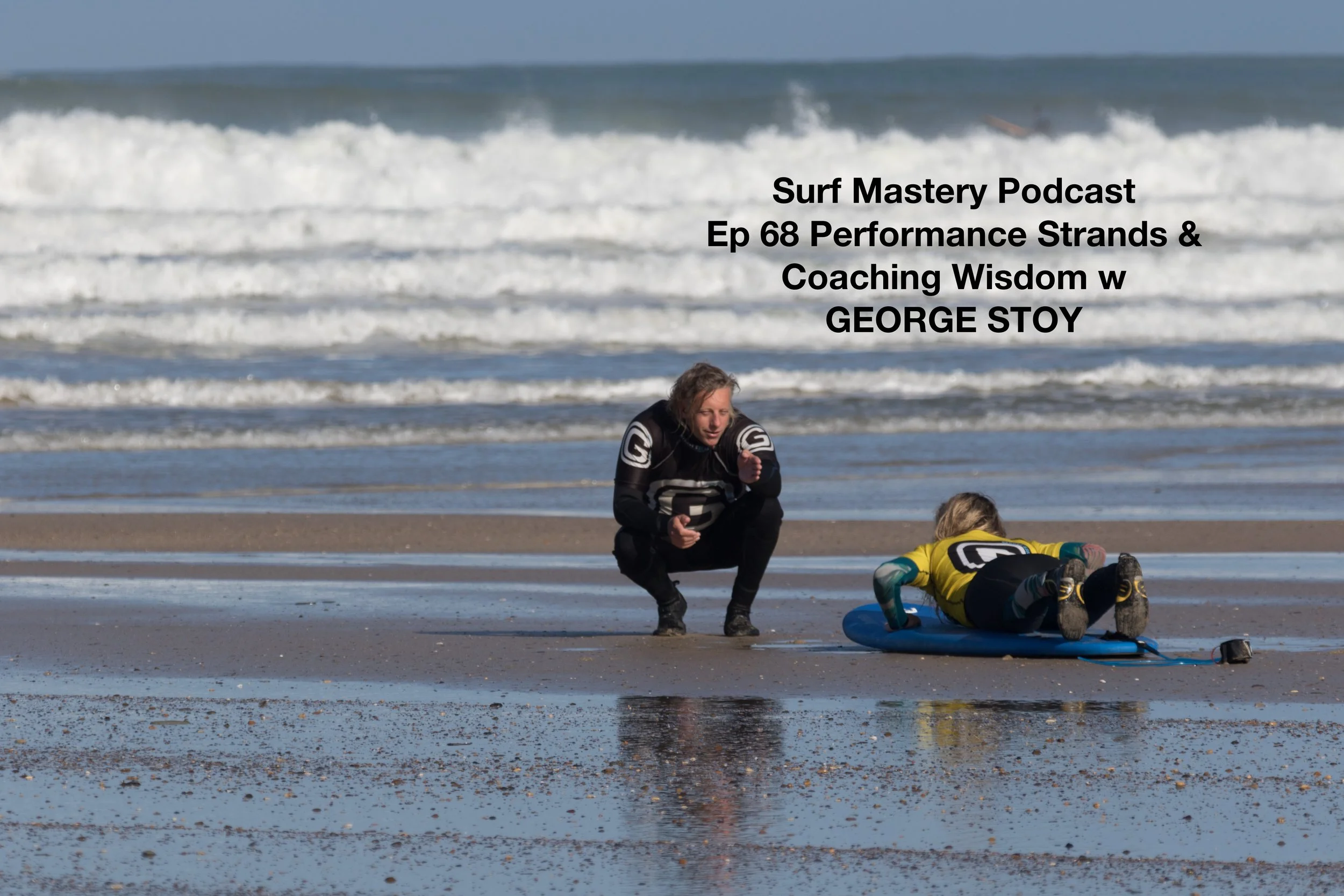
Did you know that how you first learn to surf can determine your entire future in the sport — including how fast you improve and how much fun you have?
In this deep and reflective episode, surf coach George Stoy shares the philosophy and methods behind building not just better surfers, but more resilient, self-aware, and fulfilled people through the craft of wave riding. Drawing from decades of experience — and insights from skiing, psychology, and elite coaching — George breaks down why most surf instruction falls short, and what true progression actually looks like.
Discover why early bad habits create “unlearning traps” and how to avoid them from day one.
Learn how to build a “performance strand” that links your current surf skill to future mastery.
Get insight into how mindset, equipment, and wave-reading all connect — and how to train them holistically.
Hit play now to rethink your surfing progression from the ground up — and learn how to turn every session into a step toward lasting surf confidence and flow.
Key Points
Initial skill development in surfing has a direct relation to the final refined mastery of the skill.
George Stoy emphasizes the importance of understanding a surfer's motive for coaching to facilitate therapeutic benefits.
Common mistakes among recreational surfers include inappropriate equipment and a rigid attitude towards it, which George aims to correct through open and adaptable coaching.
George employs a team of 8 to 10 surf coaches, highlighting the shift towards a more structured and methodological approach to surf coaching.
George critiques the two-day surf coaching qualification, advocating for more comprehensive training and mentoring to elevate the standards of surf coaching.
The concept of 'performance strands' in surf coaching, introduced by George, aims to ensure that initial skill development is aligned with the mastery of advanced skills.
George Stoy reflects on the emotional and physical challenges of learning to surf, particularly in confronting fears and adapting to different surfing conditions, such as his first trip to Hawaii.
George discusses the impact of the surge in recreational surfing on etiquette and the need for surfers to be aware of their surroundings and the potential risks associated with crowded waters.
The evolving attitude towards surf coaching, with more women engaging in coaching sessions compared to men, and the increasing professionalization of surf coaching as a viable career.
George encourages surfers to explore different feelings and experiences on waves, emphasizing the importance of the emotional and sensory aspects of surfing over strict adherence to technique.
Outline
Initial Skill Development and Mastery
George Stoy discusses the relationship between initial skill development and the final refined mastery of a skill.
The concept of performance strands is introduced, emphasizing the importance of foundational skills in achieving advanced proficiency.
Surf Coaching and Education
Michael thanks listeners for their support and discusses the importance of investing in surf coaching.
The Ombi online surf coaching platform and a surf coach directory webpage are mentioned as resources for those seeking coaching.
George Stoy's background in surf coaching, including the growth of the industry and the appetite for high-quality coaching, is discussed.
Therapeutic Aspects of Surfing
George Stoy highlights the therapeutic benefits of surfing, noting the positive changes in individuals after surfing sessions.
The importance of understanding a client's motives for surfing and creating a holistic coaching approach is emphasized.
Common Mistakes in Surf Coaching
George Stoy identifies common mistakes in surf coaching, particularly regarding equipment and attitude towards equipment.
The importance of appropriate equipment and a positive attitude towards it is stressed.
Surf Coaching Teams and Methodologies
George Stoy discusses the evolution of his surf coaching team and the importance of hiring motivated and knowledgeable coaches.
The challenges of standardizing surf coaching qualifications and the need for a more structured approach are highlighted.
Performance Strands in Surf Coaching
George Stoy explains the concept of performance strands, which relate initial skill development to final mastery.
The importance of correct technical DNA in early skill development is emphasized.
Takeoff Techniques in Surfing
George Stoy discusses the importance of clean takeoffs and avoiding the use of knees as a coping mechanism.
The benefits of teaching proper takeoff techniques from an early age are highlighted.
Collaboration and Knowledge Sharing in Coaching
George Stoy expresses a desire for more collaboration among coaches and the sharing of knowledge and data.
The potential for an international coach organization to gather data on effective coaching practices is discussed.
Personal Surfing Journey and Coaching
George Stoy reflects on personal breakthroughs in their surfing journey and the role of coaches in overcoming plateaus.
The emotional journey of learning new skills and the importance of a growth mindset are emphasized.
Surfing Etiquette and Sustainability
George Stoy discusses the importance of surfing etiquette and the impact of overcrowding on the surfing experience.
The analogy of surfing as a model for sustainability and the need for common sense in managing resources is presented.
Evolution of Surf Coaching as a Profession
George Stoy reflects on the evolution of surf coaching as a profession and the increasing accessibility of high-quality coaching.
The role of equipment evolution and the professionalization of surf coaching are discussed.
Transcription
George Stoy
What we're doing at the early phase in terms of initial skill development has a relation to the final refined mastery of the skill.
Michael Frampton
That was the voice of George Stoy, today's guest. And talking about the concept of performance strands. More of that soon. But first, a huge thank you to all of the support that came out of the last two episodes at the end of last year. I can't thank you enough for your donations and, of course, for investing in your own surfing education. This episode was recorded back in the end of March last year, just before my wife passed away. And it's been really nice to come back to this episode and edit it because it's inspired me so much, not just as a surfer, but as a surf coach as well. And I think it's going to inspire you as well to invest in surf coaching. And if that's something you can't do because you don't live near a good surf coach, then I just remind you that there's the OMBE online surf coaching platform that we discussed in detail in the previous episode. There's a link to that program in my bio on my Instagram, on the website, and in the show notes to this episode. I've started a surf coach directory web page on my website, and I would like to build that. So if you have personally had a great experience with a surf coach, please let me know. mike@surfmastery.com. Okay, today's guest is George Stoy out of the United Kingdom at George's Surf School on Instagram and georgesurfschool.com.
George Stoy
He owns a living coaching surfing club. And you are as well, aren't you? So you're now, you're based in Malibu?
Michael Frampton
I am.
George Stoy
Fantastic. I don't know, I'm not sure where you were when I was last in California, but I'm not sure you were in Malibu. I definitely whizzed through that way. I was there in 2016 when I was speaking to you.
Michael Frampton
I would have been in Australia then.
George Stoy
Yes. Yeah, that's exactly.
Michael Frampton
Do you still teach skiing as well?
George Stoy
A little bit, but less so and obviously not at all this year. And one of the things that I found very challenging with lockdown is that interaction and the coaching and... You know, it's more than... It's much more than a job, isn't it? You sort of forget there are elements of it that are part of your DNA and part of something you've done for a huge amount of time, and you get, you know, that interaction and that coaching and that problem solving and all those elements and how you use your body and your brain together, you take for granted until you can't do it anymore. Yeah. So yeah, I've missed it. So yeah, no skiing. No skiing this year, we did a bit last year, but yeah, I'm still doing both. I would say the surfing side has definitely taken over more as we've grown and as the coaching team has grown and as the seasons have extended. And I think, you know, really the whole appetite for high quality surf coaching has grown and changed as well, which I'm really delighted to see, and there have been some amazing people within the industry that have really driven that as well. And it's certainly... Yeah, it's certainly great to see because originally, you know, when I first started out—and I know we've had this conversation before—it was that it was a fairly small group of people globally that were coaching surfing in quite a progressive way, I think it's fair to say. What are your thoughts on it? How do you know... We've known each other... When did we first meet? 2000?
Michael Frampton
12, 13 maybe.
George Stoy
Maybe even before that. 2012 was the London Olympic year. I didn't even feel that.
Michael Frampton
You might be right. We did a Portugal trip.
George Stoy
Yeah, okay. It would have been, yeah, you're right. It would have been 2009 even. Remember that spot in Portugal? It was like almost untouched back then, remember?
Michael Frampton
Maybe.
George Stoy
There you go. Unbelievable. That slack out the front was beautiful. Pretty special. I mean, that whole... That whole place and that whole trip was thoroughly... It was a really good trip and a really amazing spot and I think we scored. We got some pretty good waves as well.
Michael Frampton
Yeah, I love that part of the world.
George Stoy
Yeah, it was fun. Do you go back? Have you been back to...
Michael Frampton
Portugal?
George Stoy
Pretty much. We were going... Yeah, we were going every year. The last one I did was to Cascais. There's some incredible waves around there as well. That was September 2019. So when did I start coaching? In 2004–2005. So that's when I started to... And it was through, you know, as you know, it was through my journey to find someone to coach me.
Michael Frampton
You started being a surf coach? That must have been back then in the early 2000s, was it?
George Stoy
And I sort of, yeah, I ended up realising that actually, you know, I almost was the answer to my own questions sometimes. And going out and, you know, in the way you had, sort of being curious and going and trying to answer the questions and then looking across other sports and other... You know, certainly at the time, more established coaching frameworks to, yeah, to piece together, to start piecing together how I was going to develop my own surfing and, you know, how I could then help other people. And I think the real hook for me, the real time that it really got me, was when I realised that actually there were other benefits. There were people... You know, I was taking people in, I was teaching them to surf, and I was always seeing them come out of the water almost like a different person to when they went in. I know obviously now there's a lot said about blue health and therapeutic benefits of surfing, but back then, there just really wasn't. And it was just something that I saw. And I was used to coaching people and taking them up mountains, and I was seeing something... It was kind of almost that, but, you know, sort of supersized. That experience and that being in nature and... There was just something extra to it. And yeah, it kind of... It was amazing to see, but it just sparked a real curiosity in me, into understanding it more and being able to give a really holistic... You know, coach people in a really holistic way. And be really curious about surfing and the ocean and the waves and the water and deliver really good technical coaching, but learn more about the therapeutic side of it and explore that as well, simultaneously. Yeah, that was sort of my... I think that was the thing that, if I'm honest about it, that really set me on the path that I've managed to stay on.
Michael Frampton
So do you think there are things that you can do or not do as a coach that can either inhibit or give space for that sort of therapeutic aspect of surfing?
George Stoy
I think first and foremost with coaching is what is someone's motive for coming to you? So people will have different motives and they'll come to you, and I think you have to... You want to understand that and really understand why someone's coming to you, and so you're engaging them, you're delivering on that. And I think if you do that well, you know, those other parts of the therapeutic side of it will occur. But there are definitely things that you can do consciously to get people into a better headspace. I mean, you know, if you take it down and you reduce it... I mean, surfing is playing. You know, if you're a contest athlete and you're going out and you're based on pure performance, then it's your job, it's your livelihood, and you're competing. And that will have a different focus and different pressures. That's it. And even then, when you talk to a lot of athletes, they'll all reference—or most of them will reference—an understanding of why they surf, because it makes them feel better as well. They love surfing. But yeah, as a coach, in order to kind of facilitate that, yeah, there's definitely things you can do about helping people with a more holistic approach. So I think, you know, I guess the thing we specialise on is... You know, we really work on recreational surfers who want to improve. And that's our focus, is helping people unlock doors to progression and to achieving things that they thought that perhaps they couldn't achieve. And that involves building a relationship with the ocean, and it involves feeling comfortable in that space, and that involves looking at—without focusing on fears—you know, moving into spaces that are sometimes less comfortable for people, and then making those spaces comfortable spaces that then facilitates progression. Does that make sense?
Michael Frampton
Yeah. So with your target market, your audience, your average clientele, what's the biggest mistake you see in that group?
George Stoy
I think there's a couple of classics, and I think you'll probably get similar answers from most coaches. Often equipment. And an attitude towards equipment. If you don't have the right board under you for not just that wave that day, and then, you know, how long... You know, the amount of time you've been able to spend in the water and the level of fitness you're at, you essentially want to have fun. The only way you have fun is by sliding along a wave and enjoying that sensation. And that means... You know, I think it was Rob Machado who said foam is fun. You know, this idea that we should all be riding a particular board in a particular way is... I don't particularly sign up to that unless you're surfing to a competition criteria where you are working towards, you know, a very defined criteria. I kind of quite like people to find their own space in their ocean, their own thing. And I think the equipment that people have is sometimes not appropriate. And what we try to do is create a really fun, open space where we can swap boards and try boards. And I love to have a go and surf the boards that the people who are surfing with us are on. I want to feel the kit. I'm always curious about equipment and how it rides. So I try not to... I try not to write off something when someone turns up. And sometimes people will turn up, you're looking at the board and you think, crikey, not sure. Yeah, we'll see how this goes. But I'll always let them... You know, first session especially, I'll always let them work with the equipment that they know and then see kind of where they're at with it and then how we can help. But most of the time I'll spend getting people—or trying to help people—onto boards where they're just going to be able to pick up, take off, and ride waves. With a bit of margin for error as well. So you can make a little mistake and it not... Yeah, it not end up with you losing that ride or that wave. You have a little wobble and... Certainly as I've got a bit older, I like that in my own surfing as well. I'd like to have a board that I really feel... You know, I'm paddling into a wave and I just know I've got the best board under me, and you relax. And of course in being relaxed you're in flow state and you just take off and go. You don't really... And I think about it too much. I know when I've got the wrong board under me because it's kind of the polar opposite of that and you start to have a bit of a scrap and then you start to maybe question things a little bit and that's of course the space you don't want to be in. So I think if we're honest as surfers, we will experience both of those places depending on the waves we're riding, where we're at, and what we've got under us.
Michael Frampton
Yeah, interesting. I mean, equipment. Yeah, most surf coaches will address equipment, but you said something, you said not only equipment, but people's attitude towards the equipment. Are there a few barriers sometimes when you suggest alternative equipment to people?
George Stoy
Yeah, sometimes. And I think different, you know, sort of different demographic groups will... They'll become emotionally attached to different equipment because sometimes it's linked to—it can become a bit linked to—the image you want to project. And I, you know, I've definitely been there. And I remember I had this... I had a little toothpick board. I've had some waves on it, but actually, if I'd had another board under me, I would have probably caught and rode more waves and progressed faster when I was a teenager. I'm kind of trying to... I guess the job of the surf coach is trying to not let people fall into the elephant traps you fell into, but sometimes that learning process is allowing people to make those mistakes, you know, helping them, suggesting it, but then allowing them to make mistakes and then guiding them kind of back out of the elephant trap, I guess, a little bit. Amen. It's sort of having to see and believe it. So that's what kind of I meant by the attitude. The attitude towards it and motive as well, you know. Why... You know, what do they want out of it? Why are people surfing? You know, what is their... What's their thing? What are they getting out of it? And I think drilling down on that as well is... You can then really help out. Develop a relationship and a trust and a safe space where you can usually take people way beyond what they thought they were capable of and develop differently, whether it's confidence in the ocean, confidence in slightly bigger surf, the knowledge needed or the fitness and conditioning needed to achieve those things and the—I think much more importantly—the mental resilience to be able to do those things and have the confidence to take on a bit more. Something slightly outside of their comfort zone a little bit.
Michael Frampton
Yeah. So do you employ a few surf coaches as well?
George Stoy
Yeah, we've got a team of—it's between eight and ten coaches now. So it was, well, I mean, remember it was just me for a long time. And then that journey of working with other coaches, that was a—I think personally, that was a real—there's a big change point for me going into... You know, how was I going to pass on the knowledge and the way I did stuff? Because I'd spent quite a long time developing it. And then I kind of realized you find the right coaches and people that are really, you know, they're bright and they're really motivated to develop their coaching and you realize that that's... You know, there's a real appetite out there. And certainly when I started hiring coaches, there was an appetite both for a more structured approach and a more methodological approach to coaching and development. And there was a real appetite for people wanting to coach that. And essentially, I think it's fair to say that's where you and I... It's the journey you and I were on, you know, we're curious and we're asking questions and we're thinking. You find other coaches in that space and... It creates a really good knowledge-sharing team dynamic where you've got curious coaches and they're bringing in their own expertise from areas that they've developed deep knowledge on as well.
Michael Frampton
And I'm guessing you've had a lot of coaches that have come from other surf schools and other coaching methodologies. Has there been any common barriers or mistakes that you've seen them try and bring into your school? Or is there any sort of... Have you noticed any large gaps in their education from your perspective?
George Stoy
I guess there are a few things. That's quite—you know, it's quite a big generalisation. I'd say what I have seen, which is more coaches coming through and developing quite interesting holistic programs. And I think different countries have had different approaches based on the sort of other sports coaching things that are available. The main issue we've got, I would say—I've been fairly openly critical of it—is that the surf coaching qualification is a two-day qualification, and you can't cover a huge amount in two days. And I actually, you know, I deliver it, and I try to run a mentoring process alongside it because, you know, it's not a... You know, if you look at any other industry or any other qualification, there's not much that you qualify to do in two days. And I think to take people out in the ocean and teach them to surf up to the level it's... Yeah, it's sort of... Yeah, I think it's something culturally that needs a little work on. And I think your approach as a coach educator to develop that is something that I've been... It's a drum I've been banging for a while, but you only change things from within. So there's work happening on it at the moment. And I think that opportunity—you know, if people invest in their... If they invest financially and time-wise into developing skills and developing coaching practices... And there's an element of standardization, and you're able to then record. And, you know, a lot of coaching is about data. It's about recording, and it's about testing a theory. And then what are the results you're getting across enough people to then really be able to understand what works and what doesn't, and then how you can adapt to different personality types in order to develop those skills. It's a combination of studying from—or being taught how to coach from—a system that explains those elements to you, and then going out and learning. And I would say surf coaching is definitely... As a sport, surfing has definitely come more from the trial-and-error approach. So people actually out there just doing it and coaching and then developing skills in terms of what works, what they see, and what works for them. And that's why you've got quite a bit of... You know, there's quite a bit of variation in terms of how people teach take-off or how people teach speed control of a surfboard or, you know, even down to arms and turning. There's a lot of—in the last few years—there's a lot of good stuff coming through on that. There tended to be a way of doing it that every coach was taught, and every coach just kind of delivered on without questioning it. And I think that ability to create coaches that are level... They understand the fundamentals, but then they're able to question them and, you know, evolve specific elements of it—that's when you get, you know, great coaches. But that's when you get a sport that kind of takes a leap forward. The performance strand between people learning to surf and elite.
George Stoy
Yeah, I think the thing that we've evolved and looked at is... I think there are fundamentals, and I think that from that first... Your kind of how you deliver it is really different, but there are certain fundamentals that, if you develop those correctly at the earlier phase, you're going to move into the capability to then develop much faster. So if you're not in it... And if you don't have to go through multiple unlearning phases, for example.
Michael Frampton
Some do.
George Stoy
Yeah, I mean, you know, unlearning is... Yeah, I think it's... Kind of performance strands is what we look at. So we look at—we're always trying to examine and go, okay, how does... When we're teaching someone to change direction for the first time, how does that relate to a high-performance turn in the critical section of a wave? And ultimately, I should be able to see the DNA down through a performance strand. So we can then—we're essentially creating the correct building blocks. So if someone does develop their surfing through and as they get coached, what we're doing at the early phase in terms of initial skill development has a relation to the final refined mastery of the skill. So I think that's certainly something that... It sounds very geeky to kind of do it. And that's not... You know, I'm not going to sit a five-year-old down and sort of put it to them in those terms. But from a methodological and planning point of view, I want to make sure that it's fun, it's play forms, but it's actually got some correct technical DNA in it as I'm sorry.
Michael Frampton
Well, can you give me an example on that? Like, say the...
George Stoy
I think take-offs are classic. That kind of thing. You know, what is the... At what stage is it acceptable to use knees and coping mechanisms in how you get up and riding? And we try to, wherever possible, get people into clean take-offs. We'll get kids leaping and jumping in plyometrics, moving in a way that hopefully will translate into a take-off. If you let someone use their knees, well, that's easy. So I'll just stick to that, and I'll stick on the knee. And then getting off the knees can be quite a lengthy process. Lengthy process. And I'd say certainly industry-wise, it's been... Everyone's been pretty happy to let people use their knees and get up and riding. Okay, fine. As you progress through that journey, getting off the knees can be quite challenging. And certainly one of the things I took from watching the kids in Hawaii... You know, they're all running around just going, "No knees, no knees." And there was a real... You know, it was definitely... It sort of amused me, actually, that there was this real clear thing. It had been really drilled into the kids that they weren't using their knees, and they used the tail pads on their boards really effectively to get up into position, and they had the strength to do it. I think there's sometimes assumptions made about what kids can and can't do strength-wise. You've got kids, and actually, you watch them leaping around and stuff. And I think if they learn the right movement, then not using your knees from an early age is definitely something that... It takes out a layer of unlearning and relearning movement. Buttons. What are your thoughts? Because you've seen lots of people with evolving take-offs and...
Michael Frampton
Yeah, no, I agree with all of that. I like this thing you're saying, performance strand. Everything in the beginning should be conducive to what is going to be at the end kind of thing. Did you get that from... I imagine that's quite common in skiing. Did you get that from being a ski coach?
George Stoy
Yeah, it's common in most sports that people do professionally and at high levels. And it's just... I've never heard it talked about in surfing. And I'm sure there are people out there. What I've not had a chance to do... The internet is pretty good for it, but I've not had a chance to have another kind of curious year where I go off and get to work with lots of different coaches. And I think certainly post-lockdown, I'm really itching. I really want to go and do some collaborations and work with other coaches again. Because I find my... You know, I spend a lot of time training and mentoring coaches and developing and delivering the product that we have. There's more stuff on the internet, but I like... I like spending time with coaches and collaborating and sharing knowledge. And I find that a really good way of having quite challenging ideas, but in almost a slightly private way. Does that make sense? So I can... You know, there's quite a lot of stuff... You know, people will talk about things on podcasts and online and things, but I quite like the space to then put them into practice and see kind of... You can see what the actual application is and then how you translate it down through, you know, through people's surfing, you know, through the coaching. And it would be lovely if there was a, you know, central data gathering system—a way of coaches plugging in, like an international coach organisation where we could plug in and try things and get global data on what's working and what isn't and why and who it works for. And I think experience as a coach—you build that. But if we were able to then combine forces and collaborate, it would be really powerful. And it would evolve... I think it would evolve the sport, but it would evolve, I think, how coaching happens. I think generally, surf coaching is improving at a pretty rapid rate. And people are now, you know, doing it as a full-time job. And it's... Certainly when I started... I didn't know many other people who had gone, "Right, I'm going to be a professional surf coach. That's going to be... That's going to... I'm going to earn a living out of it." It was quite... I think I was quite a rare animal.
Michael Frampton
Yeah, especially in the UK.
George Stoy
Yeah, especially in the UK. But there are a few out there. And so, yeah, the UK, you've got to remember the UK is, from a coaching point of view, we produce some of the best coaches in the world in other sports. We've got amazing sports coaching resources and pedigree. It was just slightly difficult plugging into that as a surf coach. So I took myself back into other sports to evolve what I was doing and I can guarantee you I was the only surf coach ever at any of those events or training sessions. I'm not sure if they ran now, whether—I imagine that would be a different story because you're motivated differently when how you pay your mortgage and how you put food on the table is defined by your ability to harness that knowledge. You know, make it relevant for people.
Michael Frampton
Yeah, it makes me think of Surf Simply and how well they've done too.
George Stoy
That's really interesting because when I started out, Ru and I taught on the same beach, and I think we were basically up to the same thing, which was analyzing and going, okay, how do we—you know, there's all this stuff going on, there's this industry, there's all these people doing this, but I think it could be done differently. And I think it should be done differently. I remember him, but not that well, we didn't know each other that well, but it's kind of funny that we both came off the same beach. And yeah, I have huge respect and I get nothing but amazing feedback from what they're doing with the setup that they've built. Have you worked with him?
Michael Frampton
No, but I've listened to the podcast a lot and yeah, he breaks things down, you know, in a lot of detail.
George Stoy
Yeah.
Michael Frampton
He's been very vocal about it too, which is great.
George Stoy
Yeah, which is—I think that's absolutely fantastic. I'm not—I don't know a huge amount about the setup that they've... I know kind of generally about it, but I'd love to go. And that's somewhere where I would like to go and spend some time, and I think that kind of approach I find—yeah, I find really appealing in terms of, you know, how you then go deep on stuff and then create a way of making it relevant to recreational surfers, which as I understand it, that's, you know, I think we've got a similar—I think we're working with similar surfers—keen enthusiasts that have, you know, limited time to put into surfing. They haven't got as much time to surf as they'd like.
Michael Frampton
Yeah. What were some of the biggest—for your personal surfing journey back when you first decided that you wanted a surf coach personally, do you remember some of the big plateaus that you got over? Do you remember any specific coaches that really helped you along the way back then?
George Stoy
The boys are really big. That's a super question. Big things. I think it was being forced to answer certain questions. So being moved into spaces and looking at movement and looking at the interaction between the surfer, the board, and the wave and making sure that they were all... Like one breakthrough is definitely that link-up where you go, right, what kind of wave is it? What kind of board is needed? And what is the thing? And so, what is the person doing and what are their—what is their potential or limitations? What is the equipment, and then how does it relate within the context of the wave that they're riding? And how am I getting someone into a growth mindset in terms of looking at the waves, having a couple of different boards, and then going, well, I think this is the right board for this wave, but not being afraid to then, you know, have a go on that and then maybe switch out and change kit. So, yeah, I think that linking those three things was really important. I think the understanding of the emotional journey. So coming in as a sports coach and looking for, you know, technical solutions to what might actually be more of an emotional journey or an emotional block. So that side of it is personally really fascinating to me and it's what I've kind of done with skiing as well. I find that skiing journey—I find nervous middle-aged adults are kind of the... Almost like if I had a speciality, certainly with skiing. And I find it really rewarding because you're essentially getting people who haven't probably learned something new in a really long time. And so we'll tend, as adults, to move into spaces that flatter us. Going back into quite a challenging space and a learning space, I think it's really brave. And I really want to encourage as many adults as possible to go and learn new things and challenge themselves and get into that space. And it's... I think life chucks stuff at us where we have to do that anyway, but then going and developing a hobby or an interest which forces you into that space, especially with a bit of fear or something that's outside your comfort zone, I think is a fantastically brave and really rewarding thing to do. So, you know, guiding people down mountains and seeing them literally locked with that—resisting the slide and not wanting to, you know... And sometimes they're there because they love someone very much who skis and they really want to be a part of that. But actually they're just absolutely terrified by the whole prospect of it. And being able to guide someone through that journey and then watch them cruising around the mountain and achieving, you know, coming through those barriers—I don't think there's a bigger rush or a bigger kick as a coach than guiding someone on that emotional journey. Allowing them to physically—you know, everyone is capable of it. You can see it and you go, right, physically we can do this. It's whether emotionally we're going to allow ourselves and allow our body to do all the brilliant stuff that it can do.
Michael Frampton
It's so common in surfing too. I mean, you must see it with surfers all the time, especially once the waves get to a certain size and some people just freeze. They're like, nah, I'm not doing it.
George Stoy
First—okay, first trip to Hawaii. I had to rewrite... Like it was the biggest learning curve of my life, 100%. And you go in, I was already a surf coach, I was already, you know, pretty comfortable. And I just, you know... I had to almost tear up everything I knew and start again. And it was great. It's a really great experience. I'd go back and I'd have to ask people and just say, look... And then half the time, you know, we're going back to the equipment conversation. What works everywhere else doesn't necessarily work in Hawaii on the North Shore. You know, you've got to recalibrate, rethink and re-educate to surf it. And all your reflexes and everything else—you know, everything changes. And that was... You know, to do that—you know, I wasn't a teenager when I first went. I was in my late 30s, early 40s on my first trip there. And it was brilliantly humbling. And yeah, getting back into that space is great because your empathy—you know, it refuels your empathy as a coach. It moves you closer to the people you're coaching as you, you know... You go back to that kind of feeling of fear, that slight imposter syndrome, all these various things that we have as human beings. It's quite good to go back into that space. And you've been cruising around the world, surfing all the places you've surfed and navigating the line-ups and feeling quite chilled, and then you're sort of, you know, you're into a different space. And that's definitely been—you know, if you're talking about experiences that are formative, that was definitely one of them. I think every surfer... You grow up and you're bombarded with images of those waves and that whole thing. And, you know, the scenes in all the movies that you've—the surf films that you've grown up watching and all the stuff that goes with it and the culture... It's quite an amazing thing to go and experience and enjoy. And I, you know, I'm very fortunate to have been able to go and spend time there. And I'm eternally grateful to the people that made it happen, to be honest, because it's... It reconnected me with that journey, and that learning journey, definitely.
Michael Frampton
So how do you relate that—you talked about relating it to your clients. I mean, for example, you're down at the beach with a client who's just an intermediate surfer, recreational surfer, and the waves are just a little bit bigger than they're used to. And they're feeling apprehensive about going out, but you know as a coach that they're capable of it. How do you get them to go beyond their... their limit?
George Stoy
You can't generalise, it depends on the personality. Say, if you... Like, I think if you know they can do it, deep down they know they can do it. I'm more concerned about people who actually don't have... They don't seem to have that—feel that limit. They'll just go for it, and physically they can get themselves in a real pickle. But I think that's what I'm watching out for much more. And I mean, yeah, that's what makes me... I remember that—at a line-up in Portugal. And it was just so sketchy. It was full of these very athletic, very strong European—mainly men—on kind of, you know, really nice boards, a lot of them, and they were just going for it. And there was no understanding of kind of... It was actually quite dangerous because there was just no awareness. And I think that's... Like, that side of it is what... I know I'm answering a slightly different question, but I think as a coach, teaching that awareness and that, you know... Essentially, you want to enjoy your surfing. You want it to be a safe space. And I think we have a moral and ethical obligation to make sure that we're equipping people with the knowledge and the skills and the manners to be a really welcome addition in any line-up. Not kind of weaponising athletic young people to sort of go at it. You know, that sort of... I think it's—you know, we talked about motive and approach. And I think that, you know, how you share motive and approach is kind of different. And it's culturally different. You know, some people are out and they just want to get as many waves as possible. And some people are quite happy to let other people ride waves and just pick off the waves that they want in a session. How that translates culturally is really different because it is a global sport. I'm not sure I've answered your question very well, but in terms of settling people, I think... You know, I'll do a lot of swimming. So I'll take—I won't even—and that's how I was taught as well. You know, the guy at Raglan... I was all excited and hopping up and down. It looked like a really good day and he didn't even let me take my board off the roof. It was like, "No, you're going to swim out. You're going to tell me the name of someone in the..." You know, all that kind of stuff. Which is... It's pretty like Karate Kid-style coaching, isn't it? But you know, I think it was... For me, the difference of then—it transformed my confidence in terms of knowing I could swim out and back. Feeling the currents and using the currents and body surfing and not getting in anyone's way. These are the experiences that I draw, and we put into our program. And I think once you've swum someone out and they've been through the impact zone, they're much more like... It kind of changes their approach with their board.
Michael Frampton
In nurturing the client in the right way, you would almost avoid that situation anyway. Yeah, that's-- That's good. That's what I'm hoping and there's always that learning moment. There's always, you know, the bit where, you know, the head down paddle and the kind of the awareness window does that a little bit. And it's a range of things. It's excitement. You know, I guess coaching terms, it's the arousal curve, isn't it? Where people kind of get fired up and the adrenaline's going and it's trying to then move people back from that space into a much calmer approach. So calmly, you know, reading the wave, timing the paddle, knowing they've got, you know, the strength and the technique to catch the wave and then if they don't, you know, accepting that, there's lots of stuff going on with that wave that may mean you might or might not catch it. And understanding what those things are so they don't go into a space of, you know, sometimes you'll get people, especially quite driven people, and they'll tend to blame themselves. They think it's something that they've done and actually with surfing there's a huge amount happening with the water and how the water's moving. And understanding all that element of it, I think is really important. I tend to say people don't look for physical solutions to technical problems. Guys will have a tendency of looking for physical solutions to technical problems sometimes and surfing, if you surf clever and you learn to surf clever and you build your knowledge as well as your physical technique, you'll hopefully have a better, kind of more fulfilling emotional experience from it. I'm possibly on the slightly more tree-hugging hippie end of, you know, the sort of surf coaching approach, but I really, I just really love seeing people, kind of really get the most out of it and really connect and really, you know, grow technically but emotionally and go on and do cool stuff. And if that then translates, you know, if someone can do something in the water and it translates back in a positive way into the rest of their life, then, you know, fantastic. That's kind of, I guess, the ultimate win. But it's moving slightly. It's kind of combining... It's a very holistic approach to what we do. That's not an excuse for not delivering really accurate, good technical coaching. It's just being aware that maybe surfing better is a part of what could be beneficial from the experience. Get one of those Tibetan bowls or something.
Michael Frampton
Have you seen a big difference in... And I'm guessing you, where you are, you're experiencing a big increase in surfing and the recreational surfer in the last few years. And what's your thoughts on etiquette? And are you seeing problems with the amount of people in the water where you are? What's it like?
George Stoy
It. I think surfing is a really good analogy for sustainability generally. I think it's a really good little kind of thing where you can look at surfing and then apply it across to lots of other stuff on the planet. There's a finite resource, there's only so much space, there's only so many waves. And when you have, you know, if you have way too many people in that space, it kind of changes the experience for everyone. I think, so surfing's kind of weird, right? No one in my family has ever surfed. I'm the first person. I found... Do you have any, did you inherit surfing or was it, did—yeah. There we go, we did the same thing. We kind of got curious, ended up somewhere and probably thought at a particular stage, yeah, I can do this. That looks easy. I'll give that a go. I can do, you know, I can do all the other stuff. And surfing is, you know, surfing looks pretty easy. I'll just add that to my sort of list of stuff I can do. And inevitably you discover it's actually really difficult. And it's quite, you know, it's a tough thing to teach yourself. So much knowledge and counterinsurances. So my kind of point is you inherit surfing, right? So most of the people I know that surf really well, surf a long time, their dad surfed, their uncle surfed, their mum surfed, their aunt—you know, they've inherited surfing and so with it, they've been taught all the subtleties and all those kind of ways, nuances that produce a surfer. And I guess if you don't have that guidance, you're kind of just trying to work it out on your own and there's a huge amount to work out. Even from the point of, you know, where is safe to go surfing? How do you get that information? You know, you and I would have—yeah, we've all seen the guides or the things where it says, you know, it refers to a wave as the best wave in Europe or something like that. And it's maybe not. You know, you look at that and you're sitting in your office in London or, you know, you do the thing of—if you're throwing—we did it, I did it once with a friend, we used to chuck the Stormrider Guide in the air and see where it came down and what page it landed on to decide where to go sometimes, which is, you know, it's an approach. And you have that, you know, you kind of look and you go, "Best go and ride that. I want to ride the best wave in Europe or the best wave in France," or wherever it is. And what that's not telling you is actually the danger rating of it necessarily. So who is that the best wave for? I don't know. Is it the best wave to learn? Probably not. But, you know, and I think all those nuances are definitely getting articulated better, but I still think that journey kind of into surfing and progressing is, you know, it's evolving. But I'm not sure—the people we speak to that tend to come through and they really love the approach that we have and it's kind of something that they've been looking for. I would say it's more accessible now. And you mentioned Ru—you know, I hear nothing but really amazing things about what those guys do. But I go to places and see absolute horror stories of kind of people just be—you know, coaches essentially just going out and sometimes not being paid very well and going out and kind of just surfing for themselves and all these people sort of clattering around, which, you know, I think it would be terrifying if they kind of understood the risk that potentially they were at. But I think, you know, sometimes ignorance is bliss. And I've seen that and I'm sure you've seen that as well. And I just feel, you know, I just feel a little upset that they're putting—that's quite a lot of trust and money they've paid to be taught a skill and taught all the stuff that goes with it. If that's not being done, I think it's a missed opportunity to educate and to essentially engage people in a much longer-term surfing and coaching relationship. So, yeah, I've sort of drifted off. You keep asking really good questions and I drift into these. No. So you're talking about like, is it a resource issue? Yes. But another part of me is like, I think people should be—especially coming out of lockdown, people need to be in nature again and we need to be in the ocean and we need to be in water. And I think you just need to use your common sense. You know, it's not a particularly pleasant experience if it's a beach that's wall to wall with people crashing into each other on surfboards. I don't want to get hit with—I don't want to be wearing surfboards—other people's surfboards. There's definitely a—it's surfing's boomed. But then sports, you know, different sports will go through periods of big growth and booming. I think surfing—you know, the evolution of the wetsuit and the evolution of the equipment now available to learn has played—you know, you can't underestimate the part that's played. And the fact that you can—like skiing now—you can earn a living as a surf coach, which is—I think it's great. You know, that was my goal. I set out to prove that you could earn a living coaching surfing. And actually it didn't have to be—I guess initially, and you and I have had this conversation, it was quite performance focused. I thought being the best surf coach meant you had to coach the best surfers. And I don't believe that anymore. I believe people that want to work in a high-performance space with contest athletes can do that. I think it's a tiny number of people that can earn a living that way, but I think it's an amazing space to be in. I think how you take what these coaches are working on, what they're doing and moving it into a fun, engaging, really rewarding space for recreational surfers is as challenging and as high-performance—just without the same level of high-performance outcome necessarily. It can be a really developed professional way of coaching, but just applied in a slightly different way. So the idea of high-performance to me isn't necessarily about the best athletes in the world. It's about developing deep knowledge and applying it for your kind of speciality or thing that you do.
Michael Frampton
Yeah, there's a lot there.
George Stoy
Feel free to disagree with me.
Michael Frampton
No, I agree. I agree. But back to the etiquette thing, like you nailed it in terms of like, this is a whole bunch of people that have this easy access to equipment, car parks, et cetera. And yeah, they're completely naive. They don't know. "I go here, I park, everyone else is surfing out there." And they think, you know, for example, there's a lot of soft tops who can only go straight on a wave that end up at First Point Malibu getting in the way of people that can surf properly. Now, I don't think they're necessarily—they're certainly not doing it on purpose or arrogance. They're just doing it because they don't know any...
George Stoy
Yeah, they're naive.
Michael Frampton
And then they get shouted at and they don't know why. And, you know, that whole emotionally—what a horrible journey to be, you know, that whole kind of thing. And that, I guess that engagement—I think some people as well, some people will engage coaching and some people won't. I mean, definitely, you know, it certainly started out a lot more women to coaching than men. You know, we saw it in our numbers and we saw it in our things and yeah, that's definitely balanced out, which is great. But that was something that I saw early on. You know, our courses were—I think everything we did was pretty 70% women coming in, taking coaching, wanting to learn how to do things. And it tended to be—I know I'm generalising now—but it did tend to be guys just, you know, "Work it out for myself. I don't need, you know, I don't need to be told how to do this. I think I've got it." Have you seen that? Or is that just...
Michael Frampton
You know, it's definitely changing. People are—yeah, no, because you're—the women are much more open to coaching.
George Stoy
I'm going to get in trouble now, aren't I? Right. I think I'm just going to say what I see.
Michael Frampton
They are. And I mean, like, good surfing—you don't need a surf coach, but I have done a lot and not at the moment.
George Stoy
Do you get coached?
Michael Frampton
No. I'm just—I'm been loving my 11-foot glider at the moment.
George Stoy
Ooh. You know what, going back and just that experience of... I tell you what, there's a photo actually in my hallway. It's one of my—shall we go and get it? I don't know if you'll be able to see this. You're going to laugh. It's cool. I'll tell you what's cool about it. I remember that moment. I remember the wave. I remember the whole setup and the morning and the light and who was there. Yeah. I've got a friend who builds wooden boards. Yeah. And I've not ridden one and I've been wanting to for ages and he just happened to be there and we swapped boards. And I was just like—the feeling of a different material and how it interacts with a wave and cruising along. I mean, that was amazing. And it just happened that someone took a photo of it as well. But I look at that photo and I remember that feeling and that moment. And you're talking about your 11-foot and just gliding along and that was... You know, just that moment, that feeling of just going with the wave and just experiencing a really different feeling. And I think that's the other thing that we try and encourage people to do is go to different places on waves. Feel—yeah, try and explore a sort of a feeling spectrum rather than sort of what they should be doing or—that's the thing about what should I be doing on a surfboard. It's not about that. How does it feel? What is it? You know, what's that like? How's that? You know? And so when you talk about riding your 11-foot wave and just kind of cruising along, I love that kind of great—sometimes you get that amazing passenger feeling. And then you just sort of—you know what? I'll chuck a turn. And you just drive your back foot and you bring it around and then you settle again and it re-accelerates. And I think those little moments are—you know, I think it's great fun challenging yourself and surfing big waves. But some of the most blissed-out moments are those smaller kind of... Am I right? Or are you talking about—I was going down this road and you're going to say, "Well actually, it's an 11-foot rhino chaser."
Michael Frampton
You're totally right, man. Like, I have—some of my best surfs have been when the waves are waist high and there's no one else out. But it's perfect to go out on the 11-foot and just make a section you didn't think was makeable because, yeah, you were relaxed or whatever. And yeah. But I think it's a good note to leave it on. George, can you tell us where listeners can find your website and your Instagram?
George Stoy
Yeah, we've got—the website is georgessurfschool.com. The Instagram is @georgessurfschool. We'd love to see—obviously we love coaching—yeah, come and take a course, come and surf with us. If you're a coach out there—yeah, come and coach with us. Come on. Explore. Jump on the bus. All on the same journey.
Michael Frampton
It's still based at Polzeath, yeah?
George Stoy
All right. So we've got two beaches that we work with. We work with a few different beaches locally, but yeah, we're based out of Polzeath.
Michael Frampton
George, thank you so much for your time.
George Stoy
Absolutely lovely to chat to you. Thank you, buddy.
68 Performance Strands & Coaching Wisdom w GEORGE STOY
For the passionate surfer—whether you're a weekend warrior, a surf dad, or an older surfer—this podcast is all about better surfing and deeper stoke. With expert surf coaching, surf training, and surfing tips, we’ll help you catch more waves, refine your paddling technique, and perfect your pop up on a surfboard. From surf workouts to handling wipeouts, chasing bigger waves, and mastering surf technique, we’re here to make sure you not only improve but truly enjoy surfing more—so you can get more out of every session and become a wiser surfer. Go from Beginner or intermediate Surfer to advanced.