
76 Donald Brink - Fascinated with Surfing
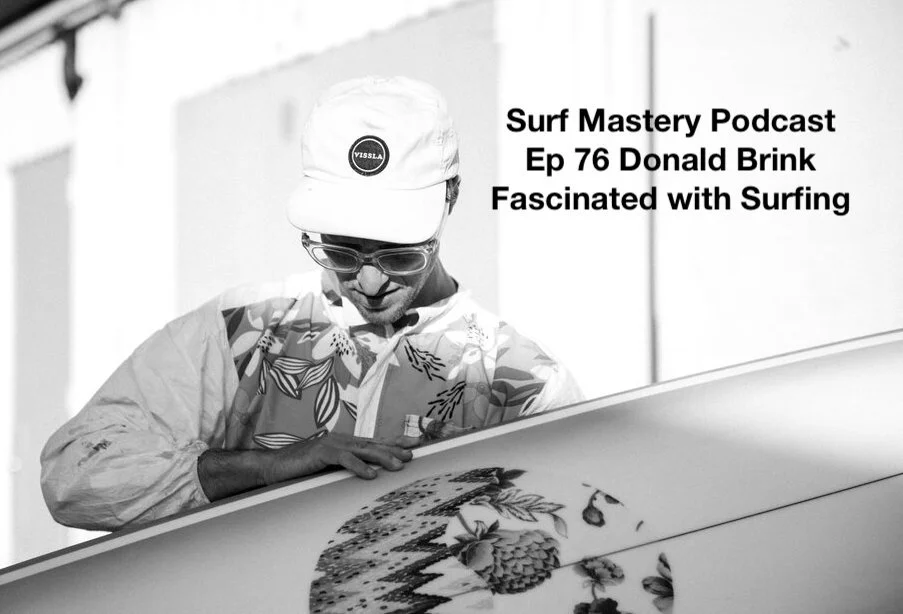
Are you obsessed with surfing—or truly fascinated by it? This episode challenges the core mindset behind how we grow as surfers and shape our relationship with the ocean.
Whether you’re coming back from injury, dealing with burnout, or just questioning your surfing identity, this conversation with surfboard designer Donald Brink explores the subtle yet powerful shift from obsession to fascination—and why that change might be the key to surfing longevity and deeper joy.
Learn how a fascination mindset helps you avoid burnout and keep progressing in your surfing.
Discover how musical rhythm, board resonance, and self-awareness all connect to improved surfing technique.
Hear raw, vulnerable stories about personal challenges, creative breakthroughs, and why great surfing isn't about passion—it's about perspective.
Press play to rethink how you relate to surfing and unlock more meaningful progress in and out of the water.
https://www.instagram.com/donaldbrink/?hl=en
Key Points
Discussion about the benefits of being fascinated with surfing versus being passionate, with fascination being seen as more sustainable and balanced due to the joy it brings.
Comparison of surfboard volume to support, with support being highlighted as a more accurate interpretation that resonates with users.
Exploration of the relationship between surfboard volume and flexibility, noting that a stiffer board with less volume might not feel as supportive as a more flexible one with more volume.
Discussion about the use of epoxy in surfboard construction, highlighting its benefits for durability and resonance, with suggestions on measuring a board's resonance using a guitar tuner.
Emphasis on the importance of technique in surfing and the value of coaching to help identify and work on specific areas of improvement, contrasting with the stigma attached to surf coaching.
Insight into the benefits of fascination over obsession in various aspects of life, including surfing, relationships, and business, with fascination being described as more balanced and less prone to burnout.
Discussion on the parallels between music and surfing, particularly in terms of timing and rhythm, with the importance of timing in surfing being highlighted.
Insight into the benefits of riding larger surfboards for beginners to develop a sense of balance and timing before transitioning to smaller, more performance-oriented boards.
Discussion on the design and testing of new surfboard shapes, focusing on a project for an exclusive collection with unique features aimed at enhancing performance in small waves.
Prediction of the future of surfing trends, suggesting a return to longer, railed, and skinny board designs from the 90s, with an emphasis on the importance of technique and the challenge of riding such boards. {{101:21}}
Outline
Fascination vs Passion
Donald discussed the concept of fascination versus passion, stating that fascination is endlessly intriguing while passion can lead to burnout and irresponsible decisions.
Donald shared a mentor's theory that fascination is better than passion, especially in a business context, as it maintains balance and joy.
Surfing Relationship and Obsession
Michael discussed their previous relationship and how it affected their surfing life, emphasizing the importance of maintaining control and shaping one's own life.
Donald highlighted the concept of fascination in surfing, suggesting that it allows for a more open-ended and precious relationship with the sport.
Surfing Goals and Intentions
Donald emphasized the importance of having goals and intentions in surfing to focus efforts and gain more from the experience.
Michael agreed, stating that having a direction, even if it changes over time, is better than being directionless.
Surfboard Design and Performance
Donald discussed the importance of support in surfboard design, suggesting that it is a better term than volume.
They explored the relationship between volume, flexibility, and the performance of surfboards, with Donald preferring epoxy over polyester for its durability and resonance.
Donald shared his method of measuring the resonance of surfboards using a guitar tuner and his dream of infusing the right frequency into a board.
Surfing and Music Parallels
Michael and Donald drew parallels between surfing and music, discussing how both involve personal preferences, cultural influences, and the evolution of styles and equipment.
They highlighted the importance of feeling and intuition in both surfing and music, emphasizing that what brings a smile is often the goal.
Surf Coaching and Learning
Donald shared their experience with surf coaching, emphasizing the importance of understanding how boards work and how to make them work better.
They discussed the value of identifying specific goals and working on them consistently, whether through formal coaching or self-study.
Fascination in Surfing and Music
Donald and Michael discussed the concept of fascination in both surfing and music, emphasizing that it is a more sustainable and enjoyable approach than obsession.
They shared personal experiences and insights on how fascination has guided their paths in both surfing and music.
Surfboard Flexibility and Design
Michael and Donald discussed the importance of flexibility in surfboard design, with Michael suggesting that a board with a lot of support could still be flexible enough to surf on rail.
Donald shared an experiment with a board that had zero resin or glass, which flexed in interesting ways but ultimately fell apart.
Future of Surfing
Donald predicted that the future of surfing might involve a return to the 90s style of chipped out, longer railed, skinny boards with tons of rocker.
They discussed the challenges and rewards of riding such boards, emphasizing the importance of learning to generate board speed off of rail through rocker.
Transcription
Donald Brink
You—is it better to be passionate or is it better to be fascinated? And his theory was, fascination will be endlessly intriguing. Passion—you can burn out and start making really rash or irresponsible decisions. So if you're fascinated with surfing, you will maintain its balance because of the joy it brings. We've actually been metering the resonance of the board—like, you can see how they retain a resonant frequency for longer and you measure them years later...
Michael Frampton
Welcome back, or welcome to the show if you are new. This is an educational resource for surfers, and each episode is standalone and timeless. So please go back through the catalog—lots of learning to do. And big thanks to everyone who donated recently, and special thanks to those who made it a recurring donation. I'm especially keen to hear from you, the listener. Some questions—what are you most frustrated with surfing at the moment? What do you want to learn about? And some guest suggestions—especially contacts if you have any. And one of the topics that Donald and I would like to hear some feedback on, which we discuss at length in this interview, is fascination versus obsession, or fascination versus passion. So you can email me, mike@surfmastery.com, or engage on Instagram @surfmastery. Okay, today's guest is Donald Brink. Donald is originally from South Africa but is based in San Clemente in Southern California. Donald is a very keen surfer and very talented surfboard shaper. You can check out his designs and products at brinksurf.com. If you'd like to hear a little bit more from Donald, including a longer bio and backstory of his, you can go back to episode number 42 of this podcast, which was recorded back in May 2019. But in today's episode, it begins—we talk about life a little bit, we discuss our relationship to the ocean, we talk about surfboard volume versus support, the resonant frequency of surfboards, we compare a lot of comparisons of music to surfing, the evolution of surf coaching, and much more. So without further ado, I give you my conversation with Donald Brink.
Donald Brink
How are you, mate?
Michael Frampton
I'm doing all right. How are you doing?
Donald Brink
Yeah, I'm doing great, man, but man, it's been so long since we've chatted. And I know your world has changed, and then you've just had one thing after the next, and then we keep not being able to get together, and it's just life stuff. But yeah, I've been thinking about you.
Michael Frampton
Yeah, life has thrown some—many curveballs since last time I saw you. Yeah, indeed. Well, last time I saw you, I was living in Point Dume, Malibu. I had a nanny and a cleaner and a business, and, you know... and now I'm a sole parent and living in the middle of nowhere in New Zealand.
Donald Brink
I didn't know if you were in Oz or New Zealand. That's why I was like, you might be in New Zealand if it's 45 degrees. Okay.
Michael Frampton
I've got—I’ve literally got a moon boot on because I broke my ankle. Life's been challenging, man, but it's the way it goes, isn't it?
Donald Brink
I mean, I think so, but... you know... the reason I'm asking is because I'm so fascinated, but your spirit seems high right now, and that's really encouraging to me. And so I know life isn't easy, and nobody's is, and there's seasons in and out, but I can hear you've got a buoyant spirit, which is really encouraging.
Michael Frampton
Yeah, no, I'm looking forward to the future, man.
Donald Brink
Awesome.
Michael Frampton
Yeah. Yeah, no, I'm definitely feeling optimistic and positive. And it's been a hell of a journey, because if I think—even if I think back to what I just described, you know, I was living in Point Dume, Malibu, successful business. It looks nice on the surface. But I'd rather be where I am now than back there. Well, because the personal romantic relationship I was in was just that bad. And I was only—at the time—I was only partially aware of that, of how bad it was. But then, you know, a year or so after we spoke, that relationship—she moved out. She just moved out of our house. Because I had signed off—you know, as a New Zealander being in America, you have to sign off. One person becomes the main visa holder, and the rest of the family gets a secondary visa. So therefore, everything’s in her name and she has all of the control. And so she really ran with that control and sort of... there wasn’t much I could do, really. And if I was to file for divorce at the time, then I would lose my visa and I would have to go back to New Zealand. So I had to legally maintain the status quo in order to... you know, be in the physical presence of my children. So essentially, she was just using that control over me and... yeah, whilst I was still living in Malibu and surfing every day—it was... it was going—getting put through the ringer by that romantic relationship. So I always—if I ever think back, you know, gosh, it'd be nice to just be, you know, surfing Little Dume. And I think back—hold on. It’s not all that. Surface-level material stuff is not worth what was happening within the relationship. And I’m so glad that I’m not with her anymore. As harsh as that might sound. You know, that’s something that keeps me positive, because it was such hell. And now I have—whilst I don’t have anything, technically, you know, we lost everything—it was all material. And now what I do have is the ability to control and to shape my own life. It’s hard to start from scratch, especially when you have three young, dependent children. But I still feel blessed to be in this situation more so than I was in what on the surface looked like a great situation.
Donald Brink
Well, yeah, I mean... that really is it, you know? It’s like—it’s, you know, perception of how things are to somebody else or how they used to be, but it’s like... it’s really—it comes to, like, maintaining peace. I think it’s like, when you’re in a peaceful situation or a peaceful part of life, like—that really is... that’s more than anybody could ask for. You know what I mean? It’s like, disease is dis-ease. Look, that’s all the word means. It’s like when things aren’t at ease. And I always think about peace being like... peace or dis-peace, which isn’t a word, but it’s a nice concept to unpack, you know? And yeah, all those surfs and times don’t really matter when you look at the big picture.
Michael Frampton
Right? Yeah. Yeah, and interesting—I literally just got off another podcast interview with Holly Beck. I don’t know if you’re aware of her. She’s a long-time ex-pro surfer, long-time surf coach who’s now moving into the surfing therapy world. And we were sort of just discussing how, you know, surfing is an art form and it’s a reflection of—you know, art reflects life and one’s relationship to the ocean is similar to one’s personal relationships, etc. It makes me realize of, like—because along that—you know, when I last spoke to you, I think not long after I’d interviewed you, I had an interview with Scott Bass and we were talking about the surfer’s relationship to surfing. And I was going through a period in my life where I was realizing, well, hold on—do I own my surfing life, or does this... the craving of surfing own me? And I was starting to develop a healthier relationship with surfing and choosing when I go surf, rather than letting the weather essentially just dictate my life. And gaining more of an ownership and control of my relationship with surfing and the ocean. And it’s interesting to think back now—it’s the same thing that was happening in my personal relationships. I started to take a stand in surfing and say, “No, hold on, I’m me. I’m not just... your husband,” and, you know, “you can’t just treat me like this.” And then she obviously didn’t like that, and she moved out and—yeah. But it’s similar how those two relationships—my relationship with surfing and the ocean and my relationship with her—they both grew. And essentially, from any sort of technical perspective, I have a much more functional relationship with surfing and the ocean now. And I was trying to get—we were in—I mean, we were in counseling and therapy as well. So I was really driving, “Hey, let’s make this relationship functional. Like, let’s make it equal.” And she was diagnosed with a narcissistic personality disorder. Alcohol—she had alcohol and drug addiction that she would not address. So she was unwilling to make our relationship functional. She wouldn’t even do it for the sake of the kids. And she chose to move out and dive into her addiction more. Whereas the cool thing about the ocean is... the ocean doesn’t necessarily do that to you. If you take the eye off the ball, you can get slammed into the reef, but... you know, the ocean’s just always going to do the ocean’s thing. And I think if I think of your relationship to the ocean as similar to what I described with my ex, then maybe surfing’s not your thing.
Donald Brink
Bye. Yeah, you bring up a good point, because it isn’t the right thing for many people. But then there’s seasons. But I think the thing that I found most accurate when I’m looking at this within my own context and within others, and just being in and around surfing and what it is—it’s all the same stuff. And that’s why it makes me know it’s real. Like, if the wisdom in somebody’s world in terms of their relationship, or their surfing, or their parenting, or their business decisions—if something isn’t—if you can’t try it on for size in every one of those categories, it’s probably not true. You know? Like, surely there’s nuance and idiosyncrasies and detail within each other, but there’s these overarching themes and even philosophy or resonance that—it’s all the same stuff. Which is—because it’s all real. And that makes me know that surfing really matters. Because I see it—it is the same, as you said, with that relationship. It can mirror or be as deep or intense or ebbing and flowing. And, as I always like to say, to cultivate that fascination with the sea—because it is a relationship, but I like to address it as a fascination, rather—because it lets it be a little more open-ended and hold a little more precious. Because sometimes it gets taken away from you. Look—right now, you’re injured. Still a surfer? Might be loving it more now. You’re imagining things, you’ve got this anticipatory stoke. So yeah, that’s as far as I’ve gotten in my own thoughts. Is like, okay—this is a fascination, and I need to cultivate it because I put value on it, because to me it’s real and it makes a difference. And it’s the same for the boards, you know? Like, this stuff matters. You know? This isn’t just another noun that somebody owns or buys or uses. It’s like—it connects people. Not to get too deep, but it is deep, because I’ve seen it make a change. I’ve felt it myself, and then you see it for others, and it’s like—there’s a mystery in it. And it’s pretty cool. It’s actually really cool. I love it.
Michael Frampton
Surfing is deep. Yeah, it really is. And it does matter. Glad you said that. And yeah, I'm definitely excited about, you know, recovering from this injury and getting back into surfing. Because I know, as I'm growing as a person, I know that it's going to make me be able to focus on surfing better and develop my relationship with the ocean. So I am excited to get back in the water once I'm ready to. But at the same time, I'm not feeling anxious about missing it either—which I know, in previous injuries, I have been. But let me ask you, how would you describe your current relationship with surfing and the ocean?
Donald Brink
It's... yeah, I'm so blessed because I can say right now it's been so... I've been surfing every single day for—I mean, now and again I'll miss a day. Today I missed. I put time aside to do this and I'm glad to. I don't think I'll get into the water after this with family things. But... I've been surfing so much. But what I did was... I really have pivoted to like real short sessions. It's been really good for me—like, really good to be working on testing boards and working on design ideas and then just working on my own surfing. Yeah, I would say I'm more frustrated with my surfing because I'm trying to get in new live now—not new levels, I don't like the language on that. I'm looking for more and I'm finding it. But that brings frustration too, because the more you know, the more you want to do. Or the more you're trying to feel, right? But I'm surfing better than I ever have, without doubt. So it's encouraging, right? And one of the things I was thinking about with what we were going to talk about—because I didn’t know what we were going to talk about—so I was thinking about things that I would like to talk about. And of course, we go wherever we go, but like is... I think that unless you're trying to do something with or for your surfing, if you're not working towards a goal—look, it's still gonna be fun. But once you do or are trying to work towards something with your surfing or within your surfing, it radically focuses things. And I'm getting so much more out of my surfing because it's not that I hadn't been intentional, it's just I'm being so hyper-focused right now. And that's—it's like with intention comes this incredible—maybe you can just measure the gain, you know what I mean? Like, well, this is coming together. It doesn't mean it was easier, but you start to get this more consistent—reward is the wrong word—more consistency in your surfing, which is just more fun. In a variety of conditions, variety of moods, variety of life. Like, surfing is becoming way more consistent. And I'm not necessarily surfing consistently as well as I want to, but maybe you're just understanding it at a deeper level. And yeah, I'm really cherishing that right now. And I know it won't end so long as I keep fascinated. Because it's endlessly deep. Which I don't need to tell you. But yeah, I'm really—gosh, I'm more stoked on surfing now than I ever have been.
Michael Frampton
It's good to hear. Yeah, surfing—you can take it—Kelly Slater can always find surfboards or types of waves to challenge him. It can always get better. It doesn't matter how good you get. That's one of the coolest things about surfing. And you're right, if you don't have a goal or a place to go, it's like that old adage. It's like... if you're a fruit on a tree, as soon as you're ripe—well, you think you're ripe as a surfer—then you start to rot. There's nowhere else to go. So you've always got to be, you know, trying to get better in some way, I think. And that's especially true for those listening to this podcast. Not necessarily true for everyone. I think, you know, people surf for a lot of different reasons. Sometimes it's just to, you know, have a chat to the salty dog out the back, you know. But... yeah. So what are you working on in your surfing at the moment?
Donald Brink
Well, it's... yeah, I think everybody has a few things that they—let's call them the Achilles heel, you know, technically speaking, that are getting in their way of consistently doing good surfing. And this is a broad brushstroke throughout a variety of equipment and conditions, which I think is fitting then to talk about it that way. But yeah, there's always things that you—everyone's got different ones—but that are in your way of—you've got to get rid of them, and there'll always be something you probably have to work on. You know, I think it's just a lot of natural, untrained, like, basic fundamentals sometimes. Or sometimes it's body language and mechanics. But yeah, for me, like there's always a few things, like—getting low and staying low throughout, from the start of the turn through the finish of a turn is always going to be something that I'll, like, default out of into standing tall through a turn, which I shouldn't be. And so you're constantly reminding yourself of that. And like, you know, you'd think of more common things that most people don't get right day in and day out that they just need to if they want to improve. And it's things like, you know, not having a back foot on the tail pad on a performance board or, you know, little things like that. And so for me, it's like just brushing up on, like, I'm trying to find next level in certain designs and boards, and that comes with having to know that you're doing the right thing on them. So I've been working on really small wave designers in particular. And if you don't—I'm trying to build these boards so that you can stay on rail, even though it's a tight canvas the whole way through a turn. But because the board's got volume and support—which I think is a better word for volume—you can stand tall and wiggle around if you want to and just get real lazy. But if you're willing to sign up and say this is a performance board and it will stay on rail and it'll do the best turn—out there for sure, let alone the best turn on that wave because it fits the wave so well. So holding yourself accountable to basically go out there, put the board on rail, stay on rail, just like good surfing should be, but reminding myself of that every time. And you can't police other people's decisions, but when you're accountable in and of your own choices of what you're doing or not doing—or what you're not going to be willing to be lazy on—in other words, just going along for the ride as opposed to, like, really doing proper turns. That's been something that's, like—it's really good. I constantly, I'll make notes on my board, like write pencil notes, little, like, visual cues to, like, tee up these things. And basically, you just keep reminding yourself of it. And it's worked really well—keeping you in the moment. And like, every day there's homework to do there. Those are the things that will sort of pop up in this conversation that I'm just thinking about, you know, just recently been working on. And... yeah, after five, six waves, you're like, okay. You do the right thing, it feels really good.
Michael Frampton
You said that support is a better word—or a better interpretation of the concept of volume in a board.
Donald Brink
I've been trying that on for size. Countless hours with people discussing boards and there is no vernacular or glossary of terms, which I like. I like that we're clawing for words, and the way people describe boards or sensations—and actually mostly frustrations—really helps one design and, like, get between the lines of what they need, what they want, what they need. And I've been using that word of support to interchange it with when somebody mentions volume. Can you switch it out for support? And does the statement hold up or does it fall apart or does it highlight maybe some other sensations or needs or frustrations, once again? And it works really well. So it's an awkward word, but I think it's spot on. Try it on for size next time you're thinking about it.
Michael Frampton
I like it. I get it. I get it. But it makes me think that maybe there is... there is a relationship between the volume of a surfboard and the flexibility.
Donald Brink
When you say flexibility, you're meaning variety of conditions or the actual twist and flex property pattern?
Michael Frampton
Yeah, the twist and flex property pattern of the board. Because I've got a 9'6" boat of a surfboard that I can't even get my arm around. It's got so much volume, but it's a soft top and it flexes like crazy. And I can surf the shit out of it, simply, I think, because it's so flexy and bendy.
Donald Brink
Is it—has it a wide tail, or is the tail pulled in?
Michael Frampton
It's got a little bit of a pulled-in tail, yeah. But I just know if it was a stiff fiberglass board, it would just be a complete pig.
Donald Brink
Yeah, just a tracker.
Michael Frampton
Because it bends so much, it just seems to... I don't know, mold to the curve of the wave a little bit more than a board—than a stiffer board would. So that makes me think more—I wonder if volume and flexibility have a bit of a relationship there. Like, would a stiffer board with less volume feel just as supportive as a slightly more flexible board with more volume?
Donald Brink
I mean, they definitely end up—there's an interplay, of course. And that's why I always like to think of a cohesive collection of elements in a board, not just one thing. So isolating one property is dangerous in my world. I don't like to do that. I know that the boards we love are ones that fit the waves, and the ones that twist and flex. And they all do, but the ones that twist and flex to, let's say, a desirable degree—they're really good surfboards. And that's why I... that's why those boards that we love and eventually you wear out and they stop working or they just lose their spark—like, people have said for years and years—that's the biggest frustration in my book. I'm like, what? And to me, that's like—polyester has a propensity to do that. But yeah, I switched over and do 100% of my work in epoxy.
Michael Frampton
—Really?
Donald Brink
Yeah. When I went start to finish again, which I used to do, and then for a few years I didn't. And the last bunch of years I've been starting to finish again—every board. Even if I'm shaping a polyester blank, which is rare nowadays. Yeah, all epoxy resin. And it's hard to work with, but there's a—you know, it's actually really interesting to look at the older boards that—I mean, some of them are not old, they're only eight or ten years old—but how they look and feel versus how they used to look and feel. And there's an argument to be made that there is less of a deterioration over time, especially over radical frequent use. Board you ride once a year, that's an anomaly. But yeah, you know, you want boards to move. You can lock them up and make them too stiff. It's really easy to make stronger surfboards. It's just we won't enjoy them.
Michael Frampton
Interesting. So you want something that's flexible but durable at the same time. And epoxy has those properties more so than poly?
Donald Brink
These are brave statements. No, I think what I'm... what I'm realizing or have heard and I'm trying on for size daily as I meter and measure things is that epoxy seems to not break themselves down as fast in terms of like the tiny stresses and those kinds of things. And I'm using different materials when I'm using actual fiberglass cloths, but that's been less of an issue I've found. I've actually been metering the resonance of the boards—and that's a whole topic for another world—but like, you can see how they retain a resonant frequency for longer and you measure them years later.
Michael Frampton
Really... hold on. How do you measure the resonance of a—guitar tuner? Yeah? Really?
Donald Brink
Yeah. I mean, it's not rocket science. It's just like, you know, when you pick up a board and you give a little tap and it's got a ping. And yeah, so I started to catalog that stuff because I was frustrated about like, wait, which one's magic? And then how do we keep the magic, right? Like, you know, that's the quest. So I set on a path to—and mixing up which materials, which layups, how the weave's going, and then baking, curing, like there's all these little elements—and I was like, okay, let's get on the same page with... if you don't have any data to analyze, you're just guessing. And that was where my confidence came in, those statements of like, I'm noticing that I'm—because I'd heard that these epoxy boards—I think Maurice Cole's probably on record for saying that's why that board of—is it the Tom Curren turn?—is still in such great shape. Good condition. I mean, it's been in a really well-archived collector's suite for years now, but apparently that board was glassed with epoxy. And, you know, there's comments from years gone by on the apparent durability of that choice of material—the resin in particular. And yeah, it's interesting. But yeah, the short story is just trying to build stuff that works and lasts. And... if it changes, can only start feeling better rather than deteriorating and something you love starts to fade away like one's health. It's just so depressing, but it's true. So like, yeah, I can—I mean, I'd venture to say that one day I think we'd be able to forecast a frequency, a resonant frequency, of a board before you build it.
Michael Frampton
Yeah. So is there any commonalities of the pitches of the surfboards you've...
Donald Brink
And I try now, but it's just because of similar length, shape, thickness, those kinds of things. I'm like, with this layout, this will probably be around about 190 hertz or 205. You just start to get a familiarity with certain boards. But... yeah, I do think there's an ability to be able to forecast that. And at best, my dream would be to infuse the right frequency into a board. And I've tried some stuff. It hasn't worked yet. But, you know, I don't have all the tools, let alone the way to get—you'd have to build them, really. But... yeah, it's not rocket science. You know, you walk through a guitar shop and you play six guitars and you like one. You go to the next shop and you play another six and you didn’t like it. And you go back and buy the one that you liked the first time, right? It's the same thing, except for it's a little bit more of a... there's a bit of a mystery. Because what's doing what—and that's why I'm saying it's the cohesion. But there's something going on and I like that.
Michael Frampton
Interesting. So you walk into a surf shop and start banging the surfboards?
Donald Brink
Well, you can come into my shop and do that. Feel free to do it in my shop. It freaks people out. I think of your own path though, when you’ve picked up a board and you're like, something about this. And like, who's to say there isn't? And what's to say you didn't know where it came from, but you felt something? So yeah, just following those feelings and then trying to get a little more scientific about them. Because of my own fascination and trying to build something better. But I like that about surfing.
Michael Frampton
Totally. I mean, it's already inherent within our language. You know, I was so in tune. I was so in tune with the waves. I was so in tune with my board. Maybe the board itself was—maybe you're literally in tune with the resonance of your board, and maybe that swell period was more in tune with the resonance of your board in that session too.
Donald Brink
I have these conversations with people that know surfboards from time to time, and I cherish every single one of them because you never know what you're going to learn. I work alone and I'm always open and willing and trying to learn. But like, it's not like a—there's no really brotherhood of shapers where you're rubbing shoulders and chatting about what's next. You know what I mean? It's like, now and again, you have conversations. But I was having this conversation with... I won't name the shaper because it'll distort the story. Very high-level profile guy that knows surfboards really well. We all know him, we love him, and his work's been outstanding. But he was explaining my board to somebody else who had questions. And I just let him fly because it was really fun to see, how is he going to defend or answer or belittle this? And I was fine with it either way. But it was really interesting hearing somebody else's description of what EPS with S-glass and epoxy is, does, doesn't do, and then how it feels. And it was really interesting. But I think, you know, that... that world will... mismanagement of descriptors—meaning which resin, which blank, which fiberglass, which cloth—you know, epoxy and EPS need to go together. Polyester can be laminated with epoxy. So it gets a little muddied, right? But his description of how epoxies feel in the water was really helpful to hear and it made me understand what I'm trying to do in balance the boards. This was a long way of saying, I do think a board can be too lively and too sparky and too skitterish—gittish, maybe. But if it's got that in it and it's tamed down enough so that you can control it, that's when you start to go, I was just so in tune. Like, your timing was on. It's like, yeah, you could build stronger boards. You could build more lively boards. Is that really what we want, though? And you start to look at the boards that people love and, you know, put careers on the line with. Like, of course they're talented, but there are certain things. Like, it wasn't too strong. It wasn't too stiff. It wasn't too supportive. It wasn't—you know, and my point is that, yeah, you don't want to just—liveliness isn't the end all. It's a balance of liveliness. It's a balance of all those things, isn't it?
Michael Frampton
Yeah, I think it's got a lot to do with both what we are used to in terms of what we grew up with surfing and what we are used to in the surfing culture itself. Because if you look at the music world, for example, when a lot of that great music was recorded in L.A. through the 60s, 70s, and 80s, it was all recorded with maple drums, Gibson Les Pauls, and Fender guitars. And we got used to the sounds of that equipment. Now, you walk into any recording studio, you've got Canadian maple drum kits, you've got Gibson Les Pauls, and you've got Fender Strats. If you don't have that in your studio... they're almost like—you have to, right? But now that music's becoming more modern, people are using different types of guitars and different drum sounds. And it's becoming—as music's sort of becoming more and more broad—you know, we're using a lot of different recording equipment and styles now. And I think that's true with the surfing world too. You know, boards are being built with different equipment and people are more accepting of these boards that feel a little bit different. And of course, they're going to look different in the way they surf because of their flex patterns and the materials that they use as well. Music and surfing are so... similar in that way.
Donald Brink
I mean, I'm besotted in those details. I actually went to audio and engineering school and worked in recording studios. It was my whole world—like, you know, took me around the world, actually brought me here. But the point you make of like, that's what we're used to, and that's—you can't have that sound without using those things, and now we've got new music with new sounds—is true. But let's always think about, if we're talking about surfboards and which ones are good, like, it always—it comes down to feeling. Like, did you like the way that felt? And if you just can't wipe the smile off your face, that's all we're after. That's all we're after. Did that feel amazing? Yep. What's working about it? I don't know. I just loved it. It's really—it's a simple way of saying like, you're chasing smiles. And if you listen to music that you've never heard before, and something that's really big but like new that just captivates you and resonates with you—just, I don't know what it is about this, but I love it—same thing, right? You know, that it sparks a response to... to that. And I love that. I don't want to sit and explain every surfboard. And it's good to try and understand them—whether you're trying to replicate it or figure out which parts are doing what, of course. But just when it comes to people and surfboards, like, which one do you like? Which one brings the smile? Which one makes you most happy or lets you do what you want to do most consistently? And it actually makes it quite simple then.
Michael Frampton
I think like, if you walked into a guitar store studio to buy or purchase a new guitar, that 1970s Gibson Les Paul might feel like the best guitar simply because you know the history and the tradition that came behind it. Do you know what I mean? I think that our psychology affects what we think we feel a lot.
Donald Brink
But that music that you listened to that was new—if you listened to it, you didn't watch it be played—and you liked it, and then you found out it was played on something else, that didn't matter. You liked it. Exactly right.
Michael Frampton
Opens up your mind.
Donald Brink
That's why I keep coming back to like, well, how did it feel? Because people are trying like, this board's doing that and this one’s—I’m like, well, how’d it feel? And if they can't explain that feeling or if they were lost for words because it was so amazing, like, just chase that. It's actually really a safe place to like—which part do you love? Doesn't—I don't know, I just love this. Great! You know? Like, because it opens up an honesty of just like, I don't know which part it is, but I like it. A lot of people can't even say which music they like or which board they like. Let alone why. Like, so we're trying to be music critics or board critics, which—there's a place for that—but just like, what stopped you in your tracks? Like what—like when you wake up and you've got to go surfing, what were you going to grab? What would you like to grab again? Or whatever it is, you know. But yeah, I like that. I like that there's things that make you smile and... then you get to build them. That's the goal. Which one made you smile? Hehe.
Michael Frampton
I think that the... I think the pros—well, let's take an example like Jack Freestone and Josh Kerr—the fact that they've been jumping on these more sort of alternative shapes from some of the Album surfboards and just tearing the bag out of waves on these boards that we thought were down-the-line average surfboards for average surfers, I think that's opened people's minds, the rest of the surfing world, up to, "Actually, maybe I could ride—maybe I could ride a fish next time the waves are pumping." And I think it's those guys that are allowing us—like the same thing, you might say your favorite musician all of a sudden uses a different type of guitar and you don't realize it until you look into it—but you liked the song. You can't... if you've already liked the song or if you already liked the surfing you saw, and then you realize he wasn't on a traditional shortboard from Blah Bar, then I think it's a good thing. It's a good thing to see that in surfing.
Donald Brink
It's funny, yeah. Well, this is fun. So... I've actually been coaching this year. And I say that with great reverence and respect for coaches because I'm not a coach, so I don't like to assign myself the title. But, you know, the way that things worked out, like, I just—this one guy, he was pleased because we did a couple loose informal sessions and found some really good ground. I was able to help him and I'd built him a few boards. And I had built him one board. Anyway, did a couple sessions and he saw immediate results, and I like to know that I'm fascinated with how surfboards work, but how you need to make surfboards work is the most important thing. Like, technique is always going to be the most important thing. And then you can have fun on anything. My point is... you know, working on what matters to somebody and how to identify what they need to know next has been infinitely rewarding. Frustrating too, but I bring it up because I've always said that the ex-pros are going to be the ones who dictate what the future of what we want to ride and how we ride it is going to be. Because they come with an incredible ability and natural talent. But now you've switched out the need to earn via winning to now maybe just the need to reinvent themselves and have fun, or a loss of identity, or now I'm getting paid because I'm the cool guy with the video. So, these people have talent and now they can take that raw talent and put it onto alternative designs that are becoming just normal now. I'm saying this, and what made me think about this story was like, I've been coaching a little bit. The last assignment I gave to the—I'm only working with one person for this year—and the last assignment I gave was like, you know what? I would like to see you identify three video clips of somebody surfing that you would like to surf like. Because if you don't know what you're trying to do, like if you can't be like... because you do that in music. Like, I really like the way this guy plays—if we bring in the music back in—it's like, okay, well, you're going to—if you really want to do that, you're going to have to play this guitar and you do it like this and you work on it and you get it right. So we don't have a static platform, which I'm grateful for, but... if you can't bring me somebody surfing that's close to something you want to do, or able to want to do—you know what I mean? Like something that's attainable. And it's... it's a beautiful thing because it starts to make you look at somebody else's surfing and be like, "Well, I want to do that." Nah. Can't do. Don't want. Bye.
Michael Frampton
Yeah, you gotta define. Like, a lot of people want to improve their surfing, but if they don't have something to aim for—exactly. You've really got to talk about that and think about it. That will forever change as you progress, but you've at least got to try and think of something, right? If you're directionless, it's worse than... you're better to choose a direction that's as good as you can at the moment than choose no direction at all.
Donald Brink
Which is funny, though, because you'll still be having fun. And that's why it's almost disguised. But that was my point in the beginning was like, what is my intention? Like, what am I working on? Like, I'm working towards something and it's like these few things, and having that intention mapped out—as loose as I want to be because I'm managing it—has really focused things out and been really rewarding. And I think, like, it would be cute to watch video parts and say, "I want to surf like this guy." But the most... the most accurate way to do it really is, I've started to notice, like, if you paddle out and you see somebody surfing in the same waves, in the same lineup that day with you, and you identify somebody doing a certain either maneuver or approach, or hopefully stringing it all together, that's the best time to learn. That's the live video. Because that's where otherwise you're watching things online and you're like, "Okay, well, that's nice warm water with barrels. I don't live there." So you can do it within a session too. Which makes the point of needing to surf around good surfers of value.
Michael Frampton
But it doesn't even have to be that specific. Like, for example, one of your goals might be, "I want to catch more waves." Well, that's nice, but... how many waves? Do you want to catch 20 waves in one hour? I think the more you can define that... like, it's such an airy-fairy goal: "I want to catch more waves." Well, how many waves? I think the best question then, if someone says, "I want to catch more waves," you go, "How many do you catch in a session? And how many do you want to catch?" And that just starts to point them in the right direction. They're far more likely to catch more waves if they have a specific goal: "I'm going to catch 20. I want to catch 20 waves in half an hour."
Donald Brink
Well, the only reason they would think that they'd want to catch more waves is they see somebody else catching, because they're out there and they're like, "Well, I want to... I can't catch these waves," and they start getting frustrated. If no one's catching waves, you don't get frustrated. If one guy's catching way more waves than somebody else, that's going, "Wait, what's going on here?" So it's like, there's your case study. But yeah, just having a, "Okay, what am I working on?" you know? I'm fascinated by small waves. I think there's so much ground to be gained in how to surf, and it's not that you become a small-wave expert. I think it is a real big takeaway that you can put into all conditions. The reason I bring it up is because it's like, there's always work to be done. You don't have to wait for good waves to be training or working on your surfing. And I like that about it, because you can look at waves that nobody else wants to ride. I was out there all by myself yesterday morning. All by myself. Had a wonderful time. Different focus, you know.
Michael Frampton
Now, that was one of the biggest perspective changes in my surfing that made the most difference is when I—this is back in 2016—when I interviewed Tom Carroll, and he said—because I went surfing with him and there were these little knee-high waves that I couldn't even catch them. I just couldn't catch them. And Tom Carroll comes out and starts doing roundhouse cutbacks on these waves that I couldn't catch. And I just was like, how?
Donald Brink
Yeah.
Michael Frampton
And he's like, "You got to look for the details."
Donald Brink
Yep. Yeah, the details.
Michael Frampton
Yeah, he's on record saying that to surf the big waves, you've got to ride the little waves, because the details are then strewn together. Yeah, I mean, I love that. And yeah, so inspirational.
Donald Brink
Yeah. You said previously before that you had thought about some things we might talk about. Is there something that came to mind?
Donald Brink
Well, yeah. I respect—I so respect—surf coaches, and that's why I was reluctant to even get into that world without formal training or... I don't know, I'd use another word, I just don't know another one to use. So yeah, I've been working with people trying to surf, trying to help them surf better, but it's helped me understand surfing, and that's the goal, is to really understand how boards work and how to make them work better. And more than anything, what happens is there's an overlap between surfers—like how surfers think—you know, because it's humans, you know. That's why it's... aiming for smiles, you know what I mean? Like, working with surfers is a joy, and I knew that conversation would have—we could talk for years on that. But yeah, I think learning how to actually surf properly is the most—it's the most important thing in this landscape right now. And it can come across sort of kooky, almost. But it's so important, and if you really realize that there's only a few things you need to work on at any given time—and you'll probably be working on them for the rest of your life—and break it down like that, surfing becomes... you can take the reins back in within your own camp and be like, "Okay, I gotta work on this." And that really guides one to know which kinds of boards you should be trying to ride or not trying to ride and which kinds of conditions you should be gravitating towards, and why it probably isn't necessary to be doing all these elaborative, extravagant trips, you know.
Michael Frampton
There's a certain stigma attached to the term "surf coach" or "surf coaching," isn't there? And I think it's similar—in a similar way—to the term "therapy." Do you know what I mean? Like having a surf coach is almost like having a therapist. It's like, you know, you don't want to admit it. You feel—sometimes you might feel—a little bit of shame going. But it's all... I think it's only because of the history of the stigma behind it. Because if you—for example—if we were to reframe what a therapist is, rather than go to therapy, you'd be more likely to go to a psychology class to learn about human behavior. And you combine that with a little bit of self-awareness, and that's all therapy is. You know, who am I? What do I want? And what is a functional relationship? And what is—and how do I manage myself and others, you know, and deal with others' human behavior?
Donald Brink
That's exactly what the surf coaching is like. That: who am I, what do I want, how do I relate with others, and what is it that I want out of this? They're like—that's exactly what your surfing is, you know. So yeah. Sorry to cut you, that was hilarious. I was like, you could have interchanged—and that's what we said when we started. I love it.
Michael Frampton
Love it. Yes, and I think sometimes people come into surfing for the therapeutic nature of surfing as well.
Donald Brink
And that's good. Like, everyone's got their own path, and they'll very quickly realize that, well, this thing's powerful if I want to really get deep in it. And it's like anything—the deeper you go, the more you start to see. But let's go take depth out and just go back to fascination. Why do some people start surfing and go away and thought that was cute and try something else, and other people can't let it go and it changes their life? Well, they were more fascinated. So that's, once again, like which parts of surfing are you fascinated about? And if you've seen a part that brings balance or leverage and helps in the rest of your life because it's all working together, you'll never let it go, or you'll hold on to it really preciously and with great care because of what it's bringing. Because life's hard, you know, and there's a time when that relationship with what surfing is and what it brings is... ready? Cool. And I see that because I see it when I work on boards for people and you have these long conversations. I really treasure them, you know. Long conversations and it's... I mean, I don't even have to make it up. Like, just three or four boards ago, it was somebody recovering from cancer and, you know, new lease on life and back healthy and always surfed and had to stop and coming back to surfing, and it's like every day was a gift. You know, just a new perspective. And it was such a joy because they knew how precious every day was now. Just because one forgets until you're up against the fence, you know? So yeah, I just think that surf coaching or how to surf—it's so important if you're really going to take this thing seriously. If you're really fascinated about this. And it's... ah, it's just wonderful. I wish I just had more time to ride more boards. I've been riding so many different boards and I just don't have enough time. But it's not because I don't have any time to do it. I've been doing it, and I love it, and I want to keep doing it. It takes it out of just being in the Donnie Brink show too. And I think it's so—I've been loving doing that. You know, what's somebody else doing? What's somebody else—how does this feel? Spending time with people is so fun, you know.
Michael Frampton
I like that term, fascination. That's a great way to put it because I think often we become obsessed. Now, if you're not a competitive professional surfer, I don't think obsession's the... if you are a competitive professional surfer, I think obsession is the right word. But if you're... but if it's not your career, then I think fascination is a much better word. And it encompasses your relationship with surfing.
Donald Brink
So that came from—I learned that from a real wise mentor. And it came out of a discussion on business principle. And he said to me, "Now don't hire people or work with people that are passionate. I want to work with people who are fascinated." And I thought about it—I'm still thinking about it. So don't quote me, because this is what—we're wrestling with these concepts. We're not telling you what to do. We're just asking these questions. So the question: is it better to be passionate, or is it better to be fascinated? And his theory was... fascination will be endlessly intriguing. Passion—you can burn out and start making really rash or irresponsible decisions. So if you're fascinated with surfing, you will maintain its balance because of the joy it brings. You surf too much—you're irresponsible. You surf too little and you get out of whack and then you come home grumpy? Irresponsible. So that's why I've... the best word I've found yet is fascination. And then hearing his point on that was like—that's powerful. Because he's looking on a hiring strategy, you know. Yeah, you don't want to be obsessed. That's out of balance.
Michael Frampton
Totally, yeah. It's a great analogy. It would be the same too, like if you met a romantic—a desirable romantic partner—if you're obsessed? Probably not going to go well. They're probably not going to like it.
Donald Brink
That's cute. It's cute at first.
Michael Frampton
Glance, yeah. If you're respectfully fascinated, that's such a better way to—it's a powerful word because it is a powerful word. There's so much to it. I would like to revisit this in months and see if this holds up because I have been wrestling with this for so long. And the words matter, because look at this. We're wrestling with them, but... I think... okay. Expanded on this conversation: which boards are you fascinated with? Which surfer are you fascinated with? How do you want to surf? And, like, you sort of reverse-engineer it through a fascination. Like, yeah, that guy's ripping—I don't want to do this. Well, I can't. Okay. Which—you know what I mean? It guides you really well. But I'd love to... yeah, we'll let the listeners—man, everyone—run their own experiment and then go and sit with your friend and hash it out. But... I think this concept of being fascinated—and like I say, if it's not true in one discipline and doesn't hold up through all the others, then it's probably not true. You know, like that's just age-old sound advice. But watching my kids grow up and you're trying to—you don't ever want to micromanage them and what they're going to be. You just want to see what are they into, you know, and you morally guide them of course. But you really just want them to find their little groove and it'll be with what they're fascinated by. And then you put a little fuel in there and... unreal.
Michael Frampton
Yeah, no, I like that. It's a great word.
Donald Brink
Pretty good. This is the best I've got yet. But it's helpful.
Michael Frampton
Yeah, no, I used to be obsessed with surfing. And I realized that it gave surfing too much power over me. And I developed—yeah—and I developed a better relationship with surfing. And now... but I am still incredibly fascinated with it.
Donald Brink
Yeah.
Michael Frampton
But I get to be fascinated with surfing when I want to be fascinated with it. And in my own...
Donald Brink
Terms. Well, you're cultivating. I love it. Yeah, so that was something that I was excited to unpack with you just because it's not what to do, it's how to think about things. And nothing's changed except the way you're looking at it, and that could bring such incredible depth to anybody because they're sitting where they're sitting with whatever they're going through. And they can maybe take that—and it's been helpful for me. And then it's like I said, and then working with somebody on what's next for their surfing and going through that sort of coaching situation. And I've been working with a few young shapers too and like working on—not working on boards—just being there to have the conversation. "Alright, look, what are you working on?" And looking at rails and rocker and... funny. You just, you learn. And you don't learn necessarily about what they are working on. It's just the way they see things, the way you see things, the way they respond, the way you respond—at best, rather than react. You know, it's just... pretty fun. All within the surfing world. I love it.
Michael Frampton
And I like that too. You could be fascinated with a type of surfboard too, and that could guide your—guide your surfing as well. Fascination. Great word. Yeah. Something I've never really had an obsession with, but I've always been fascinated with and by, is music. I was never that obsessed with it, but I've always been fascinated with it. And I've learned a lot about surfing through my journey of learning the guitar. And just being fascinated with different musicians and styles of music and different instruments too. And realizing being fascinated by the drums has helped me to be a better guitarist. Things like that. And I really like the music world, because fascination is almost more acceptable than obsession in the music world too. And I think there's a lot to learn about surfing from the music world, especially in terms of, like, different genres. Whereas if we think of, you know, the WSL and that performance surfer being, you know, pop music—which is essentially targeted towards the masses and is as popular as it can be. But some people don't like pop music. Some people like slow jams or jazz or... you know? House music. And that's—I think surfing—and I think you can be... you don't have to be a really good pop musician to be a really good jazz musician. Whereas someone like Devon Howard, he's really good at jazz. But he's not going to go out and get barreled on a 5'11".
Donald Brink
I dare say he probably could.
Michael Frampton
Well, he probably could, yeah. But same with—I think—same with great musicians.
Donald Brink
Right. Well, people that play jazz can, right?
Michael Frampton
Skills are transferable, but there's no embarrassment or there's no stigma. Like they have to play pop music. Right. And if they want to make money out of it, it's different. But if they're just doing it as a pastime. So I think there's a lot to learn from... from music in the surfing world. You have a music background. How do you feel about that line of thinking?
Donald Brink
Yeah, that's a whole can of worms. I'll tell a story. I was sitting recording a session in Cape Town, South Africa. Huge jazz scene there, you know? Incredible musicians, just incredible. And we were doing this session and they brought session guys in to play on this record. Gavin Marshall was playing drums, Buddy Wells was on the saxophone. Two of Cape Town's best, I mean. Like, you're kind of awestruck just seeing them, let alone engineering a session and they're there. The nicest people you've ever met too, like no vibes. But I was sitting there and it was, you know, it was like I had a production, like a producer's role on this record, just the way it was, you know, and you're sitting there together making musical decisions. As you're packing things in, you know, that I'll never forget that. Came to a point and we stopped the track and Buddy Wells looked into the recording booth. I'm sitting there. He looks over at Gavin and I can't remember exactly what the detail was, but should we go to the C-7th after the bridge or not? And it was something that I could hear a difference, but I was part of a decision that I was like, I don't understand music like these people. They were the best, you know. I was sparring with the wrong—but I was out of my depth. And it felt terrible. I felt so uncomfortable. But the reason I felt so uncomfortable was because I'd work at the studio till 3 o'clock and then at 3:30, I'd go and sit and watch Dave Van Ginkel shape. Because I'd earned a space to watch him and that's how I was learning. I'm sitting in this musical decision and the next stop is shaping tools. And I just, as much as I was out of my depth then too, I just felt like I could understand this endlessly better because it was... it just seemed more baked in. I'd made some radical life choices to be that involved and dedicated to music. I mean, gosh, I'd gone to school and, you know, like it was... this was one of my jobs. But I remember... I remember that being... I remember that moment. And going, man, I think I could be pretty well trained, but I'm not very talented on this. And not to say that I was more talented on the tools, but it just felt like there was a little more, you could keep polishing that and it'd be a little... a little less upstream. And so I kind of walked away from music for years, many years. Yeah, I mean radically. Almost like to a fault—looking back, to a fault. I never used to listen to music. It would be on, but I wouldn't go and choose a record to put on. I wouldn't... yeah, I wouldn't go out of my way to listen to things while I was working. It would usually be podcasts or things I was trying to learn, audiobooks, things I was trying to learn from. And then the music came back, and it came back... it came back slowly just through like, you know, picked up a guitar again and started and dabbling and that was really fun to bring the guitar back in because it's so portable and it's easy and I grew up playing guitar, so that was fun. But it was just because I was enjoying it. It wasn't because I was either getting paid to play or had to be showing up to play or be somewhere, which was always part of what life was. But I was always a drummer, and so... you know, last year... the short story is I got drums again. Another part of my everyday life. They're in the way. They're in my shaping room. They're physically in the way. But the... I feel meanness—that it brings. To be weak in the English language, but that I feel meanness when I just have headphones on and listening to something, playing, just tap along for a few bars and get back to work. It's... it's invaluable. And so my relationship with music—I didn't manage well. But there needed to be that sort of cold stop-start for me. But looking back, it was too radical. I lost many years of... both just being in love with music. I didn't have to be so radical, but I wanted to be so focused, because you want to give something everything you've got, and one day look back and go, "Man, I didn't kind of phone it in. I gave it everything I got." Not that I've arrived or anything, I just... just bringing that balance back. So that's my story about music and it's... I'm endlessly fascinated by it. And actually, every single board—when somebody orders a board—they recommend an album and it guides us through the project. And it sounds cheesy, but it came from trying to decide on colors. And colors are frequencies that enter one's eyes and music's a frequency that enters one's ears. And it just helps put you on the same page. And the rail and rocker and those design changes aren't affected. I'm going to make those the way I'm going to make them, but now with the aesthetics and the overall feeling of the project. And so what happens is people send albums that... some of the stuff I absolutely hate, but I give a time of day and I spend a week with an album while you're building the board. And I've learned to fall in love with things that I never would have listened to because it became something that I had to, with respect to that project. And now there's an album—I will hear a song on the radio and it will take me back 14 months and be... wonder how that twin fin's going. I know that longboard is, you know. And so that's my connection with what music was and what it is now. And man, I love it.
Michael Frampton
That's very cool. It's very deep. Very artsy, and I like that, and it makes sense. All your time in music and playing music and recording it—what did it teach you about surfing?
Donald Brink
That's a fantastic question. And it's never been asked. But it got posed to me in the strangest of ways just a few weeks ago. And this is what it means. You know, somebody walked into my shaping bay. And as I said, the drums—they're in the way. They're in the way. But it's great. And they said, "Wow, that's cool. You play drums. You must come in and just pound your frustration out. That's cool, man." And I looked at them. I did answer, but it was... they just didn't get it. Straight away I was like, no, it... it's not about getting the anger out, it's about getting your timing in. Because I feel that. This wasn't a rehearsed response. It was like, no, this isn't about banging out the jitters. This is about getting in tune, getting in the groove. And you know, coming up on last Christmas, my wife's uncle—really talented keys player—and he's just retired, and so he's putting the bands together. So our old Uncle Jim, he's jamming. So anyway, short story is we were going to play Christmas carols at the family dinner. But they're full jazz cats, so he was like, "Hey, you should play with us." So yeah, we had sax, keys, guitar, I was on drums. And yeah, kind of... but all Christmas carols are real swingin'. So like if you don't grab playing swing and jazz, it's like... it's kind of a—you got to be on it, you know. So I was swinging my head off, like coming into December there just every day, just swinging and listening to jazz and trying to keep up. And my point is that getting your timing in is exactly what you need to do when you surf. And sometimes I'll go out there and you're like... you know, when you're out of rhythm and you're like, "No, I just... it's just not connecting today." If you're in a heat and that happens, it's like, well, the clock's running down. How quickly can you reconnect and then win or make it through? Whatever it is. But if you're just in a surf that day, do you walk away going, "I was out of rhythm today"? Always the challenge to—how do I reset? How do I reset to get your timing back in? For me, it's how it feels. It's the same. It's like when you're just not grooving, and then it clicks. There seems to be an overlap there, Mike. And to me, it's...
Michael Frampton
Timing. Totally. Well, that's one thing that—no matter what style of music we're talking about, right? No matter the tempo, style, or who's playing—if the group or the musician's not in time and rhythm with the music, it's just not going to work. It's not music. It's almost not music.
Donald Brink
It's a noise. Yeah.
Michael Frampton
You could take the same noise and shift it an eighth of a beat and boom—next, now it's music. I think that's what Tom Carroll was doing on those little waves. He saw the timing from one little pocket to the next, and there's a silver thread that connects them all. And if you can identify it and you are able to do it, if your knees and back bend in that way—quite amazing. Because you know when you're bad at... you surprise yourself in a session, and you're like, "Whoa, I pulled that off," or something. It shows that you can do it. It's just being able to do it on a consistent basis. And I think that's the biggest thing in surfing is... when anyone's work or path is—the consistency so that you're able to actually mess with the ingredients and dance with them. But yeah, the concept of timing is endlessly fascinating because you can feel it. And then you get to enjoy it and then mess with it, you know.
Michael Frampton
Interesting. Yeah. For a musician, it's not unusual—in fact, I would argue it's necessary—that as a guitarist, you practice your scales, learn a bit of theory. As a drummer, do some work with the metronome, practice a few rudiments.
Donald Brink
Rudiments, yeah.
Michael Frampton
In order to play music. Right. There's practice and then there's music. And your practice informs and helps you be more musical and get in the zone with the group as well. And that brings it back to—that’s... but to me, that's why you should have a surf coach.
Donald Brink
I agree. And I think the reality is—you don't need a surf coach. If you were that able to be in tune with intention. In other words, if you could be like, self-study and be, "I think this is what I need to work on," and go out there and be accountable to yourself to do it. But most people—you know, that's asking a lot. So to have somebody to hold your hand and say, "I see where you're at. Please look at the video. This is what you need to work on." I mean... to do that weekly? If you really want to be a student, you'll have incredible gains. But even if you just have a few sessions and know that for the next 10 years I need to be paying attention to that—like that Achilles heel concept—that is hugely... hugely beneficial. And I don't understand why friends that surf together aren't able to do that for each other more frequently. Does that make sense? When was it that you had two surf friends being like, "Hey man, you're really not doing what you said you should be learning," or "You really need to learn this," and then watch each other and... like when last did you hear somebody in the water tell somebody else how to do something?
Michael Frampton
Yeah, that doesn't happen often. But to bring it back to music—if you're jamming with four other people and someone's out, the whole band stops and they look: "Let's start that again, bro. You're just a little bit out of time." And it's perfectly acceptable to do that as well, you know?
"Yeah, okay, let's start that again. I'll count us in and then—okay, now we're grooving. Now we're grooving." It's acceptable in the music world. It's not so acceptable in the surfing world yet.
Donald Brink
But it's because you don't surf together. Surfing is not as selfish, but it's a solo activity. That's why you have to be intentional in and of itself to do that homework. You know those people that go to surf coaching and then never listen? It's a waste of time. You see, it's like, okay, if you're not going to put on your big boy shoes and actually do what we're talking about, like, this is science. Gotta get low and stay low.
Michael Frampton
But you're right, you don't need a surf coach. Like it's like I've been, so for example, I've sort of read this, I took a long break off the guitar actually, and I've rediscovered it recently. And I've been fascinated with a character called Rick Beato. I don't know if you've heard of him before. Used to be a music producer in Atlanta and is now just making a bunch of YouTube videos. Now his music theory knowledge is incredible. He's an incredible guitarist. He knows music theory inside and out, all the scales, all the modes, blah. And he just gives this information away for free through YouTube videos. Now, I have zero background in music theory. I kind of understand the circle of fifths, that's about it. But—and I watch some of his videos. And most of the time, I have no idea what he's talking about. I'm fascinated by watching them and I've become such a better guitarist. It's quite interesting. I know I don't... it rubs off. It rubs off. So I think that, yeah, if you're not in a position where you want to, or you can get a surf coach, watch surfing, watch the educational videos that a bunch of these surf coaches have put online. Even if you don't fully get what they're saying, just watch. Be fascinated. Be entertained, be visually stimulated, and just know that probably more of it is going to sink in than you realize.
Donald Brink
I think the whole industry is kind of looking around to be like, okay, who's going to run point guard on being this? Like, technique is the most important thing. I personally feel like some of those articles Stab's been writing lately have been incredibly well done and I think well received, but you know, they're basically breaking down into surface. I think last week's one was "Reading the Room," and just the concept was like when you paddle out, like just pay attention to what's going on around you. You know, saying that in an artful, tactful manner is a... it needs to be said, but... if you're wanting to learn, hearing that and doing it—going to be incredibly helpful. And yeah, it's fascinating. You can do whatever you want with it. Surfing. And that's what's wonderful because there is so much to be done and so much joy to be had. And yeah, if you really want something out of this surfing thing, it's right there for the taking, which is so cool. And I wouldn't have always believed that as much as I have lately. And the confidence comes from knowing that you can do it in small waves. Because otherwise it's like it's a cool guys club, and that's limited with access to where you live and how you get there. Nah. I think it's all the water.
Michael Frampton
Yeah, that is a big thing. Actually, you're right. Because a lot of the surfing videos you watch, it's all... including a lot of the educational stuff, it's all based around head-high or bigger good waves. And it's just not what we... it's not what we surf all the time. And even if it's happening, that's where the crowd is. So sometimes you don't even want to go there anyway.
Donald Brink
Case in point. Yep. Yeah, the future is going to be like finding... the better you surf, the less waves you need to be able to have fun. But that's the thing—is your proficiency is if you can be consistent enough to go in there and interact. Dance, have timing with the ocean. That feels good. I mean, yeah, of course it'd be nice to surf good-size waves, but those will come. There'll be a bigger swell one day. But in between, if you're in connection with the ocean, staying on rail on a turn, no matter how big the wave is, that's... like, Dane Gudauskas to me is the best... a pioneer of being able to surf the same way from one to ten feet. It really kind of looks similar. Most of your favorite surfers you'll see—they'll do that. And to me it's fascinating because I've spent so much time with him in tiny waves, that I... blown out Santa or something and basically just going to get wet. But we had other intentions, you know, like working on certain things. Sometimes a board, but usually just a, you know, stance or arm placement. And it sounds silly, but it's not, because you know how powerful it is.
Michael Frampton
I got fascinated. I bought an 11-foot glider. Yes. And just because I got so frustrated with the crowds in California, I was like, I just want to go surfing when it's knee-high and there's no one out. Or I'm going to sit right on the inside at First Point and just catch all the waves no one else is catching. So I got this big board and just... I've surfed nothing but that board. Ended up surfing it in all conditions. I learned how to surf it in big waves. It's so good for your surfing to get in touch with those boards. And that reminds me of a... a board that you shaped. A 13-footer, right? Was it 13 foot or...
Donald Brink
Something? Yeah, I've done a bunch of big ones. Did a couple... ta-da! A 13'11" for Dane, and I did him a 14'3".
Michael Frampton
14'3", that's huge.
Donald Brink
Yeah, that was a good board there. That was the chined rail cookbox wooden hollow. Good board there. Very good.
Michael Frampton
Did you surf it too?
Yeah, there's actually some footage of like... we put a video out of making the board and then actually surfed it with him first day, first session. That board demanded an attention to what was going on, obviously, because it was A-game stuff. And the waves were only chest high at best, like waist to chest. The speed—you connected the dots. You were going so fast that you would come up on people. And we tried to be out of a crowd, obviously. But you'd come up on chop sections, things, people, beaches... so quickly. It was a really unique experience. He loves that board. He rides it a lot, where he's living now. But... yeah. I just bought a couple blanks and I'm working on some bigger boards coming up fairly soon. I have a 12'6" that's always on hand that I... yeah, so many people have borrowed that board. And it's fun because it's not the kind of board you really want to buy, but it's fun to ride. But it does—it opens up what surfing can feel like. And it's best because you're not having to want—or probably don't want—to feel that every day. But if you bring it, you always know you're going to go back to whatever you used to like. And it just opens up a new perspective—that much waterline length.
Michael Frampton
Yeah, I like that. Yeah, it taught me so much about surfing my shortboard, learning to ride that big 11-footer. Because it is—you've got to predict. You've got to predict where you're going to be so much further into the future and where the wave's going to... and because it's got no rocker, you have to paddle in at the right angle, otherwise you're gone. And... it was such a great board, and I've even been barreled on that board, you know. And it taught me so much about surfing.
Donald Brink
Well, they're fairly unique because if you're getting barreled, that means that there was six and a half feet of board getting barreled. That's in a part of the wave that you wouldn't normally have a board stuffed in, you know, and... yeah, it's kind of like nose riding too. Just that feeling of how much—how forward you are—of what the wave's doing to the rest of the board. Yeah, just feeling those things and learning them. It's not learning them—feeling them is a better way to say it because it's endlessly fascinating.
Michael Frampton
14—what did you say? 14'3"?
Donald Brink
14'3" that board was, yeah.
Michael Frampton
That's a lot of surfboard. Can you get blanks that big?
Donald Brink
And that board was wooden. Yeah, it was like the cookbox—like the box construction—but then I glued up the bottom and shaped the bottom into a chined rail. So I had meat basically there and then hollowed that out and put bulkheads in. Yeah, but the big ones I always glue up. Blanks myself and, you know, you're joining. I wouldn't say it's wasteful—it's just the only way to get there is to use really large blanks and join them. I really think it's really important to frustrate yourself or try and ride really tiny boards. But only so that... to make sure you know you're going back to your normal voice. But for the same exercise of like, just feeling. They fit into the waves in a different way and you just walk away with a fascination for different parts of it. And it's free, man. Paddle out on a boogie board. I don't know. Just figure it out. Just run the exercises, you know.
Michael Frampton
Yeah, interesting. That last year I spent in Malibu—all I surfed was my 11-foot glider. And my 5'3" fish. I went from those two extremes. And then there were a few times where the waves really turned on and I jumped on the shortboard and I was like, wow. I can just read. My technique obviously hadn't really necessarily improved, I don't think, but the way that I read waves, and my just confidence to be in different parts of the waves—because those two boards had contrasted the lines and the spaces you can occupy on a wave—I just felt so much more confident in where I was. Yeah.
Donald Brink
Yeah, no, that makes sense.
Michael Frampton
It's almost like... I wonder if it's kind of like your... if you learn to play—if you learn to get a really nice sound out of some old, shitty, oversized drums, and maybe some really small, terrible drum kits—then when you jump on a beautiful drum kit, you've just got more control and more scope for different sounds on that beautiful kit, because you've been messing around on other instruments maybe. It could be a music analogy.
Donald Brink
Well, when I got back on the drums, I was like, man, that's like... I had to, because we had the Christmas thing coming up and we got to play. I was like, Uncle Jim was like, "Well, you ready?" So I scrambled. I gotta buy a drum kit. And yeah, just—neighbor was selling something. But what a crappy kit. It was terrible. It's like, well, it's been so many years. I think it had been... if it wasn't 13, it was 17 years that I hadn't sat behind a drum kit. So, like, I'm talking about, like... like sticker shock. You're just like, whoa. Like, just felt so familiar, but not, you know. But my point is that yeah, kind of gripping on that kit. And then what was funny is actually my neighbor down at my shop, two doors down, he's actually a really good drummer—full session guy—he's incredible. But he walked past my door and he heard me playing on the janky kit. Then two days later, he rocked up and he's like, "Yeah, I heard you playing that kit." No, take it back—he recorded a video standing outside my door of me playing. And he texted it to me. So in other words, now you know I heard you play. And then two days later, he showed up and he's like, "Hey, I'm selling one of my kits. I'll sell you this kit." I was like... because he was like, this guy, he's actually into it. You know what I mean? But... then sitting behind, like, a nice, like, quality set of drums, it was like, yeah, you have so much control because it's sounding like something that can be finessed, I guess... yeah. Yeah, it was fun.
Michael Frampton
Yeah. I wonder if like learning to swing a beat, when you go back to playing a straight beat, you have a better sense of timing overall. Because you've spent some time with jazz and you've learned to manipulate and go back and forth on the beat, then you come back—I'm going to play some straight rock. Now I'm in control. I can be slightly behind the beat and sound more groovy or whatever.
Donald Brink
Yeah, you can really mess with it. For me, it was like a discipline of... okay, I haven't played for so long, so what you want to do is try and start the right way—in other words, playing traditional grip. But the trick with drums is good drummers are able to play really softly. Really, like—why has it got so loud? It sucks. But, you know, like there were little tricks that... I just kept messing with stuff until it started to feel better. But I was playing traditional grip and as softly as I could. And because I was coming back to it fresh, I was like... that was the discipline every day, all day—like that. It wasn't getting lazy, right? And those habits were very helpful because I had this kind of reset. And in that particular situation, I was sitting up way higher than I'd ever used to sit. Like the chair all the way up. And just that body language let you be sort of light over the pans, you know—over the pots and pans. And then I spoke to a drummer friend, incredible drummer. "Man, this is what I've been finding." He's like, "No, that's a real thing." I was like, "Really?" And he told me about... if you go look at all the old jazz drummers from back in the day—I forget what he said they were sitting on—but there were these tall cone-shaped something. People are screaming at this mic right now, just going like... I can't remember what it—but they were playing. Basically really high. They weren't chairs, they were like stools or something. They weren't bar stools, but there was something that they were all famous for sitting on. And it put them up real high. And that made all the difference—that you could have this control. It worked for me. But that was like kind of a cool, like, that's... yeah, it does feel different. Felt good.
Michael Frampton
Yeah, finesse is the key. Even when you play the drum kit as quiet as you can, it's still really loud.
Donald Brink
Yeah, it's a loud instrument. It's a loud—like an acoustic drum kit is a loud instrument. There's no way around it. If you're using wooden sticks, it's just, it's obnoxious, I know.
Michael Frampton
Yeah. It's not obnoxious, but it can be. You're right.
Donald Brink
Yeah, it's... yeah, that's why it's at the shop. Yeah. I wanted to ask you about something. What do you think of this concept? You know, you hear it often, it's like most people ride boards that are too small for them, right? And we've talked about the help of riding something extreme like the 11-footers and the little fishies and stuff. But like, I've really watched how people start their surfing and it's all in the soft top stuff, and it's like eight-foot bulky rails, lot of volume, all those things. What would you say from your experience watching people learn to surf? I see the value in having somebody be on a very supportive—yeah, I switched the word there—big shortboard. And the reason I say that is because I don't think that the mid-length is something that... you graduate from Wavestorm to mid-length. Performance surfing—or if somebody's battling on a quote-unquote sexy shortboard—what's your comment on putting them, say, onto a 6'7"... bulky, basically like a 230-pound guy's performance shortboard? Where's your feedback on that? Because those boards don't look sexy, but man, I've been making some hideous-looking bulky boards—but they're narrow and chipped out in the right places. And I'm finding that like, man, more people should be riding this. But they look terrible—but they feel great. But they can get in the way, so long as you're not trying to do the right thing on them and like frustrate yourself and then go back to your, you know, chipped out daily. But what's your thought on that? I've been waiting to ask.
Michael Frampton
For the absolute beginner, I agree.
Donald Brink
No, I mean people that are graduating now.
Michael Frampton
I think the ideal... I think, learn to catch the white water on a nine-foot soft top. Then as soon as you can catch one or two green waves on that soft top, go down to an eight- or nine-foot hardboard. As soon as you can learn to catch green waves on that eight- or nine-foot hardboard, then just come down and just start working your way down. And I think if you arrive at an oversized performance shortboard, that’s great for that advanced beginner or that early intermediate. I think that’s your—right—the right board to be on. And I’ve been watching some of those—there’s an Instagram account, what’s it called—Pulse Surf, I think, where it’s got a lot of footage of the older... the older pros when they’re on those big long... I love the way they surf them. Just the longer boards. Just the more drawn-out turns. And like even good surfers on those boards—I kind of miss that almost. So I think, yes, it’s a good surfboard for people to be on. That oversized shortboard, for sure. There’s a guy in Oxnard, I think, up there somewhere, who specializes in—Proctor. And the shaper, I know he makes a lot of those.
Donald Brink
Proctor? Yeah, Proctor, yeah.
Michael Frampton
The oversized shortboards.
Donald Brink
Yeah. The reason I think about it so deeply is because it’s like, you know, trends come and go, and that’s great. And it’s beautiful that we’ve got such a variety of surfcraft to choose from and enjoy. But you don’t want to make something that is never going to be able to be surfed. And sometimes you look at a design that’s popular out, and you’re just like, how is anyone ever supposed to actually unlock this board with good technique, let alone with poor technique? You know, like, is this promoting good surfing? I'm very adamant that we need to be designing boards that—I’m not saying everything should be difficult to ride—I’m saying with appropriate technique, it should come alive. Radically. Because it’s easy. Like, once again, I can make it stronger. I can make it last.
Michael Frampton
Longer. I see what you’re saying. So you’re coming at the perspective of... I agree with that as long as that’s the person’s goal.
Donald Brink
I think that should be every manufacturer’s goal. Like, this will work, but these are the rules. Not to be a police about it, but like, sometimes you see a design and you’re like—I’m asking you with your coach hat—like, surely you look at that and you’re like, I see what they’re not doing, but I don’t think you could do anything to make that board stay on rail through whatever. Yeah. Do you see the rub there? Yeah. And it’s funny because it’s like, well, yeah, of course you’re going to catch more waves and you’re going to have more fun, but it’s not actually fun. It’s false. There’s a diminishing return.
Michael Frampton
Yeah, the worst thing is when you see someone on a board like that, yet they have the goal of surfing on rail and they refuse to change boards. I just can’t help you. You can’t be my client.
Donald Brink
That’s what you have to do. Can’t help it. Yeah. That’s the science. And I like that there’s hard rules, 'cause that’s how waves work and this is how boards fit into them. But if that’s not happening, that’s... ugh. It’s a rub there.
Michael Frampton
You literally don’t weigh enough, or you don’t have big enough feet to get that surfboard on rail. Yeah, it feels nice to have all that support, but it’s not in line with what you want to do—what you’re telling me you want to achieve. But yeah, I think there has to be a point where if you do want to learn to surf on rail, then you’re going to have to eventually jump on a board that in a way forces you to have to do that. Yeah, because there’s a certain—you get to a point and there’s a certain type of board that just... it just won’t—it’s just going to plow water unless it’s on rail.
Donald Brink
Right, yeah. There’s the old bicycle analogy coming in. I like that. Yeah, it's if you're trying to do the right thing and then you're frustrated because it won't let you, then you switch and it lets you. Don't switch again. You stay there because it's letting you do what you're supposed to be doing. And that's like, what's your intention? And in other words, what are you supposed to be doing? And then are you doing it? Like, it's as simple as those two things, but it's awkward and it's fussy even like right now to discuss, but it's so blatant and it's so... It's the low-hanging fruit for everyone to work on. It's really cool. I'm talking to myself, you know. That's the experiments I'm running.
Michael Frampton
I wonder, I'm just thinking out loud, but I'm wondering if you built... If you built a surfboard that has a lot of support. The type of board where you can just surf flat on the wave and go straight. But then if you wanted to surf it on rail... But this board would have a very straight rocker, a lot of surface area, but if you wanted to surf it on rail, it has enough flex to start to get a little bit of rocker if you were to put it on rail.
Donald Brink
Interesting.
Michael Frampton
Yeah. Because to me, that's what a soft top... What a well-used soft top is. Like, I can take my 9'6" out there with a client and get them to catch the whitewater. And then when my surf lesson’s finished, I can paddle out the back and just hook a mean bottom turn and snap it in the pocket. Simply because the board flexes so much. It's got nothing to do with the rest of the design elements of the board. It's a fat pig. But because it flexes so much, because it's an old soft top, I can just get really low, grab the rail—it might not be a pretty bottom turn—but it's an on-rail bottom turn that fires me up to the pocket.
Donald Brink
Right. Right? There's your rocker, you got back into the curve, yeah. So I'm wondering if there's some play with that, with quite a thinly glassed board. Now, that board might not last very long, but maybe it helps a surfer in a six-month—it might last only six months. Because it would just fall apart reasonably quickly. I imagine a board that would flex that much that was fiberglass, but it might serve a very good purpose.
Donald Brink
I built one years ago that was... There was zero resin or glass on it. I shaped it and then I painted it with this, like, house sealant. You'd paddle over a wave and it would, like, stay sucked to its weighted surface—it would flex in and over any undulation. It was a full noodle. But it was so delicate, and it was a reject blank, and it was... yeah, it was. It wasn't so much that I set out on a wasteful project. It was like, "This will be interesting." And it really was. But then I... I surfed it in some decent waves one day. Mark Jeremias was running up the beach—he's the guy that filmed One California Day and many other movies—but he was running up the beach and he saw me take a wave, and the whole thing felt like... it fell in half. And he was like, "What were you riding?" And then he saw the board and... and he was so disappointed that he didn’t get to see it doing what he could tell it had been doing, you know? But yeah, I... I felt what you're feeling to the extreme. That was fun.
Michael Frampton
Even a poly board that... You don’t put quite enough catalyst or hardener in it, you know, and the glass stays kind of soft.
Donald Brink
Gummy. Interesting.
Michael Frampton
I don’t know. I don’t know, just thoughts, thinking out loud. Because I think that’s why even, like, you see what Jamie O’Brien does on a soft top. I mean, I just think that flex pattern of a soft top is so forgiving.
Donald Brink
Yeah, well, you're riding the board. You're not riding the core with the hard shell. So the whole thing, it's a whole different recipe, you know? Yeah, interesting. I've been using those S-wings to, like, learn a board. I really feel like those fins are amazing, but I don't... The fact that you can change them, because they're within the system, is what the beauty is. And I put them in boards, paddled out, and it lets you feel the board in a certain way. Put other fins back in, and you learn to ride the board on its line. It makes you surf a good line. But it's not like if you didn't have the fins in this board, the board wouldn't work kind of thing. I feel like it's such a good switch out. I mean, I love riding them. But I've found that putting them in certain boards helps me learn that board. That’s been really...
Michael Frampton
What's the fin called?
Donald Brink
Sorry? Those S-wings. Yeah, the French company from Guéthary. You’ve seen them—they’re real raked back, radically raked back, skinny on the tip. That’s what Tom Curren rides in those experimental boards. You’ve seen them.
Michael Frampton
Okay, really a flexible, quite a flexi fin?
Donald Brink
Very much so. But they do that—it’s like—they’re like cheat codes. Not because they’re cheating—it’s like what they do is they highlight where the board’s lighting up. And it’s because you feel the fins hold into turns. It's almost like you're feeling the board flex, but you're not. You're feeling the fins bend. But that highlights what that board’s line is really supposed to be. Been a really fun little experiment. And then you put normal fins back in and see if you can ride the same line, because it shows you that the board wants to be there. Yeah, that's been fun lately, trying that.
Michael Frampton
I never thought of that. Yeah, okay, so you—the fins. Some really flexible fins. Yeah. What's the board you're working on at the moment? What surfboard are you shaping at the moment?
Donald Brink
Right now, I'm working on... actually, I'm working on a couple of different things. I've got a single fin that's going out to Hawaii. That's a bit of a hybrid between like a classic pin tail and a stubby nose. So it's short and stubby in the front, long and drawn out in the back. And then I’ve got a quad fish that’s going to Indonesia. That one’s all about keeping rail line, even though the wave's super fast and punchy. I’ve built it with enough entry rocker to get into those tight pockets, but a really continuous curve so it can stay in the wave. I'm pretty excited about that one.
Michael Frampton
Nice. Do you name your models?
Donald Brink
I don’t. I’ve wrestled with that for years. I name the boards when they leave, like the actual board has a name, but I don’t have set model names. I’ve been tempted. I’ve actually had some retailers ask me to name them for their sake, but... I like every board to be a response. So I kind of give them names like a person would name a pet, you know what I mean? It's based on personality, context, the reason for building it. So I’ll call it something like “Jazz Twin” or “The Sidecar” or something that makes sense for that particular rider and that particular board. But no full-on model line with size runs and specs. I don’t really work that way.
Michael Frampton
I like that. I think that’s cool. It keeps it a little more bespoke and in line with your philosophy of making each board unique to the surfer and the feeling they’re going after.
Donald Brink
Yeah, that’s kind of the whole point. I think that once you start stamping things and calling them by SKU numbers, you lose a bit of the soul in it. Not saying there’s not room for that, of course—it’s important, and it helps people know what they’re buying—but in my world, I want to be a little more fluid. You know, more about listening and less about selling.
Michael Frampton
Well, I think that comes through. It’s a very artistic and thoughtful approach. It’s been great talking to you, Donald. I really appreciate the time.
Donald Brink
Yeah, likewise, Mike. I’ve really enjoyed the conversation. It’s not often you get to go this deep into surfboards and philosophy and rhythm and timing all in one go. It’s been a pleasure.
Michael Frampton
I think a lot of people will get something out of this, even if they’re not surfboard shapers or advanced surfers. Just thinking more intentionally about how and why they surf, and what they're trying to feel. That can really change everything.
Donald Brink
Yeah, exactly. That’s the whole thing, right? It’s just asking the questions. What are you fascinated with? What brings you joy? What feels good and why? That’s the entry point.
Michael Frampton
Beautifully said. Thanks again, Donald.
Donald Brink
Thank you, Mike. Let’s talk again soon.
76 Donald Brink - Fascinated with Surfing
For the passionate surfer—whether you're a weekend warrior, a surf dad, or an older surfer—this podcast is all about better surfing and deeper stoke. With expert surf coaching, surf training, and surfing tips, we’ll help you catch more waves, refine your paddling technique, and perfect your pop up on a surfboard. From surf workouts to handling wipeouts, chasing bigger waves, and mastering surf technique, we’re here to make sure you not only improve but truly enjoy surfing more—so you can get more out of every session and become a wiser surfer. Go from Beginner or intermediate Surfer to advanced.