
77 Shaun Tomson - The Evolution of Stoke
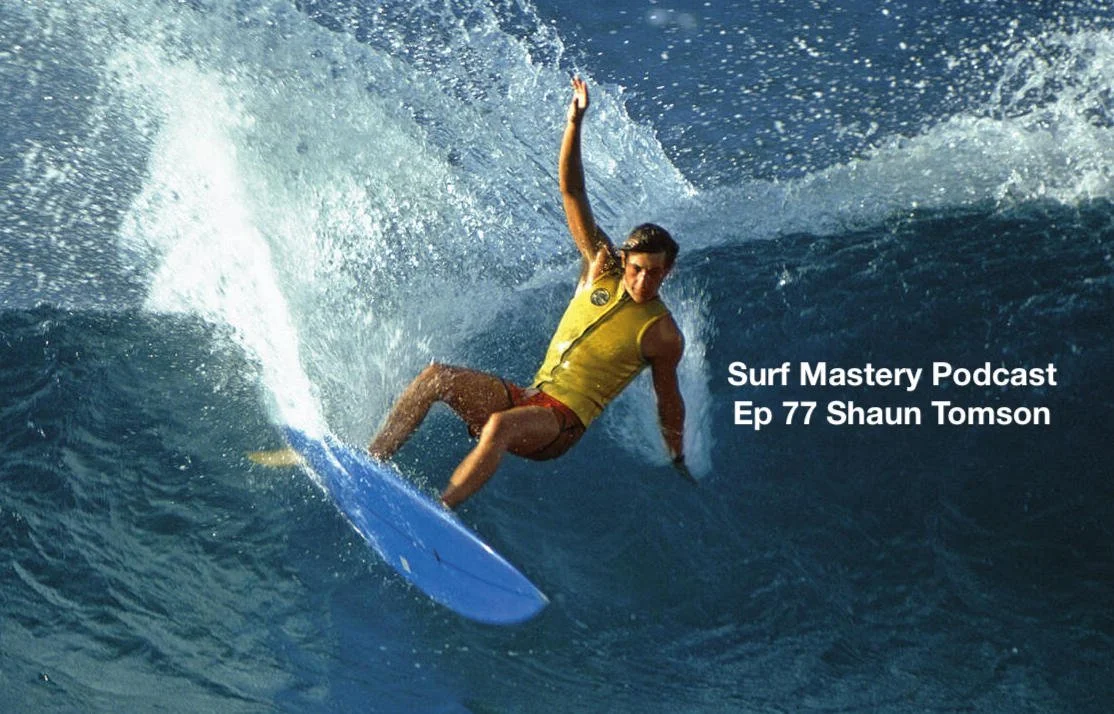
Ever wondered why some surfers—and teams—bounce back from wipe‑outs while others stay stuck in the whitewater?
Former world champion Shaun Tomson reveals the life‑saving power of “stoke” and his 12‑line Surf Code—a tool Fortune‑500 executives, PTSD survivors, and newbie surfers alike use to turn stress, anxiety, and disconnection into momentum.
Discover the exact “I Will” framework Shaun teaches that transforms fear and uncertainty into focused action.
Hear how writing one sentence a day can strengthen discipline, purpose, and relationships on land and in the lineup.
Learn why embracing vulnerability and humility in big surf (or big business) unlocks creativity, flow, and lasting joy.
Hit play now to write your own 12‑line Surf Code alongside Shaun and start converting anxiety into authentic stoke—wave after wave.
Shaun's website: https://shauntomson.com
Instagram: https://www.instagram.com/shauntomson/?hl=en
The Surfer and the Sage: https://www.amazon.com/Surfer-Sage-Guide-Survive-Lifes/dp/1641706554
Key Points
Shaun Thompson highlighted the profound impact of surfing on spirituality, resilience, and connection to nature.
The conceptualization and creation of Shaun's book 'The Surfer and the Sage' aimed to address common feelings of stress, anxiety, depression, and disconnection through positive space.
The discussion emphasized the importance of acknowledging negative emotions to better understand and achieve positive outcomes.
Surfing's art form, as described by Shaun Thompson, involves a profound sense of vulnerability and respect for nature's unpredictability.
Shaun shared insights on his evolving relationship with the ocean, from competitive surfing to mentorship and environmental advocacy.
Shaun Thompson discussed the philosophy of lifelong learning and humility, inspired by surfing, and its application in leadership and business.
Advice was given to newcomers in surfing to develop proficiency, be respectful in the water, and adhere to the 'Surfer Code'.
Shaun described the anticipation and unpredictability of surfing as key elements that keep him motivated and engaged.
The importance of writing one's own motivational code, starting with 'I will,' was emphasized as a tool for personal growth and overcoming challenges.
Shaun Thompson proposed his epitaph as 'I'll always pedal back out. I will know that there will always be another wave. I'll realize that all surfers are joined by one nation.'
Outline
Surfing as a Source of Inspiration and Knowledge
Shaun Thompson discusses the profound lessons and inspiration that can be gleaned from surfing, including humility, spirituality, connection to nature, and resilience.
Surfing is seen as a way to connect with the unknown, uncertainty, and the fear that comes with it, fostering perseverance and resilience.
Shaun Thompson's Background and Transition to Business
Shaun Thompson, the 1977 world surfing champion, transitioned from a successful surfing career to the business world, where they also achieved success.
Shaun is a best-selling author and has expertise in articulating and applying the lessons learned from surfing to various aspects of life.
Conception and Structure of 'The Surfer and the Sage'
The book 'The Surfer and the Sage' was conceived in a spontaneous meeting between Shaun Thompson and Noah-Shir, with the concept finalized within five minutes.
The book is structured with 18 chapters, each addressing a negative aspect of life followed by a positive perspective, aiming to guide readers from negative to positive spaces.
The number 18 was chosen for its significance in Judaism, representing 'high life', and each chapter was designed to address fundamental problems like stress, anxiety, depression, and disconnection.
The Importance of Acknowledging Negative Aspects
Shaun Thompson emphasizes the importance of acknowledging and understanding negative aspects of life to fully appreciate and understand the positive.
The concept of resilience and optimism is discussed, highlighting that these positive traits are underpinned by the acknowledgment of their opposites.
Surfing as an Art Form and Lifestyle
Michael views surfing more as an art form than a sport, and many listeners share this perspective, seeing it as a lifestyle rather than a competitive activity.
Shaun agrees, noting that non-surfers often see surfing as a creative pursuit and a form of man against nature, rather than a sport.
The Vulnerability and Respect in Surfing
Shaun discusses the vulnerability inherent in surfing, where surfers are often in a naked or minimally clothed state, which fosters a respect among participants.
This vulnerability is contrasted with other sports where participants wear protective gear, highlighting the unique respect and appreciation for the art and danger of surfing.
Shaun Thompson's Relationship with the Ocean
Shaun Thompson describes their relationship with the ocean as a constant and evolving aspect of their life, starting from early memories of body surfing and learning to stand on a board.
Their relationship with the ocean has transitioned from a focus on competition and tube riding to a more relaxed approach, emphasizing the joy of simply taking off and riding a wave.
The Concept of 'Stoke' in Surfing
Shaun Thompson introduces the concept of 'stoke' as a uniquely intense feeling of exhilaration, power, and connectivity experienced in surfing.
'Stoke' is described as a burning obsession and a source of constant connectivity, similar to the ebbs and flows of a wave.
Mastery and Lifelong Learning in Surfing and Business
Shaun Thompson discusses the concept of mastery in surfing and business, emphasizing the importance of lifelong learning and humility.
They highlight the value of companies and leaders who embrace lifelong learning, drawing parallels to the lessons learned from surfing, such as the inevitability of falling and the need to paddle back out.
Advice for Newcomers to Surfing
Shaun Thompson advises newcomers to surfing to read the 'Surface Code', a set of 12 philosophical commitments, and to be respectful and proficient in the water.
They emphasize the importance of waiting one's turn in the lineup, not dropping in on others, and wearing a leash.
What Keeps Shaun Thompson Stoked About Surfing
Shaun Thompson attributes their continued enthusiasm for surfing to the anticipation, unpredictability, and uncertainty of the sport.
They describe the magic of the moment when a wave is ridden, the feeling of floating, and the hope and anticipation of what's coming next.
Intimidation in Surfing
Shaun Thompson recalls a rare instance of feeling intimidated in surfing, during an event at Kelly's Wave Pool, where they were competing against the top 16 surfers in the world.
Despite the initial intimidation, they managed to perform well, highlighting the unpredictability and excitement of surfing.
Common Traits of Great Surfers
Shaun Thompson identifies commitment, stoke, creativity, imagination, flow, speed, power, aggression, and rhythm as common traits among great surfers.
They emphasize the importance of authenticity and uniqueness in surfing, noting that the great surfers are unashamedly themselves.
Best Surfing Advice Received
Shaun Thompson shares that the best advice they received from a competitive perspective came from their father, emphasizing the importance of winning like a gentleman and losing like a man.
They also highlight the importance of writing one's own code, using the phrase 'I will' to commit to personal growth and resilience, especially during dark times.
Shaun Thompson's Three Final Sentences
If Shaun Thompson were to leave three sentences for the world, they would be: 'I'll always pedal back out.', 'I will know that there will always be another wave.', and 'I'll realize that all surfers are joined by one nation.'
Shaun Thompson's Website and Upcoming Events
Shaun Thompson mentions their website, SeanThompson.com, where people can learn more and find videos.
They are planning to visit Australia in September for several events, including one for the Young Presidents' Organisation in Sydney, another for the Sunshine Coast City Council, and a charity event for the Board Meeting Surf Charity.
Shaun expresses interest in visiting New Zealand for a day to conduct an inspiring event, preferably for a multinational company or a university/school.
Transcription
Shaun
What listens and what... what inspiration, you know, what knowledge we can glean from surfing, it's... it's very profound. People love the notion of... humility with this big ocean of love and... notion of spirituality, of connecting to nature, of the unknown, of the uncertainty. The fear. The perseverance, the resilience, all this beautiful stuff that we don't really learn anywhere else. Core tubes and airs are exciting and important. I got a cough. Is like a pure brushstroke emanating from the soul to the heart to the mind and out through the body and board and onto a white embroidery on that expansive and windstruck wave face. You.
Michael
That is a couple of quotes from today's guest, 1977 world surfing champion, Shaun Tomson. After Shaun's surfing career, he took a lot of the lessons he learned into the business world and was very successful there. And Shaun's a best-selling author, and he's an expert and a master at not just articulating the lessons learned, that we need to take into surfing, but explaining how the lessons that we learn from surfing can be applied to all aspects of life. Please bear with the glitchy audio in the first five minutes. But I know you're going to enjoy this conversation with Shaun Tomson. - Thank you for taking the time, Shaun. I appreciate that. First, let me say, like the book The Surfer and the Sage, thoroughly enjoyed that on many levels, actually not just the content of the book, but the format and the succinctness of it. Because sometimes when someone recommends a book or I have to read a book or something, sometimes I cringe because I know it's going to be a 16-hour mission of just blabbering on. But this is so succinct and concise and very digestible and very profound as well. So well done on that book.
Shaun
Thank you. Thank you. The concept came together in five minutes. We met, Noah benShea and myself, and I'd heard about him, he'd heard about me, a mutual friend introduced us, we had lunch together. And we'd been chatting for about five or ten minutes and he said to me, "Hey, Shaun, let's write a book together." And I went, cool. We'll call it The Surfer and the Sage. And he said, okay, I'm hired to survive and ride life's waves. Done. So we have the basic concept dialed in on the spur of the moment, and then when we were conceptualizing the book, like how's his voice gonna work? How's my voice gonna work? Because it's complicated, you know, when you've got two people, and he has a big following, and I have sort of my own particular sort of rod and way of voice. I've been doing these presentations. I do these virtual presentations. Well, through COVID. I spoke to about, I don't know, 50, 100,000 people virtually. Through very large companies, PTSD survivors, rehab clinics. Schools, universities... some of the biggest companies in the world, some of the best universities in the world. And I'd started out, they send me a word that describes how you're feeling. And everyone can text me a word. And by... insane technology, it all flies into my PowerPoint and it forms a word cloud. So I had a good indication of how people were feeling... when we were conceptualizing the book, like how is America feeling? How is Australia feeling? How is South Africa feeling? How is Israel feeling? How is Asia feeling? Because I was doing stuff all over the world. And the four words were stress, anxiety, depression and disconnection. So those were four big fundamental problems. And the way we thought of the book, okay, well, what we're going to do is we're going to give you a cool perspective, and it's just going to be a guide. To help you go from a negative space? - Through positive space. So that's why every chapter... is a negative and a positive. With the negative first being that is the, for many people, the default thing. That's what I saw. That's what people had told me. People in all areas, sectors of life. People struggling with addiction, people that have been blown up and are suffering PTSD. University students, high schools, and then the hottest companies in the world. Fully employed, so people that weren't... were insecure financially. So that's how we structured it and then I said to Noah, hey Noah, because he's a scholar of theology. I said, you know, what's a secret number? Well, the amount of captives, like it's a sacred number. In Judaism, there's like a mystical offshoot. It's called... Gematria, I think. Gematria. And every letter in the Hebrew alphabet is assigned a numeric. So he said, well, let's do 18 chapters. So I said, well, why 18? He said, 18, one is nine is chai is life. That was the structure. How simple is that?
Michael
Yeah, I really like that. It's so important to speak of the negative because you have to acknowledge and understand the negative in order to... you know, see and understand its positive.
Shaun
Opposite. Absolutely. You can't just, you know, walk there with anxiety. I mean, I love optimism. I love hope. I love this concept of resilience, but underlying them, there's the opposite. And you have to because you can't just not look over there. Darkness. The dark of the knot. When you shine the light, it's brightest. It's amazing. You know, when you... think about light in the daytime. It's diffused. But you shine that light... the terms of, you know, helping others, being a mentor, whatever, you know, however you want to, loving your family, loving your son, your daughter, your mom, your dad, in the context of darkness, you make a much bigger... can make much bigger... impact.
Michael
The bigger the storm. The more insane... the chaos. You know, and the further with a bit of depth and a bit of time, all of a sudden you've got these beautiful waves of communication that we get to play with and push against. But we need that. That storm happened. In order to get the waves. Otherwise, they're not even there.
Shaun
Yeah, I think you need that. You need that danger. You need that power. You need... you know, you need to have that. You know... So Yeats. Okay, you're a New Zealander. Kiwi, we all grew up saying post-colonial culture, we all read the same poetry. Oxford Book of Verse at school. So there's a poem. You would have read it, maybe you forgot it, but we all read it. And I remember reading it when I was about 15. And he goes, "A lonely impulse of delight drove me to this tumult. A balanced all. Brought all to mind. The years to come seemed waste of breath. In balance with this life, this death." He's talking about an airman that's going up there to fly against the Germans. This was before Nazis, against the Germans, First World War. And how this pilot does it. For the sensations. And that's why we surf. We surf for that sensation. And the greater the risk and the challenge and the size, the better the stoke, the higher the level of stoke. So there is that opposite effect. Like you've identified. So surfers, we understand that balance. You know what I mean? We get up on the board for the first time. There's the literal aspect of balance, but there's a lot of balance that, you know, that we understand, and there's a lot that surfing gives us that we don't even know and we're not even... consciously, but out there in the lineup, you know, most of the time there's this connectivity. Not just with the ocean and the spirituality, but with other people out there. We don't know them. Most of the time, I'll go surfing. Maybe I'll know a couple of my mates out there, but I don't know. We kind of get on, you know, there's very seldom fights. Everyone sort of takes their turn to a certain extent. I mean, unless you're in a super crowded condition like the Superbank, who I'm sure Raglan gets out of control. But generally... there's a decorum. There's a balance. And it's like when we float, right? It's very... you know, I've actually devoted a big chunk of my career to like looking beneath the surface there. Just beneath the surface. To see what's what listens and what... what inspiration, what knowledge we can glean from surfing. It's very profound. And then I try to... to show this and illustrate this to people that have never surfed before in their lives. And let me tell you, they love it. People love... surfing represents. Surfing doesn't represent World Surf League, spinning aerials, big wave surfing at Nazaré. Surfing, that's not what it represents. How people see it, I mean, in my estimation. I speak to more people than about surfing than anyone on the planet. People love the notion of humility with this big ocean of love and notion of spirituality, of connecting to nature. Of the unknown, of the uncertainty. The fear. The perseverance, the resilience, all this beautiful stuff that we don't really learn anywhere else. I mean, I went to university. I went to grad school. Didn't learn about stuff like that. I learned about differentiation and integration and calculus. I mean, it's like I learned about, you know, Adam Smith and Milton Friedman and like... but surfing, man. Surfing is... really? Put me at my last.
Michael
Yeah, totally. I mean, I see surfing as more of an art form than a sport. And I think most of my listeners do too. I often ask my listeners and my clients as a surf coach — I don't usually train the... what you might think of as the shortboard rider — and sometimes I'll ask my clients and listeners, who's your favorite surfer? And they actually don't have an answer. They just love surfing. Because surfing to them is... it's not a sport, it's a lifestyle and it's an art form.
Shaun
People don't know about the sport. People don't know who Kelly Slater is. They don't know who Laird Hamilton is. Maybe they've kind of heard of Bethany Hamilton, the young girl that got her arm ripped off by a shark. But surfing is... people do not see it — non-surfers do not see surfing — as a sport. You're 100% correct. They see it as a lifestyle. They see it as this sort of man against nature, there's this creative pursuit. And I've always thought, surfing is this unbelievably creative pursuit. But I've always thought that professionalism and art form can coexist together and not in parallel lines. Some of the best waves ever ridden in the world now are ridden during a surfing competition. And I'm talking about as art. When I see Filipe Toledo or I see Kelly, or I see these guys — when I saw Kelly at the Masters this year — you know this? And that is like... art with fear. Because there's very few sports that have art with fear. That are not bound by lines. Perhaps snowboarding, skiing. But you know, in surfing, there's like this nakedness. You're naked. You've got a little... pair of boardshorts on. A lot of the time when you're surfing big stuff like in Hawaii, some other places, but there is this sort of, fuck. You... it's, you're vulnerable. And I think in that... there is a... there's a respect for that. We haven't got big, crisp helmets on and we don't have boots. There's a vulnerability there that people... I think are very appreciative about.
Michael
Yeah, that's a good point. Like even within the competitive nature of the sport of surfing, you still can't deny the art form and the ocean because you will get humbled instantly. Like in tennis, if you try and hit the ball too hard, what's the consequence? You miss, but then serve. Yeah, and surfing... it's death. It could be death.
Shaun
You get your brains bashed in. So there is that sort of... that existential element to surfing, you know, there's that life and death. Like, you know, Yeats wrote, "A balance all brought all to mind. The years to come seemed waste of breath. In balance with this life, this death." It's very profound words that I think have this application to surfing. But, you know, it's so funny that we're talking on this subject because I wrote something today, you know, I love... I love posting on LinkedIn and Instagram. I love posting just my thoughts. It's so cool. Sometimes I can send something — I wrote something about my dad the other day, beautiful piece about my dad on Father's Day — and it went out to like over 300,000 people. They've got 300,000 interactions. So... it's so cool that most of them are from non-surfers because LinkedIn is not really a site that... certainly there are a few surfers on it. But on Instagram too, you can get very cool interaction and in terms of the vulnerability and nakedness I read this: I've always thought that the true test of a surfer's ability is how he or she carves on that long, fast, perfect wall that stretches out endlessly into the future. And the king of all, at J-Bay, reveals all. Talent, style, creativity, commitment, rhythm and flow are all on display. There's nowhere to hide any deficiencies. J-Bay makes a wave that's easy to ride. It is hard to ride well. It's a truly magnificent wall stretched out infinitely by a hard southwest wind, magnifying one's speed. And when you lay down that rail on the bottom turn, it is the longest carve of your life. Sure, tubes and airs are exciting and important. But a carve is like a pure brushstroke emanating from the soul to the heart to the mind and out through the body and board and onto a white embroidery on that expansive and whimsical wave face. J-Bay reveals who you are as a surfer. It lays your soul bare. As you look with that pure line. I love that. It's so much fun to, you know, to do this, and I get stoked being in it, and the crew out in the ether, hey, they write to me and they’re stoked. And the guys and girls and people that have been, you know, maybe someone's going through a tough time. When you do your... your casts, you know, there's going to be someone that's listening and listening to something you say or one of your presenters saying — you know — it can have a fundamental impact on where they are right then. People will say, "Hey, Shaun, I needed this today." And it just makes you feel good. You know what I mean? Makes you feel... it makes you feel... makes you feel good.
Michael
Makes you feel connected, just like the carve. If the feeling of performing a carve like that — I mean, if you're not present, it won't happen. So you have to be 100% present. And everything that led up to that — the drive there, the suiting up in the cold, the paddle out, the... the mistimed paddle out that you had to paddle out again like this — and just for that one moment, that carve, but there's so much. We're so fascinated by that feeling in surfing. Let me ask you, how would you describe your relationship with the ocean and how has it evolved over time?
Shaun
Wow. You know, it's interesting that Noah... when I said to Milo, like, how many chapters should we have? And he said, well, we should have 18, because it represents chai — life. And for me, it's been... that constant. Constant in my life. And... you know, my earliest memories of being in the ocean and learning how to body surf, and then we had these like rubber surf — they’re called Surfer Planes — and we had these little wooden boards. And then I got my first little four-foot-six. Belly-boarding. And that's when I first like stood up for the first time. And... you know, they talk about animals. When they're born, they imprint. They imprint on their mothers or their parents. And you know, when I stood up for the first time, it was like... I imprinted on the ocean. You know what I mean? The ocean was such a big part. I mean, I can still remember that wave. So there's just been this wonderful connectivity, but it's been multidimensional, and it really has, Michael. It's sort of... and it's evolved. You know, at first it was like the sensation and the love and the fun. And then the competition thing started, and I loved competition. And then the tube riding — my whole tube riding thing evolved. And then I... I went to Hawaii and started winning over there and then won at the Banzai Pipeline and winning there and then being part of this movement where we turned this lifestyle into a sport, an art form that we could get paid for. That had — that in some ways captured the imagination of millions and millions of people around the world. Surfing pushed me into business, and I started my first brand, Instinct, when I was 20. And started sponsoring like Martin Potter to a world title and Tom Carroll to two world titles and all these other great athletes that I helped and, I think, in many ways mentored — Dave Parmenter and Greg Anderson and just so many... Michael Burness, all these... all these great athletes. And then as I wound up my... and then getting involved in the environmental movement, getting involved with the Surfrider Foundation, becoming the first member in '84, the first pro-surfer member, the first ambassador. And surfing just led me down these... paths and then led me — and when we left South Africa after I retired and sold Instinct — led me to Patagonia. I'd never even heard of that company. Ever even heard of it. I never even heard of them. I ended up working for them for a couple of years and had the most amazing time working for Yvon Chouinard and his wife Melinda and learning so much. And then my wife and I starting another business that was aligned with surfing, and then we located it right across the road from Rincon. And then the guy who phoned me up when Surfrider Foundation was starting to ask for my help, phoned me up and he said, "Hey, Shaun, Rincon's facing a challenge. I want you to give something to kids to inspire them." And I wrote Surfer's Code, this little poem-code: I will always paddle back out. I’ll never turn my back on the ocean. I’ll take the drop with commitment. Something super simple. And that turned into a book and turned into a speaking career and more books and workshops and programs and... it's all been... it's all been surfing. But it's... the wave has changed. And okay, now I don't... you know, when I used to paddle out, I wanted to ride the best wave I could ride. The best wave. Every time I stood up, I wanted to ride at my best. I wanted to... to the absolute max, every wave. And this was until I was about 60. And then... it evolved. So now I just want to take off and have a good one. That's enough for me, just to have that. I don't have to be the best guy on the lineup anymore. And... so, you know, the competitive aspect — and when I say competitive, I don't mean competitive as in competition — I mean competitive as in competition with self. Because we've — as I've learned over the last 15 years since I've been doing that — we have two fundamental purposes in life. And this is not some deduction that I've made. This is an observation I've made. From seeing, I don't know, over a million lines of code from people. What do they write when they write their 12 lines? What are they going to write? Because the brief is... I give. I tell a few interesting and — interesting, I think exciting, uplifting, inspirational — stories about the development of the code, about commitment, about perseverance, and about connectivity. Those are the three principal stories. Sometimes I'll talk about... creativity and innovation. And then everyone writes a code. I go, "Okay, you got 15 minutes. We'll launch." Every line beginning with I will. Make a commitment. And... everyone writes beautiful lines. I will pray. I’ll have faith. I’ll be a better father. I will do what I say I will do. I’ll live a life of integrity. That’s about "I will be better." So the one fundamental purpose in our lives is we want to be better. We want to be better today than we were yesterday. We want to be better tomorrow than we are today. That’s what drives us. That’s us. We want to be better. And then the other aspect — and what everyone else writes, when they write their 12 — sometimes it’s 50/50, sometimes it’s, you know, more to the one side. But the other one is I will help others be better. See, we want others to be better too. We want to help them on their path. We want to be a mentor. I will be a mentor. I will give back. I will donate. It’s beautiful to see the... kind of unanimity of humanity. Because in America... I don’t know what it’s like in... in Kiwiland, but in America, you have a valley. You’ve got the Republicans on one side of the valley, you’ve got the Democrats on the other side of the valley. And there’s this... space in between that’s filled with hatred and unkindness. And I try to build a bridge and show people, man, listen. We’ve got the same values.
Michael
Yeah, I love that. Fits. I’m wondering, like, I had a discussion with Donald Brink, a fellow South African. He’s a surfboard shaper in San Clemente. And we were talking about how our — how mine and his — relationships with the ocean and surfing had evolved, and I’m going to put it to you, and I’d like to hear your thoughts on it. Because initially when I was younger, I had this — I was obsessed with surfing. I’m obsessed. Like it was an obsession. And I would almost describe it as maybe too obsessed, and maybe surfing had, like, this grip on me. And then... you could argue that for the competitive surfer that may be even necessary, but I’m not a competitive surfer. So I’m... I think that was detrimental to my relationship to the ocean and to surfing. And a word Donald threw out there, which I agree with, and I think is how my relationship with surfing and the ocean has evolved over the years, which is I’m not so obsessed with surfing anymore, but I’m still... extremely fascinated. I’m just wondering how those two words — obsession and fascination...
Shaun
I’m not as obsessed with surfing. But I’m as stoked with surfing. So when I was on the tour, there was no one in the world that surfed more than me. No one. I spent more hours in the water. And I didn’t spend more hours because I wanted to practice to get better and be the best. I just loved it more. A mate of mine, he lectures up at Stanford. He interviewed me and he said, "Shaun, you know, you use... what you said to me when I teach the kids up at Stanford Law School. Let’s talk about passion, man. Let’s talk about stoke." Then he asked this, "Pressure of that, for a number one guy — like why? Why do you think you’re the best?" I said, "I know, because I was the most stoked." Yes, I can’t surf every day, but I’m still stoked with the feeling, with the thought process, with what it’s... with what it’s given me. When I wrote my 12 lines... and one of the lines I wrote was, I’ll catch a wave every day, even in my mind. Ha. Ta-ta. Yeah, just that thought, I can close my eyes right now, I’m going to get right back on that wall at J-Bay. It just gives me that feeling of stillness. Of connectivity, of challenge, of stoke, of exhilaration. I can smell — they have this aloe there. They call it fynbos. It’s like an indigenous flower. It’s just got this amazing... I smell it right now. Yeah, I understand the fascination aspect. And that is sort of more from an observational point of view. But stoke is like... the internal... connectivity to it all for me. And I get people say, "Ah, that’s the cliched word." I don’t think so. Stoke is a uniquely... from our tribe. You know what I mean? Learning. Burning. Obsession. That feeling of? Of just... fire, exhilaration, power.
How does that... how do I word this? I like the word stoked, but how can... like, let me — if this is too personal, you don’t have to answer — but are you stoked to be in a relationship with your wife still?
Shaun
I've been married now for... 3, 4, 35... 35 years. But the connectivity between humans, it's sort of like a wave. You know, it's like a tide. Sort of has its ebbs and flows. But the stoke... or wave. It's constant. Doesn't flow up and down like the tide. It's just... such a channel. It... like then. That's what it's like. That's what I feel like. Okay, the ocean... directly from my house here, it's maybe half a mile away. But I can feel it, you know what I mean? Tell you what, I could — when I was in South Africa, and I lived there — could walk outside. I could taste whether the surf was going to be insane or not. I could taste it. Swear. I could walk outside, I could feel it, and I could taste it. I'm not talking, I looked at the synoptic chart. Or I looked at a weather prediction. Just that's how... connected I was. But you know, it's interesting. There's a difference between circumcision and... there's a difference there. I always... wanted to do... like lots of things. We're not going to say lots of things. And I always love to do... different things around my surfing. It kept my surfing alive and interesting and vital. I mean, I used to spend so much time in the shaping bay with my shapers. I worked with the 34 best shapers in the world. And during my career, I would go in the shaping bay with all of them. Rusty Preisendorfer, Al Merrick, Bill Barnfield, Spider Murphy. All the best guys. And I would stand there while they made my boards. So, you know, I had that — I loved — they cut the blank, I would stand on the blank. And so I really had that... really a wonderful relationship with shaping. Then I was a student at the same time, learning, because I always thought that learning was the way... get the edge. And then I loved the entrepreneurial aspect as well. I love giving back to kids. I think I gave my first talk when I was 19 years old at a school. I was terrified. But, you know, I love... I love to do interesting stuff around surfing. So it wasn't like sort of one thing. Just a moment. It kept it all alive and vital for me.
Michael
So this is always sort of that — I like the word mastery because not in terms of how you're going to master surfing, but it just gives that... that sense of, I'm just going to be a little bit better. I'm going to just bitumen.
Shaun
Some of my friends that are really clever and they're really great... great writers and stuff. I always call them my sensei. I always call them my sensei. Like a teacher. They've mastered. I have this great... sort of mastery.
Michael
But they probably — you'd only call them that because they're still actually wanting to learn. They're still learning. Yeah.
Shaun
And let me tell you, the best companies that I deal with — some of the companies I deal with are the best ones — are the ones that have this philosophy of lifelong learning. So I'll tell you what surfing — one of the things I think surfing really teaches you is humility. So the best companies and the best CEOs and the best leaders, they have this humility that... good. They're interested in this concept of lifelong learning. Lifelong learning. So what happens is, the way I work, you know, I work with a big company, and they'll pay me to go there and present a workshop and do a keynote. It might be at a huge conference or whatever. It's all different kinds of ways. Or it might be virtual. So every time I do a paid speaking engagement, I'll do a free one. So I'll do a free one — for a school, university, rehab clinic, community, whatever. I just like to do a free one as well. So I remember a few years ago, the surfing industry was really on the ropes. In a very bad way. And I remember I found out the biggest company at the time — I left a message for the CEO — and I said, "You know what? You know me. I work with the best companies in the world, best universities. I would love to come and do a program for your team. It's free. I just want to help your team." Bye. I'm not surprised. I didn't even get a call back. And my wife said, "Shaun, why do you even contact those companies? Because you know they have no respect for you, they have no respect for learning, they have no respect for their team members. And that's why they're in the... they're having such a hard time." Okay, it's not all companies in surfing. You know, my wonderful friend Paul Naudé has got this great brand called Vissla. Exactly. Full soul. And Patagonia is like unbelievable. I did an event in Patagonia for my new book there the other night. But there... it's a whole lot of companies that know everything about everything. And it's sad, because surfing teaches us so much, and it teaches about humility and about learning. I mean, what surfer ever won a world title without falling on his ass a gazillion times and paddling back out? A lot of people... maybe in these companies haven't actually surfed. So these are lessons that could help them. That's the road that they travel on. And it's sad to see that these big outfits that are representing the essence and soul of surfing are not... looking at how surfing can actually help... help them. They were built... they were built on stoke. Get back in touch with it. Plug in. Buy in again.
Michael
Well, time will... time will sort that out. Tends to. But I think there is a sector of the surfing world that sees surfing as very shallow, very selfish. And that's actually one of the... I don't think that's my listeners, but what a lot of beginner surfers sometimes have to deal with is that sort of old-school mindset, entitlement. Surfing, you know, part of surfing that you were sort of alluding to. Any advice for newcomers to the art and sport of surfing? Ways of dealing with that aspect of the surf world?
Shaun
Yeah, you know, I think... I think for people that have — that are getting into it for the first time — I really encourage them, just read Surfer's Code, little card that I wrote. You can find it on the web. It's free. I'm not trying to sell it or anything. But it's just 12 lines. And read it and think about it. You know, I will paddle back out. I will paddle around the impact zone. I will never fight a riptide. These are both literal and... and both philosophical commitments. I will watch out for other surfers after a big set. So, you know, there's a lot there that a new surfer can glean. I'm not sure. 12 lines. And then... don't go — if you're beginning — don't go and ride the A-class waves. You don't have to go... on the best day at Raglan when you've been surfing for three months. Just don't do it. It's going to be unpleasant for you and you're going to be a danger to people around you. So firstly, become proficient and be respectful in the water. If someone's been paddling, if someone's been waiting for a wave, don't paddle around them. Just wait your turn. When I say get into it, I mean, I often say to people in the lineup — I'll be sitting waiting for a wave and it's my turn — and someone will paddle straight past me and I go, "Hey, it doesn't work like that. You need to wait your turn." And let me tell you, in my career, I was very competitive, and I was very tough in the lineup, but I was very fair. Very fair. If someone was sitting there... waiting for their wave, I wouldn't just paddle around them. I mean, maybe if they were sitting 25 yards or 20 yards out of position, I'd go up to where the position was. But if they were sitting on the button, it was their wave, and then it was my wave. But when it was my wave, if someone tried to back-paddle me, I would go. I would go not just because it was my wave, I would go out of bloody principle. Because that's not how it works. I grew up at the Bay of Plenty in South Africa. If you paddled around a guy who was sitting waiting for a wave, you instantly got a flat hand. It was just gnarly rules. Everyone waited in line and they waited their turn. Top surfers. So there was decorum in the lineup. Everyone was respectful of each other. No one dropped in, ever. So yeah, for beginners — don't paddle around the back of someone. Don't drop in. Wear a leash. Paddle around the impact zone. You read the Surfer's Code — there's a lot of good stuff up there.
Michael
Let me go back to your — thanks for that — but let me go back to the word stoked. What is it about surfing that keeps you stoked? Is it what you were describing before? Like the anticipation of the feeling of that turn or a tube ride?
Shaun
The anticipation's got a lot to do with it. I think... the unpredictability... and... this notion that you're not... you're going to get exactly what you want. It might be better, it might be worse, but it's not like at three o'clock we're going to go and we're going to have a go. It's... I think the uncertainty. You know what? I remember reading an article years ago, and this... uncertainty... gives it — mwah — makes it more... attractive. If you know what you're going to get every time, it's not as... exciting. Do you know what I mean? We don't know the outcome. You don't know the outcome. And for me, every time I go surfing, when I walk down the beach, or walk up the rocks or whatever — I got my board — and I like it. There's that time, you do that little jump, the wave comes through, you do a little jump over the wave, and you sort of go airless. And then you land and you float down. When you float up again... then you've got the horizon. That open horizon. And that's magic. I love that. And that, to me, represents... the alert. The hope. The anticipation... what's coming? The next wave. So... so even before the... before the wave is that feeling. And then that one arm over the other, that feeling of stroking out there. And then the paddle out into the lineup. And there's a guy there. And you sit there. And you move around. And then you get that... paddle, and you leap to your feet. And I'm on my feet, and it's like I'm nine years old again at the Bay of Plenty on my first ride.
Michael
Does it ever feel sometimes intimidating?
Shaun
I've never felt... I felt intimidated once. Once. The WSL having the first event ever at the wave pool — Kelly's wave pool. It's called the Founders Cup. They've invited the six founders of pro surfing. Named the event after us. It’s Rabbit. There's Mark Richards. Simon. PT and Kanga. Me. Six of us. That's six. Then now we're going to have a go. So they've got the top 16 surfers in the world sitting there, and they've gone, "Okay, Shaun, Rabbit, you're in the water." Now, Rabbit and MR have ridden the wave. I've never ridden the bloody wave before. And I'd been watching it. I'd been watching Joel and Mick... you know, wiping out, pearling. I'm going, "How can these best guys in the world pearl and wipe out?" Of course, Kelly never wipes out because he created the wave. So... I'm sitting there and the first wave is going to come through. And, you know, it's sort of like a gentleman's agreement. So I'm sitting there with Mark Richards and Rabbit, my two greatest rivals. So the first wave is going to be a left. I go to MR, "You want the first one?" And MR says, "I'm not effing going left." Hey, Beks, you want the next one? "I'm not going anything left either." And you're off. The wave is tricky on our front side. But now... I have never taken a... and I've got the 16 best surfers in the world and all the media watching and... and now I'm intimidated. I think I'm going to duff it. On my face. Plonk. So then I was up. And I can remember paddling into that wave and thinking, "I was intimidated." That’s... I did feel intimidation there. Bang. I shredded it. And then I went right into the pit, the same place where I saw Mick Fanning and Joel Parkinson eat it — nosedive — same place. I got about five or six maneuvers, but I did redeem myself. But that's... that's a whole new aspect there. The whole... the whole wave pool thing, I mean, it's mind-blowing how... you know what Kelly’s done. I’ll tell you what, Kelly... his contribution to surfing won’t be understood for another 10 years. It’s incredible what he’s done — from both a pure surfing perspective, changing boards — you know, the super thin little Persian slippers with the flips, narrow, thin — and then going to ultra short 5’8” when everyone was on 6’1”. And I mean, he just... his whole technique for riding inside the tube backside. And then the wave pool and... it was really cool. I remember when Quiksilver appointed a new CEO, a guy called Andy Mooney. He came out of the common business. And he hired a new marketing director that came out of Roxy. No matter what, the guy said, "What do we want with a 40-year-old bald guy?" And I remember hearing about this. I’d heard that Kelly went in for a meeting about renegotiating his Quiksilver contract. And I’d heard — I don’t know whether it’s true or not — but I’d heard that the guy kept him waiting for like three hours. Yeah. What a bloody insult. So eventually — and who knows whether it's true or not, but I'm just saying that's what I heard — Kelly split up from, as we know, split from Quiksilver, went on and did his own things. And I watched the market cap of Quiksilver. So I looked at the market cap — the market capitalization of Quiksilver, the worth of the company. It's the share price multiplied by number of shares outstanding. I looked at the share price before Kelly left and after Kelly left. And there was no other incidents that could materially affect the stock price. You know, there was an erosion of 250 million dollars. They lost a quarter of a billion — by not keeping a 40-year-old bald guy on the payroll. How about that? How about that marketing director for a beautiful... decision.
Michael
Yeah, it's a hard lesson to... it's a hard lesson to learn.
Shaun
Learn.
Michael
What do you think all great surfers have in common?
Shaun
I think they have commitment. They have stoke. I think they have... creativity. I think they have imagination. I think they have flow. They have speed. The power. The aggression. They have rhythm. And all of them are unique. Unashamedly unique. When I think of the greats, like the greats during my period — my period really started with the shortboard revolution. So for me, the greats starting the shortboard revolution — Wayne Lynch was right at the front of that shortboard revolution. And then there was... the Hawaiians — Reno Abellira, Larry Bertlemann, Gerry Lopez, Jeff Hakman... And then all those amazing Aussies that came up through my period there — Rabbit, Ian, MR, PT, and later, you know, Tom Carroll. I mean, these guys were like... they were so — yeah — every one of them was so different. You know, they... derivation is a curse. But it can be a form of inspiration. But there's just... too much derivation. I'm just saying, not as some old guy making a pronouncement, but as I said, there's too much... artifice and not enough art. I love it when I'll see someone out there — they'll just stop — go off differently. Felipe Toledo. John John Florence. You know, these guys are... they're supernaturally talented, but they've got their own things happening. You know what I mean? They've got that. You know, John John's got his, like, skateboard arms by his side. Felipe's got these kind of like — how — jiu-jitsu style, you know, it's like ninja — the way he does these carves. He doesn't just carve, he... carves and jags it at the same time. And then John with those beautiful, sublime, extended, like... like he's riding a single fin from 1970, a pintail that's 11 inches wide with a... ignore the... honking single fin on the tail. Just got these... just keeps that rail in the water for so long you can have a nap. So yeah, the great ones are unashamedly authentic.
Michael
I like those. Great words. What's the best surfing advice you ever received?
Shaun
Well, from a competitive perspective, it came from my father: "When you win, win like a gentleman. When you lose, lose like a man." So that, when I was a young boy, was... was very profound. And then for me, I always like to tell people that words of others are important — because that's how you learn — but for direction and action and a path, your words are the most important. The words that you write. So... when I wrote and I read Surfer's Code, you know, speaking about it so much, and it's very dear to my heart. I carry it around with me in my wallet. I wrote... I read a line in there which has been my best advice to myself. It's when I wrote... those words, my life was on an amazing trajectory. I had a company that was really successful, that a billion-dollar company wanted to buy. I had a new book at the publisher. Surfing was amazing. And I wrote: I will always paddle back out. And then I lost my son. Those words, man, helped me. I gave advice to myself. And I took my words to heart, because it's my code. And everyone can write their code. And their words will help them out of dark times. I will guarantee you that. I will promise you. I will absolutely, unequivocally state, if someone spends 20 minutes reading and they write the code — 12 lines, every line begins with I will — those words that they write, their words, your words... it's key. Finding the light to turn on in dark times. I'll tell you that. Hundreds of thousands of people. And it's open-source code. Anyone can use it any way they want. And it's luckily even cost them one cent. 12 lines. Every line begins with I will. Write your code. Write it with your family. Write it with the people you love. Write it with your colleagues at work. Write it with your rugby team. Write it with your soccer team. If you're in a rehab clinic, write it with your compadres in the rehab clinic. If you're in a group of PTSD survivors, write it. If you're in a university group, write it. If you're a C-suite survivor of a company that's a $30 billion company, get the C-suite together, write it.
Michael
That's good, important advice. Because we can do... all of the — you can read piles of books on motivation and positive thinking and philosophy that you can read, and you can get everyone's take on it. But if you don't sit down and translate that stuff into your own words and use, and put pen to paper and put it into action — do that — it doesn't translate.
Shaun
I put it — it's in my wallet. A lot of people cut it out and they put it on their... you know, their computer. They keep it going. It's got a lot of... it's got a lot of power. This very famous university here did a study on the method. And they studied three companies that I'd gone to — big companies — and... they said, "Shaun, interesting. You know, this is the most transformational" — they called it the intervention — "this is the most transformational positive intervention that we've ever studied." I went, "Well, that's pretty cool." He said, "Here’s some of the results we’ve got from it." I didn't get — I wasn't involved in the study. I just gave them — I'd done events there. I gave them the names, and they went off and interviewed people. So like, "I lost 40 pounds as a result of writing my code." How about that? "I lost 40 pounds." "I wrote the code with my eight-year-old son. We put it on the refrigerator. Our relationship's better." "It's working." "My code's like my North Star." "My code is freaking incredible." These are not my words. That's what stokes me out the most — is that... it's like... you know what it's like? Like this little code, it's like a little board. Someone can jump on it. And they can ride it. On a new wave. What is that?
Michael
Those two words — I will — there's a lot to that. Because if you're going to sit down and write I, you're like, "Who am I? I, me... ooh." I will. It's like, that's a commitment. Gosh, that's my will and my strength. So it's not like a... those two words — I will — it's so simple, yet so profound when you start thinking about it.
Shaun
And it's — you're going to do something. You know what I mean? You're going to. It's about hope. Like this young girl... wrote to me, and she said, "Shaun, I've been really struggling. And thanks for coming in and speaking. You know, I've been having mental problems, it's been tough through COVID, etc." But she said, "You know, I've got to tell you — thank you for the hope that you've shared with me." That's what it's about. It's about hope. Because it's about not right now. It's about that... that moment in the future — I will — that you're going to cross, that you're going to go towards. Surfers — you know, when you take off, you're riding towards... good sand, fort, or place. Yeah, I'm... I must say, surfing has given me so much, Michael. And I'm so grateful. I'm so appreciative. It's helped me out of some tough times. And I get so much joy now out of... out of doing these — I'm doing these presentations for large companies, for schools, universities, whatever. I love to be able to share what surfing has given me.
Michael
Maybe just acknowledge you, Shaun, for... your vulnerability, your tenacity, your innovation, and your numerous contributions — and not only to the surfing world, but now, you know, within the inspired leadership and, you know, philosophical and psychological worlds that you're doing now. Thank you for... for that. That's awesome to see. Thank you. I've got one question — one final question for you — is, let's say in some hypothetical situation, you've got to leave us from this world eventually. And on that day, sadly, you have to take everything with you, all your books. But you're allowed to leave us with three sentences. What would those three sentences be?
Shaun
The first sentence: I’ll always paddle back out.
The second sentence would be: I will know that there will always be another wave.
And the last sentence would be: I’ll realize that all surfers are joined by one nation.
That would be it. But I want these 12. That’s my epitaph right there.
Michael
Yep, and they shall be there. All right. Thank you. Shaun, do you have a website that you can point people in the direction of?
Shaun
Yeah, I have a website called ShaunTomson.com. And you can go there, you can learn a bit more. There's a couple of videos up. But anyone that's listening, I encourage you — of course, write your code. Like I said, it's open-source code. Take it out with your family, friends, colleagues, whoever, whomever, and use it any way, shape, or form you want to. But connect with me on LinkedIn. I mean, if you... have interest, connect with me on LinkedIn or Instagram. LinkedIn is pretty cool because, you know, you can have a little bit more of a... discussion on there. I love connecting. I love connecting with people. And I’ll tell you this. So maybe there’s a listener out there that can help me with something. So I’m coming out to Australia in September. I’m doing a couple of events. I’m doing an event for... a group called the Young Presidents’ Organization in Sydney. Then I’m doing another event for the Sunshine Coast City Council. And then I’m doing an event for a charity — which is a pretty cool charity — called the Board Meeting Surf Charity. That’s going to take place in like from the 19th to the 23rd of September. But it would be so amazing to come down to New Zealand for a day and do a cool event down in NZ. I would love it. You know, my father loved New Zealand. He went there, watched the Springboks play rugby in the ’60s. And he actually met a beautiful New Zealand girl and brought her back, wanted to marry her, but she decided to bail out. I would love to go to New Zealand. If anyone out there is interested... hook up with me. Let’s do something. Let’s inspire a corporation. And then we can do a corporation and I’ll do a free one for a university or school or... whatever. It could be... it’s sad. Good luck.
Michael
Okay, so that would be late September?
Shaun
Yeah, it would be like the 23rd of September. Yeah, okay. Yeah, if someone has interest. Because maybe there’s a big multinational out there or just a cool company that, you know, wants to uplift, inspire, and re-engage their team members.
Michael
Gosh knows we need it here in New Zealand at the moment. Some inspiration.
Shaun
Everyone needs it, man. Everyone’s been having a tough time. You’ve got that wonderful... I’d love to meet you — that wonderful prime minister of yours.
Michael
Yeah. Aim high. I’ll send Jacinda a text.
Shaun
Yeah. She’s a cool woman. She’s definitely one of the top ten leaders in the world at the moment.
Michael
I will put links to all of your stuff in the show notes for those listening. And again, thank you so much for your time.
Shaun
Michael, and great for the work that you do. I’m stoked. And thanks for connecting and thanks for having me. I really appreciate it. And hopefully, you know, whoever’s out there listening — that you got something out of it. Thank you. Thanks for having me. Thanks for listening.
Michael
Thank you so much for tuning in. Please, if you enjoyed this episode, share it with a friend — maybe even a non-surfer friend. Any feedback, comments, questions: mike@surfmastery.com or engage on Instagram @surfmastery. Until next time — keep surfing.
77 Shaun Tomson - The Evolution of Stoke
For the passionate surfer—whether you're a weekend warrior, a surf dad, or an older surfer—this podcast is all about better surfing and deeper stoke. With expert surf coaching, surf training, and surfing tips, we’ll help you catch more waves, refine your paddling technique, and perfect your pop up on a surfboard. From surf workouts to handling wipeouts, chasing bigger waves, and mastering surf technique, we’re here to make sure you not only improve but truly enjoy surfing more—so you can get more out of every session and become a wiser surfer. Go from Beginner or intermediate Surfer to advanced.